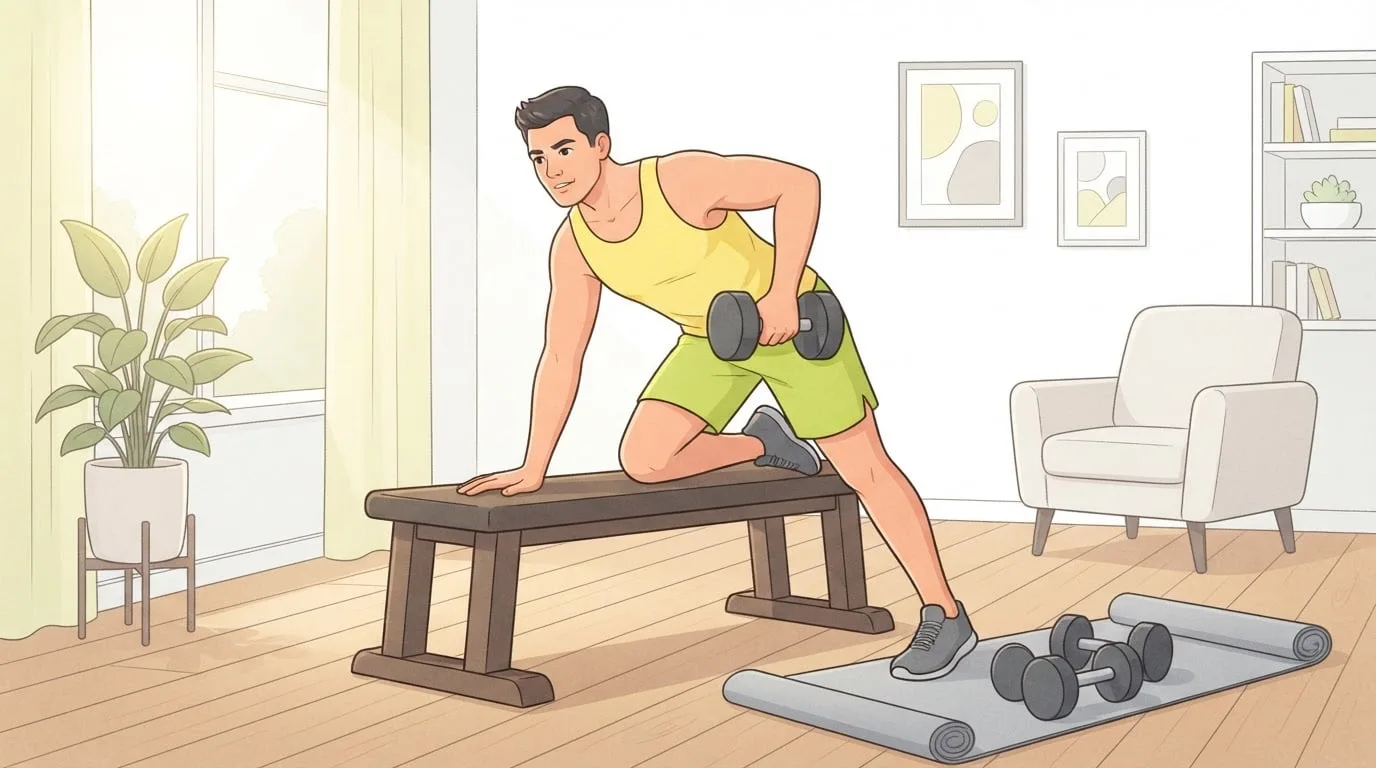
You've got 30 minutes and a pair of dumbbells. The plan says four sets of everything with two minutes of rest, and when you do the math, most of that half hour is spent sitting on the couch waiting for the next set.
So the workout gets cut short, or pushed to tomorrow, and tomorrow fills up too. After a few weeks of that, it's easy to decide you're just not a consistent person.
Running out of time isn't a discipline problem. It's a design problem, and supersets are one of the simplest design fixes in strength training. You fill the rest periods with a second exercise, so the same work fits in about two-thirds of the time.
What Is a Superset in Exercise?
A superset is two exercises performed one after the other with little or no rest, followed by a normal rest before the next round. Coaches write it as A1 and A2: do a set of A1, move straight to A2, rest, then repeat for the planned number of rounds.
The sets and reps don't change. A superset only changes the order you do them in and where the rest goes. While one muscle group works, the other recovers, which is why the total session shrinks without the work shrinking.
A few relatives use the same idea:
- Tri-set: three exercises in a row, then rest.
- Giant set: four or more exercises in a row, usually for one body area.
- Circuit: several stations done in a loop, usually with lighter loads and more rounds.
- Drop set: a different tool altogether. You stay on one exercise and strip weight off mid-set to keep going.
The 4 Types of Supersets
Supersets are grouped by how the two exercises relate. The type you pick decides whether you keep your reps or give some away.
1. Antagonist supersets (opposing muscles)
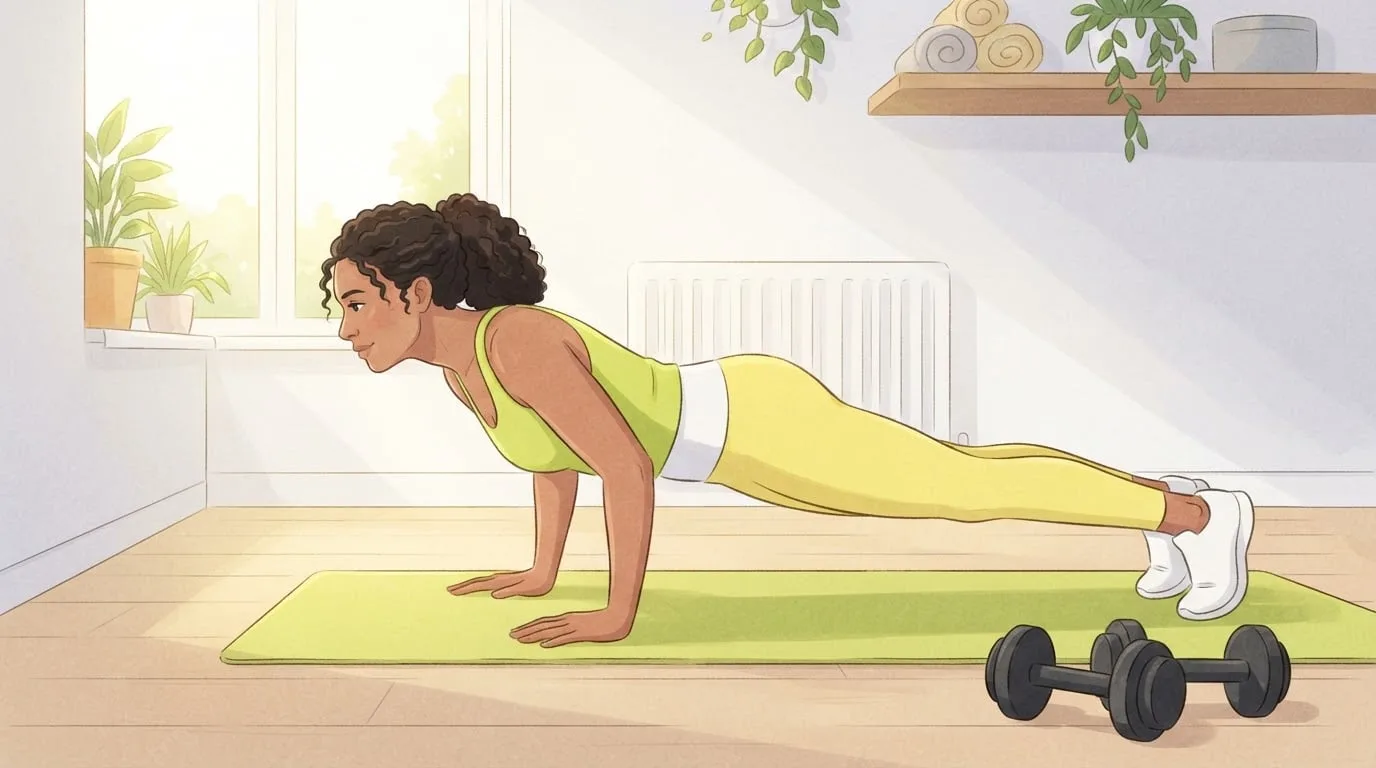
Pair a push with a pull, or a muscle with the one on the other side of the joint: push-ups with dumbbell rows, a dumbbell floor press with a one-arm row, biceps curls with overhead triceps extensions. One side rests while the other works, so your second and third rounds hold up well. This is the default choice for most people.
2. Agonist supersets, also called compound sets
Two exercises for the same muscle, back to back: dumbbell floor presses followed by push-ups, or goblet squats followed by reverse lunges. The second exercise starts on a tired muscle, so it takes you close to failure fast with light weights. That makes it a good finisher and a poor main course, because your total reps and load drop.
3. Upper-lower supersets
Pair an upper-body move with a lower-body move: goblet squats with push-ups, split squats with a dumbbell overhead press. Researchers sometimes call these alternate peripheral supersets. Neither muscle group competes for recovery, which makes this the easiest type for beginners and the best fit for full-body workouts.
4. Pre-exhaust supersets
An isolation exercise right before a compound one for the same muscle, such as lateral raises before an overhead press. The idea is to tire the target muscle first so it works harder in the big lift. The research below doesn't back that idea, so treat this as the least useful of the four.
| Type | Home example | Best for | Cost |
|---|---|---|---|
| Antagonist | Push-ups + dumbbell rows | Most workouts, saving time | Little; reps often go up |
| Agonist (compound set) | Floor press + push-ups | A short finisher close to failure | Fewer total reps and less load |
| Upper-lower | Goblet squats + overhead press | Full-body sessions, beginners | More effort per minute |
| Pre-exhaust | Lateral raises + overhead press | Rarely worth it | Fewer reps on the main lift |
Are Supersets Good for Muscle Growth?
Yes, and the evidence is better than most training tricks get. Zhang and colleagues (2025) pooled 19 studies with 313 participants in Sports Medicine. Compared with regular sets, supersets kept total reps and volume load the same, shortened sessions by about 37% and produced the same long-term gains in maximal strength, strength endurance and muscle size. Blood lactate and perceived effort were higher, so the sessions feel harder even though they're shorter.
A longer trial points the same way. Burke and colleagues (2026) randomly assigned 43 resistance-trained men and women to supersets or regular sets for 8 weeks. Both groups gained similar muscle thickness, strength and power, and the superset group finished each session in 36% less time.
The time saving is easy to see in a single workout. In Weakley and colleagues (2017), 14 university rugby players did the same six exercises three ways: straight sets took 42.3 minutes, supersets 24.0 minutes and tri-sets 17.7 minutes. Our research review of supersets walks through these studies in more detail. The rest of this guide is about using them well.
Which Superset Pairings Keep Your Reps (and Which Cost You)
The same studies show that the pairing matters more than the method. Here's what each pairing did when it was measured.
- Opposing muscles hold up or improve. Robbins and colleagues (2010) had 18 trained men alternate a pulling and a pushing exercise. The paired version took about 10 minutes instead of 20, kept the same volume load and roughly doubled the work done per minute. Paz and colleagues (2017) went further: 15 trained men lifted more total volume on every set of bench press and seated row when they paired them than when they did them separately. In Zhang's pooled data, opposing-muscle pairs allowed more reps than regular sets.
- Same-muscle pairs cost volume. In the same meta-analysis, pairing two exercises with similar movement patterns produced clearly less volume load than regular sets. The authors suggest saving them for training close to failure.
- Pre-exhaust doesn't do what it promises. Augustsson and colleagues (2003) had 17 men do knee extensions right before leg presses. Their thigh muscles were less active during the leg press, not more, and they managed fewer reps. Over 12 weeks, Fisher and colleagues (2014) found no extra strength from pre-exhaust training in 39 trained adults compared with simply doing the big lifts first.
So the rule of thumb is simple. Pair exercises that don't share the working muscle, and use same-muscle pairs only as a short finisher.
Find out what's really holding you back
FitCraft, our mobile fitness app, pairs you with an AI coach who builds you a personalized plan around your goals, schedule, and fitness level. Every FitCraft program is designed by Domenic Angelino, MPH (Brown University) and NSCA-CSCS, with research published in the Journal of Strength and Conditioning Research and Medicine & Science in Sports & Exercise.
Take the Free Assessment Free • 2 minutes • No credit cardHow to Do a Superset, Step by Step
- Pick a pair that doesn't compete. Opposing muscles or upper with lower. Avoid two exercises that both tax the same weak link, such as Romanian deadlifts with bent-over rows, which both load your lower back and grip.
- Set up both stations first. Dumbbells, mat and bench or sturdy chair in place before the first set, so the switch takes under 15 seconds.
- Choose a weight for each exercise on its own. Each one should let you hit its rep target with 1 to 3 reps left in the tank. Your row weight and your press weight will rarely be the same.
- Do A1, then go straight to A2. Walk, don't sit. A few breaths during the switch are fine.
- Rest 60 to 120 seconds after A2. Take the longer end for big leg moves. Our guide to how long to rest between sets explains why heavier work needs more.
- Repeat for 2 to 4 rounds, then move to the next pair, B1 and B2.
If the second exercise falls apart every round, the pair is competing. Swap one of them, or add 30 seconds to the rest.
Superset Workouts You Can Do at Home
Both sessions below are full-body and use the same structure: three pairs, done in order, with every pair finished before you start the next one.
Dumbbell superset workout (about 30 to 35 minutes)
| Pair | Exercises | Sets x reps | Rest after the pair |
|---|---|---|---|
| A | A1 Goblet squat A2 One-arm dumbbell row | 3 x 8-12 3 x 8-12 per arm | 90 seconds |
| B | B1 Dumbbell floor press B2 Dumbbell Romanian deadlift | 3 x 8-12 3 x 8-12 | 90 seconds |
| C | C1 Dumbbell biceps curl C2 Overhead triceps extension | 2-3 x 10-15 2-3 x 10-15 | 60 seconds |
| Finisher (optional) | Floor press, then push-ups straight after | 1 round, push-ups to 1-2 reps short of failure | Done |
Pairs A and B are upper-lower, pair C is antagonist, and the finisher is the one place a same-muscle compound set earns its spot.
Bodyweight superset workout (about 20 to 25 minutes)
| Pair | Exercises | Sets x reps | Rest after the pair |
|---|---|---|---|
| A | A1 Push-ups (or incline push-ups) A2 Bulgarian split squats | 3 x 6-15 3 x 8-12 per leg | 60-90 seconds |
| B | B1 Pike push-ups B2 Glute bridges | 3 x 5-10 3 x 12-20 | 60 seconds |
| C | C1 Forearm plank C2 Calf raises | 3 x 30-45 seconds 3 x 15-25 | 45-60 seconds |
Bodyweight-only plans are short on pulling work. If you have a sturdy table, inverted rows underneath it pair well with push-ups. If not, one pair of dumbbells for rows fills the gap.
Superset Exercises by Body Part
Want a superset for one area? These pairs all use bodyweight or dumbbells and keep the reps intact.
| Body part | Superset pair | Type |
|---|---|---|
| Chest and back | Dumbbell floor press + one-arm dumbbell row | Antagonist |
| Chest and back, no weights | Push-ups + inverted rows under a sturdy table | Antagonist |
| Shoulders | Dumbbell overhead press + bent-over rear-delt raise | Antagonist |
| Arms | Hammer curls + close-grip push-ups | Antagonist |
| Legs | Goblet squats + dumbbell Romanian deadlifts | Front and back of the thigh |
| Glutes and core | Glute bridges + dead bugs | Non-competing |
How to Program Supersets in a Week
Two or three superset sessions a week, on non-consecutive days, covers most goals. Iversen and colleagues (2021), reviewed time-efficient strength training in Sports Medicine. They set the floor at 4 hard sets per muscle group per week and noted that supersets roughly halve training time while keeping the volume. The two workouts above give each major muscle 3 to 6 sets per session, so two or three sessions land comfortably above that floor.
| Day | Session |
|---|---|
| Monday | Dumbbell superset workout |
| Tuesday | Walk or rest |
| Wednesday | Bodyweight superset workout |
| Thursday | Rest |
| Friday | Dumbbell superset workout, with new pairs: split squats + overhead press, Romanian deadlifts + push-ups, hammer curls + close-grip push-ups |
| Saturday | Optional walk, yoga or mobility |
| Sunday | Rest |
Progress one pair at a time. When you reach the top of the rep range on every round, add a little weight or move to a harder variation. If you'd rather train four days a week, the same pairs slot into an upper-lower split: antagonist pairs on upper days, front-and-back-of-thigh pairs on lower days. Every 4 to 8 weeks, or when your numbers stall, a lighter deload week lets the extra fatigue from supersets clear.
If you'd rather not plan pairs and progressions yourself, a guided app can carry that load. FitCraft's strength workouts use dumbbells and bodyweight, an AI coach demonstrates every exercise on an interactive 3D model and says your name during the workout, and your workouts adjust as you progress. Streaks and leaderboards reward the part supersets can't fix: showing up. For a side-by-side look at the options, see our roundup of the best dumbbell workout apps.
When Not to Superset
Supersets save time, but they come with costs. Skip them in these situations:
- Your heaviest strength sets. Iversen's review concluded that supersets and similar methods are probably better for muscle growth than for maximal strength, and Zhang's team noted that maximal strength needs heavier loads. Do your main lift as straight sets with full rest, then superset the rest of the session.
- A brand-new exercise. Fatigue from the first exercise blurs your technique on the second. Learn new moves fresh.
- Two exercises for the same muscle, when you want volume. That pairing cuts your total load. Keep it for the finisher.
- Back-to-back hard days. Weakley's rugby players hadn't fully recovered their jump height 24 hours after the superset and tri-set sessions, while they had after straight sets. Give superset days a lighter day after them.
- Calorie burning as the main reason. Kelleher and colleagues (2010) found that 10 young men burned a similar total during matched superset and regular sessions. The superset version burned more per minute and left a slightly larger afterburn, but the main gain was time.
The Bottom Line
Supersets let you do the same strength work in roughly two-thirds of the time, with the same long-term gains in muscle and strength. Pair opposing muscles or upper with lower, rest after each pair, keep your heaviest lift as straight sets and use same-muscle pairs only to finish.
A shorter workout is easier to start, and a workout you start is one you finish. As one FitCraft user, Katie, put it: "I've tried everything. This is the first time I've stuck with something past two weeks."
Frequently Asked Questions
What is a workout superset?
A workout superset is two exercises done one after the other with little or no rest between them, followed by a normal rest before the next round. A classic example is a set of push-ups followed straight away by a set of dumbbell rows. You do the same sets and reps you would anyway; you just fill the rest time with the second exercise.
Are supersets good for muscle growth?
Yes. A 2025 meta-analysis of 19 studies found no difference in long-term muscle growth or strength between supersets and regular sets, and an 8-week trial in 43 trained lifters found the same gains in 36% less time. The condition is a sensible pairing: opposing muscles or an upper-body and a lower-body move, so each set keeps its reps.
Are supersets better than regular sets?
Supersets give you about the same results as regular sets in roughly a third less time, so they're better when time is what limits you. They aren't better for your heaviest strength work, which still benefits from full rest between sets. Many people keep one main lift as straight sets and superset everything after it.
How many supersets should I do in a workout?
Two to four superset pairs per workout, each done for 2 to 4 rounds, is enough for most people. That covers the whole body in about 20 to 40 minutes. Rest 60 to 120 seconds after each pair, and stop adding pairs once your form starts to slip.
Do supersets burn more calories?
Supersets burn calories faster, not many more in total. In a study of 10 young men doing the same work both ways, energy use during the session was similar. The superset version burned about 32% more per minute and left a slightly larger afterburn of roughly 20 kilojoules, about 5 calories. The real gain is time.
Can beginners do supersets?
Yes, as long as the exercises are already familiar. Beginners do best with upper-lower pairs, such as goblet squats with push-ups, and moderate loads that stop 2 or 3 reps short of failure. Learn a new exercise as straight sets with full rest first, then add it to a superset once the form is steady.