You miss a week. Maybe two. You get back under the bar, the warm-up set feels heavier than it has any right to, and the obvious explanation arrives immediately: the muscle is gone. It usually isn't. But the number people quote at each other in the gym came from studies of people in casts and hospital beds, and those studies are answering a different question than the one you're asking.
The distinction isn't academic. Losing muscle has real costs, and people who are genuinely at risk of losing it (older adults, anyone recovering from surgery, anyone in a long aggressive diet) usually do not realize they are in that category. Meanwhile healthy lifters panic about a two-week holiday that costs them essentially nothing and wreck their next three months by training through an injury to avoid it.
So here is the timeline that the imaging studies actually produced, the reason the first week of a break looks worse than it is, the four variables that decide whether your situation resembles the cast studies or the holiday studies, and the minimum weekly dose that makes the entire question go away.
The Disuse Timeline, as Measured by MRI
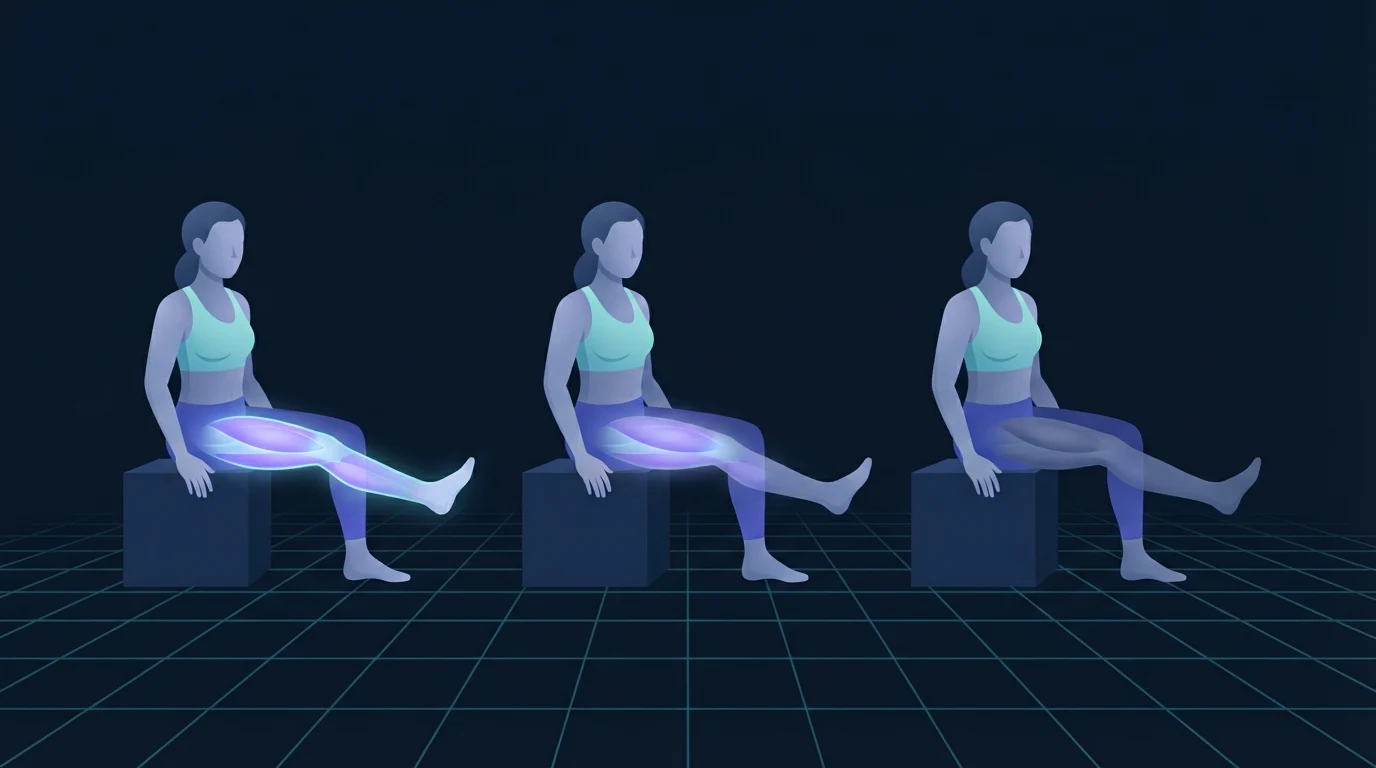
The cleanest data on this comes from a research group that immobilizes one leg of healthy volunteers and scans it repeatedly, using the other leg as a built-in control. Kilroe, Fulford, Jackman and colleagues (2020) in Medicine and Science in Sports and Exercise did exactly that with 13 healthy young men, knee-bracing one leg for seven days with MRI scans before, at day 2 and at day 7. Quadriceps volume was down 1.7% at 48 hours and 6.7% at a week, a rate of roughly 0.8% a day that stayed remarkably steady across the week. The hamstrings lost less over the same period, 1.4% at day 2 and 3.5% at day 7, which tells you atrophy is muscle-specific rather than a whole-limb phenomenon.
Wall, Dirks, Snijders and colleagues (2014) in Acta Physiologica ran the longer version: 5 days versus 14 days of one-legged knee immobilization in healthy young men. Quadriceps cross-sectional area fell 3.5% at five days and 8.4% at fourteen. Note the shape of that. The loss isn't linear. The second week costs less than the first, because the fastest atrophy happens right at the start, when protein synthesis collapses before the body recalibrates.
| Situation | Time | Measured muscle change |
|---|---|---|
| Leg in a brace, young adult | 2 days | Quadriceps volume down 1.7% (Kilroe, 2020) |
| Leg in a brace, young adult | 5 days | Quadriceps area down 3.5% (Wall, 2014) |
| Leg in a brace, young adult | 7 days | Quadriceps volume down 6.7% (Kilroe, 2020) |
| Leg in a brace, young adult | 14 days | Quadriceps area down 8.4% (Wall, 2014) |
| Walking cut to ~1,400 steps, older adult | 14 days | Leg fat-free mass down 3.9% (Breen, 2013) |
| Trained adult stops lifting, keeps living | 14 days | Strength maintained (Hwang, 2017) |
| Trained adult stops lifting, keeps living | 21 days, repeated | No deficit at 24 weeks (Ogasawara, 2013) |
Read the last three rows next to the first four and the whole confusion resolves. Every scary number on the internet comes from the top of that table. Almost every reader is somewhere near the bottom of it.
Why Week One Looks So Much Worse Than It Is
Take a week off and three things happen quickly, and only one of them is muscle loss.
The first is glycogen. Trained muscle holds a meaningful store of carbohydrate, and that carbohydrate is stored wet. The old textbook figure is about three grams of water bound per gram of glycogen, and Fernandez-Elias, Ortega, Nelson and Mora-Rodriguez (2015) in the European Journal of Applied Physiology measured it directly during recovery from prolonged exercise in the heat and found the real ratio depends heavily on hydration state, landing near 3:1 in dehydrated subjects and far higher when they were fully rehydrated. The number is not fixed, but the principle holds: glycogen and water travel together, so a drop in muscle glycogen shows up as a drop on the scale and a visible loss of fullness in the muscle within days. Train again for three or four sessions and it comes back, because it was never tissue.
The second is neural. Strength is partly a skill: motor unit recruitment, rate coding, intermuscular coordination and simple confidence under a load. All of that gets rusty faster than the muscle shrinks. This is why your first session back can feel dramatically worse than your body composition says it should, and why the second and third sessions feel almost normal again.
The third is swelling. Regular hard training keeps a low level of exercise-induced muscle swelling going more or less permanently. Stop, and it subsides. You look flatter. Nothing has been lost.
The actual contractile tissue is the slowest of the three to move, which is exactly backwards from how the week feels.
A Missed Week Is Not an Immobilized Week
This is the part most articles skip, and it is the part that changes the answer.
Ogasawara, Yasuda, Ishii and Abe (2013) in the European Journal of Applied Physiology took 14 young men and ran them through 24 weeks of bench press training at 75% of one-rep max, three sets of ten, three days a week. One group trained continuously for the whole 24 weeks. The other did three cycles of six weeks on and three weeks completely off. At the end, muscle cross-sectional area and strength were the same in both groups. The group that spent nine of those 24 weeks doing nothing ended up in the same place.
Hwang, Andre, McKinley-Barnard and colleagues (2017) in the Journal of Strength and Conditioning Research found the same thing over a shorter window: resistance-trained men who stopped training for two weeks held on to the strength they had built. That result has since been echoed enough that it is close to a working rule. A healthy, well-fed adult who stops lifting but keeps walking around and eating normally holds their muscle for roughly three weeks before anything measurable happens.
Why the enormous gap between a braced leg and a rest week? Because an immobilized limb receives essentially zero mechanical loading, while an untrained but ambulatory person is still standing up from chairs, climbing stairs, carrying groceries and walking several thousand steps. That's far below a training stimulus and far above zero, and the difference between "far above zero" and "zero" is where nearly all early atrophy lives. The same logic explains why our guide to what to do after a missed workout treats a skipped session as a scheduling problem rather than a physiological one.
Knowing what to do is the easy part.
FitCraft, our mobile fitness app, pairs you with an AI coach who builds you a personalized plan around your goals, schedule, and fitness level. Every FitCraft program is designed by Domenic Angelino, MPH (Brown University) and NSCA-CSCS, with research published in the Journal of Strength and Conditioning Research and Medicine & Science in Sports & Exercise.
Take the Free Assessment Free • 2 minutes • No credit cardFour Things That Make Muscle Disappear Faster
1. Age
This is the biggest modifier by a distance, and it does not need a cast to show up. Breen, Stokes, Churchward-Venne and colleagues (2013) in the Journal of Clinical Endocrinology and Metabolism asked healthy older adults to reduce their daily step count by roughly 76%, to about 1,400 steps a day, for two weeks. Nothing else changed. No cast, no bed, no diet. Leg fat-free mass fell about 3.9% and myofibrillar protein synthesis dropped 26%, a phenomenon the authors called anabolic resistance: the same protein feeding produced a smaller building response than it would have in a younger person.
Recovery is asymmetric too. Suetta, Hvid, Justesen and colleagues (2009) in the Journal of Applied Physiology immobilized the legs of 11 young men and 9 men aged 61 to 74 for two weeks, then retrained them for four. Both groups lost quadriceps volume. Only the young group got all of it back within the retraining period. Two weeks of a flu in your thirties is an inconvenience. The same two weeks at 70 can start a spiral that takes months to undo, which is why our guide to losing fat without losing muscle gets more conservative with age, not less.
2. A large energy deficit
Dieting hard while not training is the fastest civilian route to losing muscle. Murphy and Koehler (2022) in the Scandinavian Journal of Medicine and Science in Sports meta-analyzed resistance training performed in energy deficit versus energy balance. Lean-mass gains were significantly impaired in deficit (effect size -0.57) while strength gains were not (-0.31, not significant), and their meta-regression put the tipping point near a deficit of around 500 kcal a day, past which lean mass gains stopped happening. That's with training. Take the training away and the same deficit stops protecting anything.
3. Bed rest, illness and surgery
This is the category that actually resembles the immobilization studies, and the one where the numbers at the top of that table apply to you. Hospitalization combines near-zero loading with poor appetite and a systemic inflammatory response, which is a far worse combination than any of the three alone. The practical implication is that if you or a parent is facing a planned surgery, the weeks before it are worth training, because you will spend the weeks after it losing ground.
4. Not enough protein
Protein does not prevent disuse atrophy, and studies that have tried to supplement their way out of a leg brace have been underwhelming. What protein does is set the ceiling on the repair side of the ledger once loading returns. For an adult trying to hold on to muscle through a layoff, a daily intake around 1.6 grams per kilogram of body weight, spread across meals rather than dumped into one, is the evidence-backed target. Older adults generally need the upper end of that range to get the same response, which is the anabolic resistance finding again.
How Little Training It Takes to Hold On
The maintenance dose is the most useful number in this whole topic, and it is surprisingly small. Bickel, Cross and Bamman (2011) in Medicine and Science in Sports and Exercise trained young adults (20 to 35) and older adults (60 to 75) for 16 weeks, then cut them back to either one third or one ninth of their previous training volume for 32 weeks. Young adults maintained muscle size and strength on one third of the volume. The reduced dose held strength in the older group too, though the maintenance story was less complete for size.
Translate that into a week. If you normally train a muscle group with nine hard sets across three sessions, three hard sets in one session will hold it. That's roughly fifteen minutes. It doesn't need a gym, a barbell or a good mood, and it works with dumbbells or body weight as long as the sets get close to failure. Our review of the science of detraining covers what happens to your aerobic fitness on the same reduced dose, which follows a very different and much steeper curve.
The corollary is worth stating plainly: there is almost never a good reason to lose muscle from a busy period. A busy period costs you progress, not tissue, as long as one short session survives the week. If the hard part is not the knowledge but building a week that survives contact with real life, our personalized training program page walks through how that gets built around your schedule rather than against it.
Getting It Back
Regaining lost muscle is generally faster than building it the first time, an effect commonly described as muscle memory. The Ogasawara result is the cleanest demonstration: repeated three-week breaks cost that group nothing at all over 24 weeks, which means the retraining after each break outran the loss during it. Our review of muscle memory science covers the myonuclear mechanism proposed to explain it. The caveat is Suetta's older group, who had not caught up after four weeks of retraining. Speed of return is one more thing that changes with age.
Practical return protocol after a layoff of two weeks or more: start at roughly 70% of the loads you finished on, keep two or three reps in reserve, and take two full weeks to climb back rather than testing yourself on day one. You'll be back at your old numbers inside a month and you will not have spent that month sore. The alternative, going straight back to your previous working weights, reliably produces the kind of soreness that costs you the following week as well. Our post on getting back into working out covers the psychological half of that restart, which is usually the harder half.
What This Means for You
If you are a healthy adult under about 55 and you're taking a week or two off, take it. The evidence says you will lose essentially nothing, you will come back with fresher joints and more enthusiasm, and the first session will lie to you about how much ground you lost. Ignore it and train the second session.
If your break is going to run longer than three weeks, put one short session in each week and stop thinking about it. One third of your usual volume is the target, which for most people means a fifteen-minute session covering a push, a pull and a leg movement, taken close enough to failure to count. That single session converts a maintenance problem into a non-problem.
And if you are over 60, recovering from surgery, in a long aggressive diet, or facing a period of reduced mobility, you're in the group the immobilization studies were written about. Protect protein intake, protect what loading you can, and treat two weeks of reduced walking as a genuine event rather than a rest.

Frequently Asked Questions
How long does it take to lose muscle?
Measurably, about two days, but only if the muscle is genuinely not being used. Kilroe and colleagues (2020) braced one leg of 13 healthy young men and MRI-scanned them, finding 1.7% quadriceps loss by day 2 and 6.7% by day 7, roughly 0.8% a day. A skipped training week is nothing like that, because you are still walking, carrying things and standing up. In healthy adults who simply stop lifting, meaningful size loss takes about three weeks to become measurable and longer than that to become visible.
Do you lose muscle after 2 weeks off?
Almost certainly not enough to matter, if you are healthy and still moving normally. Hwang and colleagues (2017) tracked resistance-trained men through two weeks with no training and found their strength gains fully maintained. Ogasawara and colleagues (2013) went further: 24 weeks of bench press training split into three 6-week blocks with 3-week breaks between them produced the same muscle cross-sectional area and the same strength as training straight through. You will feel softer and weaker on the first session back. That is neural rust and lost glycogen, and it clears in a week or two.
What is detraining?
Detraining is the partial or complete loss of training adaptations when the training stimulus is removed or reduced below the level needed to maintain them. It is not one process on one clock. Cardiovascular adaptations fade first and fastest, strength holds longer than most people expect, and muscle size sits somewhere between the two. This article covers the muscle-size half of that picture; our detraining science review covers the full curve including aerobic fitness.
Does muscle turn to fat when you stop lifting?
No. Muscle and fat are different tissues and neither converts into the other. What happens is two separate things at the same time: muscle fibers shrink slightly from reduced loading, and fat gain occurs because you kept eating the way you ate when you were training. They arrive together, so it looks like a conversion. The fix is also two separate things: keep some training load in the week, and adjust intake to the activity you are actually doing.
How fast do you lose muscle as you age?
Faster, and the gap shows up in ordinary life rather than in a cast. Breen and colleagues (2013) asked healthy older adults to cut their daily step count by about 76%, down to roughly 1,400 steps a day, for just two weeks. Leg fat-free mass fell by about 3.9% and myofibrillar protein synthesis dropped 26%. Two weeks of sitting more did to older legs roughly what a brace does to a young one. Recovery is slower too: in Suetta and colleagues (2009), young men regained their quadriceps volume within four weeks of retraining and older men did not.
How much training do you need to maintain muscle?
Much less than you needed to build it. Bickel, Cross and Bamman (2011) trained young and older adults for 16 weeks, then cut them to either one third or one ninth of their previous volume for 32 weeks. Young adults maintained muscle size and strength on one third of the volume, and older adults maintained strength on the reduced dose as well. In practice that is one hard session a week per muscle group, or two short ones. If you are travelling or slammed at work, that is the number to defend.
How long does it take to get muscle back?
Faster than it took to build the first time, for most people under about 60. Regaining lost size is generally quicker than the original build because the tissue has been there before, and Ogasawara and colleagues (2013) showed a group that took repeated 3-week breaks caught all the way up by the end of 24 weeks. The honest exception is age: Suetta and colleagues (2009) found older men had not recovered their pre-immobilization quadriceps volume after four weeks of retraining while young men had. Expect two to six weeks back to your old numbers after a short layoff, and start at about 70% of your previous loads.