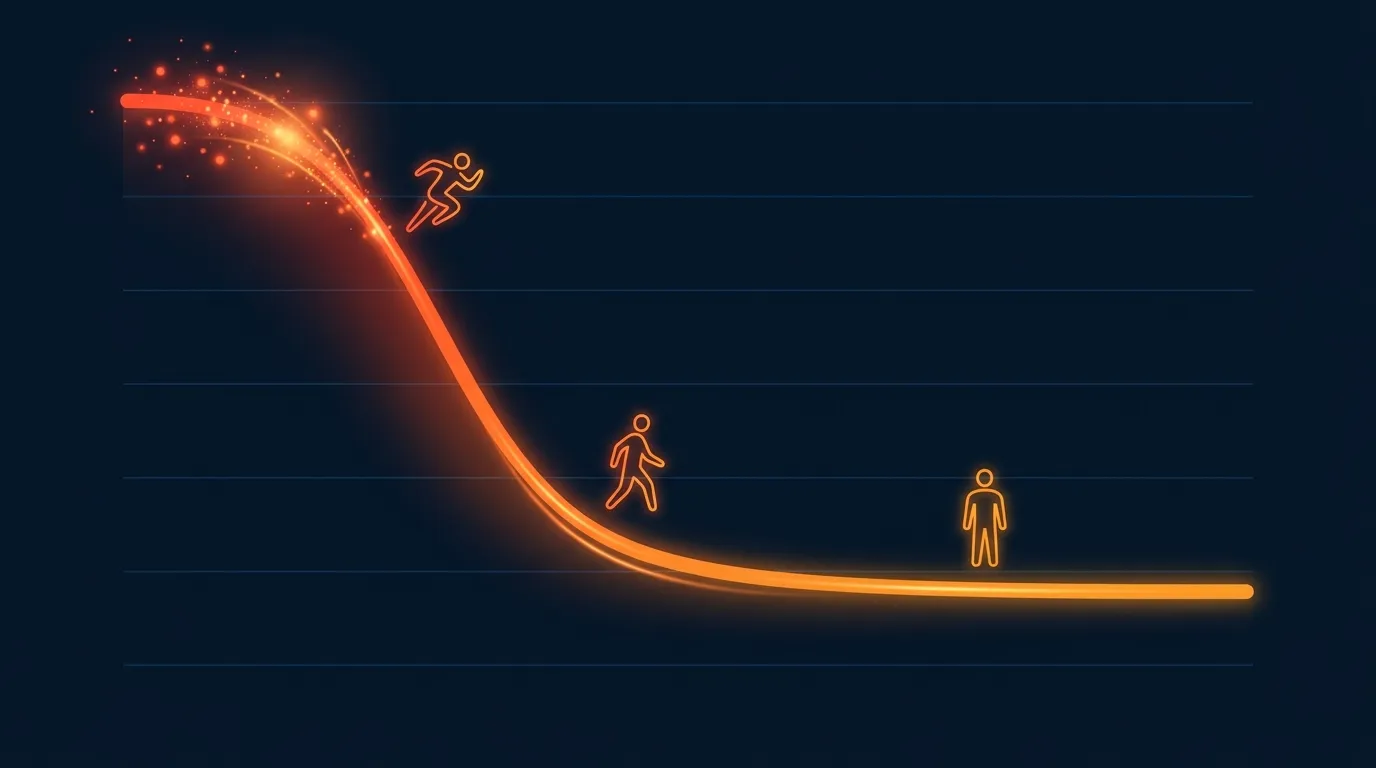
Take a week off and you'll find every fitness app, podcast, and gym wall poster ready to scare you back into the gym. Use it or lose it. Two weeks and you're back to square one. Skip a workout, lose a workout. It's catchy. It's also mostly wrong.
The actual science of detraining, what physiologists call the loss of training-induced adaptations when you stop, is more nuanced and a lot more forgiving. Different systems lose fitness on different timelines. Endurance falls fastest. Strength is sticky. Muscle memory is real. And the dose needed to maintain what you've built is shockingly small compared with the dose needed to build it.
This matters because the fear of losing your gains is one of the quiet villains behind quitting. People miss a week, panic, decide they're "back to zero," and stop showing up entirely. The data does not support that story. Here's what it actually shows.
What the Research Actually Shows
Three sources do most of the heavy lifting in the detraining literature: a 1984 study on endurance athletes, a comprehensive two-part review from 2000, and a 2011 study on minimum maintenance dose. Each answers a different version of the question.
Coyle et al. (1984): The Classic VO2 Max Curve
If one paper put detraining on the map, it's this one. Coyle and colleagues took seven highly trained endurance athletes and stopped them. No tapering. No maintenance work. Complete cessation. Then they tested them at 12, 21, 56, and 84 days.
The results are still cited 40 years later because the timeline is so clean:
- Days 1 to 12: VO2 max dropped early, mostly driven by a fast decline in stroke volume as plasma volume fell.
- Day 21: VO2 max was about 7 percent below the trained baseline.
- Day 56: VO2 max stabilized at roughly 16 percent below peak and stopped falling further.
- Day 84: Even after 12 weeks of zero training, the former athletes still had a higher VO2 max than sedentary controls who had never trained (50.8 vs 43.3 ml/kg/min).
That last bullet is the one fitness culture skips. Twelve weeks of doing absolutely nothing, and these athletes were still meaningfully fitter than a person who had never trained. Skeletal muscle capillarization, one of the harder-won endurance adaptations, was still 50 percent above sedentary controls. The body holds onto a lot of what you built, even when you give it nothing.
Muscle size runs on its own clock inside that picture, and our post on how long it takes to lose muscle walks the imaging studies through day by day.
Citation: Coyle EF, Martin WH 3rd, Sinacore DR, et al. Journal of Applied Physiology. 1984;57(6):1857-1864.
Mujika and Padilla (2000): The Comprehensive Review
Mujika and Padilla's two-part review in Sports Medicine is the closest thing the field has to a textbook chapter. They synthesized dozens of studies into a clean set of timelines that still hold up.
Cardiorespiratory adaptations come apart first. Within days, blood plasma volume drops by 5 to 12 percent. Stroke volume falls. Heart rate at submaximal exercise creeps up. Mitochondrial enzymes in trained muscle decline rapidly. By two to four weeks of full rest, VO2 max in trained athletes is meaningfully lower.
Muscular adaptations are tougher. Maximal strength tends to remain near trained levels for several weeks before measurable losses appear. Type II (fast-twitch) fibers can shrink modestly with disuse, but cross-sectional area is generally preserved for two to three weeks. Force production "declines slowly and usually remains above control values for very long periods," in the authors' own language.
Their punchline matters. The negative effects of detraining can be largely avoided if training intensity is maintained, even when frequency or volume drops sharply. In other words: a couple of hard sessions a week beats nothing, and beats it by a wide margin.
Citation: Mujika I, Padilla S. Sports Medicine. 2000;30(2):79-87 and 30(3):145-154.
Bickel, Cross, and Bamman (2011): The Minimum Effective Maintenance Dose
This is the study that should be plastered on the wall of every gym. Bickel and colleagues trained two groups, young adults (20 to 35) and older adults (60 to 75), with three sessions per week for 16 weeks. Then they cut the training way down for another 32 weeks: a one-third dose group and a one-ninth dose group. The question was how little you can do and still keep what you built.
Results in young adults were striking. Both reduced doses, even the one-ninth group doing roughly one tough session a week, maintained the strength and muscle gains from the original program. Older adults needed more, about a third of the original volume, but they too retained their strength and most of their hypertrophy on a markedly reduced schedule.
The reason this matters: the hard part is building. Once you've built the engine, keeping it idling takes a fraction of the work. If life blows up your routine, you do not have to choose between your old volume or nothing. Two short sessions a week beat the choice you actually face most weeks, which is "do I just skip everything because I can't do my normal four sessions?"
Citation: Bickel CS, Cross JM, Bamman MM. Med Sci Sports Exerc. 2011;43(7):1177-1187.
Endurance Falls First. Strength Holds.
Probably the single most useful takeaway across the literature: aerobic fitness and strength detrain on different clocks.
Aerobic adaptations sit on a few biological systems that turn over fast. Plasma volume responds within 48 hours. Mitochondrial enzymes degrade within days when no training stimulus arrives. The cardiovascular machinery is a use-it-or-lose-it system on a short timescale.
Muscular adaptations are different. Cross-sectional area is supported by structural protein, neural drive, and (the research suggests) long-lived nuclei inside muscle fibers. Those structural changes take weeks of inactivity to reverse meaningfully.
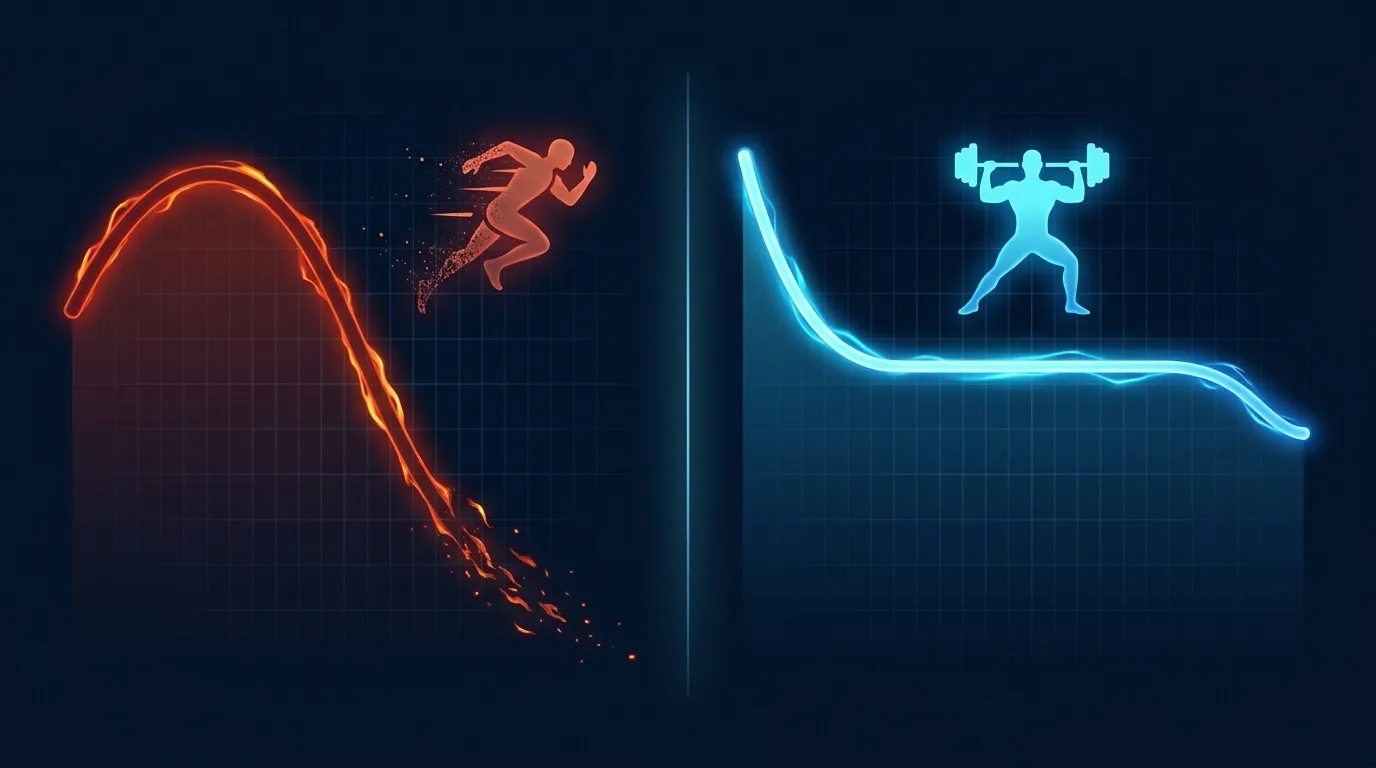
Practical implication if your schedule is a wreck: protect cardio with short, hard sessions. Twenty minutes of higher-intensity work two or three times a week preserves most aerobic adaptations. Strength is more forgiving of a missed week. If you have to triage, triage the easy thing.
Enjoying the article?
Start a new fitness routine today, written by me and coached by the AI I designed.
Take the Free Assessment Free · 2 minutes · No credit cardCommon Misconceptions
"I lost everything in two weeks."
You didn't. The flat, smaller-looking muscle you see after a week off is mostly intramuscular glycogen and the water bound to it. Each gram of glycogen pulls about three grams of water with it. Drop your glycogen stores and your muscles deflate visually within days, even though the contractile protein is largely intact.
One week of regular eating and a few training sessions and the look comes right back. Coleman et al. (2024) ran a randomized trial in PeerJ on a one-week deload inserted in the middle of a 9-week resistance program. There was no significant difference in hypertrophy, power, or muscular endurance compared with the no-deload group. A short break does not steal your progress. Your eyes lie. The biopsy doesn't.
"Muscle turns into fat."
It does not. Muscle and fat are different tissues with different cells. One cannot become the other any more than your liver can become bone. What happens during detraining is simpler and dumber: muscle shrinks slightly, daily energy expenditure falls because muscle is metabolically active, and most people keep eating the same. The math then catches up over months. The fat gain is not the muscle "turning into" fat. It is just calories.
"I'm starting over from zero."
This is the most demoralizing myth and the most clearly wrong. Previously trained muscle regains size and strength dramatically faster than it took to build the first time. Psilander et al. (2019) studied 19 adults through 10 weeks of training, 20 weeks of detraining, then 5 weeks of retraining. The previously trained leg responded quickly during the short retraining block.
Whether muscle memory is mediated by retained nuclei (Bruusgaard and Gundersen, 2010) or by long-lasting epigenetic changes in muscle DNA, the practical result is the same. Coming back is not starting over. It is reloading.
How Long Until You're Back?
Most people who return to training after a multi-week or multi-month break find that the first 2 to 3 sessions feel disproportionately hard. The fatigue spikes fast, soreness comes back, sleep gets weird. That is the cardiorespiratory and neuromuscular system unmasking quickly. It does not mean you are deconditioned forever. It means you used to be conditioned and your body remembers the demand.
Rough timelines from the literature and from coaching practice:
- 2 to 4 weeks back: Most of your aerobic capacity returns. Workouts that felt brutal on day 3 feel ordinary by week 3.
- 4 to 8 weeks back: Strength returns to roughly 70 to 80 percent of where it was. The remaining 20 percent comes back over the following month or two.
- 8 to 12 weeks back: Visible muscle fullness returns. The "flat" look from the layoff is gone.
- By 3 to 6 months: Most people are at or above their previous best, depending on how long the layoff was and how many decades of training they had banked.
Compare that with the original timeline. You spent a year, two years, maybe a decade getting to your peak. Coming back from a 6-month break takes weeks, not years. The bank account isn't empty. You are just looking at a recent bad statement.

What This Means for Your Real Life
The point of all this isn't to make you cavalier about consistency. Consistency is still the single biggest predictor of long-term outcomes. The point is that the panic loop, where you miss a week, decide you've blown it, and stop showing up entirely, is built on a story the data does not support.
If you've been off for a week, you have lost almost nothing. If you've been off for a month, you have lost some aerobic fitness and almost no strength. If you've been off for a year, you've lost more, but your body is primed to come back fast. None of these are good reasons to keep being off another week.
For people who keep falling off and restarting, what helps is not more fear. It is friction reduction and a system that absorbs your missed days without making you feel like a failure. That is exactly what we tried to design FitCraft to do. The streak system rewards return-to-training, not just unbroken perfection. The recovery from a missed workout is a feature, not a punishment.
Honest Limitations
A few caveats the literature has not resolved:
- Most detraining research uses trained or athletic populations. Recreational exercisers may detrain on slightly different curves, though the direction of effects is consistent.
- The mechanism of muscle memory in humans is contested. Bruusgaard and Gundersen's myonuclei hypothesis is supported in animals but mixed in humans. Recent epigenetic work has shifted the conversation toward long-term DNA methylation changes in muscle.
- Older adults detrain faster than younger adults across most metrics. Adults over 65 lost roughly twice the strength of 20- to 30-year-olds in matched protocols, with significant decline appearing between weeks 12 and 31 of full rest. Maintenance work matters more with age, not less. Our guide to strength training after 60 covers this in detail.
- Skill-based fitness (movement quality, technique under load) detrains differently from systems-based fitness. A few weeks off can leave a strong squatter feeling oddly clumsy at first. That comes back within sessions, not months.
How FitCraft Applies This Science
The detraining literature is one of the reasons FitCraft was built around the inconsistency villain rather than around peak-performance training. Most apps assume the user is in build mode every week of the year. Real life does not work like that.
- A 3D AI personal trainer who shows up with you. Ty is a 3D character who talks to you by name, demonstrates every exercise with interactive 3D models you can rotate and zoom, and adapts the workout as you progress. Coming back after a layoff is the worst time to face a generic spreadsheet, and the best time to have a coach in front of you.
- Programs that scale with your reality. FitCraft's multi-week programs are designed so a missed day does not cascade into a missed week. Adaptive workouts adjust to your progress, so when you return after a break the program meets you where you are rather than where you were.
- A streak system that rewards returning. Calendar tracking, calendar rewards, collectible cards, and avatar leveling are tuned to make showing up after a gap feel like progress rather than punishment. The research on streak psychology backs this up.
- Built for people who keep falling off. The whole system is designed for the user who knows the science of detraining isn't the problem. The behavioral pattern is. Read more on why people quit fitness apps and how the design fights it.
Programs are designed by Domenic Angelino, an Ivy League-trained exercise scientist (MPH, Brown University) and NSCA-certified strength coach who reviewed the research above when shaping the curriculum. A free version of FitCraft is available so you can try the system without any commitment.
References
- Coyle EF, Martin WH 3rd, Sinacore DR, Joyner MJ, Hagberg JM, Holloszy JO. "Time course of loss of adaptations after stopping prolonged intense endurance training." Journal of Applied Physiology 57.6 (1984): 1857-1864. doi:10.1152/jappl.1984.57.6.1857
- Mujika I, Padilla S. "Detraining: loss of training-induced physiological and performance adaptations. Part I." Sports Medicine 30.2 (2000): 79-87. doi:10.2165/00007256-200030020-00002
- Mujika I, Padilla S. "Detraining: loss of training-induced physiological and performance adaptations. Part II." Sports Medicine 30.3 (2000): 145-154. doi:10.2165/00007256-200030030-00001
- Bickel CS, Cross JM, Bamman MM. "Exercise dosing to retain resistance training adaptations in young and older adults." Medicine & Science in Sports & Exercise 43.7 (2011): 1177-1187. doi:10.1249/MSS.0b013e318207c15d
- Psilander N, Eftestøl E, Cumming KT, et al. "Effects of training, detraining, and retraining on strength, hypertrophy, and myonuclear number in human skeletal muscle." Journal of Applied Physiology 126.6 (2019): 1636-1645. doi:10.1152/japplphysiol.00917.2018
- Bruusgaard JC, Johansen IB, Egner IM, Rana ZA, Gundersen K. "Myonuclei acquired by overload exercise precede hypertrophy and are not lost on detraining." PNAS 107.34 (2010): 15111-15116. doi:10.1073/pnas.0913935107
- Coleman M, Burke R, Augustin F, et al. "Gaining more from doing less? The effects of a one-week deload period during supervised resistance training on muscular adaptations." PeerJ 12 (2024): e16777. doi:10.7717/peerj.16777
Frequently Asked Questions
How fast do you lose fitness when you stop training?
Endurance fitness drops first. Coyle et al. (1984) found that VO2 max declined about 7 percent in 21 days of complete inactivity, then plateaued near 16 percent below peak by day 56. Strength holds longer. Most resistance-training adaptations are largely preserved for two to four weeks before measurable decline begins.
Will I lose muscle if I take two weeks off?
Probably not in any meaningful way. A 2024 controlled trial in PeerJ found that a planned one-week reduction in training had no negative effect on hypertrophy, power, or muscular endurance. Most studies show muscle cross-sectional area remains stable for at least two to three weeks of complete rest. The "flat" look people notice in the first week is mostly glycogen and water, not protein loss.
Do you lose strength faster than endurance?
No. It is the opposite. Mujika and Padilla's 2000 review of detraining found that maximal strength tends to remain near trained levels for several weeks of inactivity, while VO2 max and oxidative enzyme activity decline within days. If you are choosing what to prioritize during a busy stretch, short cardio sessions protect aerobic fitness more efficiently than skipping cardio entirely.
What is the minimum training to keep your gains?
Less than you think. Bickel et al. (2011) showed that after 16 weeks of resistance training, young adults retained their strength and muscle mass on roughly one-ninth of the original training volume, and older adults retained gains on about one-third. For aerobic fitness, Mujika and Padilla report that maintaining intensity while reducing frequency or duration preserves most adaptations for weeks to months.
Is muscle memory real, and how fast can you regain fitness?
Yes, muscle memory is real, even if the mechanism is debated. Previously trained people regain lost size and strength faster than untrained beginners build it from scratch. Recent human studies suggest epigenetic and transcriptional changes in muscle persist long after detraining. Practically: most lifters get back to prior strength within four to ten weeks, far less time than the original training took.