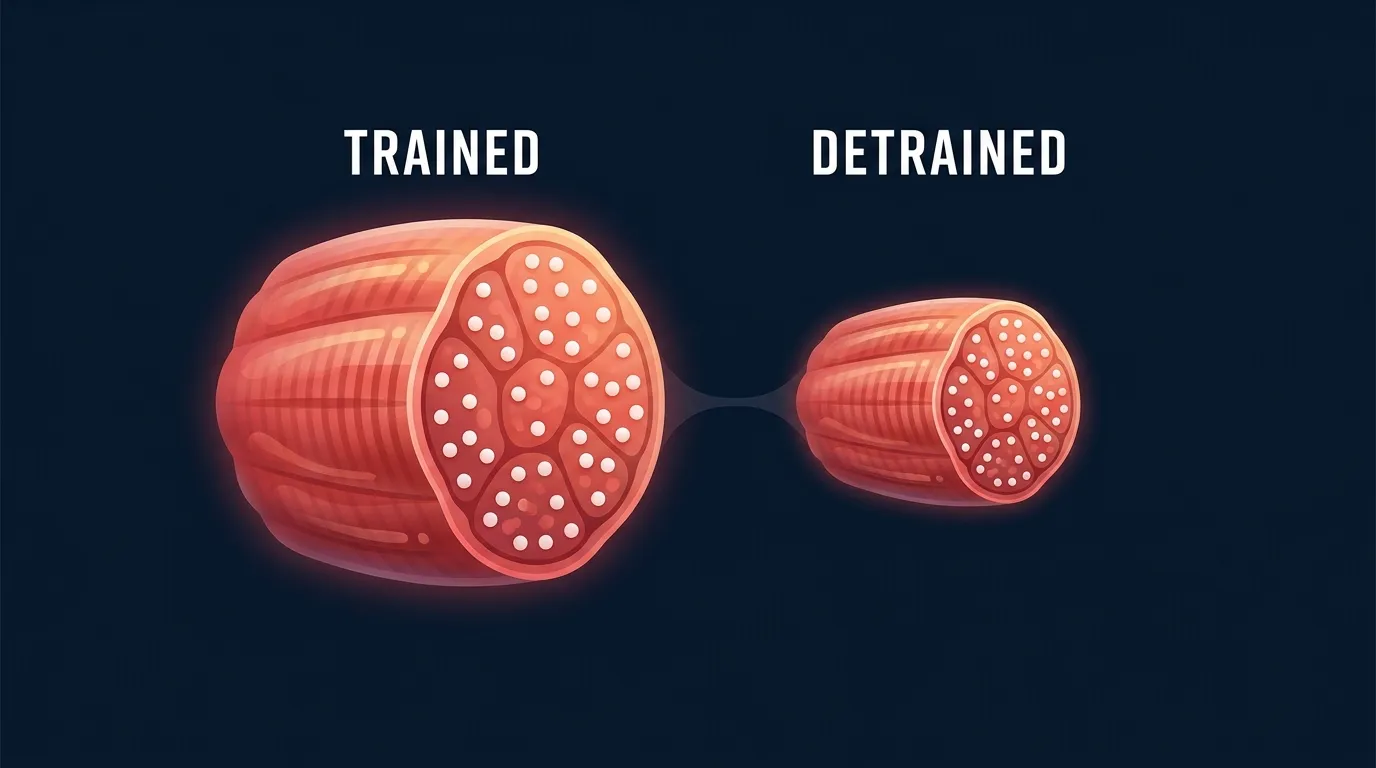
You trained for a year. You got stronger. You looked different in the mirror. Then life happened. A new job, a baby, a knee that needed time, a long stretch where the gym just wasn't going to fit. Six months pass. A year. You catch a glimpse of yourself and the visible work is gone.
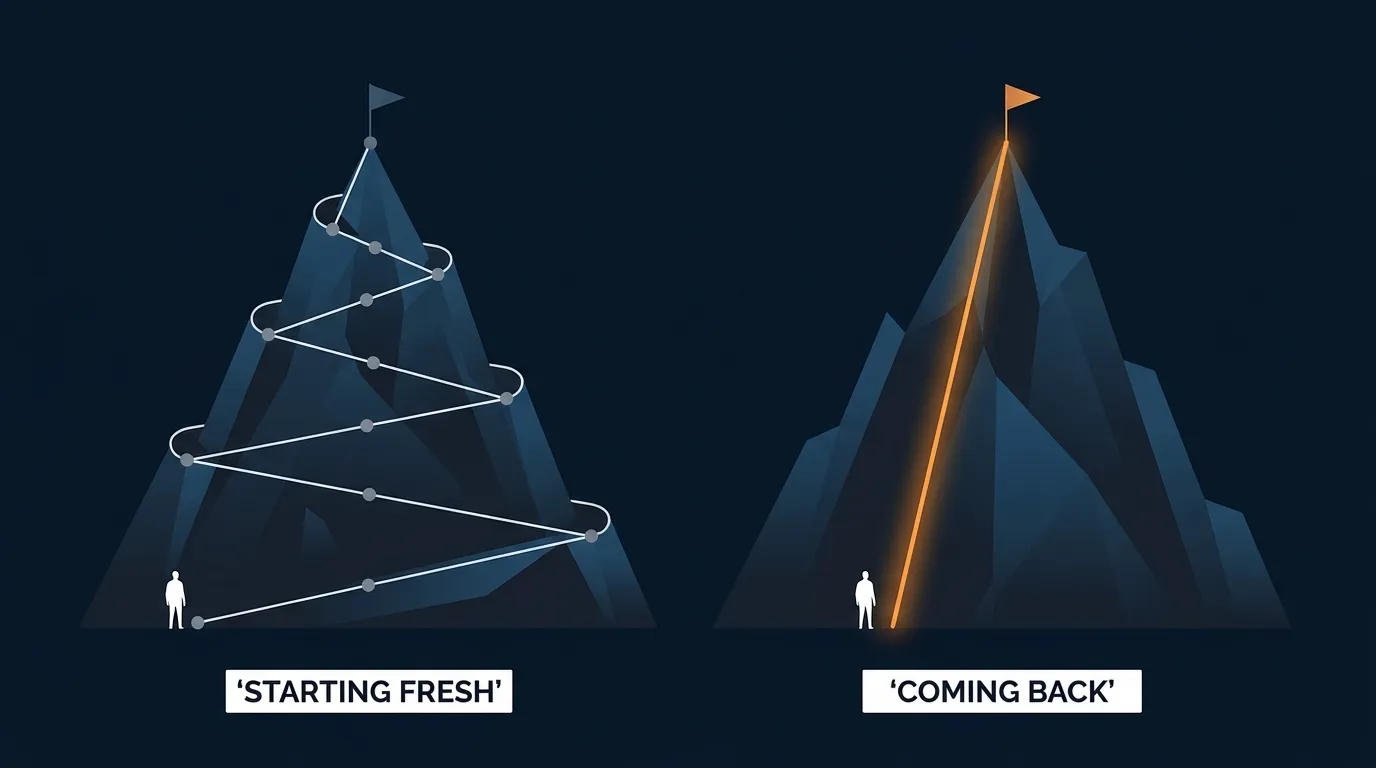
The natural conclusion is that you're back to square one. That all those workouts didn't really matter. That you have to climb the whole mountain again from the bottom.
The cell biology says otherwise. When researchers actually look at what happens inside trained muscle during a long layoff, they don't find a clean reset. They find a muscle fiber that shrunk on the outside while keeping a surprising amount of its training infrastructure on the inside. That preserved infrastructure has a name: muscle memory. And it's the reason your second time getting in shape is dramatically faster than the first.
What Muscle Memory Actually Means
The phrase "muscle memory" gets used loosely. People say it when they remember how to ride a bike. They say it when their golf swing comes back after a winter off. Both involve memory, but neither is really stored in muscle. That's neural memory: motor patterns retained in your brain and spinal cord.
The scientific term covers something different. In current exercise physiology, muscle memory refers to a measurable phenomenon: previously trained muscle regains size and strength faster than untrained muscle. The mechanisms behind that effect are still being mapped, but three candidates do most of the work. That fast lane only exists for territory you have already held, which is why the first build follows a much slower schedule: our review of how long it takes to build muscle walks through the biopsy evidence behind that timeline.
Mechanism 1: Retained Myonuclei
Skeletal muscle fibers are unusual cells. They're huge, often spanning the full length of a muscle, and they contain hundreds of nuclei instead of one. When you train hard enough to grow a muscle, satellite cells (resident stem cells in muscle tissue) donate new nuclei to the fiber. Those new myonuclei expand the fiber's protein-synthesis capacity, which is what lets it grow.
The big question, debated for decades, was what happens to those extra nuclei when the muscle shrinks back. The classic teaching said they get pruned by apoptosis. Use it or lose it.
Then Bruusgaard et al. (2010) in PNAS directly imaged single muscle fibers in mice, tracking individual myonuclei before and after a period of severe atrophy. The fibers shrunk by about 50 percent. The nuclei did not disappear. They persisted for at least three months, roughly 15 percent of the rodent's expected lifespan, despite the fiber being functionally inactive.
If you scale that timeline to a human life, the implication is striking: nuclei accumulated during a serious training phase in your twenties might still be hanging around in your forties.
Mechanism 2: Epigenetic Memory
Cells don't just store information in nuclei. They also store it in chemical tags on DNA itself. The most studied of these is DNA methylation, where small methyl groups attach to specific sites and tune which genes can be turned on.
In a striking 2018 study, Seaborne et al. in Scientific Reports took human muscle biopsies through a full cycle: 7 weeks of resistance training, 7 weeks of detraining, then 7 weeks of retraining. During the first training phase, they saw thousands of CpG sites in muscle DNA become hypomethylated, basically opening up growth-related genes. During detraining, those changes mostly held. During retraining, the same and additional sites became hypomethylated, and the muscle grew more during retraining than it had originally.
That's a fingerprint of cellular memory. The DNA in your muscle cells doesn't change, but the chemical marks layered on top of it can record that you trained, hold that record through a layoff, and amplify the response when you load the muscle again.
Mechanism 3: Neural Adaptation
The brain remembers too. Strength is partly a recruitment skill: how completely you can activate motor units, how well synergist muscles coordinate, how efficiently a movement pattern fires. Months of training carve those patterns deep, and they don't all wash out during a layoff.
This is why a returning lifter's bar speed and technique often look reasonable on day one, even when load is dialed back. The motor pattern is intact. Muscle that used to do this knows what to do. It just needs reloading.
What Happens to Strength During a Layoff
Knowing the cellular story is useful. Knowing the practical numbers is more useful, because it tells you what to actually expect when you restart.
Strength Loss Is Slower Than People Think
In Taaffe and Marcus (1997), eleven men aged 65 to 77 trained for 24 weeks, then stopped completely for 12 weeks, then retrained for 8. Twelve weeks of doing nothing only erased about 30 percent of the strength they'd built. Translation: even after three months off, most of what they'd gained was still there.
Why? Their nervous system kept much of the recruitment improvement. Their muscles shrunk less than people assume. The first thing trained muscle loses is volume, not function.
Retraining Is Faster Than Original Training
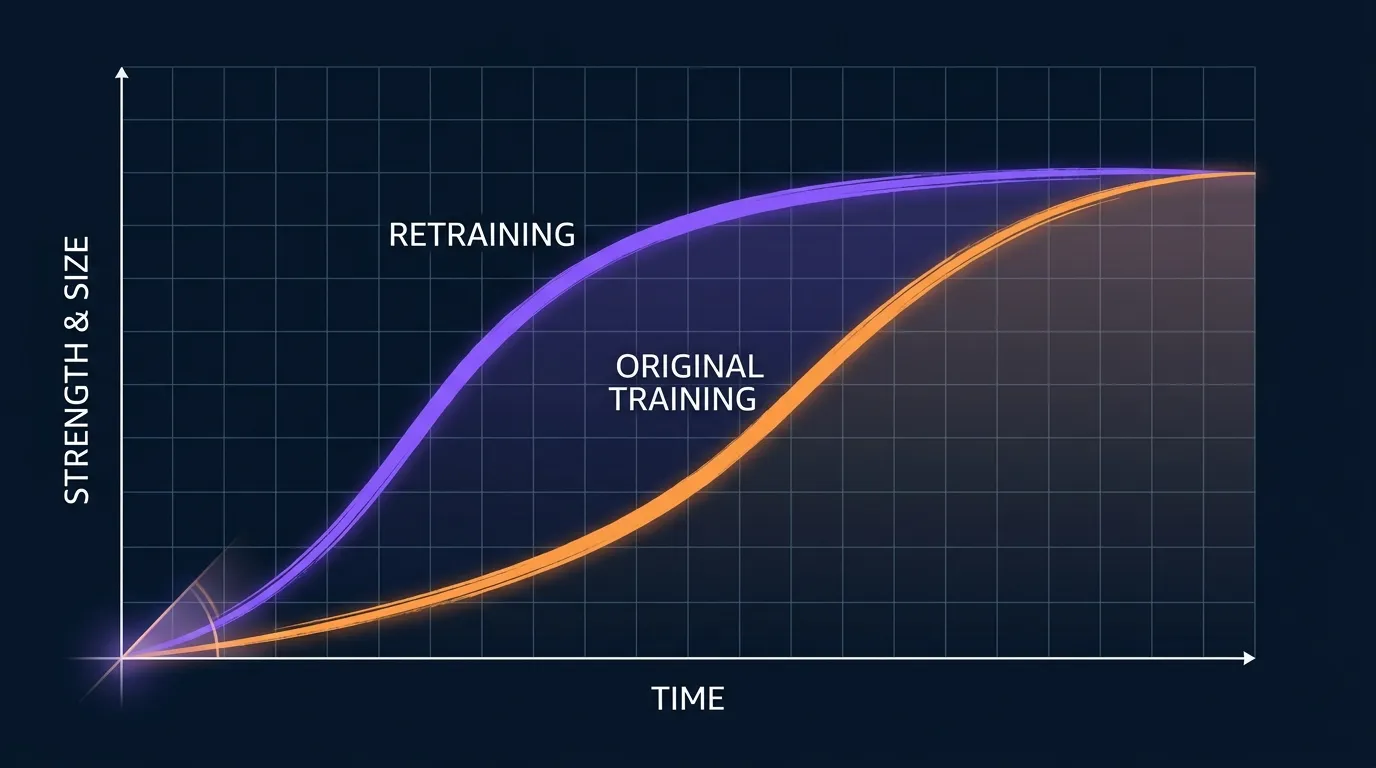
Psilander et al. (2019) in the Journal of Applied Physiology ran the same kind of cycle in younger adults: 10 weeks of unilateral training, 20 weeks of detraining, 5 weeks of bilateral retraining. The previously trained leg regained the size and strength it had originally taken 10 weeks to build, in just 5 weeks of retraining. Twice as fast.
Taaffe's elderly group needed only 8 weeks of retraining to recover everything they had lost during the 12-week break. Roughly two thirds of the original training time, in older bodies that we're often told are slow to adapt.
So if you trained seriously for a year, fell off for a year, and started again, you wouldn't need a year to get back. The literature is consistent on this. You'd need months. Not a fresh start.
Why Most People Restart at Zero Anyway
If muscle memory is this well-documented, why does almost every workout app, gym intake form, and YouTube program treat a returning lifter the same as someone who's never trained?
Three reasons.
It's safer for the program designer. If a returning lifter loads too aggressively and tweaks something, the program gets the blame. Putting everyone through "beginner phase 1" eliminates that risk and burns four weeks of your time as the toll.
It's a one-size-fits-all default. Building software (or templates) that asks about training history and ramps loads accordingly takes work. The ramp speed has to be calibrated. The decision tree gets messy. Most apps don't bother.
People underrate how much memory they have. If you stopped a year ago, you don't feel like a trained athlete. You feel like someone who can't do a pull-up. So you accept the beginner program. The cell biology says you have a head start you're not using.
Get a program built for where you're at
FitCraft's free assessment builds you a personalized multi-week program. Ty, the 3D AI coach, walks you through each session as a 3D character — demonstrating moves, motivating you by name, and adapting the load as you progress.
Take the Free Assessment Free • 2 minutes • No credit cardCommon Misconceptions About Muscle Memory
Misconception 1: "Muscle memory" means your brain remembers the movement.
Partly true. Neural memory is real and it does carry forward. But it's only one of the three mechanisms in play. Calling all of muscle memory "the brain remembering" misses the cellular story, which is where most of the rapid hypertrophy on retraining comes from. If muscle memory were purely neural, you'd see strength come back fast and size come back slow. The data shows both come back fast, which means something at the muscle-cell level is helping.
Misconception 2: Stop training and you lose everything in a few weeks.
Not what the data shows. In Taaffe and Marcus, even older adults retained roughly 70 percent of their strength gains through 12 weeks of complete detraining. Strength endurance and aerobic markers fade faster than maximal strength. Visible muscle size shrinks before strength does, because much of the size gain is from glycogen and fluid that drops fast when training stops. The structural and neural adaptations sit deeper.
Misconception 3: Myonuclei stay forever in humans, just like rodents.
This one needs care. The Bruusgaard rodent data is clear: in mice, myonuclei persist through severe atrophy. The 2022 systematic review and meta-analysis by Rahmati et al. in the Journal of Cachexia, Sarcopenia and Muscle looked at 147 papers and found that, while rodent myonuclei are robustly retained during atrophy, the human data is messier. Some human studies show myonuclear loss with disuse atrophy. Others, including Psilander 2019, find that the original training didn't add as many new myonuclei as previously assumed.
So the rodent-style "permanent myonuclei" claim is debated in humans. What's not debated: previously trained humans regain muscle faster than untrained humans. That functional muscle memory effect is real even if the underlying mechanism is partly different from the mouse story. Epigenetic memory and neural memory likely fill in the gap.
Misconception 4: Muscle memory only helps if you were really jacked.
You don't need to have been a competitive athlete. The studies that show retraining advantages used ordinary recreational subjects, including elderly men with no athletic background. If you trained consistently for several months in your past, you already laid down the substrate for muscle memory.
What This Means for Coming Back
Here's how the research translates to a smart restart, ranked by what the evidence actually supports.
- Don't start at "absolute beginner." If you trained seriously in the past, your tissues have a head start. Use a ramp that respects it. For most returners, that means starting with maybe 50 to 60 percent of your previous working loads, not the empty-bar progression a true novice gets.
- Plan to recover faster than you did initially. Most returners feel beat up the first two weeks because their connective tissue and central nervous system catch up at a slower pace than muscle. That doesn't mean stop. It means progress in slightly larger chunks once you're past week two, because your body is building on existing infrastructure.
- Expect strength to return before size. Neural patterns reactivate fast. Cellular hypertrophy takes longer. You'll feel strong before you look the part. That's the order the literature would predict, and it's not a sign your program is wrong.
- Accept that early discomfort is misleading. The first week back, ordinary movements feel hard. This is mostly because soreness gets amplified by long absence (the repeated bout effect runs in reverse). It's not evidence that you've lost everything. Two more sessions and the soreness drops sharply.
- Stay consistent past the four-week mark. Most muscle memory effects are visible by week 4 to 8. The people who quit during the awkward "I look like I haven't trained" weeks miss the part where the curve actually steepens. This is the moment where systems that gamify consistency, like FitCraft's, are most useful.
If you've been here before, you've also lived the failure version of this. You came back, felt slow, decided you'd lost it all, and quit. Knowing the cell biology can change how you read those first two weeks. They aren't the new floor. They're the bottom of a curve that climbs faster than you remember.
How FitCraft Helps You Restart Consistently
Knowing the cell biology is one thing. Showing up three times a week while soreness is loud and progress is invisible is the harder part. That's where the design of the app matters more than the muscle memory research itself.
FitCraft is built around two real features that fit a restart: a 3D AI coach (Ty) who walks you through each session as a 3D character, demonstrates moves, and motivates you by name; and multi-week programs that adapt as you progress, so the load rises only when you've earned it. The free assessment sets the starting point. The 3D demos kill the form-guessing problem. Calendar tracking and gamification (XP, levels, collectible cards) keep the consistency loop tight during the awkward first few weeks.
If you're worried that restarting means feeling like a beginner forever, that's the part the muscle memory research lets you skip — your body remembers, even when the scale and the mirror don't show it yet.
For more on the mental side of restarting, see our practical guide to getting back into working out after a layoff. And if you trained hard in earlier decades, the strength training after 60 review lays out how the same memory mechanisms still apply later in life. Both pair well with this article.
Honest Limitations of This Research
The story would be cleaner if it were tidier. It isn't. A few caveats worth knowing.
- Most myonuclei research is rodent. The cleanest evidence for permanent myonuclei comes from mouse models. Human work is harder to do (you can't biopsy people repeatedly with the same precision) and shows more variability. The human muscle memory effect is real, but the dominant mechanism may be more epigenetic and neural than nuclear (Rahmati et al., 2022).
- Detraining periods studied are usually short. Most human studies use 6 to 32 weeks of detraining. We have anecdotal case reports of muscle memory lasting decades, but high-quality data on multi-decade memory in humans is thin.
- Initial training quality matters. The studies use real, progressive training protocols. If your "previous training" was sporadic Pilates twice a month, the muscle memory head start will be smaller. Consistency in the original training set the size of the deposit you're now drawing on.
- Aging adds noise. Sarcopenia (age-related muscle loss) accelerates after 60 and may erode some of the substrate that muscle memory builds on. The Taaffe data is encouraging in older adults, but very long layoffs in older trainees are likely worse than equivalent layoffs in younger ones.
- Tendon and connective tissue have weaker memory. Even when muscle bounces back fast, tendons remodel slowly. This is part of why returners get tendinopathy more than they get muscle injuries: the tissue that needs the most ramping is the one without the strongest memory.
None of this changes the bottom line. Coming back is faster than starting over. Just don't confuse "faster" with "instant," and respect the connective tissues that don't keep records as well as your muscles do.
References
- Bruusgaard JC, Johansen IB, Egner IM, Rana ZA, Gundersen K. "Myonuclei acquired by overload exercise precede hypertrophy and are not lost on detraining." Proceedings of the National Academy of Sciences. 2010;107(34):15111-15116. doi:10.1073/pnas.0913935107
- Seaborne RA, Strauss J, Cocks M, et al. "Human Skeletal Muscle Possesses an Epigenetic Memory of Hypertrophy." Scientific Reports. 2018;8:1898. doi:10.1038/s41598-018-20287-3
- Psilander N, Eftestol E, Cumming KT, et al. "Effects of training, detraining, and retraining on strength, hypertrophy, and myonuclear number in human skeletal muscle." Journal of Applied Physiology. 2019;126(6):1636-1645. doi:10.1152/japplphysiol.00917.2018
- Rahmati M, McCarthy JJ, Malakoutinia F. "Myonuclear permanence in skeletal muscle memory: a systematic review and meta-analysis of human and animal studies." Journal of Cachexia, Sarcopenia and Muscle. 2022;13(5):2276-2297. doi:10.1002/jcsm.13043
- Taaffe DR, Marcus R. "Dynamic muscle strength alterations to detraining and retraining in elderly men." Clinical Physiology. 1997;17(3):311-324. doi:10.1111/j.1365-2281.1997.tb00010.x
Frequently Asked Questions
How long does muscle memory last?
Years, possibly decades. Animal studies (Bruusgaard et al., 2010) show retained myonuclei persist for at least 15 percent of the rodent lifespan, and human work (Seaborne et al., 2018) found resistance-training-induced changes to DNA methylation patterns persisted through 7 weeks of detraining and were enhanced on retraining. Case reports of previously trained adults regaining size and strength faster than novices have been documented after layoffs of 15+ years, though the mechanism in humans is more nuanced than the rodent myonuclei story alone.
How fast does strength come back after a long break?
Faster than the first time. In Taaffe and Marcus (1997), elderly men who detrained for 12 weeks lost only about 30 percent of their initial strength gains, and a brief 8 weeks of retraining returned them to peak training values. In Psilander et al. (2019), 5 weeks of retraining matched the gains of 10 weeks of original training in young adults. Most people recover 70 to 80 percent of previous strength within 8 to 12 weeks of restarting, even after a long layoff.
Do you really lose all your gains if you stop training?
No. Muscle size shrinks during detraining, but the underlying adaptations that make muscle grow do not fully reset. Retained myonuclei in animals, persistent epigenetic changes in humans, and neural pattern memory all give previously trained muscle a head start when training resumes. The visible "gains" may temporarily disappear, but the cellular and molecular machinery that built them is largely preserved.
What is muscle memory in scientific terms?
Muscle memory describes the ability of a previously trained muscle to regain size and strength faster than an untrained muscle. The term is often used loosely. In current research it refers to several distinct mechanisms: long-lived myonuclei from prior hypertrophy (well-documented in rodents, debated in humans), persistent epigenetic markers in muscle DNA, and neural adaptations that retain motor patterns. Together they explain why coming back is faster than starting fresh.
Does FitCraft account for muscle memory when you restart?
FitCraft's free assessment sets you up with a personalized program — a multi-week structured plan built around your goals, schedule, and equipment. Ty (FitCraft's 3D AI coach) walks you through each session, demonstrating moves and motivating you, and the program adapts as you progress.