If you trained hard for a few years and then stopped, you've probably seen it. The arms that used to fill a sleeve look softer, the waistband is tighter, and the scale has barely moved. It's easy to conclude that the muscle you built has turned into fat. Some people avoid lifting altogether for this reason, worried that if they ever stop, all that work will "go to fat."
The good news is that it can't. What really happens is two quieter changes that arrive together, and one of them, fat building up between muscle fibers, is real and shows up on scans. This page covers why the two tissues can't swap, what happens to your body when you stop working out, why the mirror makes it look like a conversion, what inactivity and ageing do inside the muscle itself, and how little training it takes to keep what you've built.
Why Muscle Can't Turn Into Fat
Muscle and fat are made of different cells with different jobs. A skeletal muscle fiber is one long cell with many nuclei, packed with proteins that slide past each other to shorten the fiber when a nerve fires. A fat cell, or adipocyte, is a small round cell that's mostly one droplet of stored fat, with its single nucleus pushed to the edge. One is an engine and the other is a fuel tank. A muscle fiber can get thicker or thinner, but there's no biological route by which it becomes a fat cell.
Fat cells also behave differently from what most people assume. Spalding and colleagues (2008) dated the DNA of human fat cells using carbon-14 left over from nuclear bomb tests. They found that the number of fat cells stays almost constant through adulthood, in lean and obese people alike, even after major weight loss. About 10 percent are replaced each year. So when an adult gains fat, the existing fat cells mostly fill up. New fat isn't arriving from your muscles.
The same logic sinks the opposite myth. Fat doesn't turn into muscle either, which we'll come back to further down.
Does Muscle Turn Into Fat When You Stop Working Out?
No. When you stop working out, two things change, and they run on separate tracks:
- Your muscles shrink. Training is the signal that tells your body a muscle is worth keeping. Take the signal away and, day by day, a little more muscle protein is broken down than is built. The fibers get thinner. They don't disappear, and they don't fill with fat.
- Fat builds up if your eating stays the same. Workouts burn energy, and so does the walking and moving that tends to come with an active routine. Stop both, keep eating as before, and the leftover energy goes into the fat cells you already have.
The clearest human test of this ran for just two weeks. Bowden Davies and colleagues (2018) took 45 habitually active adults, average age 36, and had them cut their daily steps by about 10,300, an 81 percent drop, which added close to four hours of sitting a day. After 14 days, their lower-limb lean mass had fallen, their total body fat and liver fat had risen, and their fitness and insulin sensitivity had dropped. Then they went back to their normal routine for 14 days, and most of those changes reversed. Muscle was lost and fat was gained at the same time, in the same people, and both responded as soon as they moved again.
The muscle you lose plays a smaller part in the calorie math than most people think. Resting skeletal muscle burns about 13 calories per kilogram per day, against about 4.5 for fat tissue, according to Wang and colleagues (2010). Lose 2 kilograms of muscle and your resting burn falls by about 26 calories a day. The bigger gap comes from the workouts and the daily movement you've dropped, and from an appetite that doesn't shrink to match. Our page on whether muscle burns fat runs those numbers in more detail.
How fast the muscle side moves depends on how complete the rest is. A cast is the extreme: Wall and colleagues (2014) measured a 3.5 percent drop in thigh muscle size after 5 days of knee immobilization and 8.4 percent after 14. People who simply skip the gym but stay on their feet lose far less, and much of the early softness is stored carbohydrate and water leaving the muscle. Our guide to how long it takes to lose muscle lays out the full timeline, from a missed week to a long layoff.
Why It Looks Like Your Muscle Turned to Fat
The myth survives because the mirror and the scale both point toward it. Here's what each one is really showing you:
- The mirror. Muscle sits under your layer of fat and gives your arms, shoulders and thighs their shape. When the muscle underneath gets a little smaller and the fat on top gets a little thicker, the outline softens, even at the same body weight.
- The scale. Lose 2 pounds of muscle, gain 2 pounds of fat, and the scale says nothing happened. A pound is a pound, but muscle is about 18 percent denser than fat, so the same weight of fat takes up more room. Our review of whether muscle weighs more than fat explains the density numbers.
- The flat look. Trained muscle holds extra stored carbohydrate and the water that comes with it. In the first weeks off, some of that leaves, so muscles look flatter well before much real tissue is gone.
- The habits. Former athletes and regular lifters often keep eating the portions that fueled hard training. The appetite built over years doesn't switch off in the week the training does.
Put those together and you get a body that weighs the same, looks softer and feels weaker. "My muscle turned to fat" is a natural way to describe that. It's just not what's happening in the tissue.
The Part of the Myth That's True: Fat Builds Up Inside Muscle
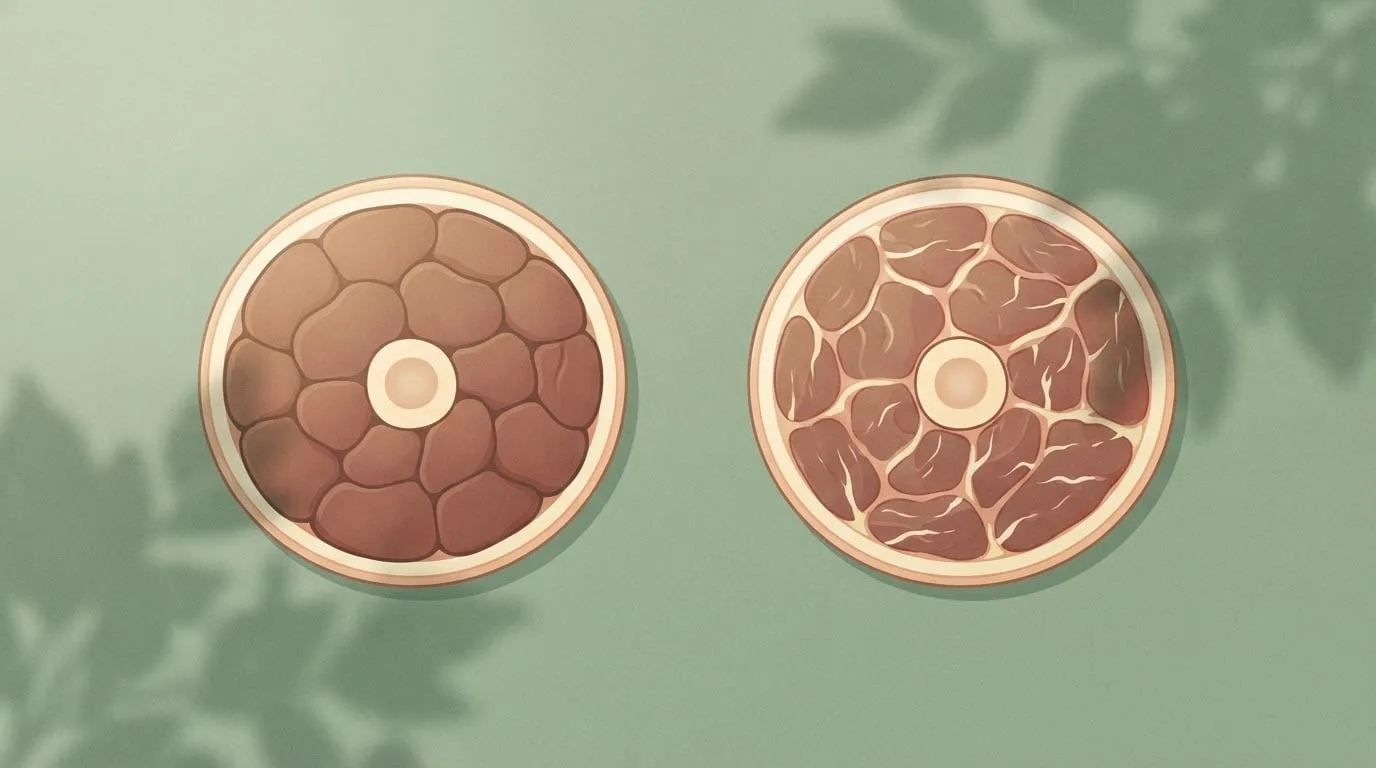
Fat doesn't only sit under your skin and around your organs. Some of it sits between your muscle bundles, called intermuscular fat, and some sits inside the fibers as tiny droplets that working muscle burns as fuel. When a lot of fat gathers in and around muscle, doctors call it myosteatosis. On a scan, it looks like marbling in a cut of meat.
Inactivity grows that marbling quickly. Manini and colleagues (2007) had 18 healthy adults aged 19 to 28 go four weeks without using one leg, getting around on crutches with a raised shoe on the other foot. MRI showed that thigh muscle volume fell 7.4 percent and calf muscle 7.9 percent. Fat between the muscles rose 14.5 percent in the thigh and 20 percent in the calf, while the fat under the skin didn't change. Thigh strength dropped 20.4 percent, and the people whose intermuscular fat rose most lost more strength than their muscle loss alone explained.
That fat still doesn't come from muscle fibers. Between the fibers live a separate group of cells called fibro-adipogenic progenitors, which help muscle repair after injury. In mice, Uezumi and colleagues (2010) tested the cell types they could isolate from muscle and found that only these cells turned efficiently into fat. Healthy muscle fibers strongly held that back. Joe and colleagues (2010) showed the same cells normally stay quiet and support repair, and lay down fat only when the muscle around them is unhealthy.
So the closest thing to "muscle turning into fat" is this: as a muscle is used less, its fibers shrink and neighboring cells store more fat in the gaps. Those are still two kinds of cells doing two different things, and training pushes both back the other way.
What Happens to Muscle and Fat as You Age
Ageing runs the same two tracks more slowly. The gradual loss of muscle mass and strength with age is called sarcopenia, and fat creeping into muscle tends to come with it. In the Health ABC study, Delmonico and colleagues (2009) scanned the thighs of 1,678 well-functioning adults with an average age of 73, five years apart. Men lost 16.1 percent of their leg strength and women 13.4 percent, a much bigger drop than the shrinkage in their muscle. Fat between the thigh muscles rose whether people gained weight, lost weight or stayed the same.
That last finding is why the bathroom scale is such a poor guide in later life. You can hold the same weight for years while the muscle shrinks and the marbling grows.
A one-year trial shows how much of this is in your hands. Goodpaster and colleagues (2008) randomly assigned 42 older adults with moderate functional limitations to a physical activity program or to health education classes. In the education group, fat in the thigh muscle rose 18.4 percent, and strength relative to muscle size fell 20.1 percent. In the activity group, muscle fat rose only 2.3 percent and strength held, up 2.5 percent. Both groups lost a little muscle area, so activity didn't stop every change of ageing. It did stop most of the fat creeping in and kept the muscle working.
Knowing what to do is the easy part.
FitCraft, our mobile fitness app, pairs you with an AI coach who builds you a personalized plan around your goals, schedule, and fitness level. Every FitCraft program is designed by Domenic Angelino, MPH (Brown University) and NSCA-CSCS, with research published in the Journal of Strength and Conditioning Research and Medicine & Science in Sports & Exercise.
Take the Free Assessment Free • 2 minutes • No credit cardWill Fat Turn to Muscle?
No, for the same reason. The fat you lose isn't converted into muscle. It's broken down for energy and leaves your body. Meerman and Brown (2014) worked through the chemistry in The BMJ: when 10 kilograms of fat is fully burned, 8.4 kilograms leaves as carbon dioxide that you breathe out, and 1.6 kilograms leaves as water. Muscle, meanwhile, is built from the protein you eat, in response to training that challenges it.
The two can happen in the same months, which is why someone who starts lifting can get leaner and stronger at once. That's the same two-track story running the other way: fat shrinks while muscle grows. Neither one turns into the other.
How to Keep Your Muscle With One or Two Sessions a Week
You don't need your full program to hold on to what you've built. Spiering and colleagues (2021) reviewed the studies on minimum doses. They concluded that younger adults can keep their strength and muscle size for up to 32 weeks with one strength session a week and one hard set per exercise, as long as the weights stay heavy relative to their strength. Older adults may need up to two sessions a week and two or three sets per exercise.
A large part of that conclusion rests on Bickel, Cross and Bamman (2011). After 16 weeks of training three days a week, young adults who dropped to one session a week kept their muscle size for the next 32 weeks. Adults aged 60 to 75 on the same reduced schedule didn't keep all of it, though their strength held up well. The lesson from both: cut the number of sessions and sets before you cut the effort.
A maintenance session at home can take 30 to 40 minutes with a pair of dumbbells:
- Goblet squat or split squat for the thighs and hips.
- Push-ups or a dumbbell floor press for the chest, shoulders and triceps.
- One-arm dumbbell row for the back and biceps.
- Dumbbell Romanian deadlift for the hamstrings and glutes.
- Plank or dead bug for the trunk.
Do one to three sets of each, with a weight that makes 6 to 15 reps hard, and stop each set with only one to three good reps left in you. If you're over 60, aim for two of these sessions a week. Then cover the fat side. Keep walking, because the Bowden Davies group gained fat after losing about 10,000 steps a day, not after skipping the gym. And eat for the week you're actually having: smaller portions when training drops, with a palm-sized serving of protein at each meal.
Can You Rebuild Muscle Loss? Yes, and Faster the Second Time
Muscle lost during a break usually comes back faster than it took to build. Ogasawara and colleagues (2013) had young men train the bench press for 24 weeks, either straight through or with two 3-week breaks. Both groups finished with the same muscle size and strength, because the group with breaks regained quickly each time they started again.
Part of that is the nervous system. Psilander and colleagues (2019) found that after 20 weeks off, muscle size had gone back to where it started, but strength stayed well above its starting point, a sign that the skill of lifting is retained. This is what people call muscle memory. Whether muscle cells keep their own memory is less settled. In mice, Bruusgaard and colleagues (2010) found that extra nuclei gained during training stayed through long disuse. In people, Seaborne and colleagues (2018) found lasting chemical marks on muscle DNA after a train, rest and retrain cycle, while the Psilander study didn't find the extra nuclei. Our review of muscle memory science goes through that debate.
What This Means for You
Your muscle won't turn into fat. The risk worth planning for is the long gap: the busy month off that quietly becomes six, while your eating stays where it was. Most of what people blame on muscle "turning" is really that gap, and both halves of it are fixable.
The fix is smaller than most people think. Keep one or two hard strength sessions in your week, even short ones, keep walking, and let your portions follow your activity. If you've already had a long break, start again at lighter weights and expect your muscle to come back faster than it did the first time. Watch the tape measure and the weights you lift rather than the scale, since the scale can't see muscle and fat trading places.
If staying consistent is the part that keeps slipping, our comparison of the best fitness apps for staying consistent looks at what actually keeps people training. FitCraft is one of them: its dumbbell and bodyweight programs are led by a 3D AI coach who demonstrates each exercise and says your name during the workout, with streaks and leaderboards that make a skipped week feel like it costs something. As one user, Katie, put it: "I've tried everything. This is the first time I've stuck with something past two weeks."
Frequently Asked Questions
How does muscle turn into fat?
It doesn't. Muscle fibers and fat cells are different cells, and neither can change into the other. What people see is two changes at once: muscle fibers shrink when they're used less, and existing fat cells fill up when you eat more energy than you now burn. Because both happen in the same weeks, it looks like a swap.
Does muscle turn into fat when you stop working out?
No. When you stop working out, your muscles slowly get smaller, and if you keep eating the way you did while training, you store the spare energy as fat. In a 2018 study, active adults who cut their daily steps by 81 percent for 14 days lost leg lean mass and gained body fat at the same time, and most of it reversed within two weeks of normal activity.
Will fat turn to muscle?
No. Fat you lose is burned for energy, and about 84 percent of it leaves your body as carbon dioxide through your lungs, with the rest as water. Muscle is built from the protein you eat when training challenges it. The two can change at the same time, so a new lifter can get leaner and stronger in the same months.
What is muscle loss?
Muscle loss, or muscle atrophy, is a shrinking of muscle fibers when they're used less, during illness or bed rest, or with age. The fibers get thinner and weaker rather than disappearing. The slow loss of muscle mass and strength with ageing is called sarcopenia.
Can you rebuild muscle loss?
Yes. Muscle lost to a break or a period of inactivity usually comes back faster than it took to build. In one trial, men who took two 3-week breaks during 24 weeks of training finished with the same muscle size and strength as men who trained straight through. Older adults rebuild more slowly but still respond to strength training.
What deteriorates your muscles?
Disuse does the most damage: bed rest, a cast or brace, illness and long stretches of sitting. Ageing adds a slow loss of muscle and strength plus more fat between the fibers. Low protein intake and a large calorie deficit without strength training speed it up. Regular strength training slows or reverses most of these.
Does muscle weigh more than fat?
A pound of muscle and a pound of fat weigh the same. Muscle is about 18 percent denser, so it takes up less space at the same weight. That's why someone can lose muscle and gain fat without the scale moving, while their clothes fit differently.
What are the signs of losing muscle mass?
Common signs are weights or daily tasks feeling heavier, arms and thighs looking smaller or softer, clothes fitting looser on the limbs but tighter at the waist, and finding it harder to climb stairs or stand up from a chair. Loss of muscle or weight that you can't explain is worth raising with a doctor.