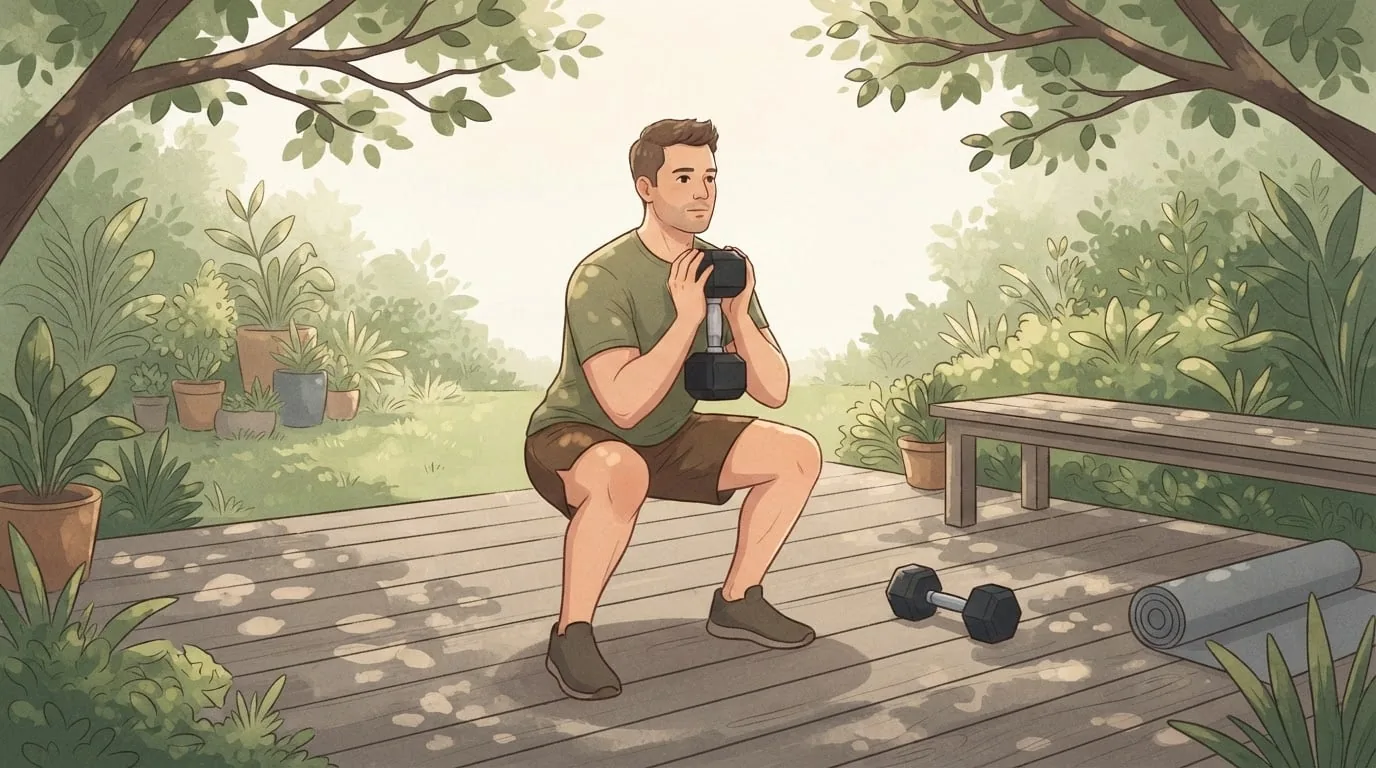
Most people learn the same story about muscle: lifting tears the fibers, and they heal back bigger. It's a neat story, and the research doesn't back it up. Muscle growth, which scientists call hypertrophy, runs on a quieter signal. Once you know what that signal is, working out how to build muscle at home gets much simpler.
It also explains a frustrating stretch that almost everyone hits. You train hard for a few weeks, the mirror doesn't change, and you start to wonder whether your body just doesn't respond. It almost certainly does. The first steps of growth happen inside each fiber, over days and weeks, long before you can see them.
This page follows a muscle from the set that challenges it to the fiber that grows, with the studies behind each step. Then it turns those steps into a plan for dumbbell and bodyweight training.
What Stimulates Muscle Growth the Most?
Mechanical tension stimulates muscle growth the most. Tension is the pulling force inside a fiber while it works against a load. As a set gets hard, your nervous system recruits more and larger motor units to keep the weight moving, so more fibers end up working under high tension. In a 2019 review of what starts hypertrophy, Wackerhage and colleagues named mechanical signals as the leading stimulus, picked up by force-sensing structures in the fiber that turn tension into chemical signals. They judged muscle damage probably not essential. The case for metabolic stress, the burn of a high-rep set, rests on indirect evidence.
Heavy or light weights?
How heavy the weight is matters far less than how hard the set is. Schoenfeld and colleagues (2017) pooled 21 studies that compared loads of 60 percent of one-rep max or less with heavier loads, with every set taken to momentary failure. Muscle size grew by similar amounts, while the heavy loads built more maximal strength. Morton and colleagues (2016) ran the same test in 49 men with about four years of lifting behind them. Over 12 weeks, sets of 20 to 25 reps at 30 to 50 percent of max added as much lean mass and fiber size as sets of 8 to 12 reps at 75 to 90 percent.
Do you have to train to failure?
You need to get close to failure, but you don't have to reach it on every set. Refalo and colleagues (2023) pooled 15 studies and found only a trivial edge for sets taken to failure over sets stopped short of it. Ending most sets with a rep or two left builds nearly the same muscle and leaves you fresher for the next session.
Does bodyweight count as a load?
Yes. Your body is a weight like any other. In a trial by Kikuchi and Nakazato (2017), young men did push-ups, adjusted with kneeling and other positions to about 40 percent of their bench press max, twice a week for eight weeks. Their chest and triceps grew about as much as those of a group that bench pressed the same relative load.
How Does Muscle Grow After a Workout?
Very little growth happens during the workout itself. The tight, swollen look of a pump comes from extra fluid in the working muscle, and it fades within a few hours. The building happens afterward, in roughly this order.
- In the first hours, a growth switch turns on. The tension of a hard set activates a protein complex called mTORC1, which tells the fiber to start building. When Drummond and colleagues (2009) gave volunteers rapamycin, a drug that blocks mTORC1, before a hard leg workout, the usual rise of about 40 percent in muscle protein synthesis over the next two hours didn't happen.
- For up to two days, building stays switched on. In untrained adults studied by Phillips and colleagues (1997), muscle protein synthesis more than doubled within 3 hours of eight sets of eight reps, and it was still about a third above normal two days later.
- Food decides whether the balance tips into growth. Breakdown speeds up after training too. The volunteers in the Phillips study were fasted, and although their protein balance improved, it stayed below zero, so they were still losing muscle protein, only more slowly. When Biolo and colleagues (1997) infused amino acids after a leg workout, synthesis rose 291 percent, against 141 percent for the same infusion at rest, with no change in breakdown.
- Over weeks, the fibers thicken. Each of those windows adds a little protein to the myofibrils, the contractile strands packed inside every fiber, and the fiber's cross-section slowly widens. Dozens of windows later, the whole muscle is measurably bigger.
So training makes muscle more responsive to protein, and protein supplies what the new tissue is built from. That's also why a rest day isn't wasted. The day after a hard session is when much of the building happens.
Do Muscles Grow New Cells? What Satellite Cells Do
Muscles grow almost entirely by making the fibers you already have bigger. Attwaters and Hughes (2022) describe three ways skeletal muscle can grow: forming new fibers, adding nuclei from muscle stem cells to existing fibers, and expanding the fiber around each nucleus. Their review finds evidence for the last two in growth from exercise. New fibers don't seem to be part of the answer in adults. MacDougall and colleagues (1984) estimated fiber numbers in the biceps of elite bodybuilders, less advanced bodybuilders and untrained men, and all three groups had about the same count. The bodybuilders' arms were bigger because each fiber was bigger.
That's where satellite cells come in. A muscle fiber is one very long cell with many nuclei, and each nucleus can only manage so much of the fiber around it. Satellite cells are stem cells that sit on the fiber's surface. When a fiber grows a lot, they fuse with it and donate new nuclei. Petrella and colleagues (2008) sorted 66 adults by how much their thigh fibers grew over 16 weeks of training:
- The 17 biggest responders grew their fibers by 58 percent and added 26 percent more nuclei per fiber.
- The 32 moderate responders grew 28 percent and added 9 percent more nuclei.
- The 17 people whose fibers didn't grow showed no significant gain in nuclei.
The biggest responders also started with more satellite cells, and their pool more than doubled with training. That's one reason two people on the same program can grow at very different speeds.
Do Muscles Grow From Microtears?
No. The microtear idea comes from the soreness and muscle damage that unfamiliar training causes, but that damage is a side effect of new or harder work rather than the cause of growth. Trials that eased people into a program without any soreness found the same growth, and early protein synthesis only tracked growth once the damage had faded. Our article on whether soreness means muscle growth walks through those studies and what soreness really measures. For your training, it means a session doesn't have to leave you sore to work, and soreness bad enough to hurt your next workout costs more than it gives.
Knowing what to do is the easy part.
FitCraft, our mobile fitness app, pairs you with an AI coach who builds you a personalized plan around your goals, schedule, and fitness level. Every FitCraft program is designed by Domenic Angelino, MPH (Brown University) and NSCA-CSCS, with research published in the Journal of Strength and Conditioning Research and Medicine & Science in Sports & Exercise.
Take the Free Assessment Free • 2 minutes • No credit cardDo Hormones Make Muscles Grow?
The short rise in testosterone and growth hormone after a workout doesn't decide how much muscle you build. In a 15-week trial by West and colleagues (2010), young men's arms grew just as much when trained on their own, with no hormone rise, as when trained right before a hard leg session that sent testosterone, growth hormone and IGF-1 up.
In their trial of 49 trained men, Morton and colleagues (2016) compared each man's post-workout hormone rise with his 12-week gains and found no relationship. A follow-up analysis by Morton and colleagues (2018) found one hormone-related factor that did track growth: how much androgen receptor the muscle contained. The androgen receptor is the docking site that testosterone acts through inside the fiber. Blood levels of testosterone, growth hormone and IGF-1, measured before or after training, didn't predict who grew most.
Hormones still matter far outside the normal range. In a trial by Bhasin and colleagues (1996), men given testosterone at doses well above what the body makes, who also lifted, gained 6.1 kg of fat-free mass in 10 weeks, and even the men who took it without training gained muscle. That's a drug effect with health risks of its own, and it tells you nothing about the brief rise after a workout. If you think your levels may be low, ask your doctor about testing. For what training does to resting testosterone, see our research review on how to boost testosterone naturally.
At What Age Is It Hard to Grow Muscle?
Building muscle gets gradually harder with age, and there's no cutoff where it stops. Each workout and each meal does less for older muscle, a change researchers call anabolic resistance. Kumar and colleagues (2009) had 25 young men averaging 24 and 25 older men averaging 70 do leg exercise at 20 to 90 percent of their max. In both groups, protein synthesis rose with effort and leveled off at about 60 to 90 percent of max. The older men's response was smaller, and so were the signals behind it.
Protein works the same way. In a pooled analysis by Moore and colleagues (2015), men around 22 reached their full building response with about 0.24 grams of protein per kilogram of body weight in one meal, while men around 71 needed about 0.40 grams. For a 75 kg person, that's roughly 18 grams against 30.
Older muscle still grows. It just needs a little more of everything: hard sets, protein at each meal, and patience.
What Kills Muscle Gains the Most?
Not using a muscle kills gains fastest. The other culprits slow growth, but disuse reverses it. When Wall and colleagues (2014) put young men's legs in a cast, quadriceps size fell 3.5 percent in 5 days and 8.4 percent in 14 days, and strength fell 9 and 23 percent. A cast is the extreme case, but a long layoff pushes in the same direction. These are the other common culprits:
- Eating too little. Training in a calorie deficit blunts lean mass gains even while strength keeps climbing, as our research review on how long it takes to build muscle explains.
- Short sleep. In a crossover trial by Lamon and colleagues (2021), one night without sleep cut muscle protein synthesis the next afternoon by 18 percent, raised cortisol by 21 percent and lowered testosterone by 24 percent.
- Heavy drinking. When Parr and colleagues (2014) had active men drink about 12 standard drinks after a hard workout, muscle protein synthesis came out 24 percent lower than with protein alone, even though they had protein too. It was 37 percent lower when the alcohol came with carbohydrate instead.
- Stopping and starting. Each workout only switches building on for a day or two, so a week with no training adds nothing. Steady, ordinary weeks add up to more muscle than a few heroic ones.
How Exactly Do You Build Muscle With Dumbbells and Bodyweight?
Every step above points to the same short list. Here's how it works when your equipment is a pair of dumbbells and the floor.
- Take each working set close to failure. Stop when you have one to three good reps left. With light dumbbells that might take 20 or 30 reps, and that's fine, because the load studies found similar growth across a wide range of reps when the sets were hard.
- Train each muscle at least twice a week. Building stays switched on for a day or two after a session, and a meta-analysis of 10 studies by Schoenfeld, Ogborn and Krieger (2016) found that training a muscle twice a week grew it more than once a week with the same total work. Three full-body sessions a week covers this.
- Add sets before you add exercises. More hard sets per muscle each week build more muscle, up to a point, and the research review linked above covers the dose.
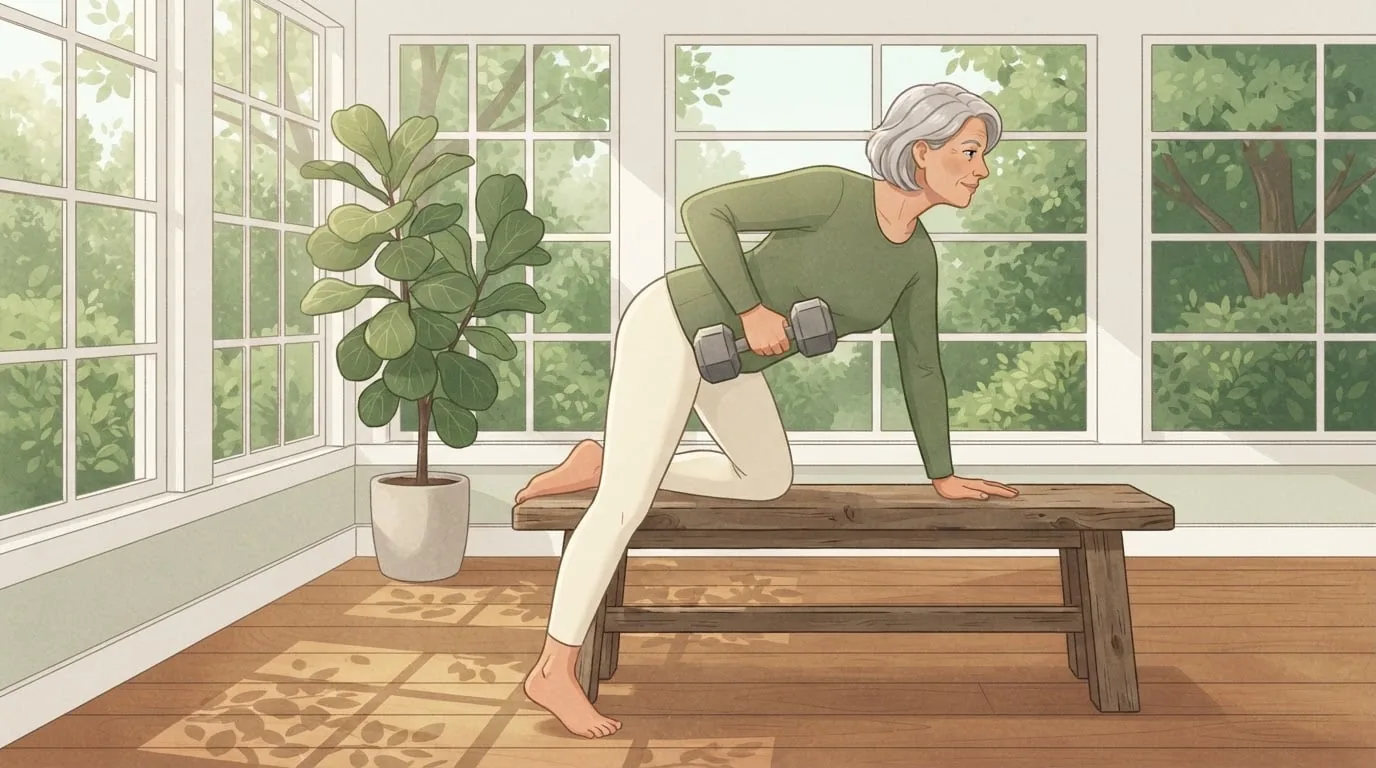
- Make the work harder over time. Tension only keeps working if the sets stay hard as you get stronger. With dumbbells, add reps until you reach the top of your range, then move up a weight. With bodyweight, slow the lowering to three seconds, pause at the bottom, add range of motion, or shift the load to one side: a split squat instead of a squat, an archer push-up instead of a push-up.
- Eat protein at every meal, and enough food overall. Protein is the raw material, and a steep calorie deficit leaves little to build with.
- Protect your sleep. A single night without it measurably lowers protein synthesis the next day.
If you'd rather not plan the sets and progressions yourself, a dumbbell workout app can do it for you. FitCraft's strength workouts use dumbbells and bodyweight, a 3D AI coach demonstrates every exercise, and the workouts adjust as you progress, with streaks that keep count of the days you show up.
What Are the Signs of Muscle Growth?
Strength is usually the first sign, partly because your nervous system gets better at each movement. Within a few weeks you'll get more reps with the same dumbbells. Signs of new muscle tissue come later and change slowly:
- Your tape measurements go up at the same spot, measured the same way.
- Sleeves and trouser legs fit more snugly while your waistband doesn't.
- Your weight holds steady or creeps up while your waist stays the same.
- A muscle looks fuller on a rest day, not just right after a workout.
Soreness and the pump right after a session aren't signs of growth, so don't judge a workout by either one. For realistic numbers and a way to measure a month of progress, see our article on how much muscle you can gain in a month.
What This Means for You
The way muscle grows is less dramatic than the myths, and that's good news. You don't need to tear anything, chase soreness, or time your workouts around a hormone spike. You need hard sets for each muscle a couple of times a week, a little more weight or reps as you get stronger, and enough food and sleep to let the building happen.
What it takes most is repetition. Each workout switches on a day or two of building, and the muscle you see in six months is the sum of dozens of those windows. That's why the people who end up with visible muscle are rarely the ones who had the most intense first month. They're the ones still training in month six. Picture yourself there, doing twice as many reps with the dumbbells that felt heavy in week one, with shirts that fit a little tighter across the shoulders, and no longer wondering whether your body responds.
Frequently Asked Questions
Do muscles grow naturally?
Yes. Muscles grow naturally when you regularly challenge them with resistance and eat enough protein, and you don't need drugs or supplements for it. The untrained adults in the training studies on this page grew muscle from exercise alone. Growth is slow, though: the first weeks mostly bring strength, and new muscle tissue builds up over months.
Do muscles grow on rest days?
Yes, much of the building happens between workouts. In untrained adults, muscle protein synthesis was still about a third above normal 48 hours after a hard session (Phillips and colleagues, 1997), so the day after training is a building day as long as you eat enough protein. A rest day, or a day spent training different muscles, doesn't stall your progress.
Do muscles grow during a workout?
No. The bigger, tighter look during and right after a workout is the pump, which comes from extra fluid in the working muscle and fades within a few hours. Actual growth happens over the following days and weeks, as new protein is added to each muscle fiber.
Can you build muscle with just bodyweight exercises?
Yes, as long as the exercises stay hard enough to bring each set close to failure. In an eight-week trial by Kikuchi and Nakazato (2017), push-ups adjusted to about 40 percent of each man's bench press max grew the chest and triceps about as much as bench pressing the same relative load. As you get stronger, keep the sets hard with slower lowering, pauses, more range of motion or one-sided moves like split squats.
Do skinny or muscular people live longer?
Among older adults, people with more muscle tend to live longer. In 3,659 older adults from a US national health survey, those in the top quarter for muscle mass relative to height had about a 20 percent lower risk of death during follow-up to 2004 than those in the bottom quarter, after adjusting for belly fat and other factors (Srikanthan and Karlamangla, 2014). The study shows an association, so it can't prove that adding muscle extends life.