The honest answer to how long it takes to build muscle is that it depends what you mean by "build" and what you mean by "muscle." If you mean the number on the bar going up, that starts in week one. If you mean your arm measuring bigger, that is a two to three month project at minimum. If you mean the change other people notice without being told, that is usually six months to a year of consistent work.
Those are not three versions of the same answer. They're three different physiological processes running on three different schedules, and confusing them is the single biggest source of frustration in early training. You get stronger fast, which feels like progress. You don't get bigger fast, which feels like failure. Both things are happening exactly on time.
What makes this topic unusually well documented is that researchers have repeatedly taken muscle biopsies and MRI scans on a weekly schedule during training programs, so we do not have to guess. Below is what those measurements show, how fast a beginner can expect to grow, why the first few weeks of data are misleading, and the four reasons progress actually stalls. If you want the broader picture of how a body composition change fits alongside cardio and endurance work, our how long it takes to get in shape breakdown puts all three timelines side by side.
The Research: What Studies Show
Damas 2016: The First Three Weeks Are Mostly Damage
The most important modern study on this question is Damas and colleagues (2016) in The Journal of Physiology. The team took muscle biopsies from untrained men at three points in a 10-week resistance training program: after the first session, after the third week, and after the tenth week. They measured integrated myofibrillar protein synthesis over multi-day windows using deuterated water, and they measured muscle damage directly through Z-band streaming.
The pattern was clean and slightly uncomfortable. The protein-synthesis response was highest after the very first bout. Muscle damage was also highest then. And the two together predicted nothing about how much muscle those participants eventually built. By week 3 the damage response had dropped sharply, the protein-synthesis response had settled to a lower level, and that lower response did correlate with 10-week hypertrophy.
The interpretation the authors drew has reshaped how the field talks about early training: the enormous anabolic signal you generate in your first week is largely a repair signal, not a building signal. Real hypertrophy is the accumulation of many smaller, later responses, once your muscle stops spending its budget on damage control. That is why the timeline has a lag built into it that no amount of effort removes.
DeFreitas 2011: Why Early Scans Overstate Your Progress
DeFreitas, Beck, Stock, Dillon and Kasishke (2011) in the European Journal of Applied Physiology did something almost nobody had done: they scanned the thigh every single week of an 8-week high-intensity program in 25 sedentary men. After only two training sessions, mean thigh cross-sectional area had already increased by 5.0 square centimetres, about 3.46 percent.
Taken at face value that suggests muscle grows almost immediately. The follow-up literature does not take it at face value. A series of exchanges in the same journal, and Damas's biopsy work above, argued that a large fraction of that very early increase is edema: fluid accumulation from the damage response, not contractile protein. The muscle is genuinely bigger on the scan. It isn't yet bigger in the way you want it to be.
This matters practically because it's the mechanism behind the week-two mirror effect. New lifters often look and feel noticeably fuller in the first fortnight, then feel like they plateau in week four when the swelling normalizes and the real, slower curve takes over. Nothing went wrong in week four. Week two was borrowing against the future.
Ahtiainen 2003: Newbie Gains, Measured Head to Head
The cleanest quantification of newbie gains comes from Ahtiainen, Pakarinen, Alen, Kraemer and Hakkinen (2003) in the European Journal of Applied Physiology. They ran eight experienced male strength athletes and eight non-strength-trained men through the same 21-week strength training program, with quadriceps cross-sectional area measured by MRI at weeks 0 and 21.
- Previously untrained men: 20.9 percent increase in maximal force, 5.6 percent increase in quadriceps cross-sectional area.
- Experienced strength athletes: 3.9 percent increase in maximal force, and a 1.8 percent decrease in cross-sectional area.
Five months of hard, supervised training moved the trained athletes almost not at all. The same five months moved the beginners substantially. That is the whole newbie-gains phenomenon in one table, and it's why timeline questions have no single answer. Your starting distance from your own ceiling sets your rate.
It also sets a realistic expectation for a first year. If 21 weeks of good training produces around 5 to 6 percent quadriceps growth in a beginner, a full first year of consistent work landing somewhere in the 5 to 10 percent range per trained muscle group is a sane target. That is a real, visible change on a lean person. It is not a physique transformation, and anything promising one in twelve weeks is selling something.
Hubal 2005: The Range Nobody Warns You About
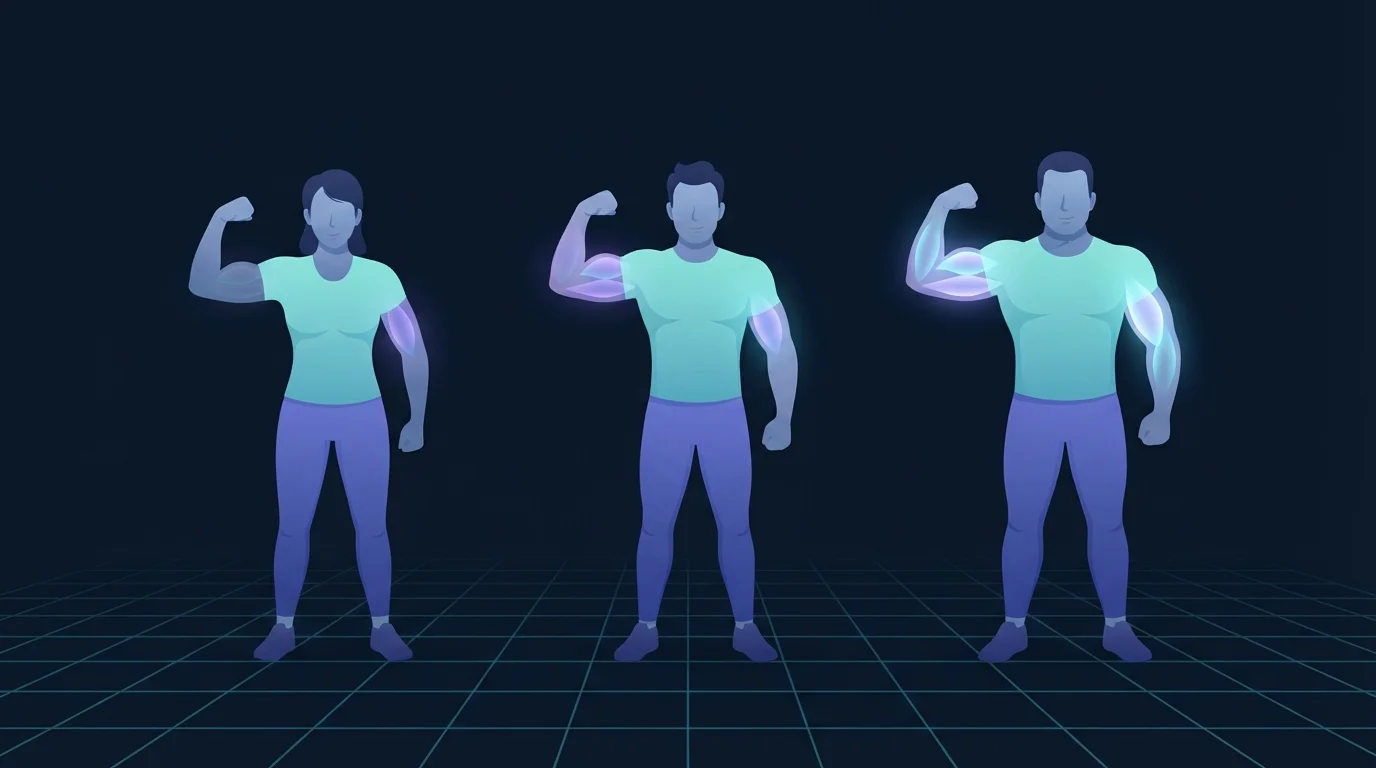
The largest single dataset on individual response is Hubal and colleagues (2005) in Medicine and Science in Sports and Exercise. Across eight study centres, 585 adults (342 women, 243 men) completed 12 weeks of progressive unilateral elbow-flexor training, with MRI of the biceps and both isometric and 1RM strength testing before and after.
Biceps cross-sectional area changes ranged from minus 2 percent to plus 59 percent. One-rep-max strength changes ranged from 0 to plus 250 percent. Men gained about 2.5 percent more cross-sectional area on average, while women posted larger relative strength gains. Every one of those people did the same program for the same duration.
The honest reading is that any single number for "how long it takes" describes an average that a large minority of people won't match in either direction. That is not a reason to skip the timeline. It's a reason to measure yourself against your own week-zero numbers rather than against a stranger's progress photo.
A Realistic Timeline, Week by Week
Putting the studies together produces a schedule that is boring and accurate. The table below assumes an untrained adult training the same muscle groups two to four times a week with progressive load, eating adequately, and sleeping something like normally.
| Window | What is actually changing | What you will notice |
|---|---|---|
| Weeks 1 to 2 | Neural adaptation plus damage-related swelling. Protein synthesis spikes but is spent on repair (Damas 2016). | Soreness, a temporary fuller look, and lifts climbing fast. Not muscle yet. |
| Weeks 3 to 6 | Damage response settles. Protein synthesis drops to a level that now correlates with growth. Motor unit recruitment and coordination improve sharply. | Strength keeps rising quickly. Size looks flat, which is the stage most people quit at. |
| Weeks 8 to 12 | Accumulated myofibrillar protein begins to show as true cross-sectional area. This is where most trials first detect reliable hypertrophy. | Measurable change in tape measurements and fit of clothing. First honest checkpoint for the program. |
| Months 4 to 6 | Growth continues at a similar or slightly slower rate. In Ahtiainen 2003, 21 weeks produced 5.6 percent quadriceps growth in beginners. | Change other people notice without prompting, especially at lower body fat. |
| Months 6 to 12 | Newbie gains taper as the gap to your ceiling narrows. Volume and progression now have to be deliberate rather than automatic. | Roughly 5 to 10 percent growth per trained muscle group over the year, with slowing month-to-month increments. |
One nuance worth keeping: strength and size don't have to move together. Strength in the first two months is dominated by learning the movement, recruiting more motor units and reducing protective inhibition. You can double a lift without adding meaningful tissue, which is exactly what the women in Hubal 2005 demonstrated. Our review of how light weights build muscle covers the load side of the same question: the amount of tissue you build depends far more on effort and total sets than on the number on the plate.
How Long Does It Take to Gain Muscle if You Have Trained Before
Returning trainees run a different clock, and a much kinder one. Previously trained muscle regains size and strength faster than untrained muscle ever built it, which is why a six-month layoff does not cost you six months of rebuilding. The leading explanation is that myonuclei acquired during your first training phase are retained through detraining, leaving the fibre with more machinery to reactivate than a true beginner has to build from scratch. We cover the cell biology and the human evidence in the muscle memory research review.
Practically, most people returning from a layoff recover the bulk of their previous size within 6 to 12 weeks. The fast lane ends where your previous best ended. Building past that ceiling puts you back on the slow timeline, which is a useful thing to know before you assume the comeback rate is your new normal rate.
Get an evidence-based plan built for you
FitCraft, our mobile fitness app, pairs you with an AI coach who builds you a personalized plan around your goals, schedule, and fitness level. Every FitCraft program is designed by Domenic Angelino, MPH (Brown University) and NSCA-CSCS, with research published in the Journal of Strength and Conditioning Research and Medicine & Science in Sports & Exercise.
Take the Free Assessment Free • 2 minutes • No credit cardWhy Am I Not Building Muscle?
When someone has trained for six months and genuinely has nothing to show for it, the cause is almost never mysterious. Four explanations cover the overwhelming majority of cases, and three of them are measurable this week.
Your weekly volume is below the dose
Schoenfeld, Ogborn and Krieger (2017) in the Journal of Sports Sciences pooled 15 studies covering 34 treatment groups and found a graded dose-response between weekly sets per muscle group and hypertrophy. Each additional weekly set was worth an effect-size increase of 0.023, which the authors translated to roughly 0.37 percent more growth per set. Comparing higher-volume to lower-volume arms within studies produced a 3.9 percent difference in gain.
That arithmetic is unforgiving for a lot of real programs. Three sets of chest work once a week is 3 weekly sets. Ten weekly sets is a different dose entirely, and the research says the difference is real rather than a rounding error. If your training log shows a muscle group getting fewer than about 6 hard sets a week, the timeline is not the problem. The dose is. How you spread those sets matters less than hitting the total, which is the core finding in our training frequency research review.
You are eating below your protein plateau
Morton and colleagues (2018) in the British Journal of Sports Medicine pooled 49 studies and 1,863 participants on protein supplementation during resistance training. Protein intake improved fat-free mass gains up to a plateau at roughly 1.6 grams per kilogram of body weight per day, above which the meta-regression found no additional benefit. For a 75 kilogram adult that is about 120 grams a day.
The word "plateau" cuts both ways. Going far above 1.6 g/kg is not buying you anything the pooled data can detect. Sitting well below it is a genuine brake on the timeline, and it's the most common nutritional reason a well-designed program underdelivers.
You are training in an energy deficit
Murphy and Koehler (2022) in the Scandinavian Journal of Medicine and Science in Sports ran a meta-analysis and meta-regression on resistance training performed with and without an energy deficit. Lean mass gains were significantly impaired in the deficit condition (effect size minus 0.57, p = 0.02). Strength gains were not (effect size minus 0.31, p = 0.28).
That dissociation explains a very common experience. People cutting aggressively often report that their lifts keep climbing while the mirror does not change, and conclude the program is broken. It is not. They're getting the neural and strength adaptations on schedule and paying for the deficit in tissue. If gaining size is the current priority, the deficit has to go. If losing fat is the current priority, the realistic goal is preserving what you have, which is the subject of our guide on losing fat without losing muscle, and of the body recomposition research for the narrow set of people who can do both at once.
Not enough weeks have actually passed
The last cause is the least satisfying. Six weeks feels long while you're living it and is genuinely too short to judge a hypertrophy program. So is eight. The trials that reliably detect growth run 10 to 12 weeks minimum, and the individual variance in Hubal 2005 means some people will need longer than that to clear the measurement noise. Sleep belongs in this bucket too: chronic short sleep suppresses the anabolic environment your program depends on, which we cover in the sleep and muscle growth review.
If you want the volume, progression and recovery decisions handled for you rather than reverse-engineered from meta-analyses, a structured plan is the shortcut. Our personalized training program page walks through what that looks like when the weekly sets, the progression and the schedule are built around your starting point instead of a generic template.
Common Misconceptions
Misconception: "You should see results in two weeks"
You will see something in two weeks. It will be neural strength gains and damage-related swelling, both real and both temporary. Damas 2016 established that the week-one anabolic response does not predict the eventual growth, and the DeFreitas 2011 exchange established that early cross-sectional area measurements are partly fluid. Two weeks is a habit checkpoint. It is not a hypertrophy checkpoint.
Misconception: "Newbie gains last exactly one year"
There is no cliff edge at twelve months. What the Ahtiainen 2003 comparison shows is a continuum: the further you are from your own ceiling, the faster you adapt. Someone who trained casually for two years is still closer to beginner physiology than someone who trained hard for two years. Newbie gains fade as a curve, not as an expiry date, and how long yours last depends on how much of your adaptive reserve you have actually spent.
Misconception: "If the scale is moving up, muscle is coming"
Scale weight in a surplus is a blend of muscle, fat, glycogen and the water bound to it. Glycogen alone can shift body mass by a kilogram or more within days of a carbohydrate or training change. None of the studies above used scale weight as the hypertrophy outcome, because it's not one. Tape measurements at fixed landmarks, progress photos at fixed lighting, and strength at fixed rep ranges are all better proxies over a 12-week window.
Misconception: "Slow progress means you need a completely new program"
Program hopping resets the clock on the very adaptations you're waiting for. Because the reliable detection window is 10 to 12 weeks, switching plans at week six guarantees you will never see a program through to the point where its results become measurable. The dose-response evidence says the highest-value changes are usually adding weekly sets and adding load over time, not replacing the exercise selection.
What the Research Suggests Going Forward
The strongest claim this literature supports is narrow and useful: reliable, measurable hypertrophy takes about 8 to 12 weeks, and the data collected before that window systematically overstates what has been built. The second-strongest claim is that the rate is set primarily by your training status, and secondarily by weekly volume, protein intake and energy availability.
Where the evidence is thinner: almost all of the tightly controlled time-course work uses untrained young men and measures the quadriceps or the elbow flexors, because those are the muscles that scan cleanly. Time-course data in women, in older adults and in trained lifters is much sparser. The response-variance work tells us the spread is enormous but not yet why, and the genetic and molecular predictors that might explain it are still an active research area rather than something you can act on.
What that means for a reader with a training log and twelve weeks to spend: pick a program, make sure each muscle group gets a real weekly set count, eat enough protein to clear the plateau, avoid running a hard deficit while you are trying to grow, and do not evaluate the outcome until you have three months of honest data. That is a less exciting answer than most timelines offer. It is the one the biopsies support.

References
- Damas F, Phillips SM, Libardi CA, et al. "Resistance training-induced changes in integrated myofibrillar protein synthesis are related to hypertrophy only after attenuation of muscle damage." The Journal of Physiology 594.18 (2016): 5209-5222. doi:10.1113/JP272472
- DeFreitas JM, Beck TW, Stock MS, Dillon MA, Kasishke PR. "An examination of the time course of training-induced skeletal muscle hypertrophy." European Journal of Applied Physiology 111.11 (2011): 2785-2790. doi:10.1007/s00421-011-1905-4
- Ahtiainen JP, Pakarinen A, Alen M, Kraemer WJ, Hakkinen K. "Muscle hypertrophy, hormonal adaptations and strength development during strength training in strength-trained and untrained men." European Journal of Applied Physiology 89.6 (2003): 555-563. doi:10.1007/s00421-003-0833-3
- Hubal MJ, Gordish-Dressman H, Thompson PD, et al. "Variability in muscle size and strength gain after unilateral resistance training." Medicine and Science in Sports and Exercise 37.6 (2005): 964-972. PMID:15947721
- Schoenfeld BJ, Ogborn D, Krieger JW. "Dose-response relationship between weekly resistance training volume and increases in muscle mass: A systematic review and meta-analysis." Journal of Sports Sciences 35.11 (2017): 1073-1082. doi:10.1080/02640414.2016.1210197
- Morton RW, Murphy KT, McKellar SR, et al. "A systematic review, meta-analysis and meta-regression of the effect of protein supplementation on resistance training-induced gains in muscle mass and strength in healthy adults." British Journal of Sports Medicine 52.6 (2018): 376-384. doi:10.1136/bjsports-2017-097608
- Murphy C, Koehler K. "Energy deficiency impairs resistance training gains in lean mass but not strength: A meta-analysis and meta-regression." Scandinavian Journal of Medicine and Science in Sports 32.1 (2022): 125-137. doi:10.1111/sms.14075
Frequently Asked Questions
How long does it take to build muscle?
Measurable muscle growth takes about 8 to 12 weeks of consistent resistance training, and visible change usually takes longer. Anything you see in the mirror in the first two or three weeks is mostly swelling and better tone from neural adaptation, not new tissue. Damas et al. (2016) in The Journal of Physiology showed that muscle damage drives the early cross-sectional area increases and that myofibrillar protein synthesis only tracks true hypertrophy after that damage response settles down. In a first training year, an untrained adult training two to four times a week can reasonably expect roughly 5 to 10 percent growth in a trained muscle group, with strength improving much faster than size.
What are newbie gains and how long do they last?
Newbie gains are the unusually fast strength and size improvements untrained people get in their first 6 to 12 months of lifting, driven by a large untapped adaptive reserve plus rapid neural learning. Ahtiainen et al. (2003) put a number on the gap: over an identical 21-week program, previously untrained men gained 20.9 percent in maximal force and 5.6 percent in quadriceps cross-sectional area, while experienced strength athletes gained only 3.9 percent in force and lost 1.8 percent of cross-sectional area. Newbie gains do not end on a specific date. They fade gradually as the gap between your current muscle mass and your genetic ceiling closes.
Why am I not building muscle?
The four causes that explain most stalled progress are too little weekly volume, too little protein, an energy deficit, and not enough elapsed time. Schoenfeld et al. (2017) found a graded dose-response in which each additional weekly set per muscle group added about 0.37 percent to the gain, so 4 sets a week is genuinely a smaller dose than 10. Morton et al. (2018) pooled 49 studies and found protein benefits rising until roughly 1.6 grams per kilogram of body weight per day. Murphy and Koehler (2022) found that training in an energy deficit meaningfully impaired lean mass gains while leaving strength gains intact, which is why people cutting hard often get stronger without getting bigger. If all three are handled, the usual answer is that not enough weeks have passed.
How long does it take to gain muscle if you have trained before?
Much faster than the first time. Previously trained muscle regains size and strength more quickly than untrained muscle ever gained it, an effect usually attributed to retained myonuclei and motor patterns you never fully lose. People returning after a layoff commonly recover most of their previous size within 6 to 12 weeks rather than the 6 to 12 months it took to build originally. The catch is that this fast lane only applies to territory you have already held. Building past your previous best follows the slow timeline again. Our muscle memory research review covers the cell biology behind it.
Can you build muscle in 30 days?
You can build a small amount, but not the amount the 30-day-transformation genre implies. Thirty days is enough for large neural gains, which is why your lifts climb quickly, and enough for a modest early hypertrophy signal in a true beginner. It is not enough for the accumulated protein-synthesis response that produces visible size. Damas et al. (2016) found that the cross-sectional area increases measured in the first weeks were confounded by damage-related swelling, meaning early scan numbers overstate what has actually been built. Use 30 days to build the habit and the technique. Judge the muscle at 12 weeks.
Why do some people build muscle faster than others?
Individual response variance is far larger than most training advice admits. Hubal et al. (2005) trained 585 adults for 12 weeks on the same elbow-flexor program and measured biceps cross-sectional area changes ranging from minus 2 percent to plus 59 percent, with 1RM strength changes from 0 to plus 250 percent. Same program, same duration, wildly different outcomes. Some of that spread is genetic, some is sleep, stress, nutrition and training quality. The practical takeaway is to compare your numbers to your own numbers from 12 weeks ago, not to someone else's before-and-after.