
You've been training for months. You show up, you finish the workout, you're sore the next morning, and the mirror looks about the same as it did in the spring. That's one of the most frustrating places to be in fitness, because it feels like all that effort should count for something. It does count. It just isn't reaching the parts of the process that make muscle grow.
Muscle growth has a short list of requirements, and researchers have measured nearly every one. Each muscle needs enough hard sets every week, sets that end close to failure, a demand that keeps rising, enough food and protein to build with, and enough sleep to rebuild. Miss one and progress slows. Miss two and it can stall completely. That points to a gap in the plan, and plans can be fixed.
Below are the eight most common reasons you're not gaining muscle, with what the studies found, how to check each one this week and what to change. After that, you'll find how to tell whether you're growing and just not seeing it, whether some people really can't gain muscle, and a four-week reset you can run at home with dumbbells and bodyweight.
The 8 Most Common Reasons You're Not Building Muscle
- Your sets end too far from failure. Check: could you have done five or more extra reps on your last set?
- Each muscle gets too few hard sets a week. Check: count the working sets each muscle gets across the whole week.
- Your workouts haven't gotten harder in weeks. Check: are you using the same weights for the same reps as a month ago?
- You're eating too little to grow. Check: has your average morning weight stayed flat or dropped for a month?
- Your protein falls short most days. Check: are you eating less than about 1.6 g per kg of body weight?
- You sleep less than seven hours. Check: what did the last seven nights actually look like?
- You train in bursts. Check: how many weeks in the last three months did you train at least twice?
- You're judging progress too early. Check: are you comparing eight weeks of your training with years of someone else's?
1. Your Sets End Too Far From Failure
Effort is the first thing to check, because nobody can see it from the outside. A set of 12 that you could have stretched to 20 counts as exercise, but it sends a weak signal to grow. Robinson and colleagues (2024) estimated how many reps in reserve each group in the proximity-to-failure research had left and ran a series of meta-regressions. Muscle growth increased as sets ended closer to failure. Strength gains, by contrast, were similar across a wide range of effort, which is why your lifts can climb while your size doesn't.
You don't need to grind every set into the floor, though. Refalo and colleagues (2023) pooled 15 studies and found no clear extra growth from training to complete momentary failure compared with stopping just short of it. The practical range is to stop with about 1 to 3 good reps left in the tank, which coaches call reps in reserve.
This matters most at home, where the dumbbells are often light. Schoenfeld and colleagues (2021) re-examined the loading research and concluded that muscle can be built across a wide range of loads, light ones included, as long as the sets get hard. If your weights feel easy, add reps, slow the lowering phase or pick a harder variation. More sets of an easy 10 won't fix it.
Rest is part of effort too. When Schoenfeld and colleagues (2016) gave 21 trained men 3-minute rests instead of 1-minute rests for 8 weeks, the longer-rest group gained more strength and more thigh muscle thickness. Short rests feel productive, but they cut the reps you can do in the next set. Rest 2 to 3 minutes on squats, rows and presses.
How to check it: on your last set of each exercise, ask whether the final two reps slowed down. If they moved as fast as the first one, you weren't close.
2. Each Muscle Gets Too Few Hard Sets a Week
Volume is the second lever, and it's measured in hard sets per muscle per week. Schoenfeld, Ogborn and Krieger (2017) pooled 15 studies and found a graded dose-response: each additional weekly set was associated with about 0.37% more growth, and the higher-volume groups in each study grew about 3.9% more than the lower-volume ones. Our research review on how long it takes to build muscle walks through what that means for your timeline.
Some people need more volume than others. Hammarström and colleagues (2020) had 34 untrained adults train one leg with one set per exercise and the other leg with three sets, two to three times a week for 12 weeks. The three-set leg grew more on average (5.2% against 3.7% in cross-sectional area), and 13 of the 34 people showed a clear growth benefit from the higher volume. If you've been doing one or two sets per exercise and growing slowly, you may simply be one of the people who needs more.
More isn't endlessly better within a single workout. A meta-analysis of 111 studies by Benito and colleagues (2020) found that piling on sets per session was linked with slightly smaller gains. So spread the work: about 10 hard sets per muscle a week, split over two or three sessions, is a solid target for most people. If a muscle gets fewer than 5, start there.
3. Your Workouts Haven't Gotten Harder in Weeks
Your muscles adapt to the demand you give them, and then they stop adapting. If you've used the same dumbbells for the same reps for a month, the stimulus that built your first gains has turned into maintenance. That's what progressive overload means: the workload has to keep creeping up.
The good news for home training is that adding weight isn't the only way to do it. Plotkin and colleagues (2022) split 43 trained lifters into two groups for 8 weeks. One group added load while keeping reps the same, and the other added reps while keeping load the same. Muscle growth was similar in both, so a fixed pair of dumbbells can still drive progress if the reps keep rising.
The simplest system is double progression. Pick a rep range, such as 8 to 15. When you hit the top of the range on every set, move to heavier dumbbells or a harder variation and start again at the bottom. Write every set down, because memory is generous about last week. Our guide to progressive overload for beginners covers the other ways to progress, including tempo and range of motion.
Knowing what to do is the easy part.
FitCraft, our mobile fitness app, pairs you with an AI coach who builds you a personalized plan around your goals, schedule, and fitness level. Every FitCraft program is designed by Domenic Angelino, MPH (Brown University) and NSCA-CSCS, with research published in the Journal of Strength and Conditioning Research and Medicine & Science in Sports & Exercise.
Take the Free Assessment Free • 2 minutes • No credit card4. You're Eating Too Little to Grow
Building muscle costs energy, and a body short on energy protects what it has instead of adding more. Murphy and Koehler (2022) pooled resistance training trials run with and without an energy deficit. Lean mass gains were clearly impaired in the deficit groups, while strength gains held up. Their meta-regression put the tipping point at a deficit of about 500 calories a day, which was enough to prevent lean mass gains.
That explains one of the most common stories in the gym: your lifts go up, your weight stays the same, and you look no different. If your goal is size, the fix is a small surplus. Iraki and colleagues (2019), reviewing nutrition for natural bodybuilders, recommend eating about 10 to 20% above maintenance and gaining about 0.25 to 0.5% of body weight a week for novice and intermediate lifters, with advanced lifters gaining more slowly. For a 75 kg (165 lb) person, that's roughly 0.2 to 0.4 kg a week.
Lots of cardio can quietly erase a surplus, so count it when you work out how much to eat. And if you'd like to add muscle while keeping fat gain small, our guide to gaining muscle without gaining fat turns those rates into daily numbers by training age.
How to check it: weigh yourself on three or four mornings a week and compare the weekly averages. If the average hasn't moved in a month and you want to grow, eat about 10% more each day and check again in two weeks.
5. Your Protein Falls Short Most Days
Protein is the raw material, and most people who think they eat plenty haven't counted. Morton and colleagues (2018) pooled 49 trials with 1,863 participants and found that extra protein boosted gains in lean mass during resistance training, up to a total intake of about 1.6 g per kg of body weight a day. Above that, the analysis found no further benefit.
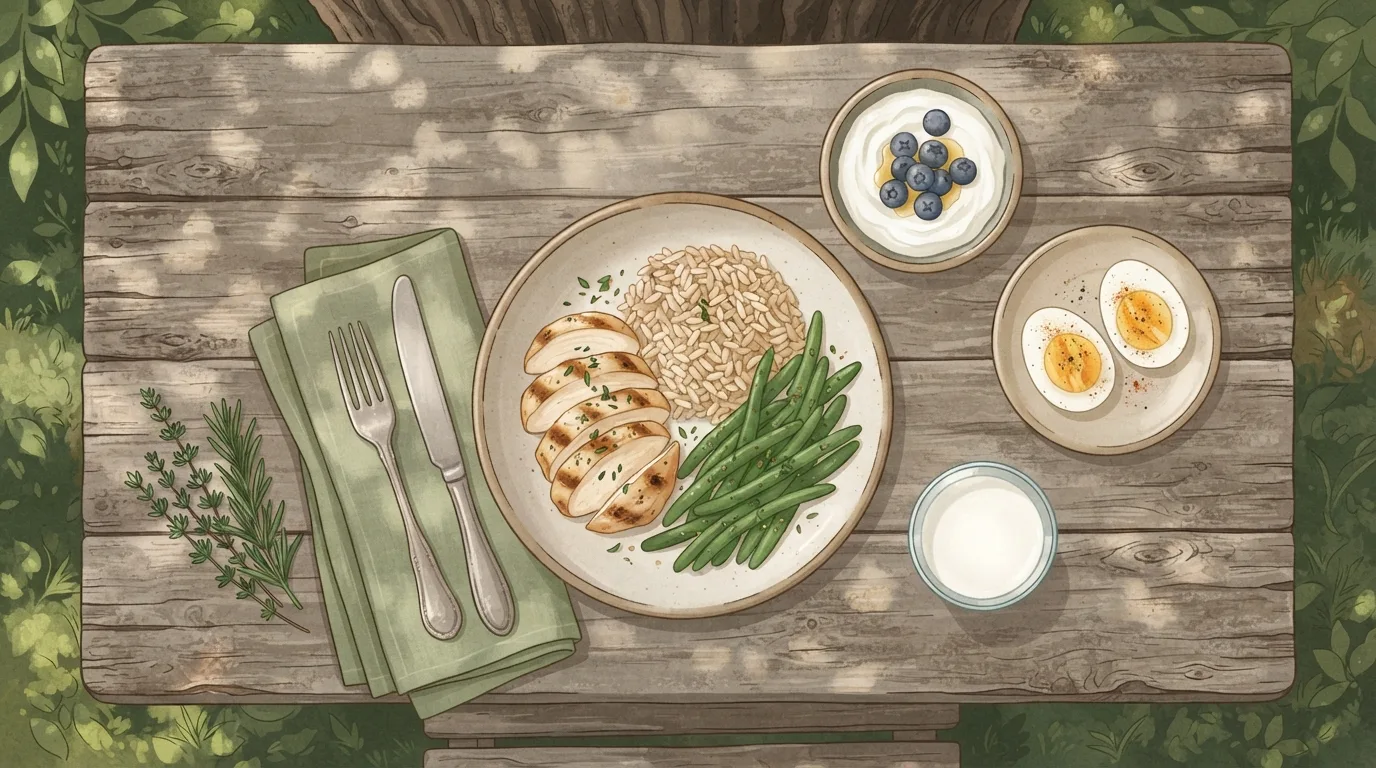
In real numbers, 1.6 g per kg is about 110 g a day for a 70 kg (155 lb) person and about 145 g for a 90 kg (200 lb) person. A breakfast of toast and coffee and a light sandwich at lunch can leave you far short before dinner even starts. Iraki's review suggests about 0.4 to 0.55 g per kg in each of three to six meals, which for most people means a palm-sized or larger portion of protein food at every meal.
Our full guide to how much protein you need a day lists the protein in common foods and when powder makes sense.
6. You Sleep Less Than Seven Hours
Sleep is when a lot of the rebuilding happens, and short nights show up in the lab within a day. Lamon and colleagues (2021) kept 13 healthy young adults awake for one night and compared them with a normal night. After the sleepless night, muscle protein synthesis was 18% lower, cortisol was 21% higher and testosterone was 24% lower.
The longer-term picture points the same way. In a study by Nedeltcheva and colleagues (2010), 10 adults dieted for two weeks twice, once with 8.5 hours in bed and once with 5.5. On the short-sleep diet they lost 60% more fat-free mass (2.4 kg against 1.5 kg). And a systematic review by Knowles and colleagues (2018) found that several nights in a row of restricted sleep can reduce the force you produce in multi-joint lifts like squats and presses, which means less work done in every session.
The American Academy of Sleep Medicine and Sleep Research Society recommend at least 7 hours a night for adults. Our review of sleep and muscle growth goes deeper on the hormones involved. The practical fix is boring and it works: a fixed wake time, and a bedtime set 7.5 to 8 hours before it.
7. You Train in Bursts
Missing a week isn't what stops muscle growth. Ogasawara and colleagues (2013) had young men train the bench press for 24 weeks, either continuously or in three 6-week blocks separated by 3-week breaks. Over the full 24 weeks, both groups gained similar muscle size and strength. A short break, followed by getting back to it, costs very little.
What costs a lot is the pattern most people actually live: three strong weeks, a busy stretch, a month off, then a restart that feels like day one. Each restart spends weeks regaining ground instead of adding new muscle, and the months of steady training that growth depends on never pile up. In a study of older adults by Churchward-Venne and colleagues (2015), the share of people who responded well rose with the length of the program, which is the clearest sign that time in the program is part of the dose.
That makes consistency a design problem. A fixed time, a session short enough to survive a bad day, and a streak you don't want to break do more than motivation ever will. FitCraft leans on exactly that, with streaks and leaderboards that give the next session a reason to happen. Mike, 23, who got visibly stronger in four months, put it simply: "The streak system got me hooked. I didn't want to break my chain."
8. You're Judging Progress Too Early
Muscle grows slowly, even when everything above is right. Across 111 studies and 1,927 men, Benito's meta-analysis found that resistance training added about 1.5 kg (3.3 lb) of muscle mass on average. That's a real change, and it's also a small one spread over a whole body. Eight weeks in, it often isn't visible yet.
Your training age changes the pace. Beginners gain fastest, intermediate lifters slower, and lifters with several good years behind them slower still, which is why Iraki's review sets more conservative targets for advanced lifters. Age matters too. A meta-analysis of 49 studies in adults over 50 by Peterson, Sen and Gordon (2011) found an average gain of 1.1 kg of lean mass, with older participants gaining less and higher-volume programs gaining more.
So compare yourself with your own starting point, not with someone who has trained for a decade. If you're three months in and your lifts, measurements and photos are all moving in the right direction, the program is working.
Working Out but Your Body Isn't Changing? Check How You Measure
Sometimes you're building muscle and your tools can't see it. The scale lumps muscle, fat, water and food together, so a gain of half a kilo of muscle in a month disappears inside normal day-to-day swings. If you're also losing some fat, you can be building muscle under fat while your weight doesn't move at all.
- Strength log. More reps at the same weight, or the same reps at a heavier one, is the earliest sign that a muscle is adapting.
- A cloth tape measure. Measure your upper arm, thigh and waist once a month, at the same time of day. Arms and thighs growing while your waist holds steady is muscle.
- Photos. Take them monthly in the same light and the same pose. Daily mirror checks are too close together to show change.
- Not soreness. Soreness tracks how new or how eccentric a workout was, not how much you grew, as we explain in does soreness mean muscle growth.
If you're gaining muscle but can't lose weight, look at your waist instead of the scale. A shrinking waist with a stable weight and rising lifts is body recomposition, and it's working.
Is It Possible to Never Gain Muscle?
For a healthy adult who trains consistently, the evidence says no. Churchward-Venne and colleagues analyzed 110 adults over 65 after 12 weeks of supervised training, and 85 of them after 24 weeks. Lean mass rose by 0.9 kg on average after 12 weeks, with a range from a loss of 3.3 kg to a gain of 5.4 kg, and every single participant improved on at least one measure of size, strength or function. More people responded well after 24 weeks than after 12.
Responses do vary widely, and slow responders often just need a bigger dose. That's the lesson of the Hammarström study above, where more than a third of people grew clearly more on three sets than on one. Low responders usually aren't broken. They're under-dosed.
A medical cause is worth ruling out if you've trained hard, eaten enough protein and calories, and slept well for six months with no change in strength or size. An underactive thyroid, low testosterone, iron deficiency or anemia, an undiagnosed illness and some medications, such as long-term oral steroids, can all sap strength and recovery. Unusual tiredness, unexplained weight loss or getting weaker are reasons to see a doctor rather than change your program again.
A Four-Week Reset With Dumbbells and Bodyweight
If you suspect several of the causes above at once, change all of them for four weeks and then judge. Do this full-body session three times a week on non-consecutive days. It gives your legs, chest and back about 9 hard sets each a week, plus direct work for your shoulders and arms.
| Exercise | Sets | Reps | Rest |
|---|---|---|---|
| Goblet squat | 3 | 8 to 15 | 2 to 3 min |
| Dumbbell Romanian deadlift | 3 | 8 to 15 | 2 to 3 min |
| Push-up (hands raised or feet raised to fit your level) | 3 | 6 to 20 | 2 min |
| One-arm dumbbell row | 3 | 8 to 15 per side | 2 min |
| Dumbbell shoulder press | 2 | 8 to 15 | 2 min |
| Dumbbell curl and overhead triceps extension | 2 each | 10 to 20 | 1 to 2 min |
Four rules turn the table into a program:
- Effort: end every set with 1 to 3 good reps left. If you finish a set and could clearly do five more, the weight or variation is too easy.
- Progression: when you reach the top of the rep range on every set, move up to heavier dumbbells or a harder variation, and log every set.
- Food: eat about 10% above maintenance and about 1.6 g of protein per kg of body weight a day, spread over three or four meals.
- Sleep: give yourself at least 7 hours in bed, with the same wake time every day.
At the end of week four, compare your log, your tape measurements and your photos with day one. Rising reps or loads and a steady or growing arm and thigh measurement mean you've found the gap. Keep going for another eight weeks before you judge size.
What This Means for You
Not building muscle almost never means you can't. It means one or two of the inputs are missing, and now you know how to find them. Picture three months from now: your log shows heavier dumbbells than the ones you started with, your sleeves fit a little tighter, and the workouts feel like they're going somewhere. That's what happens when effort, progression, food and sleep finally line up.
The hard part is keeping all of it going long enough to see. If you'd rather follow a plan than build one yourself, FitCraft programs include dumbbell and bodyweight strength workouts led by a 3D AI coach who demonstrates every exercise and adapts your workouts as you progress. If you're weighing your options, our comparison of the best strength training apps looks at which ones help people keep training.
Frequently Asked Questions
What kills gains the most?
Eating too little is the biggest single gain killer. In a 2022 meta-analysis, training in an energy deficit impaired lean mass gains while strength kept rising, and a deficit of about 500 calories a day was enough to stop muscle gain. After that come sets that stop far from failure, workouts that never get harder, and long gaps in training.
Why am I getting stronger but not bigger?
Strength climbs faster than size because your nervous system gets better at using the muscle you already have, especially in the first months. If strength keeps rising for months while your measurements don't move, check your food: a 2022 meta-analysis found an energy deficit blunted lean mass gains but left strength gains intact.
How long does it realistically take to build muscle?
Expect a few months before you see it and a year before it's obvious. Across 111 training studies in men, the average gain was about 1.5 kg of muscle mass, which is real but hard to see in the first eight weeks. Beginners gain fastest, and the rate slows with each year of training.
What age is hardest to gain muscle?
Gaining muscle gets harder with age, so later adulthood is the slowest period, but it never stops working. A meta-analysis of 49 studies in adults over 50 found an average gain of 1.1 kg of lean mass, with older participants gaining less and higher-volume programs gaining more. In adults over 65, every participant improved on at least one measure.
Is it hard to build muscle with anemia?
It can be. Anemia means your blood carries less oxygen, so workouts feel harder, you tire sooner and the quality of your training drops. Low iron and anemia are diagnosed with a blood test, so if you're unusually tired or short of breath during training, see a doctor before changing your program.
What is the fastest way to build muscle?
There's no shortcut past the basics, but stacking all of them is the fastest route: about 10 hard sets per muscle each week, sets that end 1 to 3 reps short of failure, a little more weight or reps over time, a small calorie surplus, about 1.6 g of protein per kg of body weight a day, and at least 7 hours of sleep.
Do you put on weight when you build muscle?
Usually, yes, because muscle has mass and building it works best with a small calorie surplus. A review of off-season nutrition for natural bodybuilders recommends gaining about 0.25 to 0.5 percent of body weight a week for novice and intermediate lifters. If you have body fat to lose, your weight can stay flat while your waist shrinks and your lifts climb.