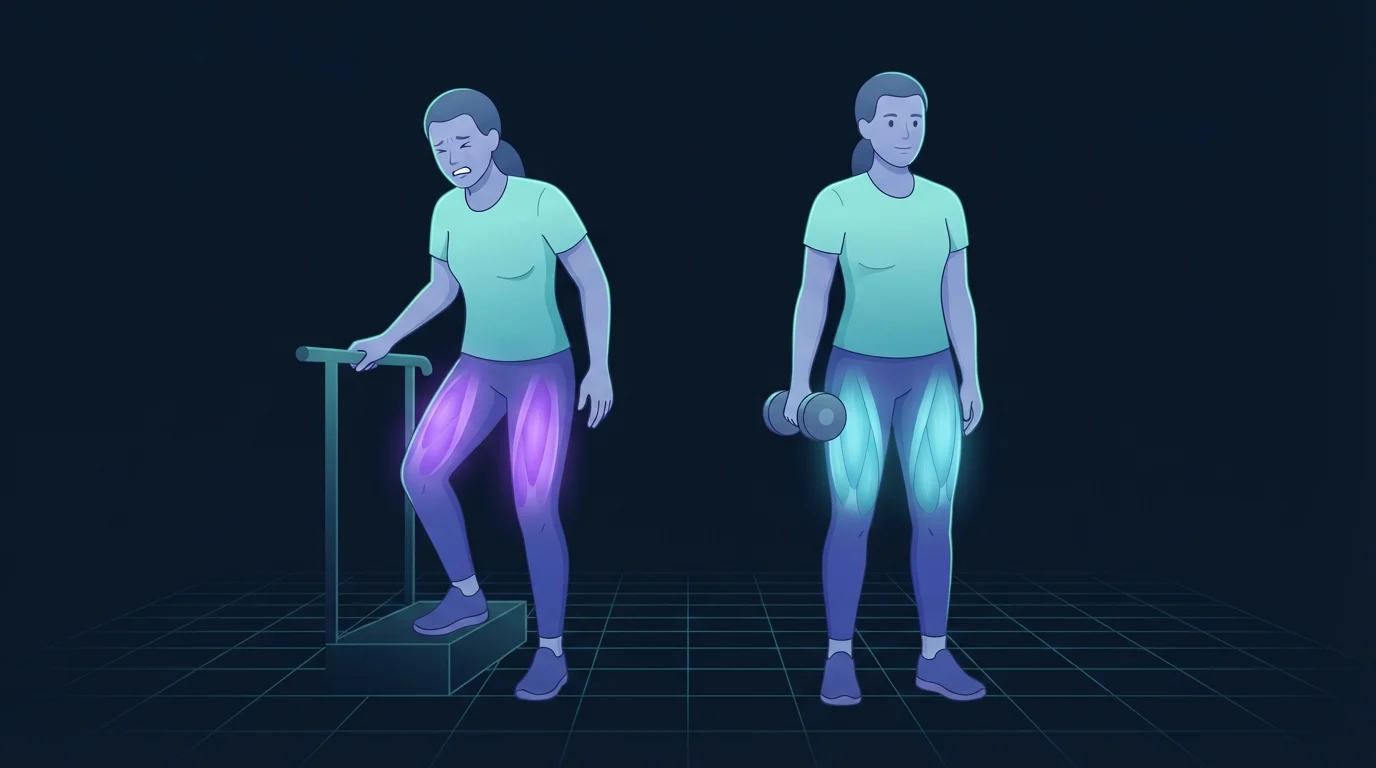
You did legs on Monday. On Wednesday the stairs are a negotiation, and somewhere in the back of your head a small voice says: good. That worked. Something is happening down there.
It's a reasonable instinct. Pain is one of the only signals a beginner gets in the first month, when nothing visible has changed yet and the scale is doing whatever the scale does. So soreness gets promoted from sensation to scoreboard. Then it disappears after a few weeks of the same program, the workouts feel easy, and people start adding exercises they do not need in order to chase a feeling that was never the point.
The research has actually addressed this head on, and in an unusually satisfying way: two sets of investigators deliberately pulled soreness and growth apart to see whether one needed the other. Here's what they found, what soreness really measures, why the first three weeks of any program lie to you about size, and the four signals worth watching instead.
What Delayed Onset Muscle Soreness Actually Is, in One Paragraph
Delayed onset muscle soreness is the stiff, tender ache that arrives 12 to 24 hours after unfamiliar exercise, peaks somewhere between 24 and 72 hours, and clears inside a week. It isn't lactic acid, which is gone within about an hour of the session. The working model involves mechanical disruption of muscle and connective tissue, an inflammatory response, and sensitisation of the nerve endings that report pain. Wilke and Behringer (2021) in the International Journal of Molecular Sciences argue the ache may be generated largely in the fascia wrapping the muscle rather than in the fibers themselves, since fascia carries a dense supply of pain receptors and irritating it produces stronger pain than irritating muscle. We cover the mechanism, the treatment meta-analyses and the myths at length in our research review of delayed onset muscle soreness. This page is about the question that review does not settle in depth: whether the ache has anything to do with hypertrophy.
The Two Trials That Pulled Soreness and Growth Apart
Most of what gets written about soreness is correlational. Someone trains hard, gets sore, and grows, so the three get bundled together. The interesting studies are the ones that broke the bundle on purpose.
Flann 2011: same muscle, with and without the soreness
Flann, LaStayo, McClain, Hazel and Lindstedt set out to test whether detectable damage is a required precursor to remodeling. They split participants into two groups for an eccentric cycling program. The naive group jumped straight into a damaging first bout. The pre-trained group spent three weeks on a gradual ramp designed specifically to avoid damage, and it worked: that group showed no rise in plasma creatine kinase and reported no muscle soreness at any point.
Then both groups trained. Both increased muscle volume. Both increased strength. The magnitudes were the same. One group had done it through the soreness, one had done it without ever feeling any, and the muscle couldn't tell the difference. Published in the Journal of Experimental Biology, the paper is titled, with admirable directness, "Muscle damage and muscle remodeling: no pain, no gain?"
Damas 2016: protein synthesis only counted once the damage stopped
The second trial comes at it from the molecular side. Damas, Phillips, Libardi and colleagues took ten untrained young men through ten weeks of resistance training and measured integrated myofibrillar protein synthesis over multi-day windows, using deuterated water rather than a snapshot infusion, alongside muscle biopsies scored for Z-band streaming, a structural marker of damage.
At week 1, damage was highest and protein synthesis was highest. Neither predicted how much muscle a participant ended up with. At weeks 3 and 10, damage had dropped to low and then minimal, and protein synthesis now correlated with actual hypertrophy. The reading is uncomfortable for the no-pain-no-gain crowd: early on, a large share of the protein synthesis signal is being spent on repair rather than on growth, and the size of that repair bill tells you nothing about the building work.
Damas, Libardi and Ugrinowitsch (2018) later reviewed the whole question in the European Journal of Applied Physiology and concluded that muscle damage neither predicted, potentiated nor explained the magnitude of training-induced hypertrophy. Schoenfeld and Contreras (2013) had reached the same verdict in the Strength and Conditioning Journal, in a review whose entire purpose was to ask whether soreness is a valid indicator of adaptation. It is not.
Why the First Three Weeks Lie to You About Size
There's a second, sneakier reason soreness feels like proof: in the same early window when you are sorest, the muscle genuinely does get bigger. It's just not muscle yet.
Damas, Phillips, Lixandrao and colleagues (2016) in the European Journal of Applied Physiology took ultrasound images of the vastus lateralis across a ten-week program and read the echo intensity of each image alongside the cross-sectional area. Echo intensity rises with fluid content. Early increases in cross-sectional area came with exactly the echo changes you'd expect from edema, meaning a meaningful share of the "growth" in the first few weeks was swelling from the damage, not new contractile tissue. The authors were explicit that early gains in whole-muscle area in untrained people are not purely hypertrophy.
So the first month hands a beginner two misleading signals at once. The soreness, which is loudest when damage is highest. And the pump-adjacent fullness in the mirror, which is partly fluid. Both fade at roughly the same time, around the point where the training finally starts producing tissue you keep. That timing is why so many people conclude a program "stopped working" right as it started to.
Muscle Soreness After a Workout Tracks Three Things, and Growth Is Not One of Them
If soreness isn't a growth signal, it's still a signal. It's just measuring something else. Three inputs dominate.
- Novelty. The single biggest driver. A movement your body has not done recently, or has never done, produces far more soreness than the same amount of work in a familiar pattern. That's also why soreness vanishes so fast. Hyldahl, Chen and Nosaka (2017) in Exercise and Sport Sciences Reviews describe the repeated bout effect: one bout of eccentric exercise makes the muscle markedly more resistant to damage from the next one, through neural changes, altered muscle mechanics, remodeling of the extracellular matrix and biochemical signaling. The protection can last weeks. Your muscles stop hurting long before they stop adapting.
- Lowering under load. Eccentric work, where the muscle lengthens while resisting, produces far more soreness than the lifting half of the same movement. Romanian deadlifts, walking lunges and slow negatives are soreness machines. Machine pressing and sled pushing are not.
- Sudden volume jumps. Four sets when you have been doing two. A session after two weeks off. Soreness here is a report on the gap between what you did and what you were conditioned for, which is a useful thing to know and still has nothing to do with the size of the adaptation.
One thing that does not make the list: intensity of effort. You can take a familiar set to the edge of failure, produce a genuinely strong growth stimulus, and feel completely normal the next day. Our post on why you are not sore after working out takes that scenario apart in detail.
Knowing what to do is the easy part.
FitCraft, our mobile fitness app, pairs you with an AI coach who builds you a personalized plan around your goals, schedule, and fitness level. Every FitCraft program is designed by Domenic Angelino, MPH (Brown University) and NSCA-CSCS, with research published in the Journal of Strength and Conditioning Research and Medicine & Science in Sports & Exercise.
Take the Free Assessment Free • 2 minutes • No credit cardWhere Soreness and Growth Do Overlap, and Why It Is Still Not Cause
Here's the honest complication, because the case above isn't quite airtight.
Training a muscle at long lengths, where it is stretched under load, produces both more soreness and, in a growing body of work, more growth than training the same muscle in a shortened position. Deep squats. Seated leg curls rather than lying. Overhead triceps work. Our review of stretch-mediated hypertrophy walks through that evidence. So there is a real category of training where the sore exercises and the effective exercises are the same exercises.
That overlap is what keeps the myth alive, and it still doesn't make soreness the mechanism. Both effects trace back to the same upstream cause, which is high tension on a lengthened muscle. Soreness is a downstream symptom sitting beside the adaptation, not upstream of it. You can prove that by removing the soreness and keeping the exercise: by week three of a long-length program you have stopped getting sore, and the growth carries on regardless. Flann's ramped group made the same point from the other direction. If soreness were doing any of the work, avoiding it entirely would have cost them something. It cost them nothing.
The reverse error is worth flagging too. Soreness bad enough to change how you train is a straightforward negative. It shortens your range of motion, drops the load you can handle and pushes sessions later in the week. Training quality is the thing that drives growth, so anything that degrades it has a cost, whatever it signals.
What Actually Tells You a Workout Is Working
Four signals, in rough order of how quickly they move:
- Performance on the lift. More reps at the same weight, or the same reps at more weight, over a four to six week window. This is the one that matters most and the one people check least.
- Range and control. A squat that reaches depth without shifting. A row you can pause at the top. Quality expanding at a given load is real progress even when the number is flat.
- Tape measurements. Same spot, same time of day, once a month. Slow, boring, honest. Visible change lags the training that caused it by weeks, which our review of how long it takes to build muscle sets realistic timelines for.
- Sessions completed. Over a year, attendance beats every acute variable in this article. The person who trains 150 times at a reasonable intensity beats the person who trains 70 times ferociously and spends the gaps recovering.
If tracking those four reliably is the part that keeps slipping, our roundup of the best strength training apps compares how the main options handle load progression, session logging and getting you back on track after a missed week.
How Long Muscle Soreness Should Last, and When It Is Not Soreness
The normal curve, per Cheung, Hume and Maxwell (2003) in Sports Medicine: onset at 12 to 24 hours, peak at 24 to 72 hours, resolution within five to seven days. Tenderness is diffuse across the whole muscle belly, affects both sides roughly equally if you trained both sides, and improves a little each day after the peak.
Three patterns fall outside that and deserve attention rather than patience:
- Sharp, localised, one-sided pain that arrived during the set. Soreness is late and diffuse. Pain that showed up mid-rep and points to one spot fits a strain.
- Getting worse after day three. The curve should be heading down by then. An upward slope after 72 hours is not the normal pattern.
- Dark, tea-coloured urine with severe pain, swelling and weakness. That combination can indicate exertional rhabdomyolysis, where damaged muscle proteins overwhelm the kidneys. It is a medical emergency and it's most likely after a brutal first session back, a long eccentric-heavy workout, or training hard in heat while dehydrated. Don't wait it out.
Active Recovery for Sore Muscles: What Actually Helps
Since soreness isn't the adaptation, blunting it costs you nothing. Dupuy, Douzi, Theurot, Bosquet and Dugue (2018) pooled 99 studies in Frontiers in Physiology and ranked the options. Massage came out strongest for both soreness and perceived fatigue. Active recovery, compression garments, cold water immersion and contrast water therapy all produced small to large reductions in soreness.
Practically, that means the cheapest useful thing is movement: a walk, an easy bike, or a very light version of the same pattern that made you sore. Ten to fifteen minutes is enough to feel different. What doesn't earn its reputation is static stretching a sore muscle, which has repeatedly failed to reduce soreness in controlled trials and can feel worse on tissue that is already sensitised.
One caveat on the cold water: it reduces soreness effectively and there is evidence it can blunt the hypertrophy signal when used routinely right after lifting. If you're training for size, keep the ice for competition weeks rather than every Tuesday. Our review of ice baths and muscle growth covers where that line sits.
What This Means for You
Stop grading sessions on how you feel two days later. It's the least informative number available to you, it's loudest exactly when you're newest and worst at interpreting it, and it disappears while the results are still arriving.
Practically, that changes three things. You stop adding novelty for its own sake, because most exercise-hopping is soreness-chasing with a rationalisation attached, and staying on the same movements long enough to add weight to them is what actually builds muscle. You stop skipping a session because the last one didn't hurt enough. And you start logging, because once the sensation is off the table you need something real to look at, and a training log answers the question in a way your quadriceps never could.
The first month is where this matters most. That's when soreness is loudest, when fluid is inflating the mirror, and when both are about to fade at the same time. Knowing all three of those facts in advance is the difference between reading that fade as failure and reading it as the program finally getting on with it.
Frequently Asked Questions
Does soreness mean muscle growth?
No. Soreness means you did something your muscle was not used to. Flann and colleagues (2011) ramped one group into eccentric cycling slowly enough that they never got sore and never raised creatine kinase, then compared them with a group that took a damaging first bout. Both gained the same muscle volume and the same strength. Damas and colleagues (2016) followed the other end of the question across ten weeks of resistance training and found protein synthesis tracked actual growth only once muscle damage had faded. Soreness and growth can happen in the same week. One does not cause or measure the other.
Why do my muscles hurt after a workout?
Because the session contained something unfamiliar: a new exercise, more lowering under load, a longer range of motion, or simply more sets than usual. That is delayed onset muscle soreness, and it shows up 12 to 24 hours later rather than during the workout. It is not lactic acid, which clears within about an hour of finishing. Wilke and Behringer (2021) make the case that much of the pain is generated in the connective tissue wrapping the muscle rather than in the muscle fibers themselves, which helps explain why soreness is such a poor guide to what happened inside the fiber.
How long should muscle soreness after exercise last?
Onset is usually 12 to 24 hours, the peak sits around 24 to 72 hours, and it resolves within five to seven days, per Cheung, Hume and Maxwell (2003) in Sports Medicine. Anything longer than a week, or soreness that gets worse instead of better after day three, is worth a second look. Soreness that is sharp, one-sided, or attached to swelling and weakness is a different problem and not delayed onset muscle soreness at all.
Does active recovery help sore muscles?
It helps the feeling, modestly, and it does not change the adaptation. Dupuy and colleagues (2018) pooled 99 studies in Frontiers in Physiology and found massage was the most effective technique for reducing both soreness and perceived fatigue, with active recovery, compression garments, cold water immersion and contrast water therapy all producing small to large reductions in soreness. Easy movement that gets blood into the area, such as a walk or a light version of the same movement pattern, is the cheapest option on that list.
Does more soreness mean more muscle growth?
No, and the relationship can run backwards. Soreness severe enough to limit your next session costs you training quality, and training quality is what drives growth. Nosaka, Newton and Sacco (2002) put 110 participants through 12, 24 or 60 maximal eccentric contractions and found soreness did not scale with the size of the damage that produced it. If soreness cannot even rank its own cause, it cannot rank an adaptation two weeks downstream.
Can you build muscle without getting sore at all?
Yes, and most muscle is built that way. Soreness fades within a few sessions of any new exercise because of the repeated bout effect, described by Hyldahl, Chen and Nosaka (2017), while the muscle keeps adapting for months or years afterwards. A lifter three years into training is rarely sore and is still growing. Judge the program on load, reps, range of motion and measurements, not on how the stairs feel on Tuesday.
When is muscle pain after a workout a reason to see a doctor?
Seek medical care promptly for dark, tea-coloured urine, muscle pain far out of proportion to the session, marked swelling, an inability to straighten or bend a limb, or a drop in how much you are urinating. That combination can indicate exertional rhabdomyolysis, which is a medical emergency rather than a bad case of delayed onset muscle soreness. Sharp, localised, one-sided pain that arrived during the set rather than a day later also needs assessment, because that pattern fits a strain, not soreness.