It is one of the most common questions a coach hears, and the framing is almost always the same. "I trained hard yesterday and I feel fine. Was the workout a waste?" The answer is almost always no. The reason people feel like it should be yes is that soreness is the most visible, most physical, most obvious signal the body gives after a hard session, and the fitness industry has spent decades telling people that pain is progress. The evidence says otherwise.
Below is what the research actually shows about muscle soreness, what it is, what it is not, and how to tell whether your training is producing results when the soreness is no longer there.
What DOMS Actually Is
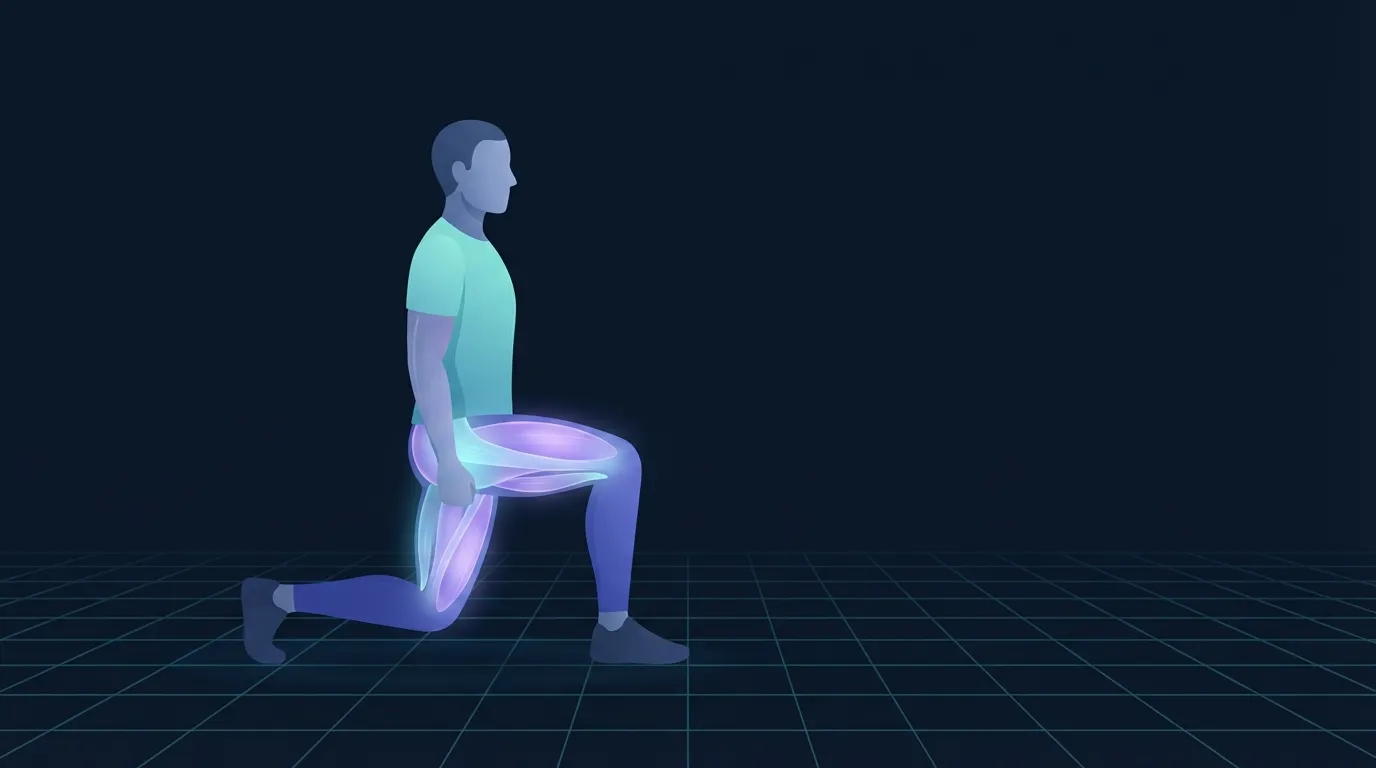
Delayed onset muscle soreness is the ache, stiffness and reduced range of motion that peaks 24 to 72 hours after a session, especially after unaccustomed eccentric loading (the lowering phase of a lift, downhill running, long sets of push-ups). Cheung, Hume and Maxwell (2003) in Sports Medicine summarized the literature and framed DOMS as a symptom of unaccustomed exercise, driven by microscopic damage to muscle fibers and connective tissue, followed by an inflammatory cascade that produces the pain and tenderness.
The key word there is unaccustomed. DOMS is not a signal of good training. It is a signal that the tissue was loaded in a way it was not ready for. A first squat session after a long layoff can produce two days of stiffness. The tenth squat session at the same load may produce none.
Why the Same Workout Stops Making You Sore
This is the repeated bout effect, and it is one of the best-characterized phenomena in exercise physiology. Hyldahl, Chen and Nosaka (2017) in Exercise and Sport Sciences Reviews reviewed the mechanisms and reported that a single previous bout of an unaccustomed movement is enough to blunt the soreness response the next time. Repeat that movement several times and the soreness response can drop to almost nothing, even at similar or higher loads.
Why does it happen? A mix of adaptations, most well-described in the review:
- Neural adaptation. The nervous system recruits muscle fibers more efficiently and distributes force more evenly across the working muscle, reducing local overload.
- Mechanical adaptation. The muscle fibers themselves add sarcomeres in series and reinforce cytoskeletal structures, making them more resistant to eccentric damage.
- Extracellular matrix adaptation. The connective tissue around muscle fibers remodels and stiffens, distributing load better.
- Inflammatory dampening. The systemic inflammatory response after a familiar session is smaller than after a novel one, which reduces the perceived pain.
So your body is doing three or four different things at once to make you less sore. All of them are adaptations of the training you already did. None of them mean the training stopped working.
Soreness and Growth Are Not the Same Thing
The most direct experimental evidence on this comes from Damas and colleagues (2016) in the Journal of Physiology. They followed young men through 10 weeks of resistance training and measured integrated myofibrillar protein synthesis (the direct process of new muscle protein assembly) alongside muscle biopsies and hypertrophy outcomes at three time points: after the very first session, after 3 weeks, and after 10 weeks.
Early in training, MPS was elevated but did not correlate with actual muscle growth, because a large share of the MPS was going to repair damaged tissue. By week 3, damage had attenuated and MPS started to correlate with muscle growth. By week 10, MPS strongly predicted hypertrophy. The paper's own conclusion is right there in the title: MPS is related to hypertrophy only after attenuation of muscle damage.
That result is coach-friendly shorthand: the sore weeks are not the growth weeks. Most of the muscle you build is built after the soreness quiets down. If you are past week 3 or 4 of a program and no longer feeling sore, you are entering the phase where the training is most efficient, not less.
Soreness Does Not Even Track Damage Well
To make the point sharper, DOMS is not a great proxy for damage in the first place. Nosaka, Newton and Sacco (2002) in the Scandinavian Journal of Medicine and Science in Sports compared perceived muscle soreness against direct markers of muscle damage (creatine kinase, force loss, range of motion) after eccentric exercise and reported that DOMS did not reflect the magnitude of the actual damage. Two people can do the same session with the same damage and one can feel very sore while the other barely feels anything. The subjective pain signal is not a calibrated instrument.
All of which is why Schoenfeld and Contreras (2013) in the Strength and Conditioning Journal answered the question directly in their title: "Is Postexercise Muscle Soreness a Valid Indicator of Muscular Adaptations?" Their answer, drawn from the same literature summarized above, was no. Soreness is a symptom, not a metric.
Knowing what to do is the easy part.
FitCraft, our mobile fitness app, pairs you with an AI coach who builds you a personalized plan around your goals, schedule, and fitness level. Every FitCraft program is designed by Domenic Angelino, MPH (Brown University) and NSCA-CSCS, with research published in the Journal of Strength and Conditioning Research and Medicine & Science in Sports & Exercise.
Take the Free Assessment Free • 2 minutes • No credit cardWhat Actually Tells You a Workout Worked
If soreness is a poor signal, what should you use instead? Four markers, checked over weeks rather than after a single session:
- Load and reps at a target RPE. Are you doing more work at the same subjective effort? Move up the same weight for more reps, or add weight at the same rep count. Both count as progression.
- Rate of perceived exertion at a working set. If the same load felt like a 9 out of 10 last month and feels like a 7 this month, the training is working. Even if the number on the bar has not moved yet, the trajectory has.
- Month-over-month progression on the same lifts. Not week to week (too noisy), but across a rolling 4 to 8 week window. Are your main lifts trending up?
- Body composition change on a 4 to 8 week window. Photos in the same light, weight rolling averages, waist measurement, how clothes fit. Session-to-session soreness tells you almost nothing about this; it just makes the average person miscalibrate on the two data points that matter (weight and shape) because they are also miscalibrated on the third (soreness).
If those four are moving the right way, the training is working. Full stop. Soreness is optional and often absent in the most productive training blocks. If those four are stagnant, the fix is progressive overload (more weight, more reps, more sets, better technique), not chasing soreness. See our delayed onset muscle soreness research review for a deeper dive into what DOMS is and how the training literature has evolved on it.
When "Not Sore" Actually Is a Problem
The main scenarios where a lack of soreness is worth investigating, and the fixes:
Scenario 1: You are not progressing on load or reps
No soreness plus no load progression usually means the sessions are not asking enough. Solutions: add a set to your main lifts, add 2 to 5 pounds to a lift you can already do cleanly, or increase reps at the same load. If your working weight has not moved in six weeks, chase progression, not soreness.
Scenario 2: You changed programs but nothing feels different
If you switched from an upper-lower split to a push-pull-legs and the sessions feel identical, the total weekly volume for each muscle group may be similar, or the new program may not be challenging enough. Progression tracking is still the referee. If reps are climbing on the new program, the swap is working.
Scenario 3: You lift, and none of the four progression markers move for 8 weeks
This is the actual worry state. Not the "why am I not sore" question, but a genuine plateau. Common causes: undereating protein (target 1.6 to 2.4 g per kg body weight daily), sleeping under 7 hours, doing too much aerobic volume around lifting, running the same lifts for months without a planned progression, or under-recovery masquerading as "I feel fine." A short deload week or a program change usually breaks the plateau. See our active recovery research review for how to program the recovery side of the equation deliberately.
Scenario 4: You are new and only cardio
Beginners doing only cardio may never feel meaningful DOMS because cardio produces less eccentric muscle damage than resistance training. That does not mean the cardio is worthless. It builds the aerobic base, improves cardiovascular health, and burns calories. But it does not build much muscle. If muscle gain is the goal, add two to three resistance sessions per week. If cardio fitness or weight management is the goal, no soreness plus improving heart rate and pace over time means the training is working. See our roundup of the best fitness apps for beginners for how the leading apps handle programming both cardio and resistance for people who are new to structured training.
What About the Occasional Sore Session?
Some soreness is normal. Novel movements, deload-and-reload cycles at higher volumes than your baseline, and the first sessions back after a break all produce some soreness. That is fine and expected. The signal to worry about is not occasional soreness after a session that earned it. The signal is soreness that lingers into your next scheduled session for the same muscle, or spreads across weeks without resolving. That points at under-recovery, not good training.
A useful mental model: soreness is like a bruise. It tells you an event happened. It does not tell you the event was productive, and it does not tell you the healing is on track. Use it as a coarse tissue signal, not as your training report card.
Common Myths
Myth 1: "If I am not sore, I did not train hard enough."
Wrong for the reasons above. Hard training is measured in load, reps and RPE, not in how the muscle feels the next day. Soreness responds to novelty, not effort.
Myth 2: "No pain, no gain."
The slogan is decades older than the research showing it is wrong. Damas and colleagues (2016) put the sharpest version of the disproof on the record: hypertrophy is driven by MPS after damage attenuates, meaning most of the muscle you build comes after the sore phase, not during it.
Myth 3: "Sore muscles are growing muscles."
Growing muscles are muscles under a progressive-overload stimulus with enough protein, sleep and recovery to support the rebuild. Sore muscles are muscles that got a load they had not prepared for. The overlap is small, and it shrinks with training age.
Myth 4: "I need soreness to feel accomplished."
Fair, and worth acknowledging. Soreness is a real, felt signal that something happened. If your motivation depends on feeling that something happened, then absence of soreness can feel like absence of accomplishment. The fix is to move the accomplishment signal to something more accurate: reps completed, RPE at a working set, week-over-week volume climbing. The bar in the log book is a better report card than the ache in your quads.
Bottom Line
Not being sore after a workout is almost always fine, and often a sign of a well-programmed, well-recovered training block. The soreness response is driven by unaccustomed load, not by the size of the training stimulus, and it drops sharply as you adapt to any movement you repeat. The muscle you build after the first few weeks of a program is built while the soreness is decreasing, not while it is peaking. Track load, reps, RPE and body composition on a 4 to 8 week window, not soreness on a 24-hour one. If those markers are moving, the training is working, and the absence of DOMS is one more piece of evidence that your body has adapted, which is exactly what you were training it to do.
Frequently Asked Questions
Why am I not sore after working out?
Usually because your body has adapted to the movement you just did, not because the session did not work. Delayed onset muscle soreness (DOMS) is the body's response to unaccustomed mechanical stress, especially eccentric loading. Hyldahl, Chen and Nosaka (2017) reviewed the repeated bout effect and reported that after even one prior bout, the soreness, strength loss and inflammatory response to a similar future workout drop sharply. If you have been training the same lifts for weeks, no soreness is the expected outcome and the growth signal is still there. Schoenfeld and Contreras (2013) argued directly that postexercise soreness is not a valid indicator of muscular adaptations.
Does muscle soreness mean muscle growth?
No. Damas and colleagues (2016) in the Journal of Physiology followed young men through 10 weeks of resistance training and measured myofibrillar protein synthesis at multiple time points against actual muscle growth. Early in training, MPS was elevated but a large share of it went to repairing damage, not building new muscle. Only later, once damage had attenuated, did MPS correlate with hypertrophy. Soreness (a subjective proxy for damage) drops with training and hypertrophy climbs. Chasing soreness chases the wrong signal.
Should I be sore after every workout?
No. If you were sore after every session, that would mean your body is repeatedly hit with a load it has not yet adapted to, which is a sign of poor programming, not good training. A well-run program produces some soreness after novel movements, new deload-and-reload cycles, or true progressive overload weeks, and little to none after steady-state training blocks. Track load, reps and rate of perceived exertion (RPE), not soreness.
Is it bad if I never get sore from lifting?
Not bad on its own, but check the load. If you never get sore and your working weight has not moved in six weeks, the issue is likely too little progressive overload. If you never get sore and your load or reps are steadily climbing, you are training productively and your body has adapted enough that DOMS is no longer part of the picture. The load progression is the referee, not the soreness.
Why am I not sore after leg day anymore?
Repeated bout effect. Legs take some of the biggest eccentric load (squats, split squats, RDLs) so they were the sorest early in training, and they benefit the most from the adaptation as you train them consistently. Nosaka, Newton and Sacco (2002) showed DOMS did not reflect the actual magnitude of eccentric damage, so the drop in soreness does not mean less damage; it means the tissues have adapted to handle the same damage without the same inflammatory response.
How do I know if a workout was effective without soreness?
Use the four markers that actually track progress: load and reps performed at a target RPE, rate of perceived exertion at a working set, month-over-month progression on the same lifts, and body composition change on a rolling 4 to 8 week window. All four track training quality much better than soreness. Cheung, Hume and Maxwell (2003) in Sports Medicine framed DOMS as a symptom of unaccustomed exercise, not a metric of training effect. Soreness after a novel session tells you the tissue was loaded in a new way; it does not tell you the loading was optimal.
Can beginners get muscle without soreness?
Yes, especially after the first 3 to 4 weeks. Beginners typically feel a large soreness response in the first several sessions because everything is unaccustomed. The response drops sharply within weeks. Damas and colleagues (2016) showed muscle protein synthesis and hypertrophy stop being explained by damage early in the training block, which means new lifters build most of their muscle after the soreness quiets down. If you are new to lifting and no longer getting sore after week 4, that is the expected trajectory.