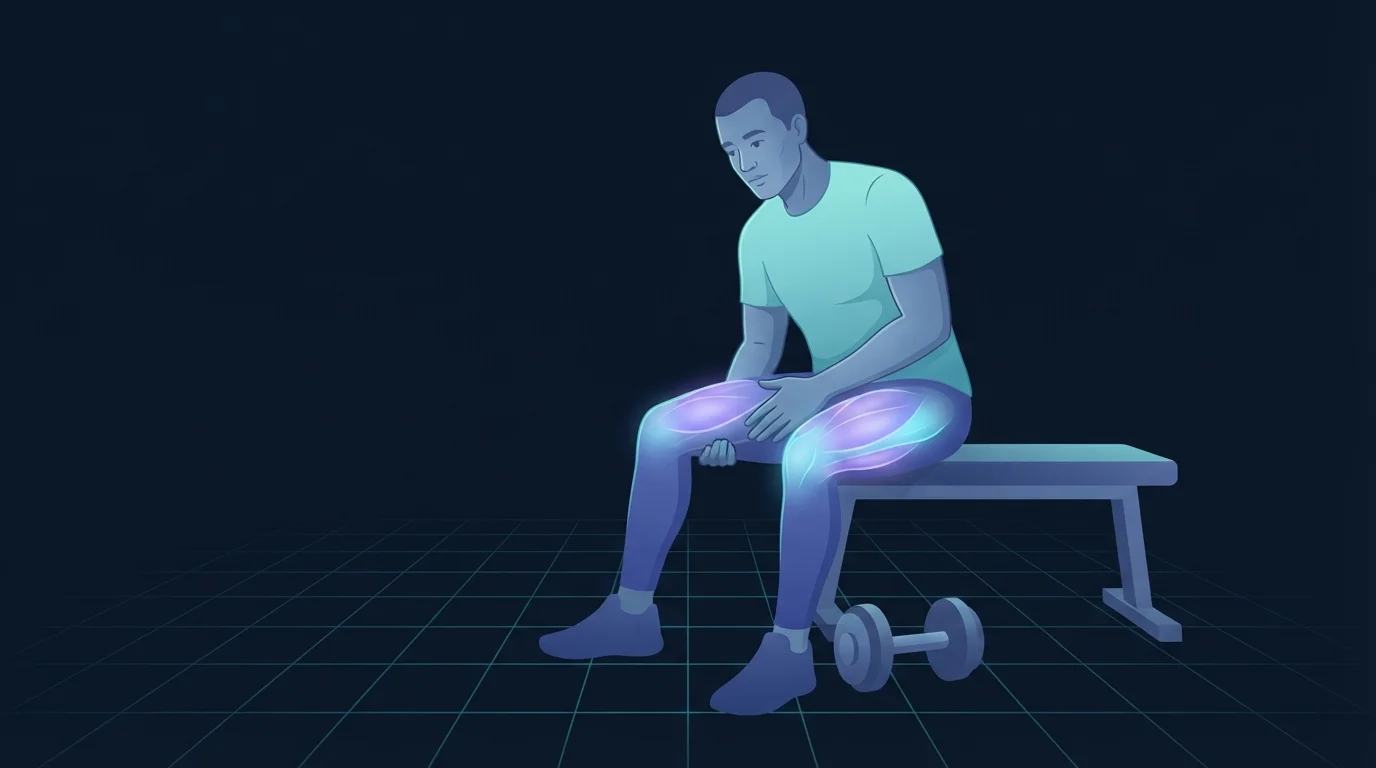
You wake up two days after leg day and the stairs have opinions. The instinct is to treat that ache as a stop sign, and plenty of coaching advice encourages it. Rest until the soreness clears, the story goes, or you will dig the hole deeper.
That story has been tested, and it did not hold up. What the evidence actually supports is a smaller, more useful set of rules: soreness changes what you should train today, not whether you should train at all. And the line that matters is not how much it hurts. It is whether the muscle still works.
Below: what DOMS actually is and how long it lasts, the study that settles the "will training make it worse" question, how to tell soreness from an injury, a ten-second decision rule, and an honest accounting of which recovery methods earn their reputation.
What DOMS Actually Is
Delayed onset muscle soreness arrives 6 to 12 hours after a session, peaks between 24 and 72 hours, and clears within roughly 5 to 7 days. Cheung, Hume and Maxwell (2003) in Sports Medicine synthesized decades of work on it and described DOMS as a microscopic Type I muscle strain: mechanical disruption at the level of the sarcomere and the connective tissue around it, followed by an inflammatory repair response that sensitizes the local pain receptors. That last step is why the ache is delayed. You are not feeling the damage. You are feeling the cleanup crew.
Two things reliably cause it: novelty, and eccentric loading. A movement your fibers have not handled recently produces far more disruption than one they meet twice a week. And lengthening contractions, the lowering half of a rep, running downhill, the bottom of a lunge, generate more tension per active fiber than shortening ones. Combine the two, say a first hill session or a new leg day with slow negatives, and you get the version that makes stairs a negotiation.
One correction worth making early, because it changes how seriously you take the ache: soreness is not lactic acid. Lactate clears from muscle within an hour or two of a session, long before the soreness arrives. And soreness does not measure how well the session worked either, which is the flip side of this question covered in why am I not sore after working out.
Training Sore Does Not Make the Damage Worse
This is the part people get wrong, and there is a direct test of it. Nosaka and Clarkson (1995), publishing in Medicine and Science in Sports and Exercise, set out specifically to test whether repeating eccentric exercise before recovery was complete would make the damage worse. Twelve untrained men did three sets of 10 maximal eccentric elbow flexor actions with a dumbbell, then repeated the identical session 3 days later and again at 6 days, while still sore and still measurably weaker.
They tracked maximal isometric force, elbow joint angles, soreness, plasma creatine kinase, and ultrasound images of the upper arm. The first bout moved every marker significantly. The second and third bouts did not exacerbate the damage and did not appear to slow the recovery rate. The authors' conclusion was blunt: strenuous exercise performed with damaged muscles did not exacerbate damage or affect the repair process.
Two caveats keep this honest. First, the participants were untrained young men doing single-joint arm work, not lifters squatting heavy, so this is evidence about muscle damage rather than a green light for maximal loading on a compromised joint. Second, performance while sore is genuinely worse: force production drops, range of motion narrows, and technique degrades under fatigue. Nothing gets worse because you trained. Plenty gets harder.
What that means in practice
- Sore quads on a scheduled leg day: train, but lower the load 10 to 20 percent and stop each set two reps further from failure. You will usually find the soreness eases after the warm-up.
- Sore quads on a scheduled upper day: train normally. The sore muscle is not involved.
- Sore everything, three days into a new program: that is week one. Do a shorter version of the session rather than skipping it, because the repeated bout effect means this is the last week it will feel like this.
- Sore and the movement is limited: that is the one case where the muscle group genuinely sits the day out.
Knowing what to do is the easy part.
FitCraft, our mobile fitness app, pairs you with an AI coach who builds you a personalized plan around your goals, schedule, and fitness level. Every FitCraft program is designed by Domenic Angelino, MPH (Brown University) and NSCA-CSCS, with research published in the Journal of Strength and Conditioning Research and Medicine & Science in Sports & Exercise.
Take the Free Assessment Free • 2 minutes • No credit cardSoreness or Injury? How to Tell the Difference
Every rule above assumes you are dealing with ordinary soreness. Most of the harm in this topic comes from people applying "train through it" to something that was never DOMS in the first place. The two feel different in ways you can check in about fifteen seconds.
Ordinary soreness is diffuse and spread across the muscle belly, roughly symmetrical between limbs, worst 24 to 72 hours after the session, tender to press, stiff at first and easier as you warm up, and steadily improving day over day.
An injury is sharp or stabbing rather than achy, findable at one specific point, often near a joint or a tendon, frequently one-sided, usually arrived suddenly during a rep you remember, and it gets worse as you move rather than better. Swelling, bruising, clicking, a joint that gives way, pins and needles, or numbness are all in the injury column, not the soreness column.
There is also a rare emergency worth naming. Rawson, Clarkson and Tarnopolsky (2017) reviewed exertional rhabdomyolysis in Sports Medicine, the condition where damaged muscle contents spill into the bloodstream and can injure the kidneys. The pattern to react to is severe pain and swelling wildly out of proportion to the workout you did, dramatic strength loss, and dark cola-colored urine, typically after an unaccustomed high-volume session. That is a same-day call to a doctor, not a training decision. It is uncommon, and it is not what a normal sore leg day feels like.
The Ten-Second Decision Rule
Run this before you decide, ideally after a light warm-up rather than in bed:
- Can you move the joint through its full range? If no, that muscle group rests today.
- Is the pain diffuse or sharp? Sharp, one-sided or point-specific means stop and reassess, not train through.
- Does a warm-up set at half your usual load feel normal? If it feels heavy, drop the working weight or switch the session to a different muscle group.
- Is it day 4 or later and still severe? That is more than ordinary DOMS. Take the extra day and make the next session less novel.
If you cleared all four, train. The most common right answer is not "rest", it is "train something else hard and give the sore muscle an easy version". Which is also why a schedule that rotates muscle groups makes this decision almost disappear. Our breakdown of how many rest days a week you need covers how to build that rotation so soreness rarely collides with a hard session.
Illness is the one case where the rule flips and a genuine stop beats an adjusted session. If you are sore and also running a fever or carrying symptoms below the neck, our guide to working out while sick covers exactly where that line sits.
Does Stretching Help Sore Muscles?
Not meaningfully, and this is the most consistently oversold intervention in the whole category. Herbert, de Noronha and Kamper (2011) pooled 12 randomized studies for the Cochrane Collaboration, including one field trial with 2,377 participants, and converted every effect onto a common 100-point soreness scale. Stretching before exercise reduced next-day soreness by an average of half a point. Stretching after exercise reduced it by about one point. Stretching both before and after reduced peak soreness across a week by under four points. Their conclusion was that stretching does not produce clinically important reductions in delayed onset muscle soreness.
Stretch because you want range of motion, or because it feels pleasant. Do not stretch expecting it to fix tomorrow.
What has better evidence
- Massage. The strongest performer in Dupuy and colleagues' (2018) meta-analysis of 99 studies in Frontiers in Physiology, which compared eight recovery techniques against passive rest across soreness, fatigue, inflammation and damage markers. Guo and colleagues (2017) reached the same conclusion in a dedicated massage meta-analysis. The catch is that it needs another person, or at least a device, and time.
- Light movement. Zainuddin, Sacco, Newton and Nosaka (2006) found that light concentric exercise cut soreness and tenderness by roughly 40 percent immediately afterwards, then changed nothing about recovery across the following seven days. It is real relief, and it is temporary. Walk anyway.
- Foam rolling. Wiewelhove and colleagues (2019) meta-analyzed the foam rolling literature and found small effects overall, with the clearest one being a modest reduction in muscle pain when rolling after exercise. Small but free, and it takes five minutes.
- Sleep and protein. Unglamorous and the highest-leverage items on the list. Neither shows up in recovery-gadget marketing because neither can be sold to you.
One method with a real cost
Cold water immersion reliably reduces soreness, which is why it is popular. It also appears to blunt the adaptation you trained for. Roberts and colleagues (2015) in The Journal of Physiology compared post-session cold water immersion against active recovery across 12 weeks of strength training and found cold water immersion attenuated both the acute anabolic signalling and the long-term gains in muscle mass and strength. If you are training to build muscle, save the ice for competition weeks rather than making it a habit after every hard session. A fuller breakdown of the recovery evidence sits in our guide to how to recover faster from a workout.
What This Means for You
The reason this question matters is not really physiological. It is that soreness is the single most common reason a promising training week quietly becomes a skipped week, and then a skipped fortnight. You are sore on Tuesday, you tell yourself you are being smart, and by Friday the habit has lost its grip. The villain here is not the ache. It is the gap.
A workable sore day looks like this: warm up for ten minutes instead of three, train a muscle group that is not sore, give the sore one a lighter technique-focused version, walk in the evening, eat your normal protein, sleep. You keep the streak, you keep the stimulus, and the soreness clears on its own schedule regardless of what you do.
If sore days are the thing that keeps breaking your consistency, the tools built specifically around adherence rather than intensity are worth a look. Our roundup of the best fitness apps for consistency compares them on exactly that.
Frequently Asked Questions
Should I workout when sore?
Usually yes. Ordinary delayed onset muscle soreness is not an injury and it is safe to train through. Nosaka and Clarkson (1995) had untrained men repeat hard eccentric elbow flexor work 3 and 6 days after a damaging first bout, while the muscle was still sore and weak, and found the extra bouts did not exacerbate damage or slow the repair process. The sensible adjustments are to train a different muscle group hard, keep the sore one to lighter technique work, and skip the session only if you cannot move the joint through a full range or the pain is sharp rather than diffuse.
How sore is too sore to work out?
Use function rather than feeling. If you can move the joint through its full range, walk down stairs normally, and produce close to your usual force on a warm-up set, you are fine to train. If your range of motion is visibly reduced, the pain is sharp or point-specific rather than a diffuse ache, or a warm-up set at half your usual weight feels heavy, that muscle group gets the day off. Soreness at level 7 or higher out of 10 on a movement you do every day is also a reasonable line to respect.
Does working out sore make it worse?
No, not for ordinary soreness. In Nosaka and Clarkson's (1995) study, strenuous eccentric exercise performed with already damaged muscles neither exacerbated the damage nor affected the repair process across markers including maximal isometric force, creatine kinase, range of motion and ultrasound echo intensity. Training a sore muscle usually feels worse in the moment and performs worse for a set or two. It does not deepen the injury.
Does stretching help sore muscles?
Barely. Herbert, de Noronha and Kamper (2011) pooled 12 randomized studies in a Cochrane review and converted the effects to a common 100-point scale. Stretching before exercise reduced next-day soreness by about half a point, stretching afterwards by about one point, and stretching both before and after reduced peak soreness over a week by under four points. The authors concluded stretching does not produce clinically important reductions in delayed onset muscle soreness. Stretch because you want range of motion, not because you expect relief.
Is it better to rest or do active recovery when sore?
Light movement is better for how you feel, and neutral for how you heal. Zainuddin, Sacco, Newton and Nosaka (2006) found light concentric exercise cut soreness and tenderness by roughly 40 percent immediately afterwards, but changed nothing about the underlying recovery across seven days. So a 20 to 40 minute walk, an easy bike ride or a gentle mobility session is worth doing because it makes the day more comfortable. Just do not expect it to speed the repair.
How do I know if it is soreness or an injury?
Soreness is diffuse, symmetrical, worst 24 to 72 hours after the session, felt in the muscle belly, and eases as you warm up. Injury tends to be sharp, one-sided, located at a specific point or near a joint, often arrived suddenly during the session, and gets worse rather than better as you move. Swelling, bruising, clicking, giving way, or numbness are not soreness. And severe pain and swelling well out of proportion to the workout, with marked strength loss or dark cola-colored urine, needs same-day medical assessment rather than a training decision.
How long should I wait to train the same muscle again after soreness?
About 48 hours between hard sessions for the same muscle group is the practical default, and mild residual soreness at that point is not a reason to wait longer. What should move the decision is performance. If your loads and reps hold up at the next session, the gap is long enough. If they slide across two weeks, add a day or drop the volume. Soreness that is still severe after 72 hours usually means the previous session was too novel or too long, not that you need a permanently lighter schedule.