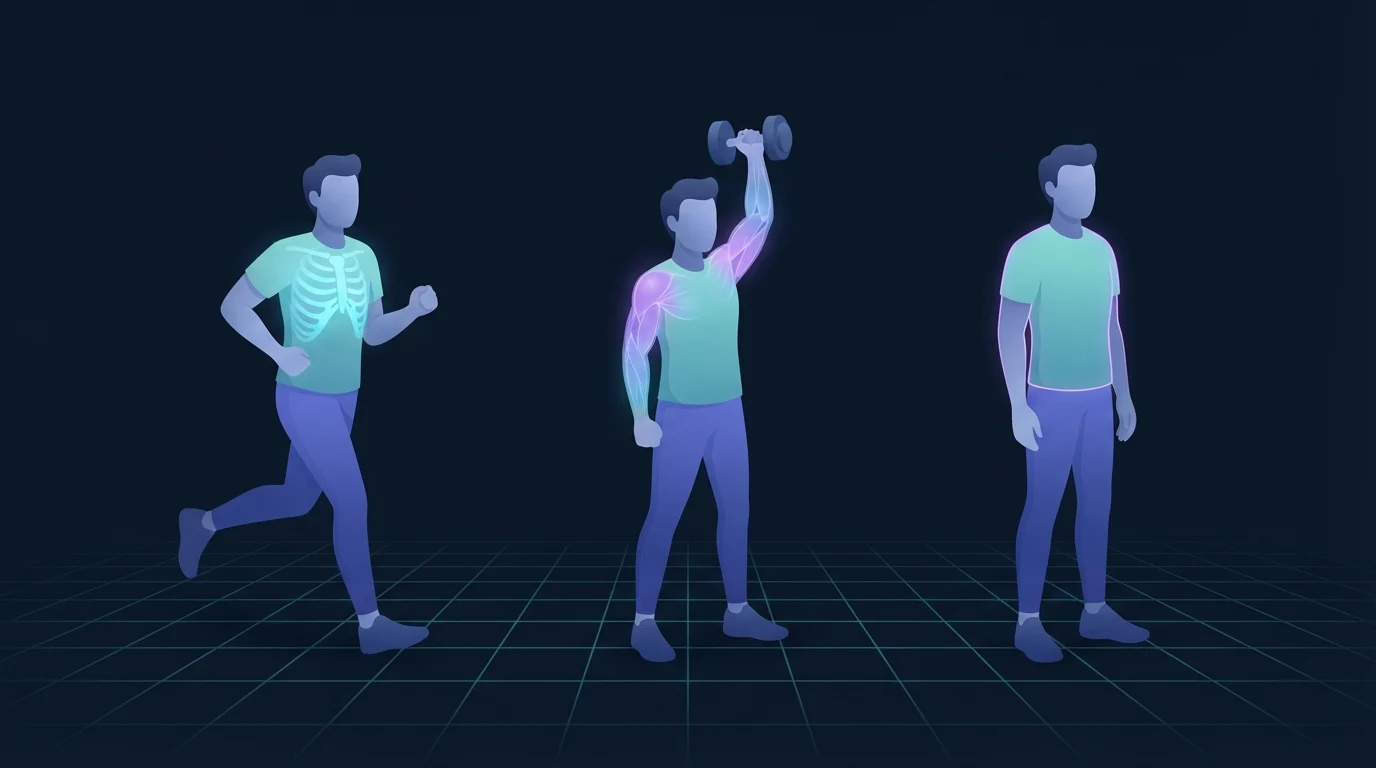
Ask ten people what "in shape" means and you'll get three answers wearing one label. One person means they can run for the bus without their heart rate telling them about it for ten minutes. Another means they can carry both suitcases up the stairs in one trip. A third means they like what they see in a fitted shirt.
Those are three different physiological projects. They respond to different training, they're measured with different tools, and they arrive on wildly different schedules. Asking how long it takes to get in shape without saying which one you mean is like asking how long it takes to get somewhere without saying where.
So here's the plan. We'll define each version, give the evidence-based timeline for it, then put all three on one week-by-week table. After that: the three things that genuinely speed this up, and the five things that quietly add months.
"In Shape" Means Three Different Things
Before the timelines, the definitions. Each one has a real measurement behind it, which matters because it's the difference between guessing whether you're improving and knowing.
Cardiorespiratory fitness
The ceiling on how much oxygen your body can take in and use, measured as VO2 max in millilitres of oxygen per kilogram of body weight per minute. It's the single best-studied marker of aerobic fitness and it tracks with how you feel on stairs, hills and long walks. You don't need a lab to watch it move. Resting heart rate, how fast your heart rate comes down after a hard minute, and how far you can walk or run in a fixed twelve minutes all move in the same direction.
Strength
How much force you can produce. Measured in reps at a given weight, or in weight at a given rep count. This is the one that responds fastest and the one beginners most consistently underestimate, because the first several weeks of improvement don't require any new muscle at all.
Body composition
The ratio of fat to lean tissue, which is what almost everybody actually means when they say they want to get in shape but is the slowest of the three to change visibly. This one is largely a nutrition project with a training component, not the other way around, and it's the clock most likely to make someone quit at week five.
For a baseline target, the Physical Activity Guidelines for Americans (Piercy et al., 2018) in JAMA ask adults for 150 to 300 minutes of moderate aerobic activity a week plus muscle-strengthening work on two or more days. Hitting that consistently is the dose every timeline below assumes.
Cardio: 8 to 12 Weeks for a Real VO2 Max Jump
Aerobic fitness improves on a curve that starts moving almost immediately and takes a couple of months to produce a change worth putting a number on.
The clearest picture of the magnitude comes from Milanovic, Sporis and Weston (2015) in Sports Medicine, who pooled 28 controlled trials covering 723 healthy young to middle-aged adults. Continuous endurance training improved VO2 max by 4.9 mL/kg/min against no-exercise controls. Interval training improved it by 5.5, a small extra edge of about 1.2 mL/kg/min. For context, a sedentary 40-year-old often sits somewhere around 30 to 35 mL/kg/min, so that's roughly a 15 percent improvement from a couple of months of work.
For the timeline specifically, Helgerud and colleagues (2007) in Medicine and Science in Sports and Exercise ran 40 moderately trained men through 8 weeks of training at three sessions a week. The group doing four-minute intervals at 90 to 95 percent of maximum heart rate gained about 7 percent in VO2 max, beating groups doing the same total work at easier intensities. Eight weeks, three sessions a week, one clear jump. The Norwegian 4x4 protocol is that exact session, and our breakdown covers how to run it without a track or a lab.
The front end of the curve is faster than either of those suggests. Talanian and colleagues (2007), in the Journal of Applied Physiology, put eight women through seven interval sessions across two weeks and measured a 13 percent rise in VO2 peak plus a 36 percent increase in fat oxidation during exercise. Two weeks. Small sample, trained protocol, but the direction is real and it matches what beginners report: the stairs get easier long before anything else does.
The practical read is that mitochondria and blood volume respond in days to weeks, while the cardiac and vascular changes that set your actual ceiling take the full 8 to 12. If your goal is endurance rather than a number, our guide on how to increase stamina covers the pacing side of that build.
Strength: The First Gains Arrive in 2 to 4 Weeks
Strength is the fastest clock in the building, and the reason is that the first month of progress is mostly a software update.
Moritani and deVries (1979) trained seven men and eight women for 8 weeks and separated how much of the strength increase came from neural factors versus actual muscle growth. Neural factors accounted for the larger share of the early increase, with hypertrophy only becoming the dominant contributor after roughly the first 3 to 5 weeks. Your nervous system gets better at recruiting motor units, firing them in sync and switching off the muscles that were fighting the movement. None of that requires a bigger muscle. All of it makes you stronger.
That's why a beginner can add reps almost every session for the first month and then feel like progress stalls. Nothing stalled. The easy adaptation finished and the slow one took over.
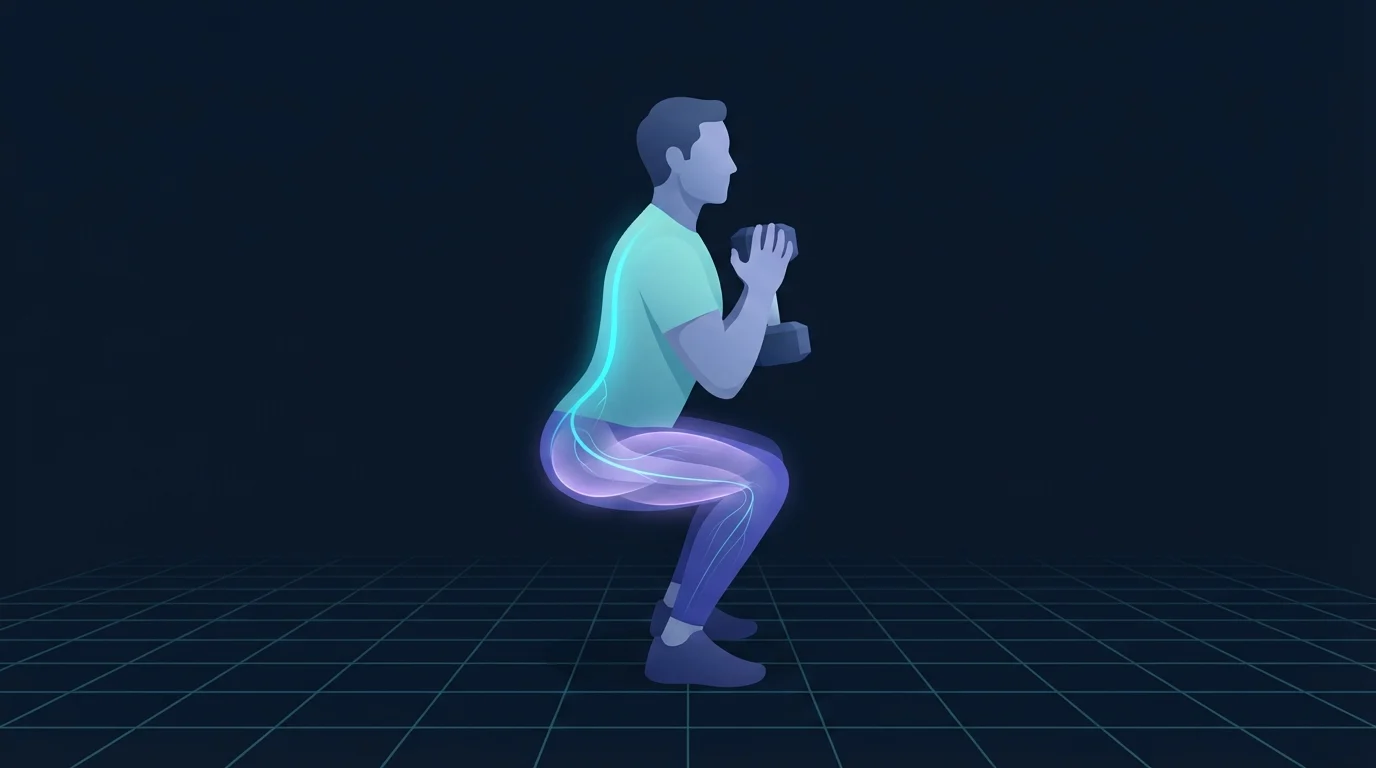
Concrete expectations for an untrained adult training two or three days a week with dumbbells or bodyweight:
- Sessions 1 to 3: almost everything feels awkward and you're sore in places you didn't plan for. This is normal and it fades.
- Week 2 to 4: the same weight moves for several more reps. Push-ups go from 4 to 9. A goblet squat that felt heavy feels like a warm-up.
- Week 6 to 8: progress slows to a steadier climb, and this is when structure starts mattering more than effort.
- Week 12: you're substantially stronger than you were and the numbers now move in small increments rather than leaps.
If you don't have a structure yet, a full body workout routine two or three days a week is the highest-return shape for a beginner, because it hits every muscle group often enough to keep the neural adaptations coming.
Knowing what to do is the easy part.
FitCraft, our mobile fitness app, pairs you with an AI coach who builds you a personalized plan around your goals, schedule, and fitness level. Every FitCraft program is designed by Domenic Angelino, MPH (Brown University) and NSCA-CSCS, with research published in the Journal of Strength and Conditioning Research and Medicine & Science in Sports & Exercise.
Take the Free Assessment Free • 2 minutes • No credit cardLooking Different: 8 to 12 Weeks Before Anyone Else Notices
This is the clock everyone is secretly asking about, and it's the slowest of the three for two separate reasons.
The first is measurement noise inside your own muscle. Damas and colleagues (2016), in The Journal of Physiology, tracked untrained men through weeks 1, 3 and 10 of resistance training and found that muscle damage was highest in week 1, lower by week 3 and minimal by week 10. Early increases in muscle thickness largely reflect swelling and repair rather than new contractile tissue. The authors are explicit that separating edema from true hypertrophy is the hard part of reading any short study. Translated: the pumped, fuller look in week 2 is real but it isn't muscle yet. Around week 10 it is.
The second reason is arithmetic. Visible change on the fat side needs several pounds of fat gone, and a sustainable rate puts that at roughly 0.5 to 1 percent of body weight a week. Our breakdown of how much weight you can lose in a month runs those numbers by starting weight, and the short version is that the mirror needs about 10 to 15 pounds before other people start commenting.
Put the two together and the honest visible-change timeline for someone training three or four days a week and eating with some intent is: clothes fit differently at 6 to 8 weeks, you notice in photos at 8 to 12, and other people say something between 12 weeks and 6 months.
What Changes Week by Week
All three clocks on one page. This assumes an untrained adult training three or four days a week, mixing strength and aerobic work, and sleeping something close to seven hours.
| Timeframe | Cardio | Strength | What you notice |
|---|---|---|---|
| Weeks 1 to 2 | Breathing steadies sooner after effort | Coordination improves, soreness peaks | Better sleep, better mood, stairs feel easier |
| Weeks 3 to 4 | Resting heart rate starts dropping | Clear rep and load increases | Sessions stop feeling like an event |
| Weeks 5 to 8 | Longer efforts at the same effort level | Growth begins contributing, progress steadies | Clothes start fitting differently |
| Weeks 9 to 12 | Clear VO2 max improvement | Visible muscle definition in trained areas | You see it in photos |
| Months 4 to 6 | Aerobic base supports real endurance work | Strength roughly doubles from untrained in some lifts | Other people comment |
Two honest caveats. Your starting point moves every row: someone who trained for years in their twenties comes back faster than someone who never did. And every row assumes you're still training, which is the variable that fails far more often than the physiology does.
The Three Things That Genuinely Speed This Up
Most of what gets sold as an accelerator is noise. These three actually compress the timeline.
1. Frequency beats session length
Three 30-minute sessions beat one 90-minute session for every adaptation on this page, because each session is a separate signal and the body responds to signal count more than to total minutes in one sitting. It's also far easier to protect 30 minutes three times than 90 minutes once. Our breakdown of how many days a week you should work out works through where the returns actually flatten.
2. Intensity, in a controlled dose
The interval edge in the Milanovic meta-analysis was small but real, and the Helgerud and Talanian results both came from hard intervals rather than steady easy work. One or two genuinely hard sessions a week, with the rest kept easy, moves the aerobic clock faster than the same total volume at one moderate speed. The catch is that intensity is also what gets beginners injured, so it belongs after a few weeks of base, not on day three.
3. Protein and sleep
Both are unglamorous and both are load-bearing. Protein at roughly 1.6 grams per kilogram of body weight per day supports the rebuild that turns training into adaptation. Seven or more hours of sleep does the same job from the other direction. Neither adds a workout to your week and both make the workouts you already do count for more.
The Five Mistakes That Quietly Add Months
- Starting at week eight's intensity on day one. The most common way to turn a 12-week timeline into a 20-week one is three brutal sessions followed by a strained calf. Your heart and muscles adapt faster than your tendons and ligaments, which is exactly why an on-ramp exists.
- Changing the program every two weeks. Progress needs a constant to measure against. If the exercises change every fortnight you can't tell whether you're improving, and neither can the adaptation.
- Judging the whole project by the mirror. The slowest of the three clocks is the one most people check daily. Track reps, loads, resting heart rate and how a fixed walk feels. Those move weeks before your reflection does.
- Doing only cardio, or only lifting. Each one leaves a different half of the definition untouched. A runner who never lifts and a lifter who gets winded on stairs are both partway in shape.
- Stopping for three weeks and calling it a reset. Mujika and Padilla (2000), reviewing short-term detraining in Sports Medicine, found aerobic capacity declines within the first few weeks of insufficient training alongside falls in blood volume and cardiac output. Strength holds up better. A missed week costs you almost nothing, and a missed month costs you the aerobic clock.
What This Means for You
If you start this week and train three or four days, here's what you're actually signing up for. Two weeks from now you'll sleep better and climb stairs more easily, and you'll have very little to show anyone. Four weeks from now your numbers will have moved enough that you know it's working. Eight to twelve weeks from now the aerobic change is real, the mirror has started cooperating, and the sessions have become something you do rather than something you psych yourself up for.
Six months from now you're a different athlete, and the honest surprise is that nothing dramatic happened on any particular day. The timeline is not slow because the body is stubborn. It's slow because adaptation is a rebuilding process and rebuilding takes the time it takes.
Which makes the real question a different one. Not how long it takes, but what makes you still be doing it in week ten, because that's the only variable in this article you fully control. If the honest answer is that you've started and stopped before, that's a design problem rather than a discipline problem, and our roundup of the best fitness apps for beginners compares the tools built specifically to get a new trainee through the weeks where nothing visible is happening yet.
Frequently Asked Questions
How long does it take to get in shape?
It depends which kind of fitness you mean, because three separate clocks are running. Strength moves first: Moritani and deVries (1979) showed the earliest gains come from neural adaptation, which dominates until about week 3 to 5, so a beginner is measurably stronger inside 2 to 4 weeks. Aerobic fitness moves next, with meaningful VO2 max improvement at 8 to 12 weeks of consistent training. Visible body composition change is last, typically 8 to 12 weeks before other people notice. A fair single answer for an untrained adult training three or four days a week is 8 to 12 weeks to feel genuinely fit and about 6 months to look it.
How long does it take to improve VO2 max?
Eight to twelve weeks for a clear change, with the first measurable movement inside 2 to 4 weeks. Milanovic, Sporis and Weston (2015) pooled 28 controlled trials covering 723 participants and found VO2 max rose by 4.9 mL/kg/min with continuous endurance training and 5.5 mL/kg/min with high-intensity interval training against no-exercise controls. Helgerud and colleagues (2007) got roughly a 7 percent gain from 8 weeks of 4 by 4 minute intervals three times a week. Even two weeks does something: Talanian and colleagues (2007) raised VO2 peak 13 percent with seven interval sessions.
How long does it take to see results from working out?
You feel results before you see them. Weeks 1 to 2 bring better sleep, better mood and less breathlessness on stairs. Weeks 3 to 4 bring measurably more reps and heavier weights. Weeks 6 to 8 are when clothes start fitting differently. Weeks 8 to 12 are when other people comment. Damas and colleagues (2016) explain part of the delay: early increases in muscle thickness are largely swelling and damage rather than new muscle, and true hypertrophy only becomes clean to measure around week 10.
How long does it take to get in shape after being sedentary for years?
Longer to start and faster to progress. Expect 2 to 3 weeks of a deliberately easy on-ramp before the real program begins, because tendons, ligaments and connective tissue adapt more slowly than muscle and heart. After that, an untrained body improves faster than a trained one on every measure, so the 8 to 12 week timeline still applies from the end of the on-ramp. The Physical Activity Guidelines for Americans (Piercy et al., 2018) set the target at 150 to 300 minutes of moderate activity a week plus two muscle-strengthening days, and building to that over a month is a reasonable first goal.
How long before you lose fitness if you stop?
Faster than most people expect for cardio, slower than most people fear for strength. Mujika and Padilla (2000) reviewed short-term detraining and found aerobic capacity starts declining within the first two to four weeks of insufficient training, alongside drops in blood volume and cardiac output. Strength holds up better over the same window. The practical version: a two-week holiday costs you almost nothing you can't get back in a week, and a three-month stop means restarting the aerobic clock, not the strength one.
Can you get in shape in 30 days?
You can make real, measurable progress in 30 days, and you can't finish the job. Thirty days is enough for a large strength jump, a noticeable drop in resting heart rate, better sleep and an easier flight of stairs. It isn't enough for a clear VO2 max change or for visible body composition change in most people. The most valuable thing a 30-day block produces is not a result. It's a habit that's still running in week 12, which is when the results you actually want start arriving.
How many days a week do you need to train to get in shape?
Three or four days covers almost everyone. The Physical Activity Guidelines for Americans (Piercy et al., 2018) ask for 150 to 300 minutes of moderate aerobic activity per week plus muscle-strengthening work on two or more days, which fits comfortably into three or four sessions. Going from zero days to three is where nearly all of the gain is. Going from four days to six changes the timeline far less than people assume and raises the odds of quitting, which is the only thing that reliably resets the clock to zero.