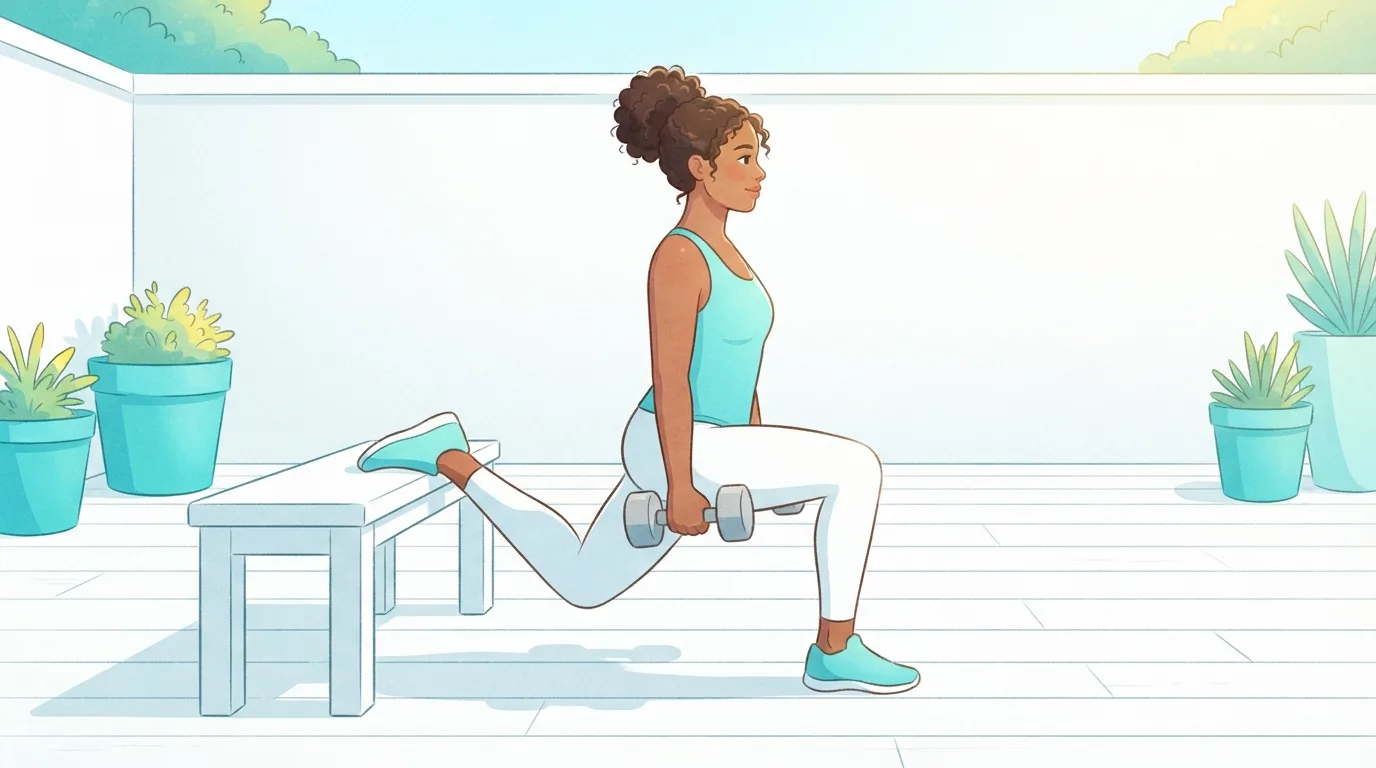
Maybe you've tried a 30-day glute challenge. Hundreds of bodyweight squats, donkey kicks every night, a burn you could definitely feel. A month later your jeans fit exactly the way they did before.
That's discouraging, and it's easy to decide that your body just doesn't build glutes. It does. The challenge format is what failed you: the same easy moves repeated until they stop being hard, with no plan for making them harder.
Learning how to grow glutes comes down to a short list of rules applied for a long time. Below you'll find how the three glute muscles work, what the EMG and hypertrophy studies found when they pitted hip thrusts against squats, how many sets a week you need, and a two-day glute workout with dumbbells and body weight that tells you exactly when to make it harder.
Glute Anatomy: Three Muscles With Different Jobs
"Glutes" means three muscles on each side, layered from the surface inward.
- Gluteus maximus. The largest and most superficial of the three, and the one that gives your backside its shape. Its main job is hip extension: driving you up out of a squat, up a flight of stairs or forward in a sprint. It also rotates the thigh outward.
- Gluteus medius. Sits on the outer hip, partly under the gluteus maximus. It lifts the leg out to the side and keeps your pelvis level when you stand on one foot. It's also a powerhouse: when Ward and colleagues (2009) dissected 21 lower limbs and measured each muscle's physiological cross-sectional area, the gluteus medius ranked with the soleus and vastus lateralis as one of the three strongest muscles in the leg.
- Gluteus minimus. The smallest and deepest, under the medius. It helps the medius steady the pelvis.
The gluteus maximus also has an upper and a lower region that don't always work equally. Selkowitz, Beneck and Powers (2016) placed fine-wire electrodes in both regions in 20 healthy adults and tested 11 exercises. The upper part worked harder than the lower part in the five exercises that included moving the leg out to the side or rotating it outward. In the moves built mainly on hip extension, both regions worked to a similar degree.
The practical upshot: loaded hip extension (squats, lunges, hinges and bridges) trains the whole gluteus maximus, and a small dose of side-to-side and one-leg work covers the upper glute and the medius.
Hip Thrust vs Squat: What the EMG and Hypertrophy Studies Show
For a decade the argument over the best glute exercise ran on electromyography (EMG), which measures the electrical activity of a muscle through sensors on the skin. Higher activity was assumed to mean more growth. The trials that followed tested that assumption directly.
The EMG case for the hip thrust
Contreras and colleagues (2015) had 13 trained women perform an estimated 10-rep max on the back squat and the barbell hip thrust. Mean activity in the upper gluteus maximus was 69.5 percent of maximum during the hip thrust against 29.4 percent in the squat. The lower gluteus maximus showed the same pattern, at 86.8 against 45.4 percent. The authors wrote that training studies were needed to see whether the extra activity turned into extra muscle.
A wider net found plenty of contenders. Neto and colleagues (2020) reviewed 16 EMG studies of loaded hip-extension exercises and classed more than a dozen as very high activation, above 60 percent of a maximal contraction. Step-ups and their variations topped the list, followed by deadlifts, hip thrusts, lunges, split squats and some squat variations.
The hypertrophy trial that tested it
Plotkin and colleagues (2023) randomized 34 untrained college-aged adults to hip thrusts or back squats with the same number of sets, for 9 weeks and 15 to 17 supervised sessions. In the first session they recorded EMG, and the hip thrust beat the squat at every gluteal site measured. Then they measured the glutes by MRI before and after training.
- Glute growth was similar. The estimates leaned slightly toward the hip thrust for the lower, middle and upper glutes, but the differences were small and the ranges overlapped zero.
- The higher EMG didn't predict who grew more. The muscle activity measured in session one wasn't a reliable guide to the gluteal growth measured nine weeks later.
- Squats built more elsewhere. The squat group gained more muscle in the quadriceps and the adductors of the inner thigh.
- Strength followed the exercise. Each group improved most on the lift it practised, and deadlift strength rose by the same amount in both.
- The side glutes barely changed. Neither exercise produced much growth in the gluteus medius and minimus.
That result fits a broader warning. Vigotsky and colleagues (2022) argued in Sports Medicine that surface EMG amplitude has never been validated as a predictor of long-term muscle growth, so studies that rank exercises by activation alone deserve scrutiny. EMG tells you a muscle is working. It doesn't tell you how much that muscle will grow.
So choose glute exercises you can load, progress and do with good form, and use a mix: a squat or lunge pattern, a hip hinge, a bridge or thrust, and a little side work for the medius.
What Is the Number One Glute Growing Exercise?
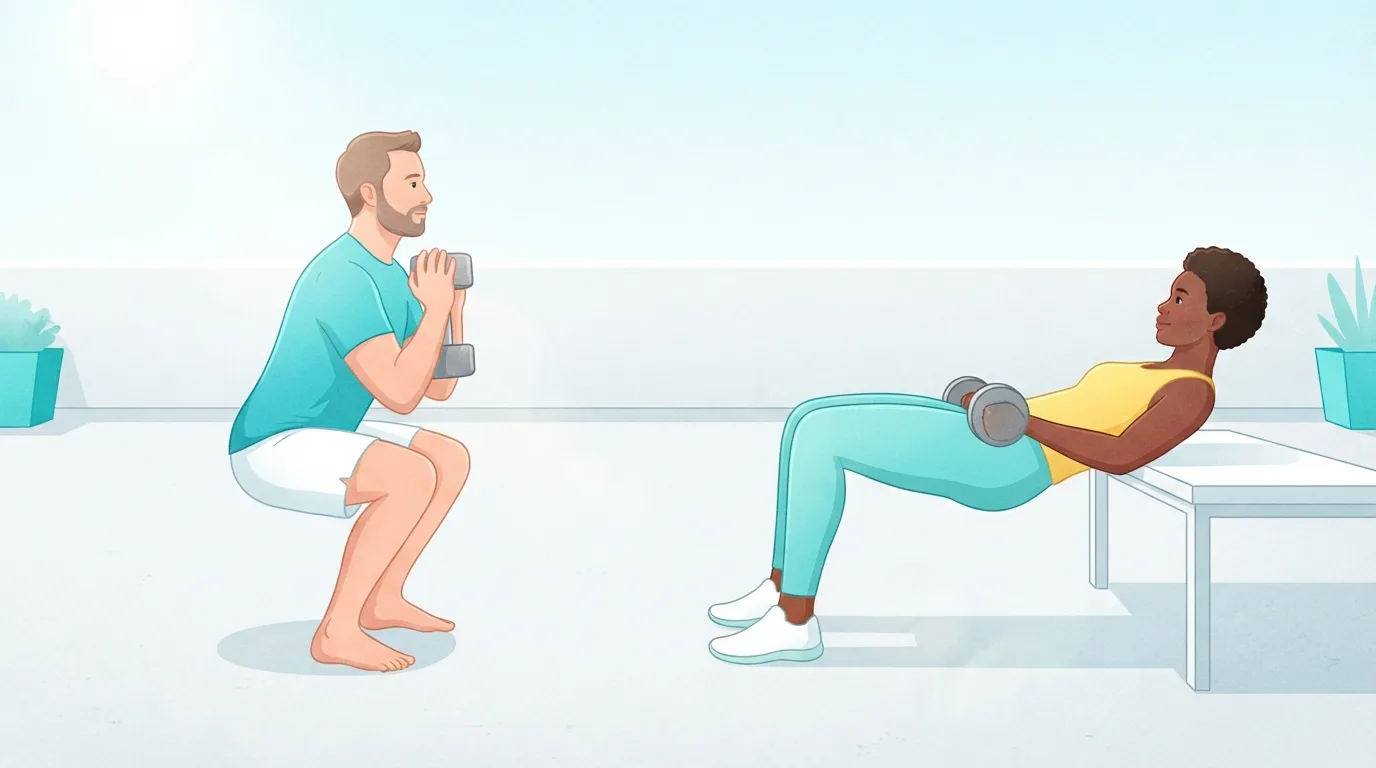
There isn't one. If you train at home with dumbbells, three moves give you the most for your effort:
- Bulgarian split squats load one leg at a time and take the glute of the front leg into a deep stretch at the bottom, so a light pair of dumbbells feels heavy.
- Dumbbell Romanian deadlifts train the hip hinge, working the glutes and hamstrings from a long, stretched position.
- Dumbbell hip thrusts load the glutes hardest near the top, where the hips are fully extended. Rest your upper back on the edge of a sofa or a sturdy bench and set a dumbbell across your hips. The floor version is the glute bridge.
Step-ups onto a sturdy chair or box earn a place too, given how high they rank for activation. If you have no equipment at all, our list of the best glute exercises at home builds a bodyweight-only progression, and this guide doesn't repeat it.
How Many Sets for Glutes Per Week?
Aim for at least 10 hard sets a week. Most people can work up to around 16 once the movements feel familiar and they're recovering well between sessions. Our review of how many sets per muscle group per week walks through the dose-response studies: around 10 weekly sets is where growth becomes reliable, and 4 is the smallest dose that produces measurable change. A set counts when it ends within about 3 reps of failure.
Squats, lunges, split squats, step-ups, Romanian deadlifts and hip thrusts all count as glute sets, which the Plotkin trial supports for squats. Light activation drills done far from failure don't count, however much they burn.
How Often Should You Train Glutes?
Two or three times a week. Schoenfeld, Ogborn and Krieger (2016) pooled 10 studies that compared training frequencies with the total work matched, and training a muscle twice a week produced more growth than once a week. Whether three sessions beat two was still unclear. Splitting your weekly sets over two or three days also keeps each session short enough that the last set is still a hard one. Leave roughly 48 hours between hard glute days.
Find out what's really holding you back
FitCraft, our mobile fitness app, pairs you with an AI coach who builds you a personalized plan around your goals, schedule, and fitness level. Every FitCraft program is designed by Domenic Angelino, MPH (Brown University) and NSCA-CSCS, with research published in the Journal of Strength and Conditioning Research and Medicine & Science in Sports & Exercise.
Take the Free Assessment Free • 2 minutes • No credit cardA Dumbbell and Bodyweight Glute Workout Plan
This glute workout plan uses two sessions a week, A and B, with at least two days between them. It needs a pair of dumbbells, a sturdy bench, sofa or step, and a mat. Warm up with five minutes of easy movement plus a set of bodyweight bridges, or use the drills in our glute activation exercises guide. Rest about two minutes between sets of the first three exercises and one minute for the last.
| Workout | Exercise | Sets | Reps |
|---|---|---|---|
| A | Goblet squat | 3 | 8 to 12 |
| A | Dumbbell hip thrust, upper back on a bench or sofa | 3 | 10 to 15 |
| A | Rear lunge holding dumbbells | 2 | 8 to 12 per leg |
| A | Fire hydrants | 2 | 12 to 20 per side |
| B | Dumbbell Romanian deadlift | 3 | 8 to 12 |
| B | Bulgarian split squat holding dumbbells | 3 | 8 to 12 per leg |
| B | Dumbbell step-up onto a sturdy box or chair | 2 | 8 to 12 per leg |
| B | Clamshells | 2 | 15 to 20 per side |
At the full numbers that's 16 hard sets of hip extension a week, plus 4 sets of side work for the medius. For the first two weeks, do 2 sets of everything while you learn the movements, which gives you 12 glute sets a week, then move to the numbers in the table. If you'd rather train three days a week, alternate the workouts: A, B, A one week and B, A, B the next.
Every set should end with 1 to 3 reps left in the tank. If you could have done 6 more, the set was too easy to count. If you're training in a gym, a barbell hip thrust or squat can replace its dumbbell version, but nothing in this plan requires one.
How to progress: the double-progression rule
Progressive overload is what turns this plan into glute growth, and the simplest way to apply it is double progression.
- Start at the bottom of the rep range. Choose a dumbbell you can lift for the lowest number of reps in the range with 2 or 3 reps to spare.
- Add reps first. Each session, try to beat last time by a rep or two on at least one set while keeping the form identical.
- Then add weight. When every set reaches the top of the range, move to the next dumbbell, usually 1 to 2.5 kilograms (2.5 to 5 pounds) heavier, and drop back to the bottom of the range.
- When the dumbbells run out, make the rep harder. Take three seconds to lower, pause for a second at the bottom of split squats and at the top of hip thrusts, switch to one leg (a single-leg hip thrust or single-leg deadlift), or stand the front foot on a low step to deepen the split squat.
Write down the weight and reps for every set. Without a record, it's almost impossible to know whether you beat last week, and that comparison is the whole engine of the plan.
How Long Does It Take to Grow Glutes?
Longer than a challenge, shorter than most people fear. In the Plotkin trial, nine weeks and 15 to 17 sessions were enough for untrained adults to show gluteal growth on MRI. Here's the usual sequence for a beginner who trains twice a week:
- Weeks 1 to 3: The weights climb quickly, mostly because your nervous system is learning the movements. Your glutes may be sore after the first sessions, and that fades.
- Weeks 4 to 8: Muscle growth is under way but hard to see in the mirror. Keep progressing.
- Months 2 to 3: Most people notice that jeans fit differently across the seat.
- Months 6 to 12: Shape changes that other people can see, if the loads keep climbing.
Our review of how long it takes to build muscle explains why gains come fastest in the first year and slow down after.
Signs your glutes are growing
- You're using heavier dumbbells, or more reps, for the same exercises than you did a month ago.
- Your jeans or shorts feel tighter across the seat while your waist measurement stays the same.
- A tape measure around the widest part of your hips, taken at the same time of day every four weeks, creeps up.
- Side-on photos in the same spot and light, every four weeks, show more shape under the hip.
How to Grow Your Glutes With Food
Training is the signal and food is the material. The best-supported number is protein. Morton and colleagues (2018) pooled 49 trials with 1,863 participants and found that extra protein increased gains in muscle size and strength from resistance training, with no further gain in lean mass once total intake passed about 1.6 grams per kilogram of body weight a day. For a 70-kilogram person that's roughly 110 grams a day, easiest to reach as 25 to 40 grams across three or four meals.
Calories matter too. Eating at maintenance or slightly above gives a beginner the easiest path to growth. You can still build glutes while losing fat, especially in your first year of training, but expect the change to show more slowly. Whole foods do the job, and protein powder is only a convenience.
How Can I Become Glute Dominant?
"Glute dominant" usually means feeling your glutes, rather than your quads or lower back, do most of the work. Three changes help:
- Lengthen the stride. In split squats and lunges, a longer step and a slight forward lean of the torso shift more of the work to the hip of the front leg.
- Hinge, don't bend. In Romanian deadlifts, push your hips back with soft knees and a flat back until you feel a stretch high in the hamstrings, then drive the hips forward to stand.
- Finish with the hips. At the top of thrusts and bridges, lock out by squeezing the glutes rather than arching your lower back. Your ribs stay down and your chin stays tucked.
If you struggle to feel your glutes at all, a few minutes of low-load drills before the session can make the main lifts easier to coach yourself through.
How to Grow Glutes as a Woman
The plan above works the same for women and men. Roberts, Nuckols and Krieger (2020) pooled 10 studies that put women and men through the same resistance training and found no meaningful difference in relative muscle growth. Women do start smaller in absolute terms and tend to store more fat on the hips and thighs, which changes how growth shows, not how it happens. Use the same exercises, the same set targets and the same progression rule.
The Bottom Line
Glutes grow from ordinary exercises done consistently. Train squats, lunges, hinges and thrusts close to failure for about 10 to 16 sets a week, add a rep or a few pounds whenever you've earned it, eat enough protein, and give it months rather than weeks. The hip thrust is a great tool, and the squat turned out to be just as good for the glutes in the one trial that measured both.
Most people stall around week five, when progress is invisible and the novelty has worn off. FitCraft's dumbbell and bodyweight programs put an AI coach beside you as a 3D character who demonstrates each exercise and says your name mid-workout, and a streak that makes skipping feel like it costs something. Our dumbbell workout app page shows how those programs progress. One user, Mike, 23, got visibly stronger in four months and put it simply: "The streak system got me hooked. I didn't want to break my chain."
Frequently Asked Questions
What are the best glute exercises based on scientific evidence?
Hip thrusts, squats, split squats, lunges, step-ups and Romanian deadlifts all have good evidence. A 2020 review of 16 EMG studies ranked step-ups, hip thrusts, deadlifts, lunges and split squats among the moves with the highest glute activity, and a 2023 MRI trial found hip thrusts and squats grew the glutes by similar amounts. Pick a few you can load and progress.
How often should you train glutes?
Two or three times a week works for most people. A 2016 meta-analysis found that training a muscle twice a week grew it more than once a week when total sets were matched. Leave about 48 hours between hard glute sessions so you can push each one.
Will squeezing my buttocks strengthen glutes?
A little, at first. In a 2019 study of 32 students, Lehecka and colleagues found that eight weeks of daily glute squeezes raised hip extension strength about as much as daily bodyweight bridges. That was a small study with beginners and no added load, so squeezes are a useful extra, not a replacement for loaded glute workouts.
Is walking good for glute activation?
Walking uses your glutes, but at a low effort that won't make them grow in someone who already walks every day. Uphill walking and stairs ask more of the glutes than flat walking. For growth you need sets that get hard within 8 to 15 reps, which walking can't provide.
How long does it take to grow glutes?
Growth is measurable on an MRI scan within about nine weeks of consistent training, based on a 2023 trial in untrained adults. Most people notice a difference in how their jeans fit after two to three months, and a clear change in shape takes six months or more of steady progression.
Can you grow glutes without weights?
Yes, especially as a beginner. Single-leg bridges, split squats and slow, deep lunges can be taken close to failure with body weight alone. Once you can do more than about 20 reps, a pair of dumbbells makes it much easier to keep the sets hard.