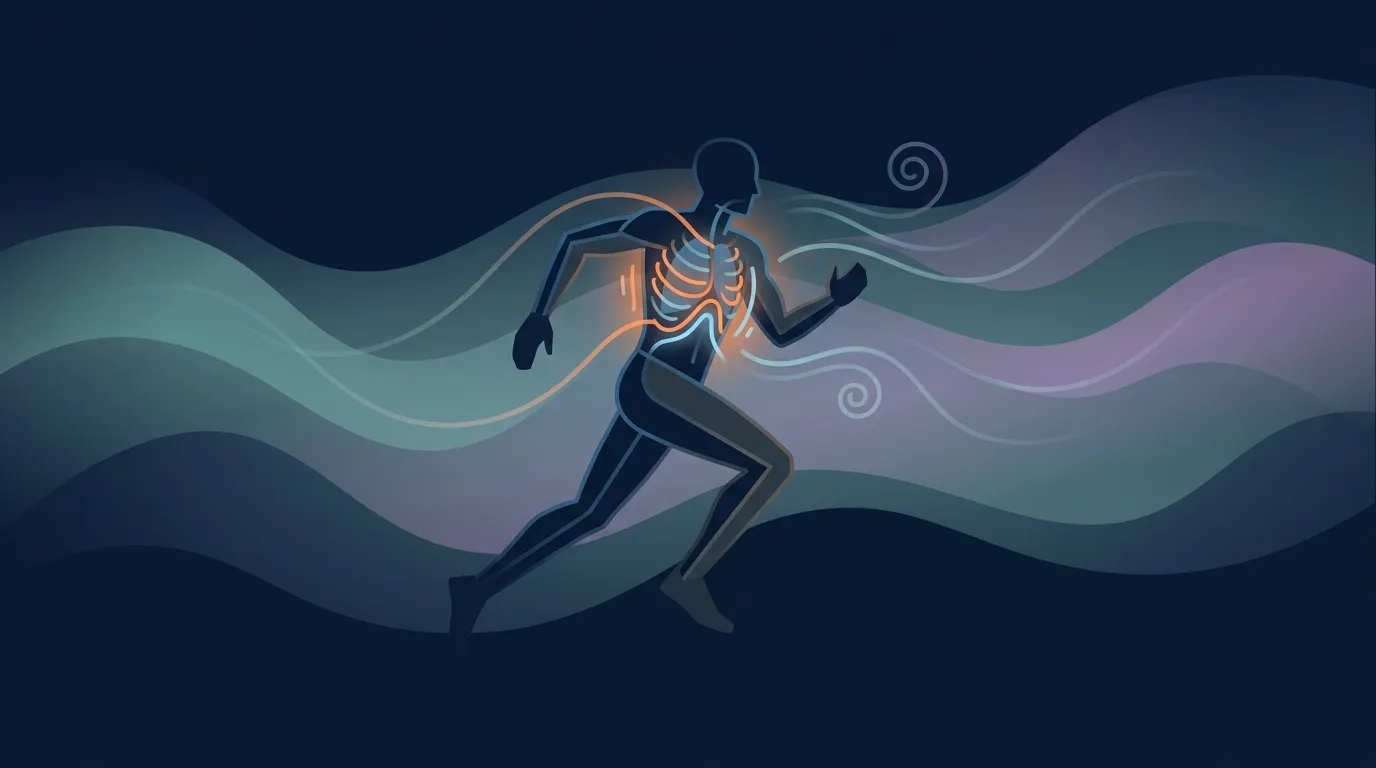
For most of training history, the chest was considered passive. You ran or cycled, and your lungs delivered the air. Effort, the thinking went, lived in the legs. Then in the early 2000s a small group of British physiologists started measuring what happens when you specifically train the diaphragm and the intercostals against pressure. The performance numbers that came back were big enough that the field stopped treating breathing as a fixed input and started treating it as a trainable variable.
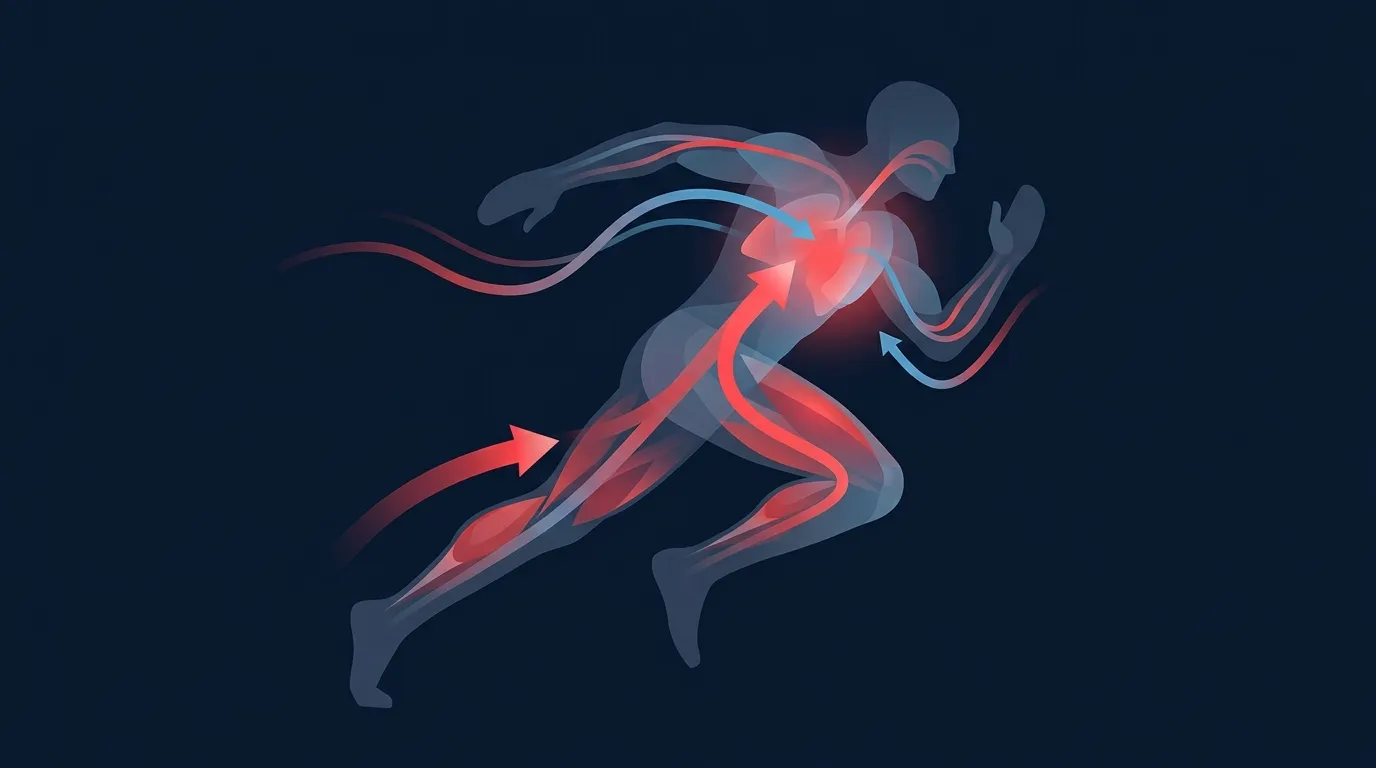
The mechanism is interesting. Inspiratory muscle training (IMT) doesn't really make you "more aerobic." It interferes with a reflex. When the diaphragm fatigues, type III and IV afferents fire. Your sympathetic nervous system clamps down on blood vessels in your working limbs to protect oxygen delivery to the failing breathing muscles. Train the diaphragm to fatigue less, and that vasoconstriction reflex (the inspiratory metaboreflex) fires later and weaker. More blood stays at the legs. Time to exhaustion goes up.
This piece walks through the trials that matter, what the protocols look like, and what the evidence does and doesn't support. It complements our coverage of VO2 max and longevity and our practical guide to zone 2 cardio, both of which assume your breathing apparatus is up to the work.
The Research: What Studies Show
Romer 2002: 4.6% Off a 40 km Time Trial
The trial that put IMT on the map is Romer, McConnell, and Jones (2002) in the Journal of Sports Sciences. The team at the University of Birmingham recruited 16 trained male cyclists (mean VO2max 64 ml/kg/min, well into the competitive range) and randomized them double-blind to either pressure-threshold IMT or sham training. The active group did 30 breaths twice a day at 50% PImax for 6 weeks. Controls did the same number of breaths at 15% PImax (a load too low to drive adaptation).
The numbers:
- 20 km time trial: 3.8% faster vs placebo
- 40 km time trial: 4.6% faster vs placebo
- Maximal inspiratory pressure (PImax): +28% in the active group, no change in controls
- Perceived exertion at fixed power: meaningfully lower
In trained cyclists, a 4.6% gain on a 40 km time trial is enormous. It is the kind of margin that separates the top 5 from the top 50 in a real race. And the controls actually did breathe through the same device at the same cadence. The signal isn't a placebo on cadence or device theater. It's the load.
Illi 2012: The Meta-Analysis That Settled the Debate
For years there was a back-and-forth about whether the early IMT trials were too small. Illi, Held, Frank, and Spengler (2012) in Sports Medicine pulled together 46 trials of respiratory muscle training (RMT, the umbrella that includes IMT and expiratory muscle training) in healthy subjects and ran a proper systematic review and meta-analysis.
The headline finding: RMT produced a statistically and practically meaningful improvement in endurance exercise performance. The effect was strongest with the resistive/threshold strength protocols (which is what IMT typically uses) and with endurance hyperpnoea protocols, both of which produced significant gains over controls. The improvement was larger in less-trained subjects and smaller (but still detectable) in highly trained athletes. Sport type mattered too. Cycling and rowing trials showed larger benefits than running trials, possibly because the upright torso during running already loads breathing musculature more during sport.
The Illi review also flagged an honest caveat. Not every individual trial reaches significance. Sample sizes are small. But the pooled effect across 46 trials goes in one direction. Respiratory muscles are trainable. Trained respiratory muscles improve endurance.
Witt 2007: The Mechanism — Reduced Blood-Stealing Reflex
The cleanest mechanism paper is Witt, Guenette, Rupert, McKenzie, and Sheel (2007) in the Journal of Physiology. The team tested whether IMT actually attenuates the inspiratory metaboreflex. They induced diaphragm fatigue in 8 subjects before and after 5 weeks of IMT and measured the cardiovascular response.
Before training, fatiguing the diaphragm jacked heart rate up 35% and mean arterial pressure up 17%. After 5 weeks of IMT, the same fatigue protocol jacked heart rate up only 27% and mean arterial pressure only 4%. The sympathetic clamp on the periphery got dramatically weaker. That's the smoking gun. The performance gains in Romer's cyclists aren't magic. They're vascular: when your diaphragm doesn't scream for blood, your legs get to keep it.
This converged with earlier work showing that inducing diaphragm fatigue in unfit people directly accelerates quadriceps fatigue during cycling. The respiratory and limb systems are coupled. Train one, partially un-couple the penalty on the other.
Ren 2025: The Modern Replication in Amateur Runners
The 2002 cyclist data is foundational. But most people aren't elite cyclists. Ren, Guo, He, Luo, and Wu (2025) in Life ran a randomized controlled trial on 30 male amateur runners. Subjects were assigned to high-intensity IMT (80% MIP), low-intensity IMT (50% MIP), or a control group. Both training groups did 8 weeks of supervised IMT on a flow-resistance breathing trainer.
What improved after 8 weeks:
- Maximal inspiratory pressure (PImax)
- Time to exhaustion on a graded treadmill test
- Blood lactate accumulation during the tolerance test (lower means less metabolic stress at the same workload)
- Rating of perceived exertion and dyspnea
The high-intensity group saw larger improvements in exercise tolerance than the low-intensity group. That maps to a dose-response curve the earlier work hinted at: light loading does build inspiratory strength a bit, but harder loading drives the actual endurance benefit. The trial used a relatively small sample (a known limitation of this literature), but the direction of effect was consistent with the prior 20+ years of work.
McConnell & Romer 2004: Resolving the Earlier Skepticism
In the late 1990s there was real disagreement in the field about whether IMT trials were properly blinded. The sham group was breathing through a device too. Was the perception of "doing real training" enough to drive the effect? McConnell and Romer (2004) in the International Journal of Sports Medicine wrote a methodological review that addressed this directly. The pattern that emerged across the better-controlled trials: when the sham load was set low enough to truly fail to recruit the inspiratory muscles, real IMT produced effects that the sham did not. The placebo argument doesn't hold up against the load-response curve. The breathing-against-resistance is doing the work, not the ritual.
Why This Matters for Your Training
Three honest implications fall out of this evidence base.
First, if you're a runner, cyclist, rower, or triathlete and you've never trained your breathing muscles directly, you have a small lever sitting on the table. The effect is biggest if you're a recreational athlete (the Illi meta-analysis is clear about this). Elite endurance athletes already have well-developed inspiratory musculature, so the headroom is smaller. But anyone training under 6 hours a week probably has untouched respiratory capacity that takes minutes a day to develop.
Second, the protocol is cheap and low-time. A pressure-threshold device costs about as much as a pair of running shoes you'll wear out in three months. The training takes 5 to 10 minutes a day. It does not interfere with your other training (you can do it on rest days, in the morning, watching TV). The Romer 2002 protocol of 30 breaths twice a day at 50% PImax remains the most cited starting point.
Third, the gain isn't in your aerobic capacity. It's in your tolerance of the same work. IMT doesn't typically raise VO2max. It lets you push closer to your VO2max for longer before the perception of effort and the metaboreflex shut you down. If you've ever felt your legs were "fresh" but your breathing capped you out at the same finish-line pace, IMT targets that exact failure mode. This connects to the same pattern we cover in training to failure vs. reps in reserve: small changes in perceived effort at high intensity translate into large changes in time to exhaustion.
How Inspiratory Muscle Training Works in Practice
The basic equipment is a handheld pressure-threshold or flow-resistance device that makes you inhale through a spring-loaded valve. Common brands include POWERbreathe and Threshold IMT. They cost roughly $30 to $100 depending on the model.
The Standard Protocol
- Load: 50% of your maximal inspiratory pressure (PImax). Most devices have approximate load settings. Start middle-of-the-range and adjust so 30 consecutive breaths feel like an 8 out of 10.
- Reps: 30 forceful, full inhales through the device. Exhale relaxed.
- Frequency: Twice a day, 5 to 6 days a week.
- Duration: 4 to 8 weeks for the first measurable performance change. Many athletes maintain after that with 1 session a day, 3 to 4 days a week.
- Progression: When 30 breaths at the current load feels easier than a 7 out of 10, bump the load up.
What Adapts
Maximal inspiratory pressure typically rises 20 to 40% inside the first month. Diaphragm thickness measured by ultrasound also increases (muscle hypertrophy of the diaphragm is a real, measurable thing). The blunting of the inspiratory metaboreflex is the slower adaptation and is the one that translates most directly to endurance.
When You'll Notice It
The first sign is usually in the breathing pattern at moderate efforts. The "I have to catch my breath after every climb" sensation eases. Pace at zone 3 (the comfortably-hard, just-under-threshold range) feels less suffocating. Race-pace efforts show the gain on the stopwatch, but the day-to-day feel shows up first.
This complements the steady-state cardio work we cover in zone 2 cardio at home. Zone 2 builds the mitochondrial side of endurance. IMT removes one of the perceptual ceilings that stops people from pushing into zone 4 when it counts.
Get an evidence-based plan built for you
FitCraft, our mobile fitness app, pairs you with an AI coach who builds you a personalized plan around your goals, schedule, and fitness level. Every FitCraft program is designed by Domenic Angelino, MPH (Brown University) and NSCA-CSCS, with research published in the Journal of Strength and Conditioning Research and Medicine & Science in Sports & Exercise.
Take the Free Assessment Free • 2 minutes • No credit cardCommon Misconceptions
Misconception: "Cardio already trains my breathing"
It trains the cardiovascular delivery system and the metabolic machinery in the legs. It under-trains the inspiratory muscles relative to their adaptive ceiling. Even elite endurance athletes show a measurable PImax increase after starting IMT. Running and cycling load the diaphragm at maybe 40 to 60% of its peak capacity. That's not enough resistance to drive specific strength adaptation. Adding a high-load resistance breathing session does.
Misconception: "It only helps unfit people"
The largest effect is in unfit and recreational athletes. The Romer 2002 trial used trained cyclists with VO2max in the 60s and still produced a 4.6% time trial improvement. Less headroom doesn't mean no headroom. Elite athletes get smaller relative gains. They still get gains.
Misconception: "Breathwork apps and box breathing replace IMT"
Different intervention, different goal. Box breathing, 4-7-8, and similar diaphragmatic breathing protocols are excellent for stress regulation, vagal tone, and parasympathetic recovery. They do not load the inspiratory muscles enough to drive a strength adaptation. Both can coexist in a routine. They are not substitutes.
Misconception: "Singing or wind instruments are the same thing"
They build breath control and capacity, but the load profile is different. IMT specifically loads inhalation against high resistance. Wind instruments and singing load exhalation more than inhalation. There's likely some overlap in benefit, but the research-validated endurance protocol is the resistive inhale.
What the Research Suggests Going Forward
A few honest caveats are worth flagging.
First, sample sizes in IMT trials remain small. The Illi 2012 meta-analysis pulls together 46 studies, but many had fewer than 20 subjects. The pooled effect is robust, but individual variation is real. Some people respond more than others, and we don't yet have great predictors of who.
Second, the cycling and rowing literature is stronger than the running literature. Some of this is methodological. Treadmill time-to-exhaustion is noisier than cycling power output. Some may be physiological. The upright running posture already pre-loads the diaphragm during sport. Cyclists in an aero tuck don't get that same baseline stress. The Ren 2025 RCT in runners is encouraging but the broader endurance-running literature could use larger trials.
Third, IMT does not appear to raise VO2max in healthy athletes. It improves performance and tolerance at submaximal and near-maximal intensities without moving the ceiling. This isn't a flaw. It's a feature: most race results are won and lost in the gap between threshold and VO2max, not at VO2max itself.
Fourth, the clinical IMT literature (COPD, asthma, heart failure, weaning from mechanical ventilation) is separate and the effects, contraindications, and protocols are different. The athletic protocol described here is for healthy adults. People with diagnosed lung disease, cardiac disease, recent surgery, or pregnancy should work with a clinician.
References
- Romer LM, McConnell AK, Jones DA. "Effects of inspiratory muscle training on time-trial performance in trained cyclists." J Sports Sci. 2002;20(7):547-562. PMID: 12166881
- Illi SK, Held U, Frank I, Spengler CM. "Effect of respiratory muscle training on exercise performance in healthy individuals: a systematic review and meta-analysis." Sports Med. 2012;42(8):707-724. PMID: 22765281
- Witt JD, Guenette JA, Rupert JL, McKenzie DC, Sheel AW. "Inspiratory muscle training attenuates the human respiratory muscle metaboreflex." J Physiol. 2007;584(Pt 3):1019-1028. PMID: 17855758
- Ren Z, Guo J, He Y, Luo Y, Wu H. "Effects of Inspiratory Muscle Training on Respiratory Muscle Strength, Lactate Accumulation and Exercise Tolerance in Amateur Runners: A Randomized Controlled Trial." Life (Basel). 2025;15(5):705. PMID: 40430134
- McConnell AK, Romer LM. "Respiratory muscle training in healthy humans: resolving the controversy." Int J Sports Med. 2004;25(4):284-293. PMID: 15162248
Frequently Asked Questions
Does inspiratory muscle training actually work?
The trial evidence in healthy athletes is reasonably positive. Romer, McConnell, and Jones (2002) ran a double-blind placebo-controlled trial on 16 trained cyclists and found 6 weeks of pressure-threshold inspiratory muscle training improved 20 km and 40 km time trial times by 3.8% and 4.6% above placebo. Illi and colleagues (2012) meta-analyzed 46 trials in healthy adults and reported a moderate average improvement in endurance. The effect size is bigger in less-trained athletes and smaller in elite endurance athletes. It is not a miracle. It is a real, measurable adjunct.
How long does inspiratory muscle training take to work?
Most of the trials that show a performance benefit ran 4 to 8 weeks. The Romer 2002 cycling trial used 6 weeks. The 2025 Ren RCT in amateur runners used 8 weeks. Maximal inspiratory pressure (PImax) usually improves within 4 weeks of consistent training. The downstream endurance benefit takes a bit longer to register on the stopwatch.
What is the protocol for inspiratory muscle training?
The most studied protocol is 30 breaths twice a day at roughly 50% of your maximal inspiratory pressure (PImax), 5 to 6 days a week, using a pressure-threshold device like a POWERbreathe or Threshold IMT. The 2025 Ren trial used a similar pattern with progressive load. Higher intensity (around 80% PImax) produces faster strength gains. Most trainers progress load weekly as the breaths get easier.
Does inspiratory muscle training reduce lactate?
Yes, in submaximal and near-maximal exercise. The Ren et al. (2025) randomized controlled trial in amateur runners reported lower blood lactate accumulation and reduced subjective dyspnea during a treadmill tolerance test after 8 weeks of IMT. The proposed mechanism is the inspiratory metaboreflex: fatigued breathing muscles trigger sympathetic vasoconstriction that steals blood from the limbs. Train the diaphragm, blunt the reflex, keep more blood at the legs. Witt et al. (2007) demonstrated this metaboreflex attenuation directly.
Is inspiratory muscle training good for asthma or COPD?
There is a separate, larger body of clinical literature on IMT in COPD, asthma, and heart failure where it improves exercise tolerance and dyspnea. But the protocols, contraindications, and goals are clinically distinct from athletic training. If you have a diagnosed lung or cardiac condition, do not self-prescribe an athletic IMT protocol. Work with a pulmonologist or respiratory therapist who can pressure-test your starting load against your condition.