What is the strongest muscle in the human body? Many of us grew up hearing it's the tongue. It isn't, and the real answer is more useful. Strength can mean raw pull, power, bite pressure or a lifetime of unbroken work, and a different muscle wins each one.
This matters if you train, or if you've ever felt weak next to someone else in the room. Strength comes mostly from how much muscle you have and how well your nervous system uses it, and both respond to training at any starting point. Once you know where your biggest force producers sit, you know where a short dumbbell workout pays off most.
Our main page on how many muscles are in the human body covers the count and the three muscle types. This page sticks to strength: the measurement behind each claim, what it means for men and women, and how to train the winners.
The Strongest Muscle in the Body Depends on What You Measure
Scientists don't crown one strongest muscle, because the question has several valid answers. Here's who wins each version:
| What "strongest" means | Winner | The measurement |
|---|---|---|
| Most force from one muscle | Soleus | Largest cross-section: 51.8 cm² |
| Most force from a muscle group | Quadriceps | 11.4 kN in men, 8.7 kN in women |
| Most power | Gluteus maximus | Largest volume: 1.9 liters for the pair in men, 1.4 in women |
| Highest pressure | Masseter and the other jaw closers | Up to about 34 MPa on a molar |
| Most work in a lifetime | Heart | About 1 watt at rest, nonstop, for decades |
| Most force per cross-section | No winner | 54 to 60 N/cm² in the quadriceps of men, women and children |
Force per Cross-Section: Why Muscle Tissue Is About Equal
A muscle's force depends mainly on its cross-section, because each square centimeter of muscle tissue produces about the same force from one person to the next. O'Brien and colleagues (2010) measured the quadriceps in 20 adults and 20 children and calculated this figure, called specific tension. It came to 55 N/cm² in men, 57.3 in women, 54 in boys and 59.8 in girls, with no significant difference between groups.
Men were stronger because they had more muscle: the physiological cross-section of the quadriceps was 214 cm² in men and 152 cm² in women. That's the measure that counts here. It adds up how many fibers pull side by side, so a thick bundle of short fibers scores higher than a long, slim muscle of the same weight.
The exact number depends on the method. Erskine and colleagues (2009) got about 30 N/cm² in 27 young men using a different calculation on the same muscle, so treat the figure as an estimate. The useful finding is the comparison: no group in O'Brien's study had stronger tissue.
Which Muscle Has the Most Raw Force?
The soleus has the most raw force of any single muscle. It lies under your calf and works every time you stand or push off the ground. Ward and colleagues (2009) took apart 21 legs and measured 27 muscles. These are the top five strongest muscles in that data by cross-section:
| Rank | Muscle (one leg) | Cross-section | Fiber length | Mass |
|---|---|---|---|---|
| 1 | Soleus | 51.8 cm² | 4.4 cm | 276 g |
| 2 | Vastus lateralis (quadriceps) | 35.1 cm² | 9.9 cm | 376 g |
| 3 | Gluteus medius | 33.8 cm² | 7.3 cm | 274 g |
| 4 | Gluteus maximus | 33.4 cm² | 15.7 cm | 547 g |
| 5 | Medial gastrocnemius (calf) | 21.1 cm² | 5.1 cm | 114 g |
The table shows why size and strength aren't the same thing. The gluteus maximus weighs almost twice as much as the soleus, but its fibers are more than three times longer, so fewer of them fit side by side. Those donors averaged 83 years old, so younger muscles are likely larger. Son and colleagues (2024) repeated the work in 34 legs from a wider age range and found the soleus at 53.9 cm², about 50 percent ahead of the vastus lateralis. An MRI estimate in 10 young adults by Charles and colleagues (2019) put the two nearly level at about 32 cm² each, so the lead may be smaller in life.
The strongest muscle group
Add muscles together and the quadriceps take over. In Ward's data the four parts total 85.9 cm², just ahead of the three calf muscles at 82.6 cm². O'Brien's team worked out what that means in a living leg: 11.4 kN of force through the quadriceps tendon in men and 8.7 kN in women, which is about 2,560 and 1,960 pounds of force. That's the tension inside the tendon during a maximal knee extension. The tendon attaches close to the joint, so only a fraction of that force reaches your foot.
Which Muscle Is the Most Powerful?
The most powerful muscle in the body is probably the gluteus maximus. Power is force times speed. Force tracks cross-section and shortening speed tracks fiber length, so when you multiply them you get muscle volume, and the gluteus maximus has the most of it: 1,914 ml for the pair in men and 1,427 ml in women in MRI scans of 10,840 UK adults. That ranking comes from anatomy rather than a direct measurement, but it fits how the muscle behaves. Bartlett and colleagues (2014) recorded far more gluteus maximus activity in sprinting than in running. Our page on the biggest muscle in the body has the full size ranking.
Knowing what to do is the easy part.
FitCraft, our mobile fitness app, pairs you with an AI coach who builds you a personalized plan around your goals, schedule, and fitness level. Every FitCraft program is designed by Domenic Angelino, MPH (Brown University) and NSCA-CSCS, with research published in the Journal of Strength and Conditioning Research and Medicine & Science in Sports & Exercise.
Take the Free Assessment Free • 2 minutes • No credit cardWhy the Jaw Wins on Pressure
Your jaw reaches the highest pressure of anything on this list, and the masseter, the thick muscle at the corner of your jaw, does much of the work. Waltimo and Könönen (1993) measured maximum molar bite force at 847 N in 15 young men and 597 N in 15 young women, about 190 and 134 pounds. The Guinness record is 442 kg (975 lb), held for about 2 seconds in 1986.
Spread that force over the small contact area of a tooth and the pressure is enormous. In 35 adults studied by Dey and colleagues (2025), natural first molars reached a maximum of 34.2 MPa, about 5,000 pounds per square inch, across 28.4 mm².
The jaw owes that number to leverage. As Scientific American notes, the masseter works through a short lever arm, which puts your molars close to the muscle's pull. It's a small muscle, too: a 2017 ultrasound review put its relaxed thickness at about 10 to 15 mm in men and 9 to 13 mm in women. The masseter also has help from the temporalis and the pterygoids, so a bite is a team effort.
It trains like any other muscle. In a randomized trial by Kashiwazaki and colleagues (2023), 107 adults aged 65 to 85 chewed a training gum every day for 2 months, and their median bite force rose from 457.8 to 663.8 N, while the control group's stayed about flat.
Which Muscle Never Gets Tired?
The heart is the muscle that never gets tired, and it does the most work of any muscle over a lifetime. At rest it moves about 5 liters of blood a minute against an average arterial pressure of about 93 mmHg, and those standard resting values work out to about 1 watt. That sounds tiny until you run it nonstop. At that resting rate and 70 beats a minute, 80 years adds up to about 2.9 billion beats, 210 million liters of blood and 2.5 billion joules of work.
Two things make that possible. The heart relaxes for part of every beat, so it never has to hold a long contraction, and it's built for steady energy. Mitochondria take up at least 30 percent of the volume of each heart muscle cell. Its output can also grow with fitness. In a study of 70 people ranging from heart failure patients to athletes, the extra power the heart could add at peak exercise ran from 0.27 to 5.65 watts.
Is the Uterus the Strongest Muscle?
The uterus is often called the strongest muscle by weight, but we couldn't find a measurement that backs that up. It's a remarkable organ: made of smooth muscle, it grows to about 1 kg by delivery and shrinks to about 60 g within six to eight weeks.
What doctors measure is pressure inside the uterus. Labor contractions count as adequate at 200 Montevideo units, a score that adds up contraction pressures over 10 minutes. With 3 to 5 contractions in that time, that's about 40 to 67 mmHg each. Buhimschi and colleagues (2002) found that pushing raised that pressure by 62 percent on average in 52 women, so the abdominal muscles do a large share of the work late in labor. No study we could find measures uterine force per gram of tissue, and the force figures that circulate online don't trace back to one, so the claim can't be compared with the numbers on this page.
Is the Tongue Actually the Strongest Muscle in the Body?
No. The tongue is a group of eight muscles rather than one, and it's nowhere near the strongest. Kim and colleagues (2019) measured how hard 101 young adults could push their tongue forward: 17.8 N in men and 14.7 N in women, or about 4 and 3 pounds. That's about 2 percent of a molar bite.
The myth probably comes from stamina and agility. Scientific American's review of the claim describes the tongue as a muscular hydrostat, like an octopus's tentacle or an elephant's trunk: it moves with no bone inside it, and its overlapping fibers let it keep working all day while you talk, chew and swallow.
What This Means for Your Training
Since a square centimeter of muscle produces about the same force in anyone, you get stronger mainly by adding muscle and teaching your nervous system to use it. The largest force producers are in your legs, so that's where training pays off most. Take your sets close to failure, even with moderate weights, because lighter loads build muscle when the sets are hard. Here's a session built around the winners:
| Exercise | Sets and reps | Muscles it targets |
|---|---|---|
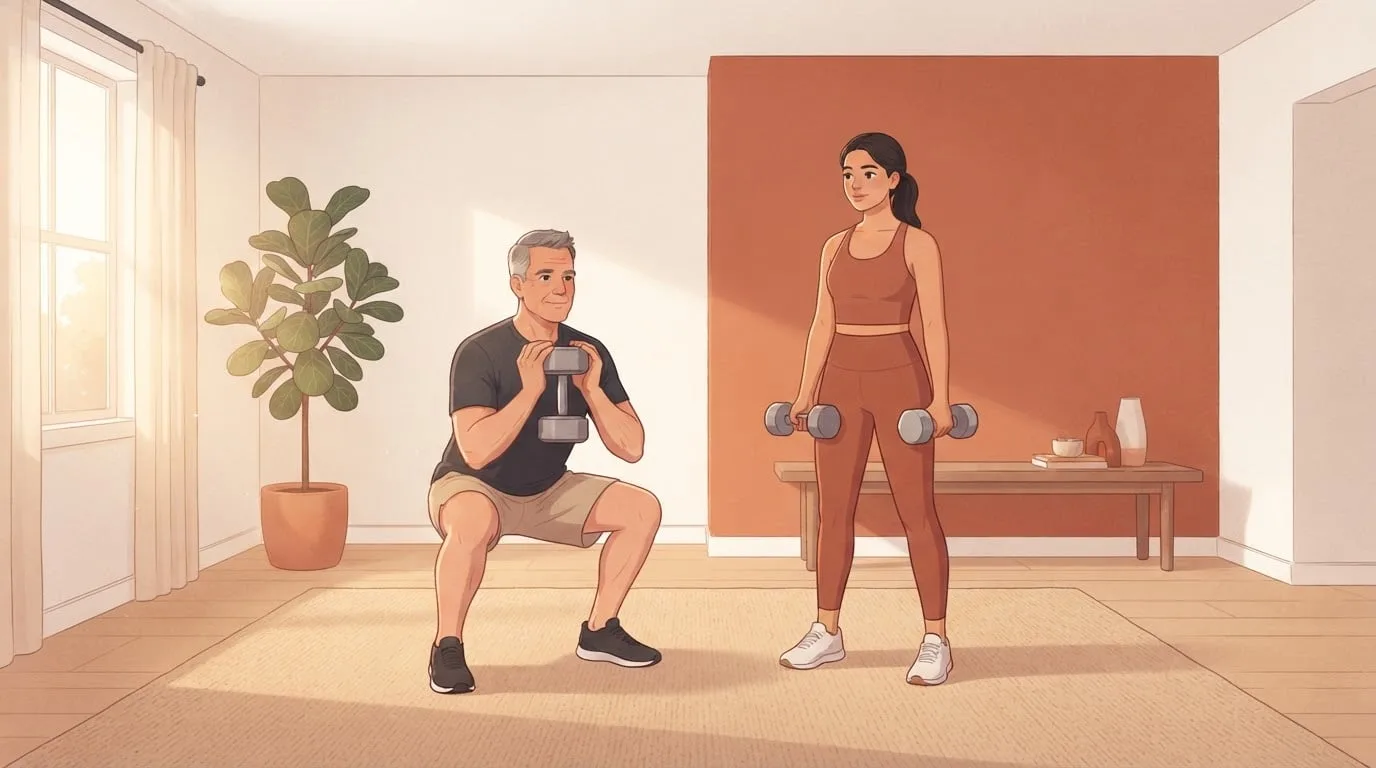
| Goblet squat | 3 x 8 to 12 | Quadriceps, glutes |
| Bulgarian split squat | 3 x 8 to 10 per leg | Quadriceps, glutes |
| Dumbbell Romanian deadlift | 3 x 8 to 12 | Gluteus maximus, hamstrings |
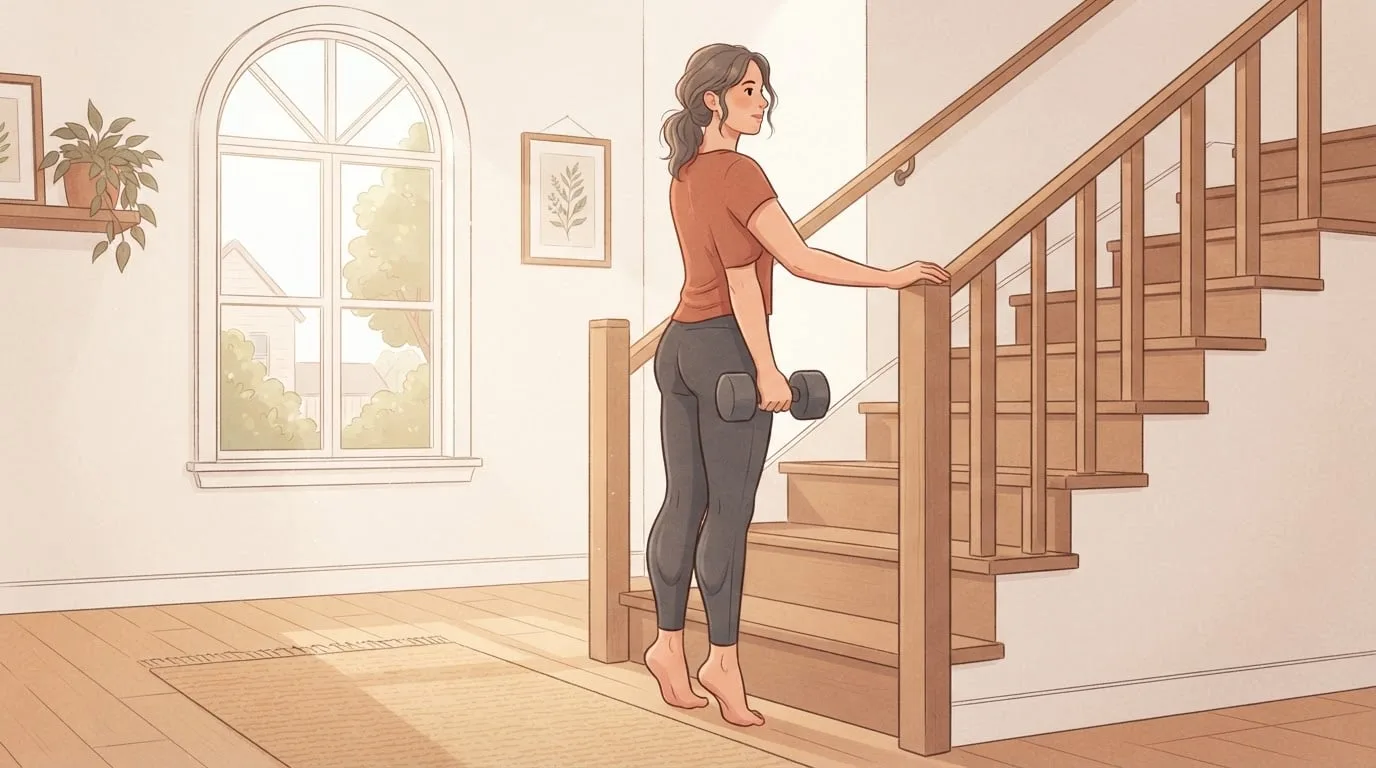
| Single-leg standing calf raise on a step | 3 x 10 to 15 per leg | Soleus, gastrocnemius |
Use the standing version of the calf raise. Kinoshita and colleagues (2023) trained one leg with standing calf raises and the other with seated ones in 14 adults for 12 weeks. The two parts of the gastrocnemius grew 12.4 and 9.2 percent with standing raises against 1.7 and 0.6 percent with seated ones, while the soleus grew about the same either way, at 2.1 and 2.9 percent. Hold a dumbbell once body weight gets easy, and see our guide to how to get stronger for adding load over time.
The hard part is repeating this for months. You don't get a stronger soleus from one good week, and most plans lose people long before the muscle changes. A dumbbell workout app can carry that part for you. In FitCraft, a 3D AI coach demonstrates each exercise on an interactive model and adapts your workouts as you progress, and streaks and leaderboards give you a reason to show up. As one user, Tim, said: "I didn't think an app could replace my trainer. My AI coach proved me wrong."
Frequently Asked Questions
Which muscle never stops working?
The heart never stops working, from before birth until death. The diaphragm comes second: it keeps you breathing through every night of sleep, though you can pause it on purpose by holding your breath.
What is the weakest human muscle?
No study has ranked every muscle from strongest to weakest. The stapedius in the middle ear is the likely answer, because force follows cross-section and it's the smallest muscle in the body, with a belly about 3 mm long.
Can a weak heart become strong again?
Often it can improve, depending on the cause, and that's a question for your cardiologist. In a Cochrane review of 44 trials and 5,783 people with heart failure, exercise-based cardiac rehabilitation cut hospital admissions by about 30 percent in the first year and improved quality of life, with no clear effect on deaths.
What is the strongest muscle in the female body?
The ranking is the same in women and men: the soleus by pull, the quadriceps as a group, the jaw for pressure and the heart for lifetime work. In one study of living adults and children, quadriceps force per square centimeter was 57.3 N in women and 55 N in men, so the difference in total force came from muscle size.
Is the eye the strongest muscle in the human body?
No. Eye muscles are small and only need to move a light eyeball. Force transducers in four patients recorded 8 to 40 g of tension to hold a gaze, plus another 15 to 25 g to jump to a new target.