You've been working out for a while, and you're not sure it's working. The push-ups feel the same. The dumbbells feel the same. You want to be the person who carries every grocery bag in one trip and moves the couch without a second thought, and right now you can't tell whether you're any closer.
That uncertainty is what makes people quit. Workouts that feel random give you nothing to point to, so after a few weeks it's easy to decide you're just not built to be strong.
You don't need a different body or a gym membership to build strength. You need a handful of movements, a way to make them harder over time and a plan that runs long enough for the changes to show. That's what this guide gives you, along with the studies behind each rule.
What Actually Makes You Stronger
Strength is the force you can produce in a movement. Two things set it: how well your nervous system drives the muscle you have, and how much muscle there is to drive. Training improves both, but not on the same timeline.
In a classic eight-week study, Moritani and deVries (1979) trained the arm flexors of seven young men and eight young women and tracked where their new strength came from. Neural factors explained most of the early gain, and muscle growth became the main driver after the first 3 to 5 weeks. The untrained arm got stronger too. That cross-education effect only makes sense if the nervous system is doing part of the work.
Strength is also specific to how you train and how you test it. In a meta-analysis of 21 studies, Schoenfeld and colleagues (2017) found that heavy loads, above 60 percent of a one-rep max, produced bigger gains in one-rep strength than light loads. Isometric strength, measured by pushing against something that doesn't move, improved about the same with either. Muscle growth was similar as well. The heavy-load groups got best at the thing they practiced, which was lifting heavy.
So getting stronger has two jobs. The first is practicing the movements you want to be strong in, with loads that are heavy for you. The second is building enough muscle to raise your ceiling. That second job has its own playbook, and our guide to how to build muscle at home covers it in full: sets taken close to failure, weekly sets per muscle, protein and a full-body hypertrophy plan. This page sticks to the strength side.
How to Get Stronger: 7 Rules
These seven rules sit underneath every good strength program, from a beginner's living-room routine to a competitive lifter's plan. The first three do most of the work.
1. Make the work a little harder over time
Progressive overload means giving your body a slightly bigger challenge than it handled last time, so it has a reason to adapt. You can add a rep, add a set, switch to a harder variation, slow the lowering phase or pick up more weight. Change one thing at a time, and only once the current version feels controlled. Our guide to progressive overload for beginners walks through each method with examples.
2. Practice the movements you want to be strong in
Strength carries over best to movements that look like the ones you trained. Build your week around six patterns: a squat, a hinge (bending at the hips, as in a Romanian deadlift), a horizontal push, a pull, an overhead press and a loaded carry. Keep the same version of each one for at least four weeks so you can actually practice it. When you change it, swap it for a harder version of the same pattern rather than a random new exercise.
3. Spend most of your sets in a lower rep range
For maximal strength, the load has to be heavy enough that you can't do many reps with it. A network meta-analysis of 28 studies and 747 adults by Lopez and colleagues (2021) sorted programs by how many reps their load allowed. Heavy loads (8 reps or fewer) and moderate loads (9 to 15) both beat light loads (more than 15) for strength, and heavy came out ahead of moderate by a margin that fell short of statistical significance. Muscle growth didn't differ by load.
In practice, do most strength sets in the 3 to 8 rep range and some in the 8 to 12 range for extra muscle. Ranges for building muscle run much wider, which is why the muscle guide uses higher reps than this one. At home, "heavy" means the hardest variation you can do with clean form for 3 to 8 reps.
4. Train each movement two or three times a week
Grgic and colleagues (2018) pooled 22 studies on training frequency. Strength gains grew as frequency went up, but when total weekly volume was matched, spreading it over more days stopped making a difference. The extra sessions helped because they added practice and sets. The benefit of frequency showed most clearly on multi-joint exercises and upper-body strength. Full-body workouts on three days a week give each pattern that frequency without long sessions.
5. Do enough hard sets each week
Ralston and colleagues (2017) analyzed nine studies with 61 training groups and found a graded dose-response: more weekly sets per exercise produced bigger strength gains, with an effect size of 1.01 for the highest volumes against 0.82 for the lowest. Medium volumes beat low ones too. The difference is real but modest, so your first few weekly sets on a movement buy most of the result. Start at about 6 to 9 hard sets per movement pattern each week, and build toward 10 to 12 when progress slows and you're recovering well.
6. Rest long enough between sets
A strength set only works if you start it fresh enough to push. A second 2018 review from Grgic and colleagues, covering 23 studies and 491 participants, concluded that untrained people make full strength gains with 60 to 120 seconds of rest, while trained lifters seem to need more than 2 minutes. If you're new, rest 1 to 2 minutes. After your first few months, give your hardest sets 2 to 3 minutes.
7. Sleep and eat to recover
Adults need at least 7 hours of sleep a night, according to a joint consensus statement from the American Academy of Sleep Medicine and the Sleep Research Society (Watson 2015). Strength suffers when short nights pile up: a systematic review by Knowles and colleagues (2018) linked consecutive nights of restricted sleep to lower force in multi-joint lifts. Food matters too. You need enough protein and enough total calories to recover, and the muscle guide linked above sets out the protein targets and food choices.
Want to push one lift in particular? If your goal is narrower, such as moving up to the next pair of dumbbells on a press or a squat, our guide to how to lift heavier weights covers that in detail: double progression, bridging the jump between dumbbell sizes, lifting each rep with intent and a four-week plan built around it.
What Are the Benefits of Different Types of Resistance Training?
Every form of resistance training builds strength if it keeps getting harder. The types differ in how easy they are to load, where you can do them and what they carry over to.
| Type | What it's good for | The catch |
|---|---|---|
| Dumbbells | Loading every movement pattern, one-arm and one-leg work, training at home | Fixed jumps between sizes |
| Bodyweight (calisthenics) | Pushing, core and single-leg strength with no equipment | Legs outgrow it first, and pulling needs a bar or a sturdy table |
| Resistance bands | Light, portable and cheap, with strength gains similar to weights | Tension changes through the range and is hard to measure |
| Machines (gym) | Easy to learn and safe to push hard | Need a gym and train less balance and stabilizing work |
| Isometric holds | Joint-friendly strength at a chosen position | Gains are largest near the joint angle you hold |
The evidence for bands is better than most people assume. A meta-analysis of eight studies by Lopes and colleagues (2019) compared elastic resistance with weight machines and dumbbells and found no difference in strength gains for either the upper or the lower body. The best type is the one you can make progressively harder and will actually do three times a week.
Find out what's really holding you back
FitCraft, our mobile fitness app, pairs you with an AI coach who builds you a personalized plan around your goals, schedule, and fitness level. Every FitCraft program is designed by Domenic Angelino, MPH (Brown University) and NSCA-CSCS, with research published in the Journal of Strength and Conditioning Research and Medicine & Science in Sports & Exercise.
Take the Free Assessment Free • 2 minutes • No credit card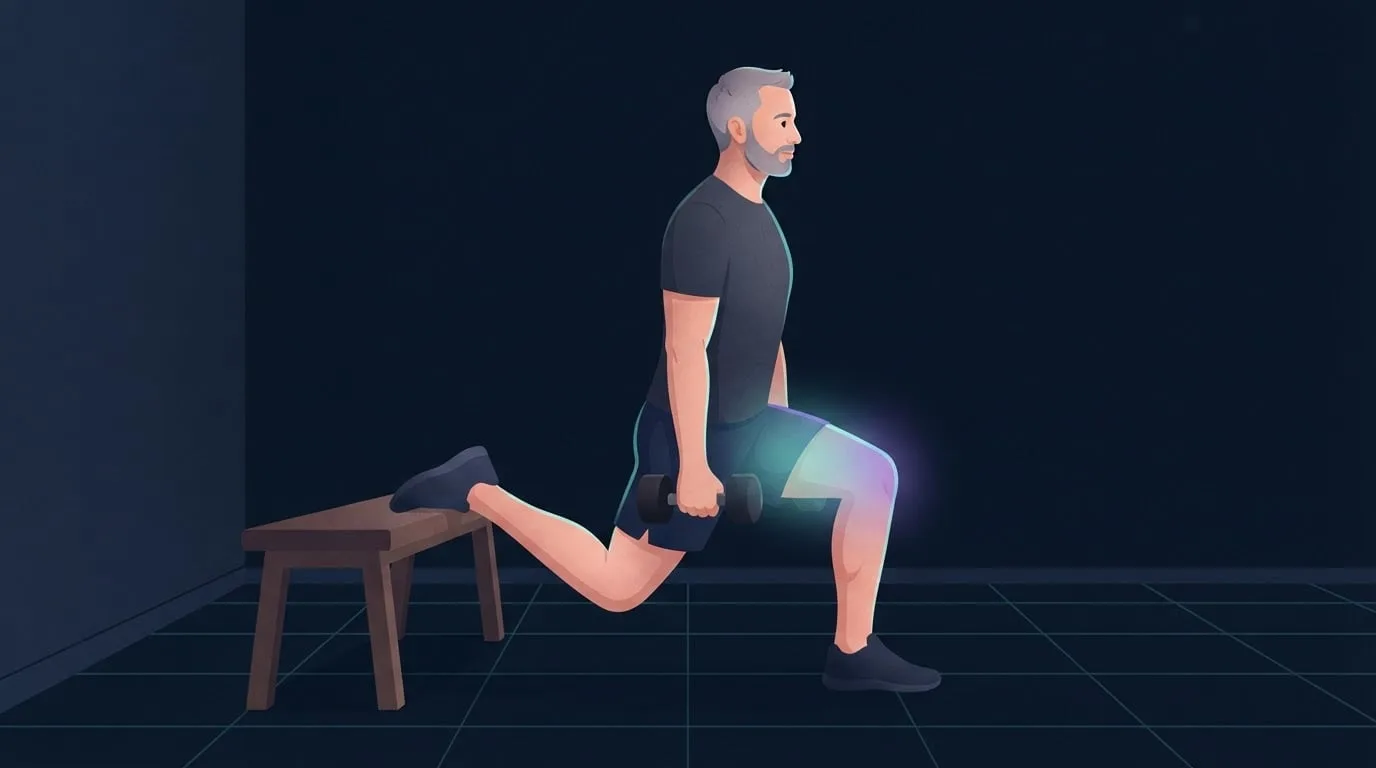
How to Get Stronger at Home With Dumbbells and Bodyweight
You can build real strength at home. The challenge is keeping each movement hard enough once your dumbbells start to feel light, because strength work needs sets that end within about 3 to 8 hard reps.
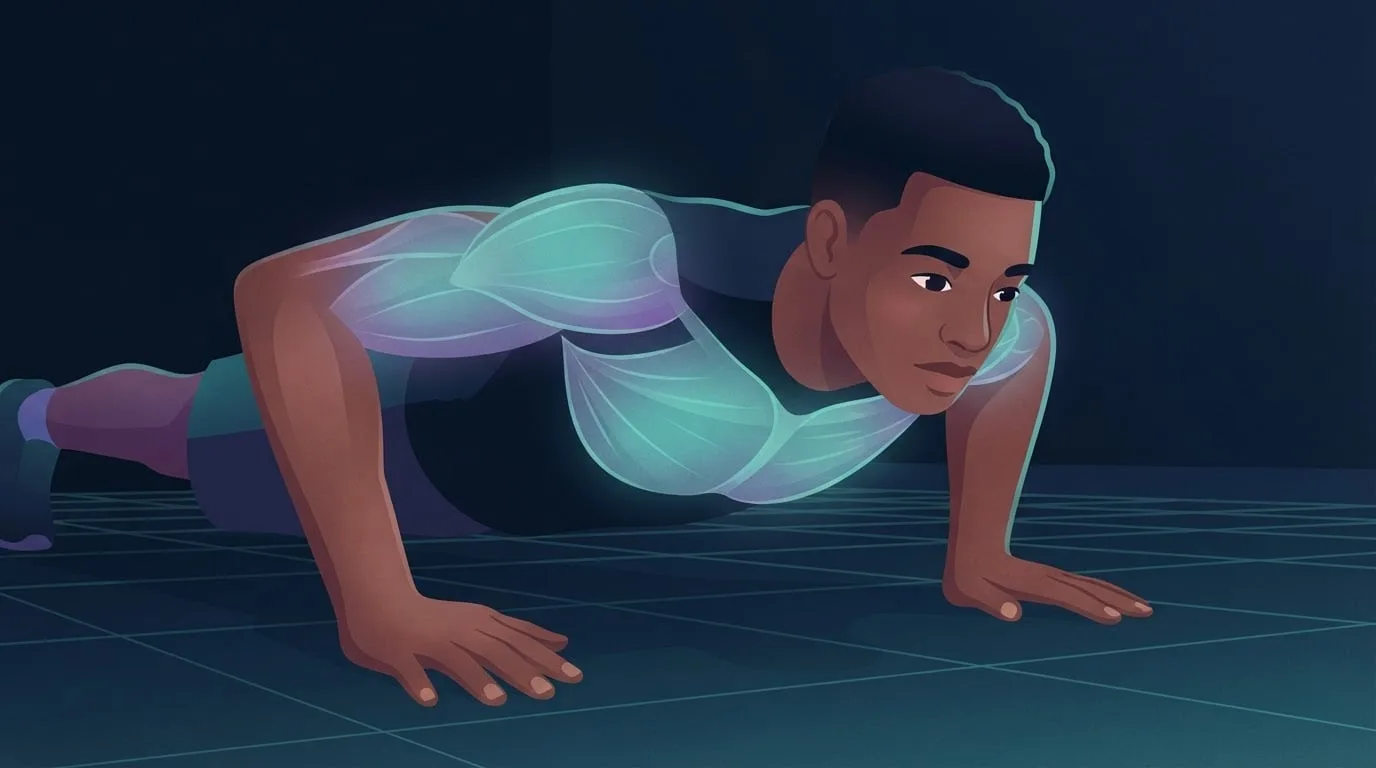
Bodyweight progressions hold up in the research. In a four-week trial, Kotarsky and colleagues (2018) had 23 moderately trained men either bench press or work through progressively harder push-up variations three days a week. Both groups significantly increased their one-rep bench press, and the push-up group improved far more on the push-up progression itself. The authors concluded that calisthenics, made harder in planned steps, can build upper-body strength.
Five levers make a home exercise heavier for the muscles doing it:
Use harder variations
Changing leverage moves more of your body weight onto the working muscles. Push-ups progress from incline to floor to feet-elevated to archer push-ups. Squats progress from bodyweight to split squats to rear-foot-elevated split squats to assisted single-leg squats. For strength, choose the version that stops you at about 3 to 8 clean reps.
Train one side at a time
One-leg and one-arm work doubles the load on the working limb without new equipment, and the strength carries over to two-limb movements. In Speirs and colleagues (2016), 18 academy rugby players trained twice a week for five weeks with either the back squat or the rear-foot-elevated split squat. Both groups improved both lifts by similar amounts, so the single-leg version built back squat strength as well as back squats did.
Slow down and pause
A three- to four-second lowering phase and a two-second pause at the bottom take away the bounce and make a light load feel heavy. These changes help most on squats, split squats and push-ups once you've run out of harder variations. Treat them as a bridge to the next variation or dumbbell, because strength is still measured by how much you can move.
Add load where you can
Adjustable dumbbells, a heavier pair just for leg exercises or a backpack loaded with books all extend how long a home setup keeps working. Legs outgrow light dumbbells first, so if you buy one thing, buy heavier weights for squats and hinges.
Carry heavy things
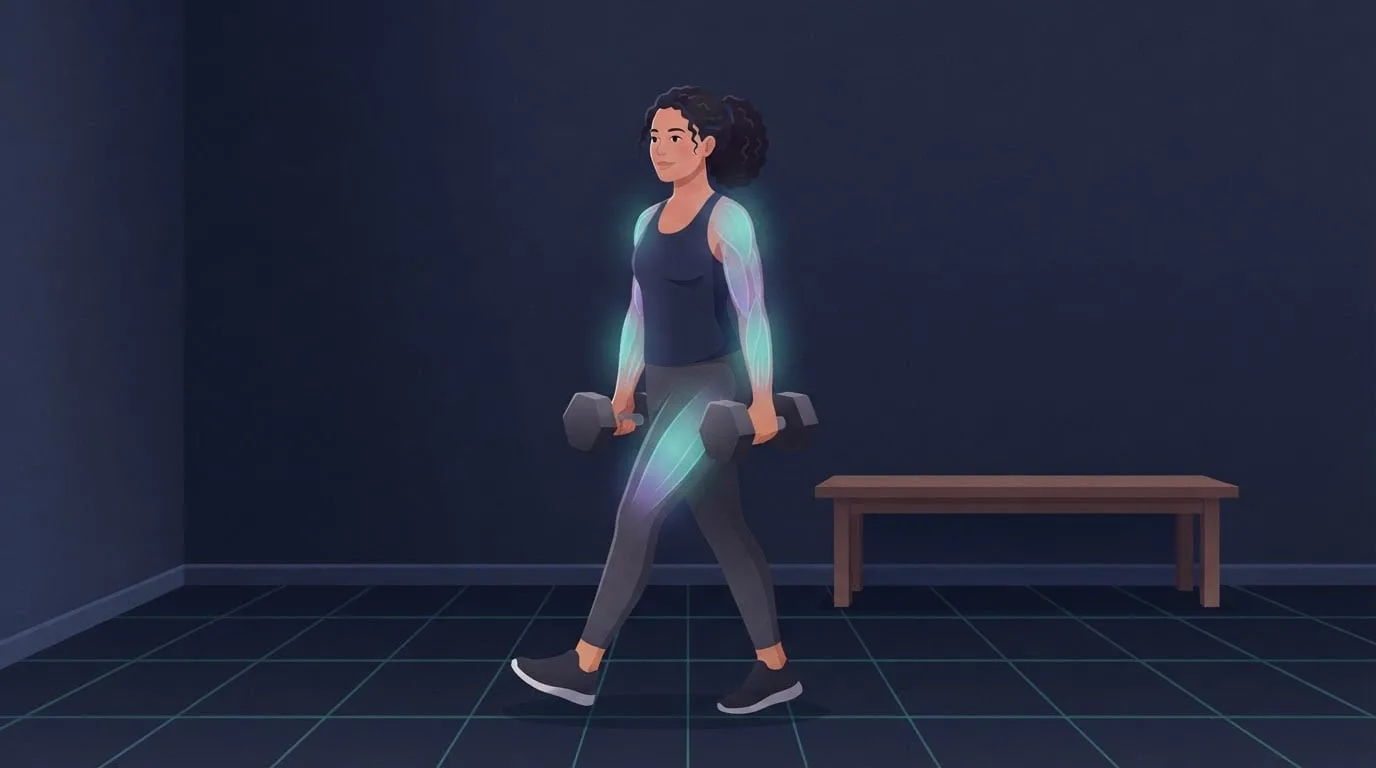
Loaded carries are one of the most underrated home strength exercises. Walking with a heavy dumbbell in each hand trains your grip, trunk and hips together. Make it harder by walking farther, holding heavier weights or carrying a single dumbbell on one side, a suitcase carry, which forces your trunk to resist leaning.
A 12-Week Plan to Get Stronger at Home
This plan uses three full-body workouts a week on non-consecutive days, alternating Workout A and Workout B (A, B, A one week, then B, A, B the next). You need one or two pairs of dumbbells, a sturdy chair or bench and a little floor space. Three training blocks and a test week move you toward fewer, heavier reps.
Effort is counted in reps in reserve, the clean reps you could still do when you end the set. "2 left" means you stop when you're sure you could manage two more with good form.
| Weeks | Sets x reps | Effort | Rest | Goal |
|---|---|---|---|---|
| 1 to 4: Foundation | 3 x 8 to 10 | 3 left | 90 seconds | Learn each movement and find your starting variations |
| 5 to 8: Build | 4 x 6 to 8 | 2 left | 2 minutes | Move to harder variations or heavier dumbbells |
| 9 to 11: Strength | 4 x 4 to 6 | 1 or 2 left | 2 to 3 minutes | Own the hardest variation you can do for 4 to 6 reps |
| 12: Test | 2 x 5 early in the week | Easy, then one test set | 3 minutes | Recover, then measure what you gained |
| Pattern | Workout A | Workout B |
|---|---|---|
| Squat | Goblet squat | Rear-foot-elevated split squat |
| Hinge | Dumbbell Romanian deadlift | Single-leg Romanian deadlift |
| Horizontal push | Push-up, hardest version for your rep target | Dumbbell floor press |
| Pull | One-arm dumbbell row | Two-arm bent-over dumbbell row |
| Overhead push | Half-kneeling one-arm dumbbell press | Standing dumbbell overhead press |
| Carry | Farmer's carry, 3 walks of 30 to 40 meters | Suitcase carry, 2 walks per side |
How to progress through the plan:
- Warm up with five minutes of easy movement and one or two lighter sets of the first exercise.
- Within a block, add a rep to a set whenever you can. Once you reach the top of the rep range on every set at the target effort, move to a harder variation or heavier dumbbells the next session.
- At the start of each new block, pick variations that put you near the bottom of the new rep range.
- In week 12, do two easy sessions at half the usual sets, then use the third session for the tests in the next section.
That gives each pattern three sessions a week and about 9 to 12 hard sets across the week by the middle block, inside the range the frequency and volume research supports.
How to Measure Strength Gains Without a 1RM
You don't need to test a true one-rep max to know you're stronger, and at home you usually can't. A rep test with a fixed load tracks maximal strength closely.
Reynolds and colleagues (2006) had 70 men and women aged 18 to 69 test their 1, 5, 10 and 20 rep maximums on the chest press and leg press. The 5-rep max predicted the 1-rep max most accurately, and the authors advised using no more than 10 reps in the usual linear estimates. The fewer reps in your test set, the closer it tracks your maximal strength.
- Rep test at a fixed load. Pick a dumbbell weight you can lift about 5 to 10 times. Every four weeks, after the same warm-up, do one set with a steady tempo and stop when your form breaks. More reps with the same weight means more strength.
- Estimated one-rep max. Put a set of 10 reps or fewer into a standard formula such as Epley's, weight x (1 + reps / 30). Treat the result as a trend line rather than an exact number.
- Hardest variation for 5 reps. For bodyweight movements, record the hardest version you can do for 5 strict reps, for example incline, floor, feet-elevated or archer push-ups.
- Carry distance. Record how far you can walk with your heaviest pair before your grip starts to slip, and set them down on purpose before it does.
- Write it down. A notebook or a notes app is enough: the date, the exercise, the variation, the load and the reps.
Test under the same conditions each time: the same time of day, the same warm-up and the same amount of rest beforehand. Small changes in setup can look like strength changes.
How Long Does It Take to Get Stronger?
Most beginners notice they're stronger within two to four weeks, and the early change is mostly neural. In Moritani and deVries' study, better muscle activation drove the first gains, and muscle growth took over after 3 to 5 weeks.
Expect quick progress for the first three to six months, with something improving most weeks. After that, gains slow to an extra rep here and a harder variation there, and a good month might mean one step up on each main movement. That slowdown is normal. It means the quick neural gains are used up, and progress now depends more on muscle, which grows slowly.
Why You Stopped Getting Stronger, and How to Break a Plateau
A plateau is three or more weeks with no improvement in reps, variation or load on a movement you train regularly. Check the usual causes in this order:
- No planned progression. The same sets of the same version every week keep you exactly where you are.
- Too much variety. Switching exercises every session resets the skill side of strength.
- Too few hard sets. Two or three easy sets per movement a week won't move much. Add sets before you change anything else.
- Too little rest. Sets done on a 45-second clock turn into conditioning work. Rest 2 to 3 minutes before hard sets.
- Variations that are too easy. If you can do 20 reps, the set builds endurance more than maximal strength.
- Short sleep or a steep calorie deficit. Both limit how hard you can train and how well you recover.
Planned easy weeks help some people, but stopping completely has a cost. Coleman and colleagues (2024) randomized 39 trained men and women to a nine-week program, done either straight through or with a full week off at the midpoint. Muscle growth came out the same, but the group that trained straight through gained more lower-body strength. If you need a break from hard training, halve your sets for a week and keep practicing the movements.
If you've checked everything and you're still stuck, change one variable for four weeks: add a set per movement, drop to a slightly lower rep range or add a fourth short session. Then retest.
Is It Easy to Maintain Muscle Once You Build It?
Yes. For most people, keeping strength and muscle takes far less work than building them. Bickel and colleagues (2011) trained 70 adults three days a week for 16 weeks, then cut them to one-third or one-ninth of that weekly dose, or stopped training altogether, for 32 weeks. In the younger group, aged 20 to 35, both reduced doses kept the muscle they had built. In the older group, aged 60 to 75, the reduced doses didn't fully preserve muscle size, so older lifters need more weekly work to hold on to it. Strength held up well in both age groups, even after training stopped, with only a slight drop by the final test.
So if life gets busy, a much smaller dose of the same movements will hold most of what you built until you can ramp back up.
Staying Consistent for 12 Weeks
Knowing the rules is the easy part. The hard part is doing three workouts a week for twelve weeks without drifting, and that's where most strength plans fall apart. Missed weeks cost you more than a less-than-ideal exercise or rep range ever will.
FitCraft's strength workouts use dumbbells and bodyweight, and the workouts adjust as you progress. An AI coach demonstrates every exercise as a 3D character you can pinch and zoom to see the movement up close, says your name during the workout and keeps your streak going, while leaderboards and collectible cards give you a reason to come back on low-motivation days. If you're comparing options, our roundup of the best strength training apps sets FitCraft beside the alternatives.
The Bottom Line
Getting stronger is a slow and predictable process. Practice a handful of big movements two or three times a week, make them a little harder whenever they feel controlled, keep most sets in the 3 to 8 rep range, rest between them and sleep enough to recover. At home, harder variations, one-limb work, tempo and carries take you a long way before you need more equipment.
Matt, a FitCraft user, described the change that matters most: "The real win is I actually want to work out now. That's never happened before." Twelve weeks of steady practice builds the strength. Wanting to show up is what gets you through all twelve.
Frequently Asked Questions
How to get really strong physically?
To get really strong physically, train a squat, a hinge, a push, a pull, an overhead press and a loaded carry two or three times a week for months, keep most sets in the 3 to 8 rep range, and make each movement a little harder whenever it feels controlled. Recovery is part of the program, so sleep at least 7 hours and eat enough protein to keep training hard. Real strength takes years to build, but the first gains show up within weeks.
How can I get stronger fast?
The fastest way to get stronger is to practice the same few movements two or three times a week with loads heavy enough that you can only do about 3 to 8 reps, and to rest 2 to 3 minutes before your hardest sets. Most beginners notice gains within two to four weeks, largely because the nervous system gets better at using the muscle it already has. Missed weeks slow you down more than any detail of the program.
Can you get stronger at home without weights?
Yes. Harder bodyweight variations, one-leg and one-arm exercises, slower lowering and pauses all make your own body weight a heavier load for the working muscles. In a four-week study, men who trained progressively harder push-up variations significantly increased their bench press one-rep max. Legs usually outgrow bodyweight squats first, so a pair of heavier dumbbells or a loaded backpack is the most useful first addition.
What foods help build strength?
No single food builds strength. Training builds it, and food supports the recovery. Eat enough total calories, include a protein-rich food at each meal, such as eggs, Greek yogurt, milk, fish, chicken, beans, lentils or tofu, and add carbohydrates like rice, potatoes, oats or fruit to fuel hard sessions.
How often should I train to get stronger?
Train each movement two or three times a week. A meta-analysis of 22 studies found that strength gains rose with training frequency, mostly because more sessions added more weekly sets. Three full-body workouts on non-consecutive days is the simplest way to reach that frequency.
I want to get stronger. Where do I start?
Start with three full-body workouts a week built on six movements: a squat, a hinge, a push-up, a row, an overhead press and a loaded carry. Use versions you can do for 8 to 10 controlled reps, end each set with about 3 reps left for the first month, and add a rep or move to a harder variation each week. Retest every four weeks so you can see the progress.