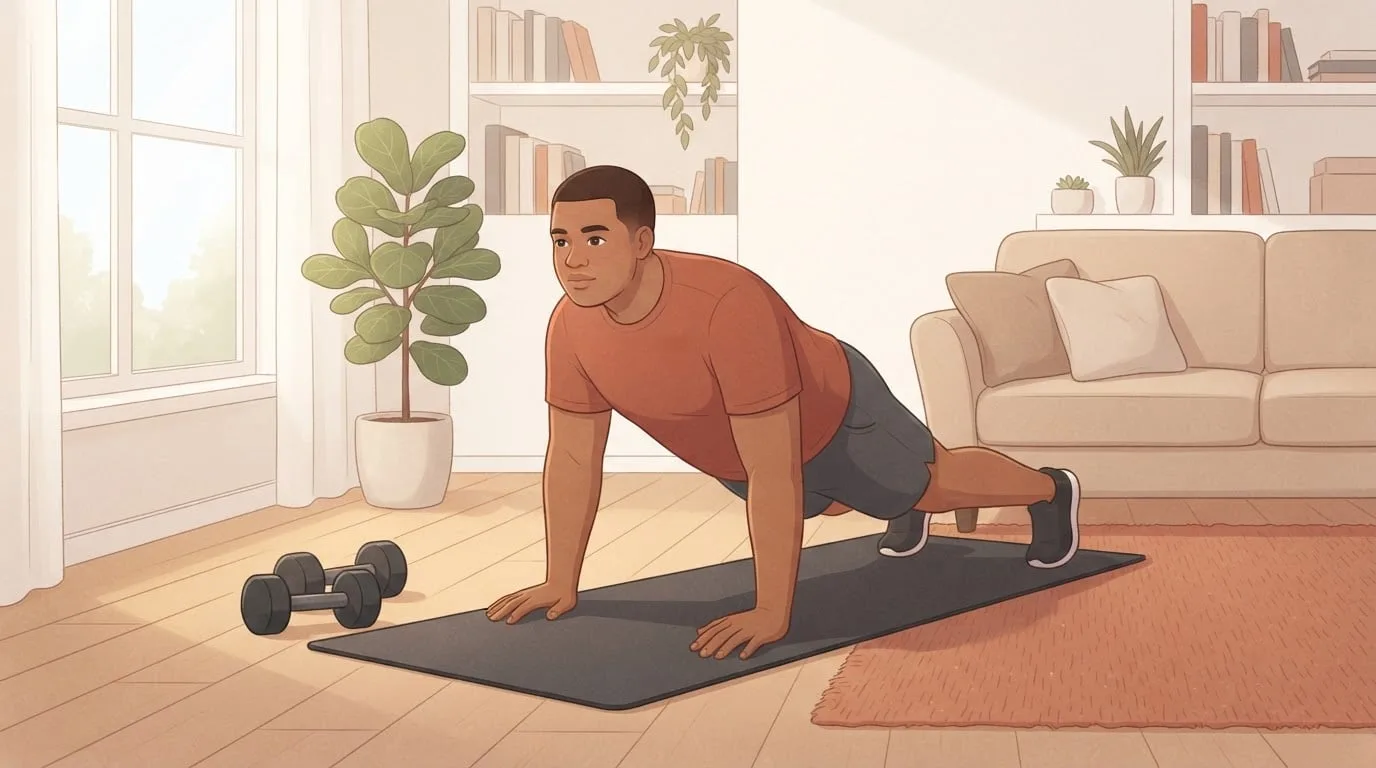
You've done the home workouts. The circuits leave you sweaty, the push-ups get a little easier, and when you look in the mirror after two months, not much has changed.
So you start to wonder whether home training is only good for staying in shape, and whether real muscle takes a gym, a barbell and someone who knows what they're doing.
Your muscles can't tell where you are. They respond to effort, volume and recovery, and you can control all three in a living room. If you've been asking how to gain muscle at home, the answer comes down to how hard each set is and how you progress it from week to week.
Can You Really Build Muscle at Home?
Yes, and the research on load is the reason. When sets are taken close to failure, light loads build muscle about as well as heavy ones, so you don't need gym-sized weights.
Schoenfeld and colleagues (2015) split 18 resistance-trained men into two groups for eight weeks. One group did sets of 25 to 35 reps and the other did sets of 8 to 12, both to failure, three sessions a week across seven exercises. Muscle thickness rose by similar amounts in both groups, light versus heavy: 8.6 versus 5.3 percent in the elbow flexors (the biceps group), 5.2 versus 6.0 percent in the triceps and 9.5 versus 9.3 percent in the quadriceps, with no significant differences between groups. The heavier group gained more squat strength, which is the strength side of the story.
Bodyweight exercises count too. Kikuchi and Nakazato (2017) had 18 young men train twice a week for eight weeks with either a bench press at 40 percent of their one-rep max or push-ups adjusted, kneeling if needed, to the same load. Both groups gained similar chest and triceps thickness and similar bench press strength.
One caveat keeps this honest. An earlier meta-analysis of eight hypertrophy studies by Schoenfeld and colleagues (2016) found a trend toward more growth with heavier loads that didn't reach statistical significance. Load still matters at the very light end, as the next section shows. Across a broad middle range, effort matters more.
Why Effort Matters More Than the Weight
Light loads only work when the set gets hard. A set of push-ups that ends while you could still do 15 more gives the muscle little reason to grow, however many of those sets you do.
Robinson and colleagues (2024) ran a series of meta-regressions on how close to failure sets were taken, estimated as reps in reserve. Muscle growth increased as sets ended closer to failure. Strength gains, by contrast, were similar across a wide range of reps in reserve, which is one reason muscle programs and strength programs look different.
You don't have to reach total failure, though. A meta-analysis of 15 studies by Refalo and colleagues (2023) found only a trivial advantage for sets taken to failure over sets stopped short, and no advantage at all when failure meant the point where another rep is impossible. Ending most sets with 1 to 3 reps left captures nearly all of the benefit, with less fatigue and less risk of your form breaking down.
Load does have a floor. Lasevicius and colleagues (2018) trained 30 men twice a week for 12 weeks, with one arm and one leg working at 20 percent of their one-rep max and the other limb at 40, 60 or 80 percent, total volume matched. The 20 percent limbs grew far less: 8.9 percent in the thigh against about 20 percent for the heavier loads, and 11.4 percent in the arm against about 25 percent. Loads of 40, 60 and 80 percent produced similar growth.
For home training, that gives you three working rules:
- Pick variations that bring you within 1 to 3 reps of failure somewhere between about 6 and 30 reps. If a set takes more than about 30 reps to get close to failure, the exercise is too easy to build muscle efficiently.
- Go closer on safe exercises. Take the last set of push-ups, rows, curls and raises to 0 or 1 rep left.
- Leave more in the tank on riskier ones. Keep 2 to 3 reps in reserve on heavy split squats and Romanian deadlifts, where tired form costs the most.
Our guide to how many reps you should do breaks down rep ranges by goal if you want more detail.
How Many Sets per Muscle per Week?
Volume is the other main lever. Schoenfeld, Ogborn and Krieger (2017) pooled 15 studies and found a graded dose-response between weekly sets and muscle growth. Each extra weekly set per muscle added about 0.37 percent to the average gain, and the higher-volume groups within each study grew 3.9 percentage points more than the lower-volume groups. When the authors sorted programs into fewer than 5, 5 to 9 and 10 or more weekly sets per muscle, the trend favored 10 or more but didn't reach significance.
A practical starting point is about 10 hard sets per muscle group each week, which three full-body sessions reach easily. If you stop progressing for a few weeks while recovering well, add 2 sets per muscle and reassess. Many people do well somewhere between 10 and 20.
| Muscle group | Home exercises that count | Weekly hard sets to start |
|---|---|---|
| Chest | Push-up variations, dumbbell floor press | 9 to 10 |
| Back | Dumbbell rows, table rows, band rows | 9 to 10 |
| Quadriceps | Goblet squats, split squats, lunges | 9 to 10 |
| Glutes and hamstrings | Romanian deadlifts, hip thrusts, single-leg deadlifts | 9 to 10 |
| Shoulders | Overhead press, pike push-ups, lateral raises | 6 to 9, plus pressing work |
| Arms | Curls, triceps extensions, chair dips | 3 to 6 direct, plus pushing and pulling |
Find out what's really holding you back
FitCraft, our mobile fitness app, pairs you with an AI coach who builds you a personalized plan around your goals, schedule, and fitness level. Every FitCraft program is designed by Domenic Angelino, MPH (Brown University) and NSCA-CSCS, with research published in the Journal of Strength and Conditioning Research and Medicine & Science in Sports & Exercise.
Take the Free Assessment Free • 2 minutes • No credit card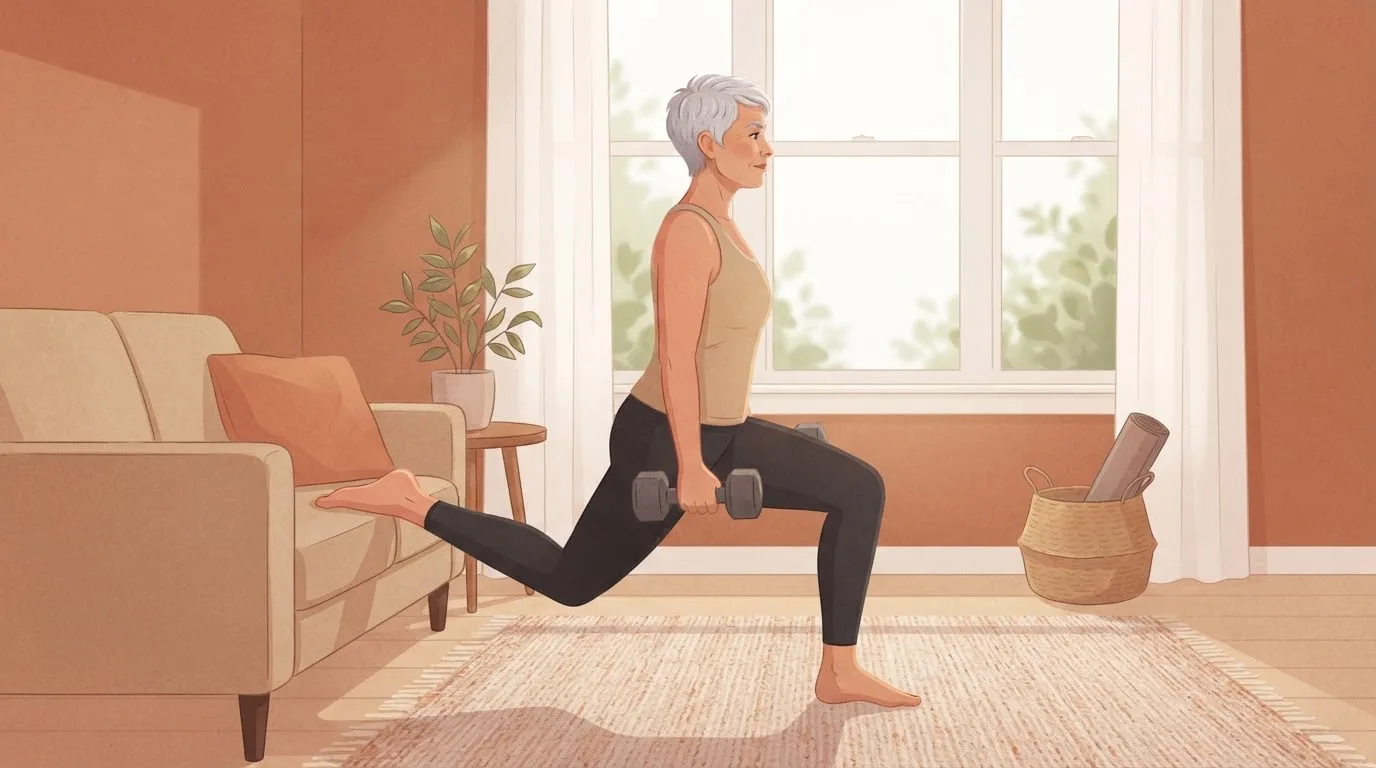
A Full-Body Home Workout to Build Muscle
This plan runs three days a week on non-consecutive days, such as Monday, Wednesday and Friday, with a different rep range each day. Every session trains every major muscle, so each one gets worked three times a week and reaches about 9 to 10 hard sets a week from the start. You need a pair or two of dumbbells, a sturdy chair or sofa, a mat and, ideally, a sturdy table for rows.
| Pattern | Day 1: 8 to 12 reps | Day 2: 12 to 20 reps | Day 3: 6 to 10 reps |
|---|---|---|---|
| Squat or lunge | Goblet squat | Bulgarian split squat | Dumbbell reverse lunge |
| Hinge | Dumbbell Romanian deadlift | Single-leg hip thrust | Single-leg Romanian deadlift |
| Horizontal push | Push-up variation | Feet-elevated push-up | Dumbbell floor press |
| Pull | One-arm dumbbell row | Table row or band row | Two-arm bent-over dumbbell row |
| Shoulders | Standing dumbbell press | Dumbbell lateral raise | Pike push-up |
| Arms | Dumbbell curl | Overhead dumbbell triceps extension | Hammer curl |
- Sets and rest: 3 sets of each exercise. Rest about 2 minutes on squats, hinges and presses and 60 to 90 seconds on arms and raises.
- Effort: end each set with 1 to 3 reps left, closer to 0 on the last set of safe exercises.
- Choosing variations: pick the version that lands you inside that day's rep range. If you can go past the top of the range, it's too easy for that day.
- Adding volume: after 4 to 6 weeks, add a fourth set to the exercises for the muscles you most want to grow.
- Time: each session takes about 45 to 60 minutes. Finish with calf raises or a plank if you have time.
Progressions for Each Movement Pattern
Progression is what keeps your sets hard as you get stronger. Within a day's rep range, add reps first. Once you reach the top of the range on every set with 1 or 2 reps left, move one step harder for that exercise.
| Pattern | Step 1 | Step 2 | Step 3 | Step 4 |
|---|---|---|---|---|
| Squat | Chair squat | Goblet squat | Bulgarian split squat | Skater squat or assisted single-leg squat with a slow lowering |
| Hinge | Glute bridge | Dumbbell Romanian deadlift | Single-leg hip thrust from the sofa | Single-leg Romanian deadlift with dumbbells |
| Horizontal push | Push-up with hands on a counter | Floor push-up | Feet-elevated push-up | Archer push-up or push-up wearing a loaded backpack |
| Pull | Band row | One-arm dumbbell row | Table row with knees bent | Table row with straight legs and a pause at the top |
| Shoulders | Seated dumbbell press | Standing dumbbell press | Pike push-up | Pike push-up with feet on a chair |
For curls, lateral raises and triceps extensions, add reps first, then slow the lowering to 3 seconds, then move to a heavier pair. Two changes make any step harder without switching exercises: a 3- to 4-second lowering phase, or a pause at the hardest point of the rep. Both are handy when the next step in the table feels like too big a jump.
How to Build Muscle at Home Without Equipment: The Limits
Bodyweight-only training builds real muscle, but it runs into four limits that are worth planning for.
Legs outgrow bodyweight first
Your legs carry your body weight all day, so a bodyweight squat is light work for them. Within a few weeks most people can do 30 or more, and sets that long mostly test endurance. Move to single-leg work early. Bulgarian split squats, skater squats, step-ups and single-leg hip thrusts put close to your full body weight on one leg, and a slow lowering with a pause at the bottom extends them further.
Pulling needs something to pull on
Push-ups cover the chest, shoulders and triceps, but nothing on the floor trains your back the same way. Without dumbbells or a pull-up bar, a table row is the best option: lie under a sturdy table, grip the edge and pull your chest up toward it. Test the table first. If you're not sure it'll hold you, use a resistance band anchored in a door frame or row a loaded backpack instead.
Small muscles are hard to isolate
The side shoulders, biceps and hamstrings get some work from big movements but grow better with direct work. A light pair of dumbbells or a band handles lateral raises and curls, and towel slider leg curls on a smooth floor train the hamstrings with no equipment.
Very long sets cost time
Once a variation takes 25 or 30 reps to get close to failure, sets drag on and your breathing gives out before your muscles do. That's the signal to switch to a harder variation or add load, even if the load is a backpack full of books.
If you're deciding what to buy first, our guide to working out at home and actually seeing results covers the minimum equipment that makes the biggest difference.
How Much Protein Do You Need to Build Muscle at Home?
Training creates the signal for growth, and protein supplies the building material. A meta-analysis of 49 trials and 1,863 people by Morton and colleagues (2018) found that adding protein increased gains in muscle and strength during resistance training, and that the benefit for fat-free mass leveled off at a total intake of about 1.62 grams per kilogram of body weight a day. The extra protein helped less in older adults and more in people who already trained.
- Daily target: about 1.6 g per kilogram of body weight. For a 70 kg (154 lb) person, that's roughly 112 grams a day.
- Spread it out: three or four meals with roughly 25 to 40 grams each is easier than one huge serving.
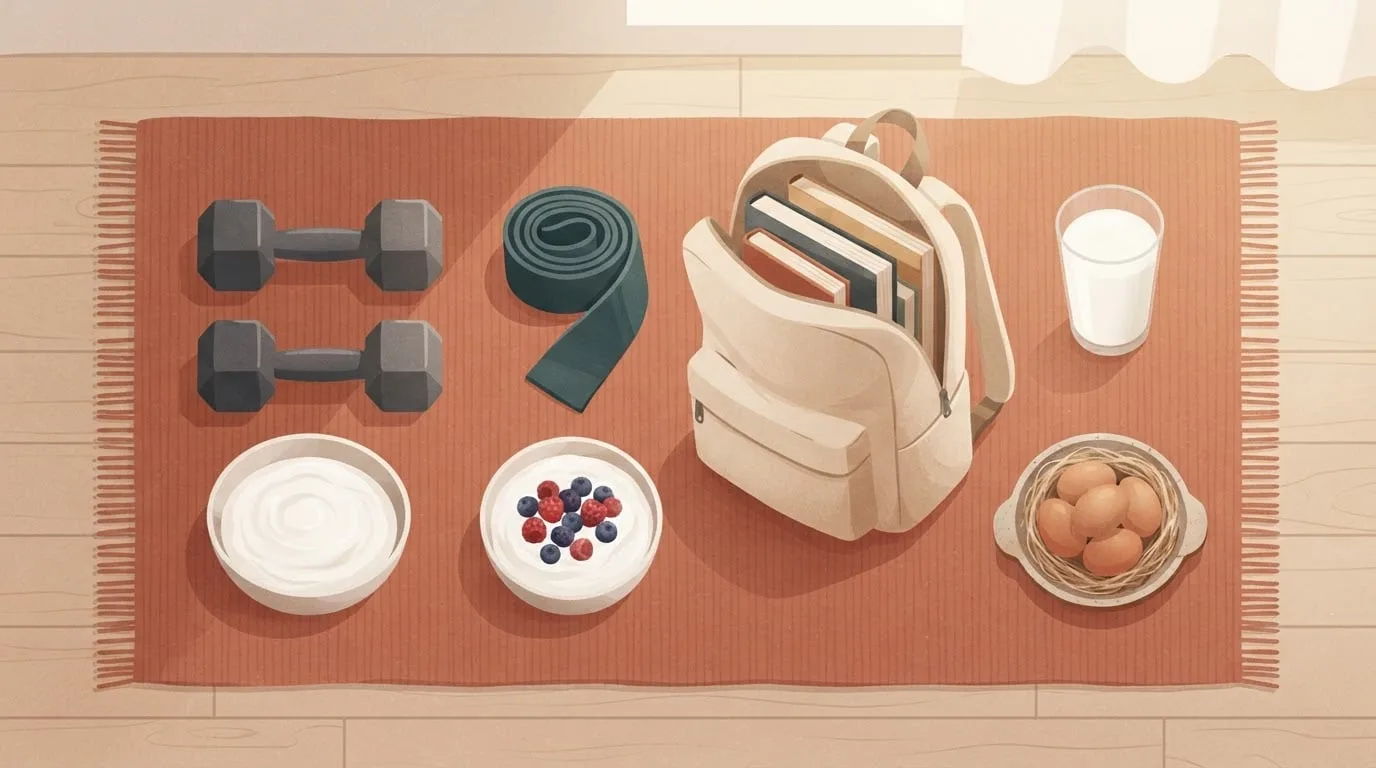
- Food first: eggs, Greek yogurt, milk, cottage cheese, chicken, fish, lean beef, tofu, tempeh, lentils and beans. Protein powder is simply a convenient way to fill a gap.
- Eat enough overall: a small calorie surplus makes it easier to recover from hard sets, while a steep deficit makes building muscle much harder.
Milk is a convenient choice after a workout. Hartman and colleagues (2007) followed 56 young men who lifted five days a week for 12 weeks. Those who drank fat-free milk after training gained more lean mass than those who drank a soy drink or a carbohydrate drink with the same calories.
How Fast Can You Build Muscle at Home?
Muscle growth starts sooner than most people think, but it takes longer to see. Seynnes and colleagues (2007) scanned the thigh muscles of seven young adults during 35 days of high-intensity leg training. Muscle cross-sectional area had grown 3.5 to 5.2 percent after 20 days and 6.5 to 7.4 percent after 35 days. That's measurable on a scan but rarely visible in a mirror.
For a beginner training consistently and eating enough protein, a typical timeline looks like this. These ranges come from coaching experience, so treat them as a guide:
- Weeks 1 to 4: you get stronger quickly, mostly through your nervous system, and your muscles may feel fuller after workouts.
- Weeks 4 to 8: growth is underway and measurable, and clothes may start to fit a little differently.
- Months 2 to 3: you'll probably see the change yourself, especially in the shoulders, arms and chest.
- Months 6 to 12: other people start to notice.
Men and women grow at similar rates
Women gain muscle in proportion to their starting size about as fast as men do. A meta-analysis of 10 studies by Roberts, Nuckols and Krieger (2020) found no significant difference in relative muscle growth between men and women following the same program. The plan on this page works as written for anyone.
Building muscle gets slower with age
Muscle gets harder to build with age, and it never becomes impossible. A meta-analysis of 49 studies and 1,328 adults aged 50 and over by Peterson and colleagues (2011) found an average gain of 1.1 kg of lean mass from resistance training. Higher-volume programs produced bigger gains, and the oldest participants gained the least. Some medications matter too: in the MASTERS trial of adults aged 65 and older, those taking metformin gained less lean mass and thigh muscle from 14 weeks of training than those on a placebo (Walton 2019). Never change a prescribed medication on your own to improve training results.
Building Muscle vs Getting Stronger
Muscle and strength grow together, but they respond to slightly different training. Muscle grows across a wide range of loads when sets are hard, while maximal strength depends more on heavy loads and on practicing the specific movement. If strength is your main goal, our guide to how to get stronger covers the seven rules for strength, a 12-week strength plan and how to test your strength without a one-rep max.
Making a Home Plan Stick
The plan above works only if you run it for months. Many home routines fade in the stretch between the first few weeks and the first visible results, when the novelty has worn off and the mirror hasn't caught up yet. That's when structure and a reason to show up matter most.
FitCraft's strength workouts use dumbbells and bodyweight, so they fit a living room. An AI coach demonstrates each exercise as a 3D character you can pinch and zoom, says your name during the workout, and the workouts adjust as you progress. Streaks, XP and collectible cards reward the consistency that muscle growth depends on. Our page on the FitCraft dumbbell workout app explains how it works with the weights you own, and our look at whether you can build muscle with just a fitness app goes deeper on training with an app.
The Bottom Line
Building muscle at home comes down to a few things done consistently: sets that end within a few reps of failure, about 10 or more hard sets per muscle each week, a harder variation whenever the top of your rep range gets easy, and around 1.6 g of protein per kilogram of body weight a day. Bodyweight alone runs out first for the legs and back, so add single-leg work, table rows or a pair of dumbbells when it does.
Mike, 23, got visibly stronger in four months with FitCraft, and he credits the habit more than any exercise: "The streak system got me hooked. I didn't want to break my chain." Muscle is built in the weeks you keep showing up.
Frequently Asked Questions
How can I gain muscle fast at home?
The fastest way to gain muscle at home is to train every major muscle two or three times a week with sets that end 1 to 3 reps short of failure, build up to at least 10 hard sets per muscle a week, and eat about 1.6 grams of protein per kilogram of body weight a day with enough total calories. Beginners gain fastest. Expect measurable growth within a few weeks and visible change in two to three months.
Can I build muscle at home without equipment?
Yes, especially in the chest, shoulders, triceps and core, where push-up and pike push-up variations stay challenging for a long time. Legs and back are harder to load, so use single-leg exercises such as Bulgarian split squats and skater squats, and rows under a sturdy table for your back. A pair of dumbbells or a backpack loaded with books extends a no-equipment routine once the hardest variations get easy.
Which foods grow muscle fast?
No food grows muscle without training, but protein-rich foods help most once you train: eggs, Greek yogurt, milk, cottage cheese, chicken, fish, lean beef, tofu, tempeh, lentils and beans. Aim for about 1.6 grams of protein per kilogram of body weight a day, spread over three or four meals, and eat enough total calories to recover.
What to drink to gain muscle?
Drink water for hydration, and consider milk after training. In a 12-week study of 56 young men who lifted five days a week, those who drank fat-free milk after training gained more lean mass than those who drank a soy drink or a carbohydrate drink with the same calories. A protein shake also works, since it's simply a convenient way to reach your daily protein.
What age is hardest to gain muscle?
Gaining muscle gets gradually harder with age, and the oldest adults gain the least from the same training. They still gain: a meta-analysis of 49 studies in adults over 50 found an average increase of 1.1 kg of lean mass from resistance training, with bigger gains from higher-volume programs. It's never too late to start.
Can I still build muscle on metformin?
Yes. In a trial of adults aged 65 and older, those taking metformin gained less lean mass and thigh muscle over 14 weeks of resistance training than those taking a placebo, but muscle fibers grew in both groups. Never stop or change a prescribed medication to improve training results, and talk to your doctor if you have questions.
How to build muscle at home for females?
Women build muscle at home with the same approach as men: hard sets, about 10 or more weekly sets per muscle, progressively harder variations and enough protein. A meta-analysis of 10 studies found no significant difference between men and women in relative muscle growth on the same program. The full-body plan on this page works as written for anyone.