- Dead butt syndrome is a nickname, and the diagnosis underneath it is usually gluteal tendinopathy. That's irritation and degenerative change in the gluteus medius and minimus tendons at the outside of the hip, the main driver of greater trochanteric pain syndrome.
- It's common, and it skews female and mid-life. Segal et al. (2007) screened 3,026 adults aged 50 to 79 and found lateral hip pain in 15.0% of women on one side plus 8.5% on both, against 6.6% and 1.9% of men.
- It's almost never bursitis. Long et al. (2013) scanned 877 patients with lateral hip pain. 49.9% had gluteal tendinosis. Only 20.2% had trochanteric bursitis.
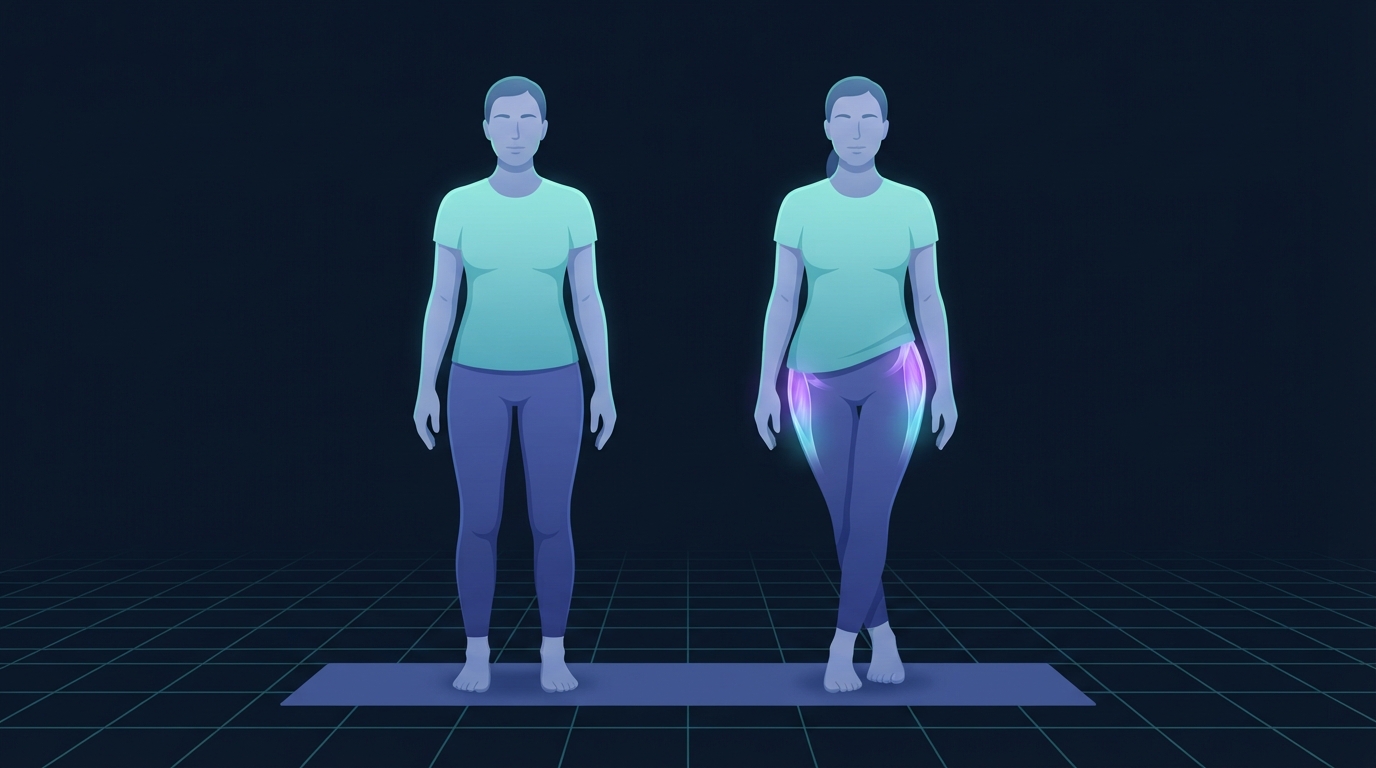
- Compression is the mechanism, not sitting. Grimaldi et al. (2015) point to excessive hip adduction squeezing the tendon against bone, which is why hanging on one hip or crossing your legs provokes it.
- Loading beats an injection. In the LEAP trial, Mellor et al. (2018) found 77.3% of the education-plus-exercise group were successfully recovered at 8 weeks, versus 58.5% after corticosteroid injection and 29.4% for wait and see.
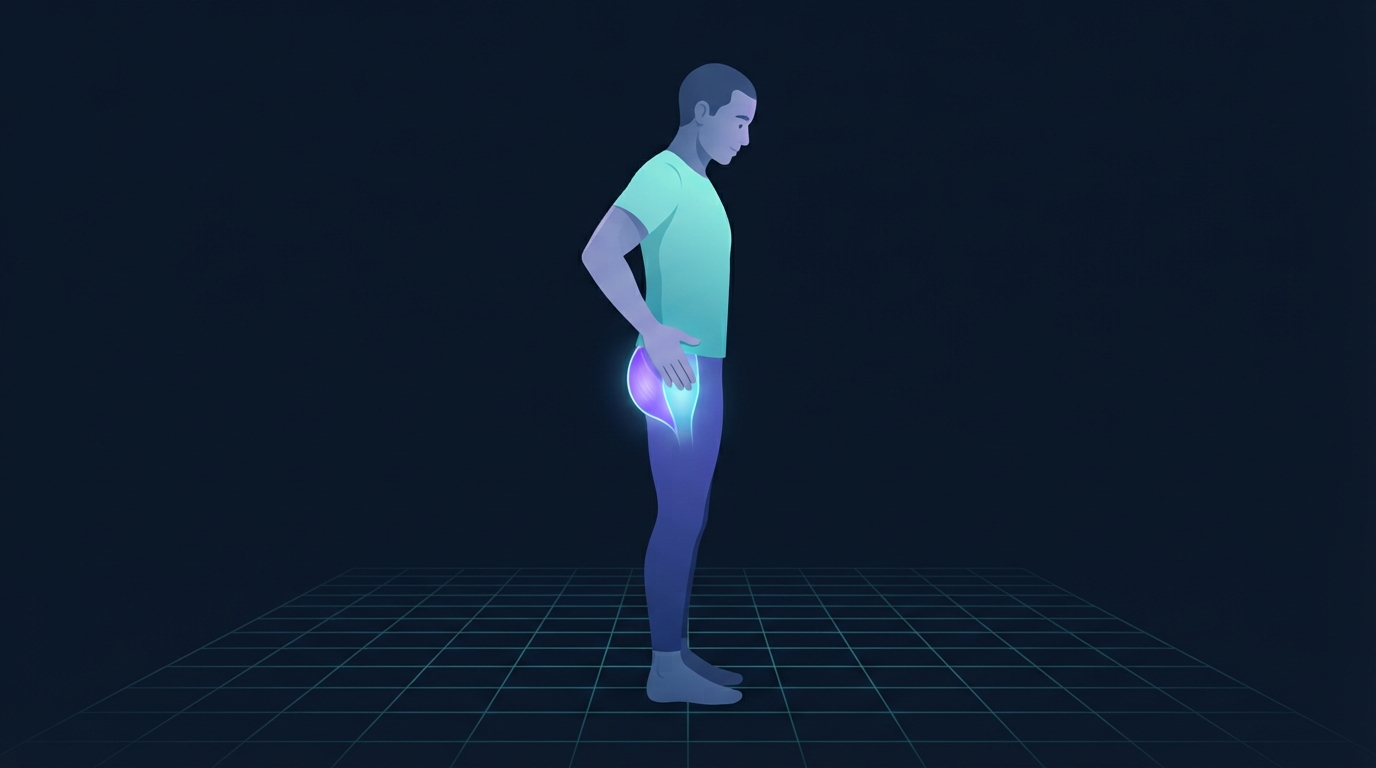
Search the phrase and you get one story: your glutes fell asleep because you sit for a living, and a handful of clamshells will wake them up. It's a good story. It's also the wrong explanation for the version of this problem that actually sends people to a clinic, and the treatment it implies is much weaker than the treatment that works.
The people who search for dead butt syndrome split roughly into two groups. Some feel a vague weakness or disconnection in the backside, usually with no pain. Others have a specific, sharp, lateral hip ache that flares on stairs, wrecks their sleep on that side, and has been building for months. The second group has a condition with a name, an epidemiology, an imaging signature, and randomized trial evidence behind its treatment. The first group has a coaching metaphor.
This page covers what the research supports for both. What gluteal tendinopathy actually is, how common it is, why compression rather than inactivity drives it, what the best trial in this space found, and where the evidence is honestly weaker than the internet suggests.
What "dead butt syndrome" actually refers to
The phrase gets attached to three different problems, and telling them apart is most of the work.
Gluteal tendinopathy. Pain and tenderness directly over the greater trochanter, the bony bump on the outside of the hip. Worse lying on that side, worse on stairs and hills, worse after standing on one leg. This is the version with real research behind it, and it's the one clinicians mean when they say greater trochanteric pain syndrome.
Gluteal inhibition, sometimes called gluteal amnesia. The idea that the glutes stop contributing and the hamstrings and lower back take over. There's fair evidence that pain in a joint changes how nearby muscles behave. There's no evidence that a desk job deletes a muscle's nerve supply. Our guide to glute activation exercises takes that claim apart in detail, so this page won't repeat it.
Nerve symptoms in the buttock. Actual numbness, pins and needles, or a limb that feels asleep after a long ride or a long sit. Hernando et al. (2015) in Skeletal Radiology describe this territory as deep gluteal syndrome: entrapment of the sciatic nerve in the space beneath the gluteus maximus, from fibrous bands, muscle, or trauma. That's a different problem from a sore tendon, and a genuinely dead feeling is the symptom that separates them.
The Research: What Studies Show
Segal 2007: lateral hip pain is far more common than people assume
Segal and colleagues (2007) in Archives of Physical Medicine and Rehabilitation screened 3,026 community-dwelling adults aged 50 to 79 for greater trochanteric pain syndrome. Among women, 15.0% had it on one side and another 8.5% had it on both. Among men the figures were 6.6% and 1.9%. Women had roughly three times the odds (OR 3.37).
Two details from that paper are worth holding onto. Body mass index showed no significant association, which cuts against the assumption that this is a weight problem. And the conditions that did travel with it were iliotibial band tenderness, knee osteoarthritis, and low back pain, which fits a picture of a hip that's being loaded badly rather than a hip that's simply out of shape.
Long 2013: it's almost never bursitis
For decades this was called trochanteric bursitis, and plenty of people still get told that. Long, Surrey, and Nazarian (2013) in the American Journal of Roentgenology reviewed six years of musculoskeletal ultrasound in 877 patients presenting with greater trochanteric pain. The breakdown:
- Gluteal tendinosis: 438 patients, 49.9%.
- Thickened iliotibial band: 250 patients, 28.5%.
- Trochanteric bursitis: 177 patients, 20.2%.
- Gluteal tendon tear: 4 patients, 0.5%.
Nearly 80% of these patients had no bursitis at all. That single finding reframes the whole condition. A bursa is an inflamed fluid sac, and anti-inflammatory logic fits it. A tendon with degenerative change is a load problem, and load problems respond to graded loading, not to rest and an injection.
Grimaldi 2015: compression, not overuse alone
Grimaldi and colleagues (2015) in Sports Medicine wrote the review that changed how clinicians think about this. Their central mechanical claim is that the combination of excessive compression and high tensile load is what damages a tendon, and that the compression comes from excessive hip adduction, meaning the thigh drifting across the midline of the body.
When the hip adducts, the iliotibial band and the overlying tissues press the gluteal tendons into the greater trochanter. Hold that position long enough and the tendon is being squeezed while it's also being pulled. The everyday postures that create it are ordinary:
- Standing with your weight slung onto one hip, the classic hip-hitch stance.
- Sitting with your legs crossed, or with your knees squeezed together.
- Sleeping on your side with the top knee dropped forward onto the mattress.
- Sitting in a low, deep chair or car seat where the knees end up above the hips.
- Stretching by pulling the knee across the body, which is the position people reach for because it reproduces the pain.
Grimaldi's group also flags why it interferes so much with life: it disrupts sleep on that side and makes ordinary weight-bearing tasks unpleasant, which is a heavier burden than a training niggle. And they recommend a battery of clinical tests that deliberately combine compressive and tensile load rather than one poke at the sore spot.
Mellor 2018: the LEAP trial
This is the best trial in the area. Mellor and colleagues (2018) randomized 204 adults aged 35 to 70 (167 of them women, mean age 54.8) with at least three months of lateral hip pain and MRI-confirmed gluteal tendinopathy into three arms: education plus exercise over 14 sessions in 8 weeks, a single corticosteroid injection, or wait and see.
Success on a global rating of change at 8 weeks:
- Education plus exercise: 77.3%.
- Corticosteroid injection: 58.5%.
- Wait and see: 29.4%.
Pain scores told the same story, averaging 1.5 out of 10 in the exercise group against 2.7 after injection and 3.8 for wait and see. At 52 weeks the exercise group held at 78.5% while the injection group sat at 57.1% and the wait-and-see group had drifted up to 51.7%, which tells you that time helps some people and that a cortisone shot's early advantage does not last.
The education half of that intervention matters as much as the exercises. Participants were taught to stop loading the tendon in compression: don't hang on one hip, don't cross your legs, put a pillow between the knees at night, avoid the cross-body stretch. That's an unusually cheap intervention with an unusually good effect size.
Ganderton 2018: the honest counterweight
Not every trial is as clean. Ganderton and colleagues (2018) in the Journal of Women's Health randomized 94 postmenopausal women with greater trochanteric pain syndrome to a targeted gluteal loading program or a sham exercise program, with both groups receiving the same education about avoiding tendon compression. Both groups improved significantly at 12 and 52 weeks. Neither beat the other.
The reading that fits both trials is that the education and the general activity are doing a lot of the work, and that the specific choice of loading exercise may matter less than getting the compression off the tendon and keeping the hip moving. That's a less satisfying answer than "do these four exercises," and it's the one the evidence supports.
Why this matters if you sit all day
The sitting story isn't entirely wrong, it's just aimed at the wrong target. Sitting is a sustained hip flexion position, and if you sit in a way that lets the knees fall together or the legs cross, you're holding the compressive position for hours. The problem is the geometry, not the chair time.
There's a second reason the sitting story is sticky, and it's a real finding. Bartlett, Sumner, Ellis, and Kram (2014) in the American Journal of Physical Anthropology measured gluteal muscle activity across gaits and reported that gluteus maximus activity was greatest in sprinting, similar in running and climbing, and least in walking. In other words, ordinary daily movement genuinely doesn't ask much of the biggest muscle you own. Walking to the kitchen is not glute training. That's a fair argument for deliberate hip work. It isn't evidence that a muscle forgets how to contract.
It's also worth being careful about the causal direction. Rathleff and colleagues (2014) in British Journal of Sports Medicine pooled the hip-strength literature for patellofemoral pain and found something uncomfortable for the weak-glutes narrative: prospective studies showed no association between hip strength and the risk of developing pain, while cross-sectional studies showed that people who already had pain were weaker. Their conclusion was that the weakness is probably a consequence rather than a cause. Different joint, same caution. Finding weak glutes in someone with hip pain does not prove the weakness came first.
Get an evidence-based plan built for you
FitCraft, our mobile fitness app, pairs you with an AI coach who builds you a personalized plan around your goals, schedule, and fitness level. Every FitCraft program is designed by Domenic Angelino, MPH (Brown University) and NSCA-CSCS, with research published in the Journal of Strength and Conditioning Research and Medicine & Science in Sports & Exercise.
Take the Free Assessment Free • 2 minutes • No credit cardWhat the evidence says to actually do
Step one: take the compression off
This is the part the LEAP education arm taught, and it costs nothing. Stand with your weight on both feet instead of parked on one hip. Uncross your legs. Sleep with a pillow between your knees, and if you sleep on the painful side, consider not doing that for a few weeks. Raise low seats so your hips sit at or above knee height. And stop doing the cross-body glute stretch that feels like it's reaching the sore spot, because reproducing the pain is exactly what compressing an irritated tendon does.
Step two: load it, starting with holds
Isometric holds are the standard entry point for an irritated tendon because they let you produce real force without moving through the range that provokes it. For the hip abductors that means squeezing outward against an immovable object, or holding a bridge, in a neutral position with the knees apart rather than together. Build tolerance here before adding range.
Step three: progress to weight-bearing and single-leg work
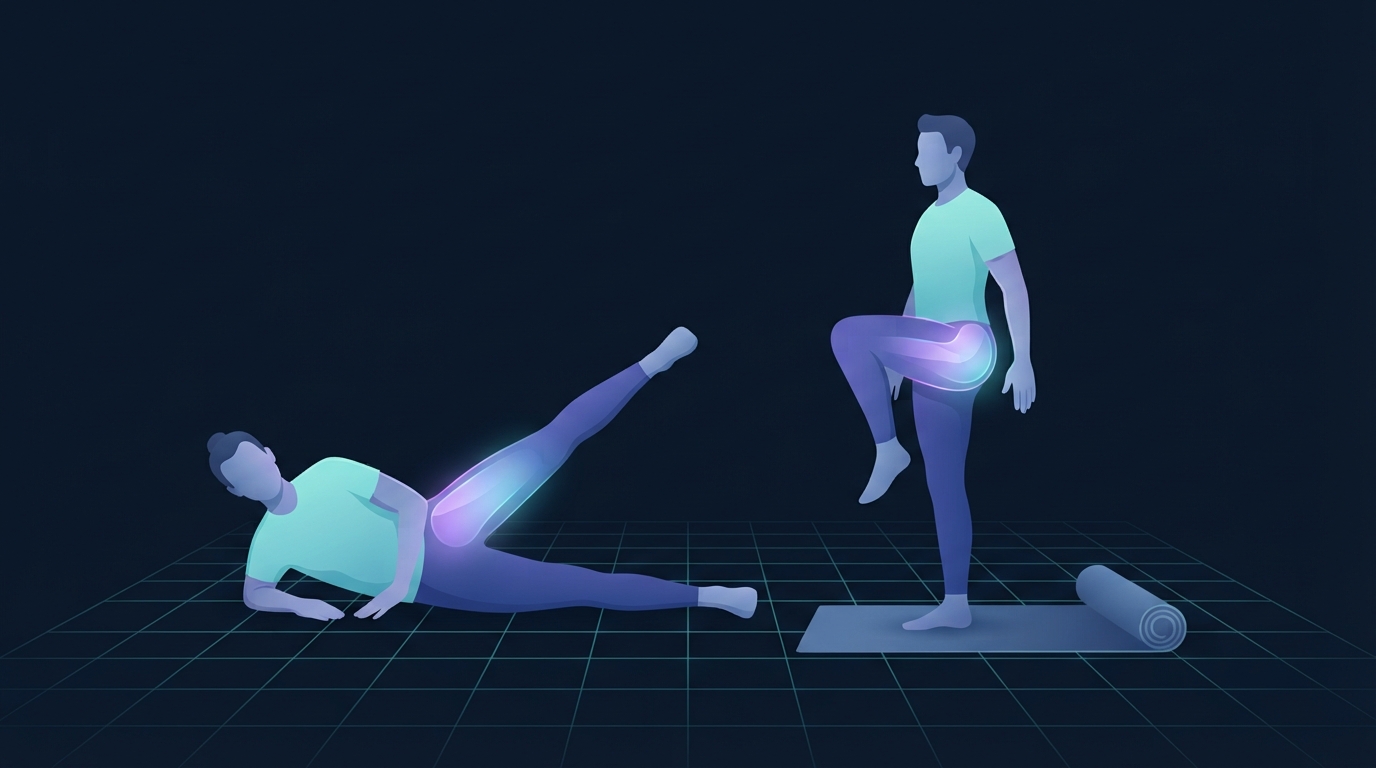
Distefano and colleagues (2009) in the Journal of Orthopaedic & Sports Physical Therapy put surface electrodes on 21 healthy adults across 12 common rehab exercises and gave us the activation ranking most programs still use. Side-lying hip abduction produced the highest gluteus medius activity at 81% of maximum voluntary contraction. For gluteus maximus, the single-limb squat and single-limb deadlift tied at 59%.
That's a useful map. Side-lying abduction is the highest-yield isolation drill for the muscle group that fails here, and the graduation exercises are the single-leg patterns, because standing on one leg is the exact task that hurts. Our review of the single-leg training research covers why that transfer works. For a sequenced version you can do on a floor, the home glute exercise progression orders the same movements by difficulty.
One caveat on band work: the popular banded lateral walk and clamshell drills add abduction resistance, which is what you want, but a band pulled tight across the knees in a flexed position can also drive the hip toward adduction at the start of each rep. Early on, keep the resistance light and the hip out of the pinched position.
Step four: give it months, not days
LEAP ran 14 sessions across 8 weeks and measured its main outcome at week 8. Tendons remodel slowly. If you've had lateral hip pain for six months, a two-week experiment tells you nothing. Consistency across a couple of months is the variable that moves the outcome, which is the same problem most people have with any program. If that's where you keep losing the thread, our comparison of workout apps for busy professionals looks at which ones are built to keep short sessions happening on a full calendar.
Common Misconceptions
Misconception: "It's bursitis, so an injection will fix it"
Long 2013 found bursitis in only 20.2% of 877 patients with lateral hip pain, and gluteal tendinosis in 49.9%. LEAP found corticosteroid injection beat doing nothing at 8 weeks, then lost that edge by 52 weeks while the exercise group held. An injection can buy a window of reduced pain. Used as the whole plan, it leaves the load problem untouched.
Misconception: "Sitting switched my glutes off"
No trial has shown that sedentary time inhibits gluteal motor recruitment in a lasting way. What sitting does is hold the hip in positions that compress the tendon and remove the loading that keeps the muscle strong. Those are load and posture problems, and they're fixable without invoking amnesia.
Misconception: "Stretching the ITB will release it"
The stretches people reach for pull the knee across the body, which is hip adduction, which is precisely the compressive position Grimaldi's group identifies as the damaging one. The stretch feels productive because it reproduces the symptom. If your hip flexors genuinely need attention, target them directly with the hip in neutral rather than dragged across the midline.
Misconception: "Numbness means dead butt syndrome"
Gluteal tendinopathy hurts. It doesn't produce numbness or pins and needles. Hernando et al. describe those symptoms as pointing toward sciatic nerve entrapment in the subgluteal space, a separate problem with separate management. If your leg genuinely goes numb, that's a reason to get assessed rather than to start an activation routine.
What the Research Suggests Going Forward
Three honest limits are worth naming before anyone treats this page as a protocol.
First, the strongest evidence sits in one population. LEAP recruited adults aged 35 to 70 with at least three months of symptoms, and 82% of the sample was female. Ganderton studied postmenopausal women exclusively. How well any of this transfers to a 24-year-old runner with two weeks of lateral hip soreness is genuinely unknown.
Second, the active ingredient hasn't been isolated. LEAP bundled education with exercise, so we can't say how much of that 77.3% belongs to each half. Ganderton's sham comparison suggests the education and the general loading may account for most of it, with the specific exercise selection mattering less than programs imply.
Third, nothing in this literature validates the popular version of dead butt syndrome. There are no prevalence figures for gluteal amnesia, no diagnostic criteria, and no trials, because it isn't a defined condition. That doesn't make hip work useless. It makes the framing wrong, and wrong framing sends people to five minutes of clamshells when the thing that would help is eight weeks of progressive loading plus a change in how they stand.
References
- Segal NA, Felson DT, Torner JC, et al. "Greater trochanteric pain syndrome: epidemiology and associated factors." Arch Phys Med Rehabil. 2007;88(8):988-992. doi:10.1016/j.apmr.2007.04.014
- Long SS, Surrey DE, Nazarian LN. "Sonography of greater trochanteric pain syndrome and the rarity of primary bursitis." AJR Am J Roentgenol. 2013;201(5):1083-1086. doi:10.2214/AJR.12.10038
- Grimaldi A, Mellor R, Hodges P, Bennell K, Wajswelner H, Vicenzino B. "Gluteal tendinopathy: a review of mechanisms, assessment and management." Sports Med. 2015;45(8):1107-1119. doi:10.1007/s40279-015-0336-5
- Mellor R, Bennell K, Grimaldi A, et al. "Education plus exercise versus corticosteroid injection use versus a wait and see approach on global outcome and pain from gluteal tendinopathy: prospective, single blinded, randomised clinical trial." Br J Sports Med. 2018;52(22):1464-1472. doi:10.1136/bjsports-2018-k1662rep
- Ganderton C, Semciw A, Cook J, Moreira E, Pizzari T. "Gluteal loading versus sham exercises to improve pain and dysfunction in postmenopausal women with greater trochanteric pain syndrome: a randomized controlled trial." J Womens Health. 2018;27(6):815-829. doi:10.1089/jwh.2017.6729
- Distefano LJ, Blackburn JT, Marshall SW, Padua DA. "Gluteal muscle activation during common therapeutic exercises." J Orthop Sports Phys Ther. 2009;39(7):532-540. doi:10.2519/jospt.2009.2796
- Rathleff MS, Rathleff CR, Crossley KM, Barton CJ. "Is hip strength a risk factor for patellofemoral pain? A systematic review and meta-analysis." Br J Sports Med. 2014;48(14):1088. doi:10.1136/bjsports-2013-093305
- Bartlett JL, Sumner B, Ellis RG, Kram R. "Activity and functions of the human gluteal muscles in walking, running, sprinting, and climbing." Am J Phys Anthropol. 2014;153(1):124-131. doi:10.1002/ajpa.22419
- Hernando MF, Cerezal L, Perez-Carro L, Abascal F, Canga A. "Deep gluteal syndrome: anatomy, imaging, and management of sciatic nerve entrapments in the subgluteal space." Skeletal Radiol. 2015;44(7):919-934. doi:10.1007/s00256-015-2124-6
Frequently Asked Questions
What is dead butt syndrome?
Dead butt syndrome is a lay term, not a diagnosis. When it describes a real, painful problem, the clinical entity underneath it is almost always gluteal tendinopathy, which is degenerative change and irritation in the gluteus medius and gluteus minimus tendons where they attach to the outside of the hip. That condition sits inside the broader label greater trochanteric pain syndrome. The other common use of the phrase, meaning glutes that have forgotten how to fire from sitting, has no diagnostic criteria and no prevalence data behind it.
Is dead butt syndrome caused by sitting too much?
Sitting is not the mechanism the research points to. Gluteal tendinopathy is driven by compressive load on the tendons, which happens when the hip drifts into adduction, so the thigh crosses toward the midline. Grimaldi and colleagues (2015) in Sports Medicine identified the combination of compression and high tensile load as the most damaging pattern. Standing with your weight hanging on one hip, sitting cross-legged, and sleeping on your side with the top knee dropped forward all create that compression. The length of your workday matters less than the positions you hold.
What does dead butt syndrome feel like?
Gluteal tendinopathy produces pain on the bony point on the outside of the hip, not deep in the buttock. It's usually worse lying on that side at night, worse on stairs and hills, and worse after standing on one leg for a while. It's a localized ache, not numbness. Pins and needles, a genuinely dead or asleep feeling, or pain that shoots down the back of the leg point toward nerve involvement such as deep gluteal syndrome instead, and those symptoms deserve a proper assessment.
How do you fix dead butt syndrome?
The best evidence is for education plus progressive loading. In the LEAP trial, Mellor and colleagues (2018) randomized 204 people with MRI-confirmed gluteal tendinopathy and found that 77.3% of the education-plus-exercise group rated themselves successfully recovered at 8 weeks, versus 58.5% after a corticosteroid injection and 29.4% for wait and see. The education half taught people to stop compressing the tendon in daily postures. The exercise half started with isometric holds and progressed to loaded single-leg work.
Do glute activation exercises fix dead butt syndrome?
Activation drills are a reasonable warm-up and a reasonable starting load, but they're not the cure the phrase implies. Distefano and colleagues (2009) measured side-lying hip abduction at 81% of maximum voluntary contraction for gluteus medius, which is a real training stimulus. What the evidence does not support is the idea that a few clamshells switch a sleeping muscle back on. Loading the hip progressively over weeks, and removing the compressive positions that provoke it, is what changes the outcome.