You wrap a tape around your arm, get a number and have no idea what it means. One forum says 14 inches is small. A gym chart says serious arms start at 15. Most of those numbers don't say whether the arm was flexed, who was measured or how.
The CDC's numbers answer all three. Its survey staff measure thousands of Americans the same way every time, with the arm hanging loose, so you get a real average and a real rank for your own measurement. That average may be bigger than you expect, because a tape can't tell muscle from fat.
Below you'll find the averages by age and sex, a chart that ranks each measurement, what flexing adds and how fast the number changes with training.
Average Bicep Size for Men
The average bicep size for men in the US is 13.7 inches (34.7 cm), and half of men measure 13.5 inches (34.4 cm) or less. These numbers come from the CDC's latest anthropometric reference report, which covers 2,652 men aged 20 and older examined between August 2021 and August 2023. Here's the average arm size for men at each age, in inches and centimeters:
| Age | Average (in / cm) | Median (in / cm) | 75th percentile (in / cm) | 90th percentile (in / cm) |
|---|---|---|---|---|
| All men 20 and older | 13.7 / 34.7 | 13.5 / 34.4 | 14.8 / 37.5 | 15.9 / 40.4 |
| 20 to 29 | 13.5 / 34.3 | 13.5 / 34.4 | 14.7 / 37.3 | 15.8 / 40.1 |
| 30 to 39 | 13.9 / 35.4 | 13.7 / 34.9 | 15.0 / 38.0 | 16.1 / 40.8 |
| 40 to 49 | 14.2 / 36.0 | 14.0 / 35.6 | 15.2 / 38.6 | 16.7 / 42.5 |
| 50 to 59 | 13.9 / 35.2 | 13.6 / 34.5 | 15.0 / 38.1 | 16.3 / 41.4 |
| 60 to 69 | 13.4 / 34.0 | 13.2 / 33.6 | 14.3 / 36.4 | 15.4 / 39.0 |
| 70 to 79 | 13.1 / 33.4 | 13.1 / 33.3 | 14.1 / 35.9 | 15.4 / 39.0 |
| 80 and older | 12.5 / 31.7 | 12.3 / 31.2 | 13.4 / 34.1 | 14.6 / 37.0 |
Centimeters are from Table 16 of the CDC report, and inches are our conversion, rounded to one decimal place. The 90th percentile is the size that 90 percent of men fall below. The exam response rate was 25.6 percent. The estimates are weighted to represent the US population.
Men's arms are largest in their 40s, at 14.2 inches, and about 1.7 inches smaller by age 80. Average BMI in the same survey follows the same curve up to midlife, rising from 27.8 at ages 20 to 29 to 30.5 at ages 40 to 49. So some of that midlife peak is probably body weight, not muscle.
Average Bicep Size for Women
The average bicep size for women in the US is 13 inches (32.9 cm), and half of women measure 12.6 inches (32.1 cm) or less. The same report covers 3,198 women aged 20 and older and leaves out pregnant women.
| Age | Average (in / cm) | Median (in / cm) | 75th percentile (in / cm) | 90th percentile (in / cm) |
|---|---|---|---|---|
| All women 20 and older | 13.0 / 32.9 | 12.6 / 32.1 | 14.2 / 36.1 | 15.9 / 40.5 |
| 20 to 29 | 12.6 / 31.9 | 12.2 / 30.9 | 13.8 / 35.1 | 15.7 / 39.8 |
| 30 to 39 | 13.3 / 33.9 | 12.8 / 32.6 | 14.8 / 37.5 | 17.0 / 43.2 |
| 40 to 49 | 13.2 / 33.6 | 12.8 / 32.5 | 14.4 / 36.6 | 16.2 / 41.2 |
| 50 to 59 | 13.3 / 33.8 | 13.0 / 33.1 | 14.7 / 37.4 | 16.1 / 41.0 |
| 60 to 69 | 12.9 / 32.8 | 12.7 / 32.2 | 14.1 / 35.9 | 15.7 / 39.9 |
| 70 to 79 | 12.6 / 32.1 | 12.4 / 31.6 | 13.9 / 35.2 | 15.2 / 38.6 |
| 80 and older | 11.7 / 29.8 | 11.5 / 29.3 | 12.9 / 32.8 | 13.9 / 35.2 |
The average woman's arm is only 0.7 inches smaller than the average man's, and the top 10 percent of both groups start at about 15.9 inches. That doesn't mean women carry as much arm muscle. In a study of 139 international flag football players who all trained at least 5 days a week, the men's relaxed arms were 1.6 inches bigger, more than double the national gap. Body fat appears to fill in much of the difference in the general population.
Average Arm Size: What the Tape Really Measures
Average arm size and average bicep size are the same measurement, because you can't wrap a tape around one muscle. The tape takes in the biceps brachii, the bicep's full name, and the brachialis at the front, the triceps at the back, and the bone, skin and fat. The triceps is the bigger muscle group, as our guide to building bigger arms explains, so much of a bicep measurement isn't biceps at all.
The CDC measures the arm relaxed. Its procedures manual has you stand with your shoulders relaxed and your right arm hanging loosely, and it warns: "Flexing or tightening the arm muscles will yield an inaccurate measurement."
Because the tape can't separate muscle from fat, arm size rises with body size. In a study of 650 adults in Bangladesh, arm circumference correlated with BMI at 0.81 in men, and the link was at least as strong in women. The average US adult in the CDC survey has a BMI of about 30, so the national average isn't a picture of a lean arm.
Athletes show the difference. In a 2021 study, 20 Super League handball players stood about 6 ft 2 in and weighed about 207 pounds, yet their relaxed arms averaged 13.3 inches, smaller than the average American man's. A bigger number doesn't automatically mean a stronger or more muscular arm. Our article on why some people are strong but don't look it covers the other side of that.
Flexed vs Relaxed: How Much Bigger Is a Flexed Bicep?
A flexed bicep measures about 0.7 to 1.5 inches more than the same arm relaxed in trained men. The CDC doesn't measure flexed arms, so the best numbers come from studies that taped the same athletes both ways:
| Group | Relaxed | Flexed | Difference |
|---|---|---|---|
| 20 Super League handball players (men) | 13.3 in (33.8 cm) | 14.7 in (37.3 cm) | 1.4 in (3.5 cm) |
| 20 first league handball players (men) | 13.0 in (33.0 cm) | 14.3 in (36.2 cm) | 1.3 in (3.2 cm) |
| 30 university handball players (men) | 12.3 in (31.2 cm) | 13.8 in (35.0 cm) | 1.5 in (3.8 cm) |
| 91 international flag football players (men) | 13.1 in (33.4 cm) | 13.9 in (35.3 cm) | 0.7 in (1.9 cm) |
| 48 international flag football players (women) | 11.5 in (29.3 cm) | 11.7 in (29.8 cm) | 0.2 in (0.5 cm) |
Handball data from Lijewski and colleagues (2021), flag football data from Talavera-Hernández and colleagues (2025). Inches are our conversion.
These are athletes, so treat the gap as a rough guide. Adding it to the CDC average puts the average American man somewhere around 14.5 to 15 inches flexed, which is our estimate, not a measurement. It also means a 15-inch arm measured flexed is probably about 14 inches relaxed, only a little above the US average.
Bicep Size Chart: Where Your Measurement Ranks
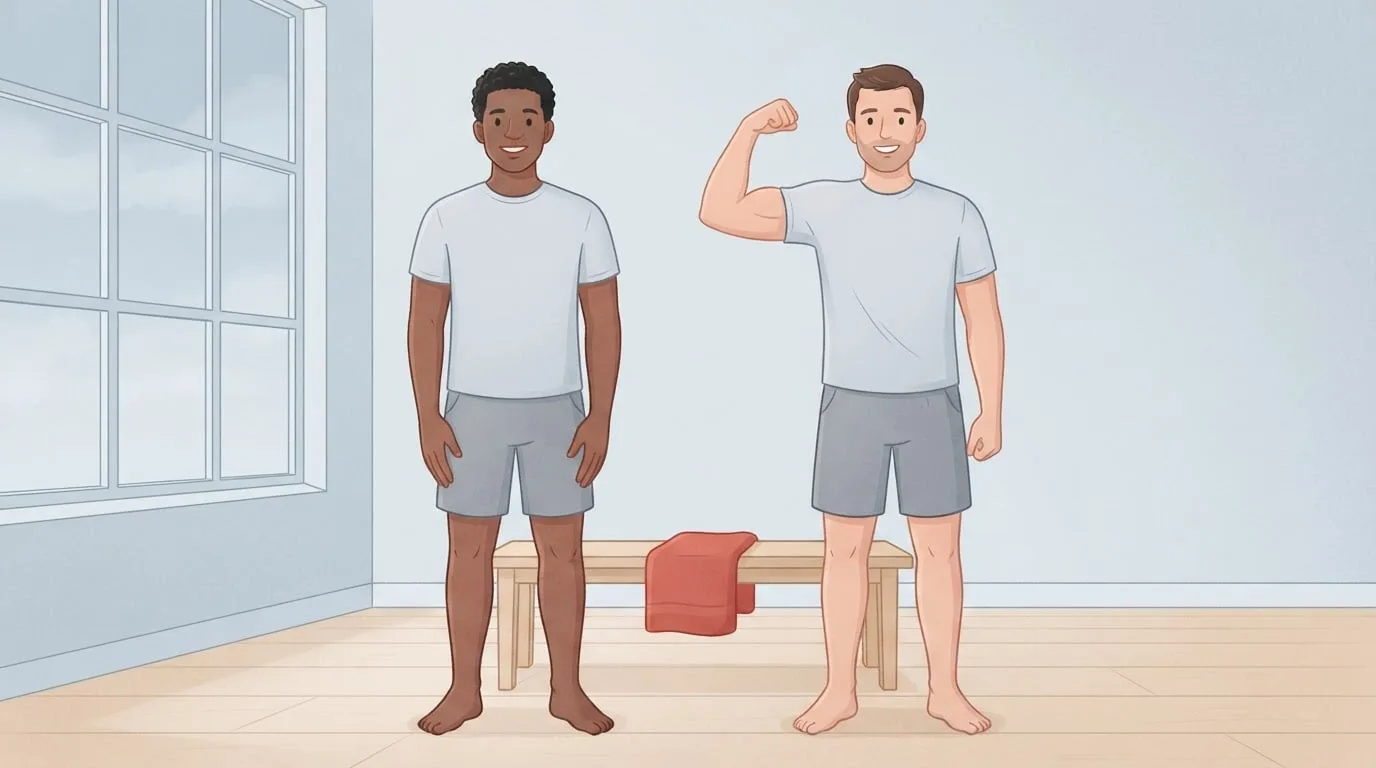
This bicep size chart shows how each relaxed measurement ranks among US adults aged 20 and older. The CDC publishes nine percentiles for each group, so we estimated the ranks in between by straight-line interpolation and rounded them to the nearest 5 percent.
| Relaxed arm | Men smaller than this | Women smaller than this |
|---|---|---|
| 10 in (25.4 cm) | Under 5% | About 5% |
| 11 in (27.9 cm) | About 5% | About 20% |
| 12 in (30.5 cm) | About 20% | About 40% |
| 13 in (33.0 cm) | About 40% | About 55% |
| 14 in (35.6 cm) | About 60% | About 70% |
| 15 in (38.1 cm) | About 80% | About 80% |
| 16 in (40.6 cm) | About 90% | About 90% |
| 17 in (43.2 cm) | Over 95% | About 95% |
A 13-inch arm is slightly under average for a man and about average for a woman. A 10-inch arm sits near the bottom of both charts. From 15 inches up, men and women rank about the same, most likely because the tape is counting fat as well as muscle at that end.
Knowing what to do is the easy part.
FitCraft, our mobile fitness app, pairs you with an AI coach who builds you a personalized plan around your goals, schedule, and fitness level. Every FitCraft program is designed by Domenic Angelino, MPH (Brown University) and NSCA-CSCS, with research published in the Journal of Strength and Conditioning Research and Medicine & Science in Sports & Exercise.
Take the Free Assessment Free • 2 minutes • No credit cardHow to Measure Bicep Size
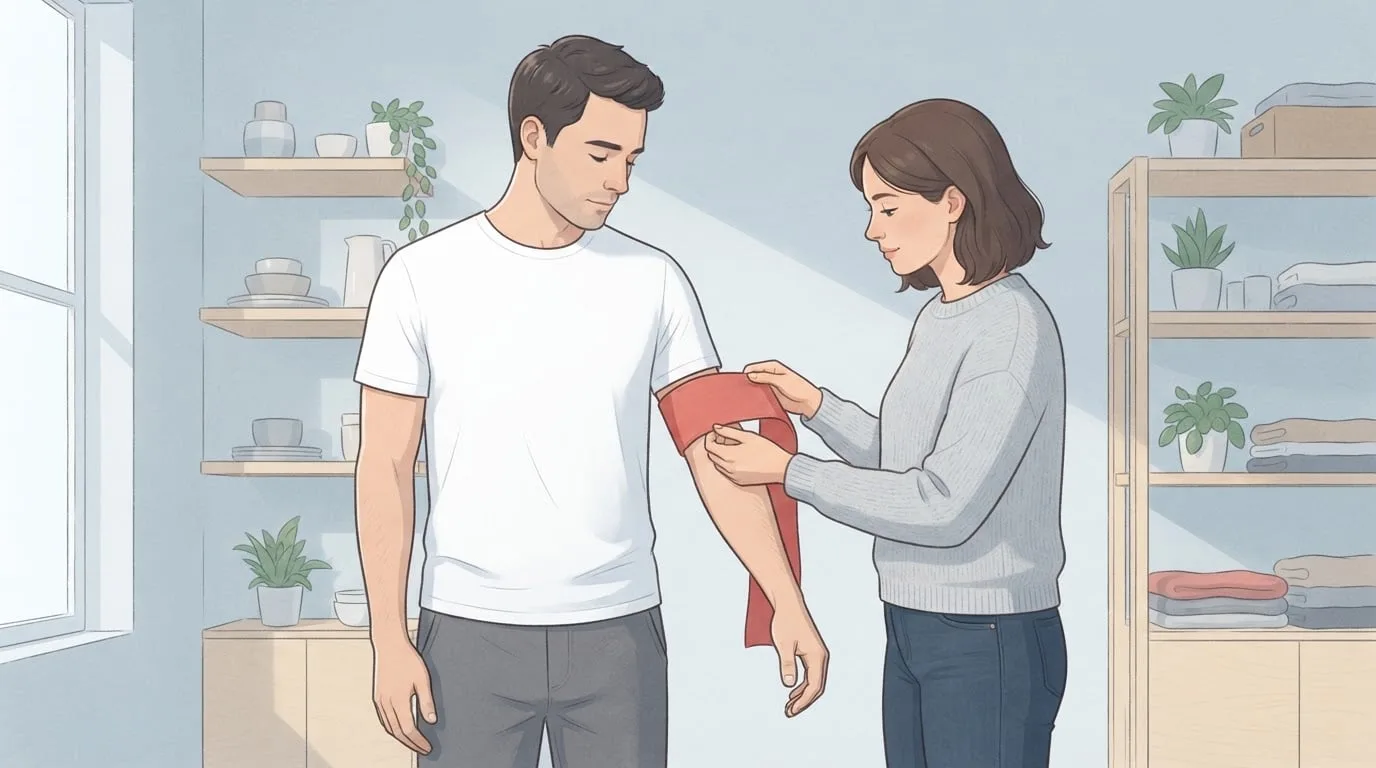
To measure bicep size, wrap a soft tape around the midpoint of your upper arm with the arm hanging loose. That's the CDC's method, so it lets you compare your arm with the tables above. A helper makes it easier, because finding the midpoint of your own arm is awkward.
- Bend your right elbow to 90 degrees with your palm facing up.
- Measure along the back of your upper arm from the bony tip of your shoulder to the point of your elbow, and mark the halfway point.
- Let your arm hang loosely, with your shoulders relaxed and your weight even on both feet. Don't tense anything.
- Wrap the tape around your arm at the mark, at a right angle to your arm. It should sit snugly without pressing into the skin.
- Read the number to the nearest millimeter or sixteenth of an inch.
To measure flexed, use the method from the training studies below. Raise your upper arm forward to shoulder height, bend your elbow to 90 degrees, contract as hard as you can and measure the largest point. Take three readings and average them.
Measure on a rest day, at about the same time of day. Those researchers took their measurements 3 to 5 days after the last workout to keep swelling out of the result.
What Are Considered Big Arms?
Relaxed arms of 16 inches or more count as big by US standards, because only about 1 adult in 10 measures that much. But the CDC's chart includes fat, so it tells you about size more than muscle. Measurements from trained people give a better idea of what muscular arms look like on a tape:
- Young men before training: 12.3 to 13.0 inches flexed (Gentil and colleagues, 2020).
- Young men with training experience: 14.2 inches flexed (same paper).
- Super League handball players: 14.7 inches flexed (Lijewski and colleagues, 2021).
- Competitive male bodybuilders: about 16.5 to 16.8 inches, though the paper doesn't say whether the arm was flexed (de Moraes and colleagues, 2019).
These are small groups, so read them as landmarks. A lean 15-inch flexed arm beats the average in the trained groups here, and a lean 16-inch arm is close to competition size. We didn't find a study that measured any group near the 20-inch or 22-inch arms quoted online.
How big should your arms be for your height?
A taller person of the same shape has a proportionally larger arm, but the CDC doesn't report arm size by height. So use a ratio. The average US man's relaxed arm is about 20 percent of his height (13.7 inches on a 68.9-inch man), and the average woman's is about the same (13 inches on 63.5 inches). For men, the top 10 percent starts at about 23 percent of height.
| Height | Average for that height | Big for that height |
|---|---|---|
| 5 ft 6 in | 13.1 in | 15.2 in |
| 5 ft 9 in | 13.7 in | 15.9 in |
| 6 ft 0 in | 14.3 in | 16.6 in |
| 6 ft 3 in | 14.9 in | 17.3 in |
These rows are our arithmetic from the national averages for men, not measured arms at each height, so use them as a rough guide.
How Fast Can Your Arms Grow?
Arms grow slowly on a tape measure, and fastest when you're new to training. Gentil and colleagues (2020) pooled three studies in which 67 young men did 10 to 12 weeks of supervised resistance training, with 6 to 12 weekly sets for the arm muscles. Flexed arm size rose 4.9 percent on average:
| Group | Before | After | Gain |
|---|---|---|---|
| Untrained men, first study | 12.3 in (31.3 cm) | 12.9 in (32.8 cm) | 0.6 in (1.5 cm) |
| Untrained men, second study | 13.0 in (33.0 cm) | 13.5 in (34.3 cm) | 0.5 in (1.3 cm) |
| Trained men | 14.2 in (36.1 cm) | 14.4 in (36.5 cm) | 0.2 in (0.4 cm) |
So half an inch in your first three months is a good result. The trained men gained about a quarter to a third as much in the same time. At that pace, a trained lifter would need most of a year to add the same half inch.
Your own response may differ a lot. Hubal and colleagues (2005) had 585 men and women train the elbow flexors of one arm for 12 weeks. Biceps size on MRI changed by anywhere from a 2 percent loss to a 59 percent gain, and men gained only 2.5 percent more than women.
Our dumbbell arm workout turns the sets, positions and progression into a 30-minute session, and our review of how long it takes to build muscle covers the wider timeline.
What This Means for You
If your relaxed arm is close to 13.7 inches as a man or 13 inches as a woman, you're right at the US average. That's a starting point. It says nothing about how strong you are or what your arm can become. Measure the same way each time, write the number down and check again every month or two.
The slow pace is the real obstacle. Half an inch in three months is hard to see from week to week, which is why so many people stop before the tape moves. That isn't a lack of discipline. Arm growth rewards months of regular sets, and regular is the hard part.
If you've got a pair of dumbbells and no plan, a dumbbell workout app can handle the planning for you. In FitCraft, a 3D AI coach demonstrates every curl and press on an interactive model, says your name during the workout and adapts your workouts as you progress. Streaks, leaderboards and a new quest each month give you a reason to come back. As one FitCraft user, Mike, put it: "The streak system got me hooked. I didn't want to break my chain."
Frequently Asked Questions
Is a 14 inch bicep good?
A 14-inch relaxed arm is a little above average for a man and well above average for a woman. It's larger than about 60 percent of US men and about 70 percent of US women in CDC data. If you measured 14 inches flexed, your relaxed arm is probably about 12.5 to 13.3 inches, which is close to or a bit below the male average.
Is a 12 inch bicep good?
A 12-inch relaxed arm is below average for an adult man and a little below average for a woman. It's larger than about 20 percent of US men and about 40 percent of US women. It's a normal place to start: untrained young men in training studies averaged about 12.3 to 13 inches flexed.
How rare is a 15 inch bicep?
About 1 in 5 US men and women measure 15 inches or more around the relaxed upper arm, so it isn't rare. That count includes arms with a lot of fat, though. A lean, muscular 15-inch arm is much less common: trained young men in one set of studies averaged 14.2 inches flexed.
What is a normal bicep size?
A normal relaxed upper arm for US adults runs from about 12.4 to 14.8 inches for men and 11.3 to 14.2 inches for women. Those ranges cover the middle 50 percent of adults in CDC data. About a quarter of adults measure smaller and about a quarter measure larger.
What is the average bicep size for a 15 year old?
Boys aged 14 to 15 average 11.7 inches (29.7 cm) and girls 11.1 inches (28.3 cm), measured relaxed in the CDC's 2021 to 2023 survey. By age 18 to 19, the average is 12.4 inches (31.4 cm) for boys and 12 inches (30.4 cm) for girls. Teens are still growing, so their numbers change without any training.
What is the average bicep size in cm?
The average bicep size is 34.7 cm for US men and 32.9 cm for US women, measured around the relaxed upper arm. The largest 10 percent of both groups start at about 40.5 cm.