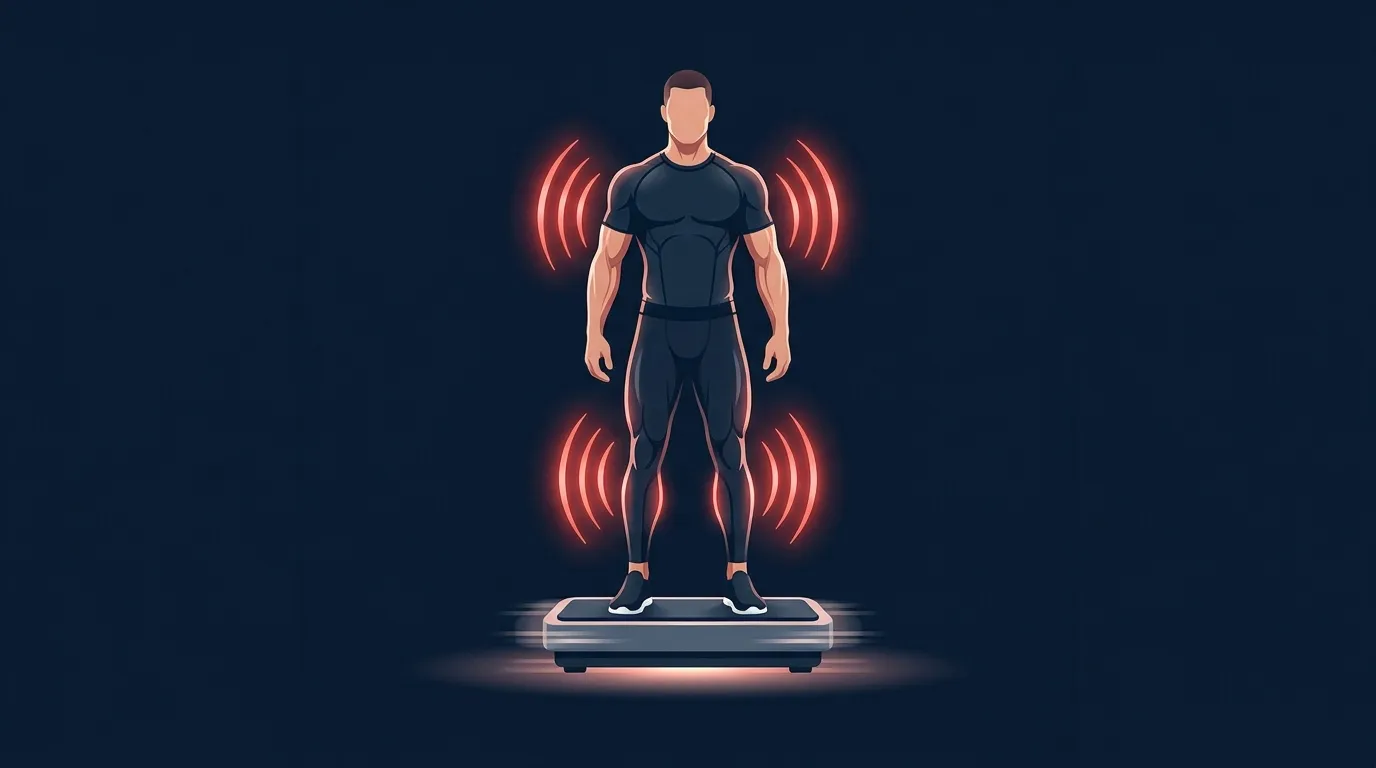
Vibration plates got their moment. TikTok filled up with clips of people standing on shaking platforms in leggings, captioned with claims like "10 minutes on this equals 30 minutes of cardio." Amazon searches spiked. Vibration plate sales grew an estimated 49% year over year across 2025. And the honest question, buried under all that noise, is a good one. Does standing on a shaking platform actually do anything? The mini trampoline sits in the same aisle with the same style of claim, and we held it to the same standard in our review of rebounder benefits, where the intensity and balance numbers hold up and the NASA 68 percent line does not.
The answer is yes, but not what the marketing implies. Whole-body vibration produces measurable muscle activation and, in some populations, real physiological adaptations. It also does not replace exercise, does not burn meaningful calories, and does not accomplish anything close to "30 minutes of running." Both things are true.
This piece walks through what a vibration plate actually is at the mechanism level, the four most recent and best-designed meta-analyses across athletes, healthy women, postmenopausal women with osteoporosis, and nursing home residents over 80, and where the honest use cases start and stop. The frame that fits the evidence is straightforward. Compared to doing nothing, vibration plates do a small amount. Compared to actually training, they do very little extra.
What a Vibration Plate Actually Is
A whole-body vibration platform is a flat or teeter-totter-style plate that oscillates vertically (or side-to-side, depending on the design) at 20 to 50 Hz with an amplitude of 1 to 10 mm. You stand on it, sometimes in a static squat or lunge, sometimes doing a slow movement, usually for 30 to 60 seconds at a time across a 10 to 20 minute session.
The proposed mechanism is the tonic vibration reflex. Fast oscillation stretches the muscle rapidly and repeatedly, which triggers reflex contractions via the muscle spindle. The result is involuntary muscle activation at rates you cannot produce voluntarily. Surface EMG studies confirm the effect: standing on a vibration plate produces elevated muscle activity in the calves, quadriceps, and glutes above what quiet standing produces. That much is not controversial.
The controversial question is what that reflex activation actually adds up to when you stack it over weeks. Two categories of claim are worth separating:
- Mechanism-anchored claims. "Vibration triggers muscle activation" is true. "Vibration briefly increases muscle temperature and blood flow" is true. "Vibration can be used as a warm-up modality" is supported.
- Marketing-inflated claims. "10 minutes equals 30 minutes of running" has no research behind it. "Vibration plates burn hundreds of calories" is false. "Vibration replaces resistance training" is false. "Vibration causes rapid fat loss" is false.
The four meta-analyses below map where the mechanism-anchored effects show up chronically, and where they don't.
The Research: What Studies Show
Peng et al. (2024): The Athlete Meta-Analysis
The most rigorous synthesis in a general-population-adjacent group comes from Peng, Guo, Wu, and Hou (2024) in the Journal of Human Kinetics. They pooled 18 randomized controlled trials of whole-body vibration in athletes and quantified effects on three components of exercise performance: muscle power (jumping), muscle strength (knee isokinetic torque), and cardiovascular endurance (VO2max).
The strength result was clearly positive. Isokinetic knee extensor torque improved by +8.86 N·m (95% CI 6.00 to 11.72, p<0.00001) and knee flexor torque by +9.56 N·m (p<0.00001). Those are meaningful effect sizes on a strength outcome that matters for athletic performance.
The power result was not significant. Countermovement jump improved by only 0.66 cm (95% CI −0.13 to 1.44, p=0.10) and squat jump by 0.44 cm (p=0.33). For context, a training-induced improvement in vertical jump from a real plyometric or resistance program is typically 3 to 8 cm over 6 to 12 weeks. Vibration was nowhere near that.
The cardio result was negative. VO2max change was −1.18 mL/kg/min (95% CI −4.25 to 1.89, p=0.45). Not zero, but not a real signal in the direction the marketing implies. If a vibration plate genuinely delivered "30 minutes of running," a VO2max response would show up. It doesn't.
The clean read from Peng (2024) is that whole-body vibration in athletes produces a modest, sport-relevant strength benefit in the knee extensors and flexors, no meaningful power benefit, and no cardiovascular benefit. It's a niche tool, not a general one.
Qiu et al. (2025): The Healthy Women Meta-Analysis
The most recent and largest synthesis in general-population women is Qiu, Wang, Yin, and colleagues (2025) in PLOS One. They pooled 21 randomized controlled trials in 748 healthy women and quantified whole-body vibration training effects on muscle performance, with two comparator arms: sedentary controls and exercise controls.
Against sedentary controls, vibration training worked. Knee extension strength improved by a standardized mean difference of 0.534 (95% CI 0.303 to 0.766, p<0.001), a medium effect size. Countermovement jump improved by SMD 0.470 (95% CI 0.211 to 0.729, p<0.001), a small-to-medium effect. So compared to doing nothing, standing on a vibration plate and doing a few static holds is genuinely better than sitting still.
Against exercise controls, the story reversed. Knee extension SMD dropped to 0.274 (95% CI −0.070 to 0.618, p=0.118), not statistically significant. Countermovement jump was significant but small (SMD 0.338, p=0.028). The authors were direct in their interpretation: "WBVT significantly improved only the countermovement jump performance when compared with the exercise control groups." For every other strength outcome, vibration training was no better than an equivalent exercise intervention.
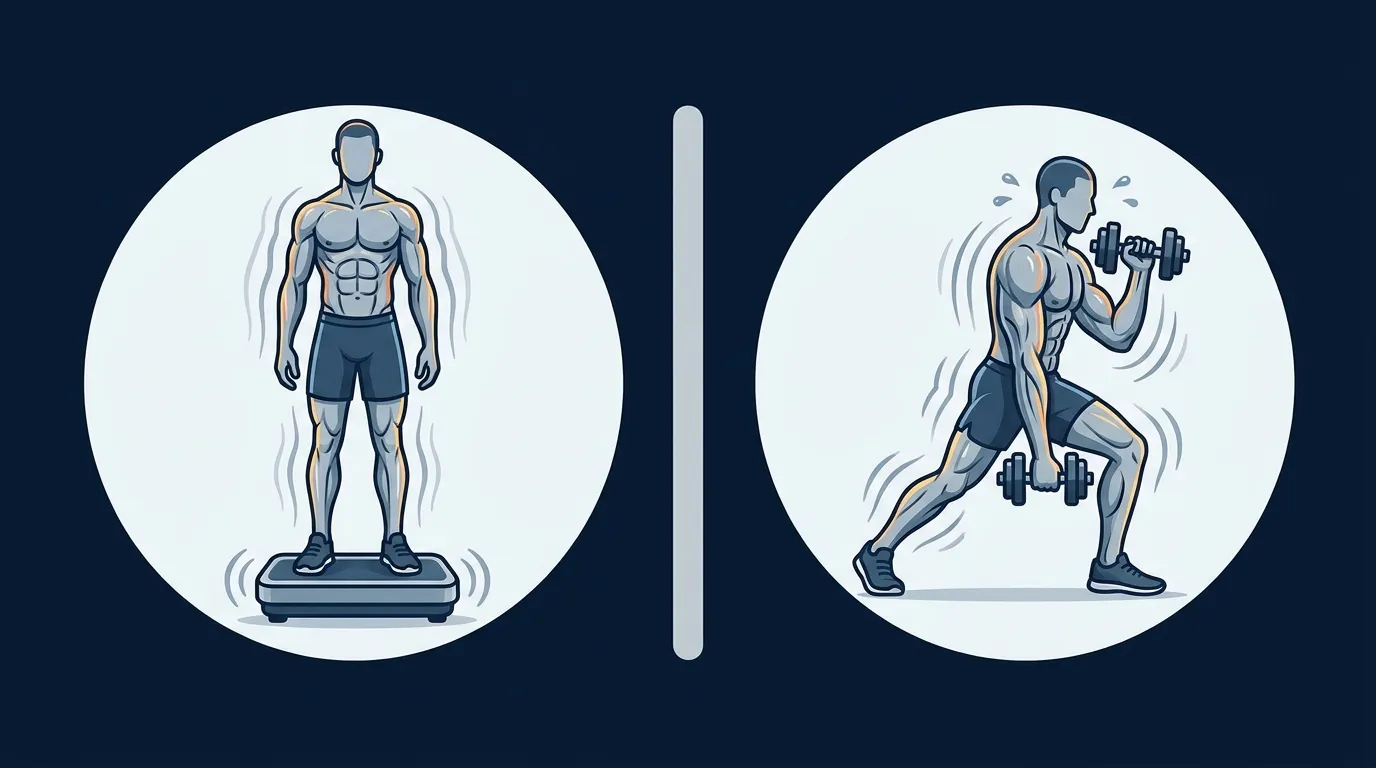
The Qiu (2025) result is the cleanest test of the "does this replace exercise?" question in a general adult female population. And the answer is no. Vibration plates match some aspects of training and lose on most. If you're going to do something, exercise wins. If your alternative is nothing, vibration is better than nothing.
Li et al. (2024): Postmenopausal Osteoporosis and Bone Density
The strongest population-specific case for vibration plates is postmenopausal women with osteoporosis. Li, Liang, Gao, and Zong (2024) in the Brazilian Journal of Medical and Biological Research pooled 13 randomized controlled trials in 783 postmenopausal women with diagnosed osteoporosis and quantified effects on bone mineral density, pain, and body composition.
Both primary bone density outcomes improved significantly. Lumbar spine BMD increased with a weighted mean difference of 0.018 g/cm² (95% CI 0.004 to 0.032, p=0.011) versus controls. Femoral neck BMD increased with WMD 0.005 (95% CI 0.001 to 0.011, p=0.049). Effects were largest at the 6-month follow-up (WMD 0.024 at lumbar, p=0.002; WMD 0.024 at femoral neck, p=0.003) and washed out by 12 months (both non-significant), which strongly suggests the bone effect requires sustained use rather than a discrete "prescribed course."
Pain reduction was also significant. Weighted mean difference in pain score was −0.786 (95% CI −1.300 to −0.272, p=0.003). Real, if not dramatic. And, importantly, body composition did not change. Muscle mass WMD was 0.547 (p=0.52) and fat mass showed no significant change. Whole-body vibration in this population moves the bone and pain outcomes without moving the composition outcomes.
The Li (2024) findings support a niche but genuine use case. Postmenopausal women with osteoporosis who cannot tolerate impact loading (running, jumping, plyometrics, heavy squats) but need a bone stimulus benefit from regular whole-body vibration. That doesn't make vibration plates a general fitness tool. It does make them a defensible adjunct in this specific clinical context, alongside the more evidence-heavy interventions: resistance training, dietary calcium and vitamin D, and any prescribed pharmacotherapy.
Sañudo et al. (2024): Nursing Home Residents Over 80
The other well-supported population is very old adults with reduced physical function. Sañudo, Reverte-Pagola, Seixas, and Masud (2024) in Physical Therapy pooled randomized controlled trials of whole-body vibration in nursing home residents over 80 years old and analyzed effects on physical function parameters relevant to fall prevention.
Lower-limb functional strength, measured by the Chair Stand Test, improved with a standardized mean difference of 0.59 (95% CI 0.16 to 1.03, p=0.007), a medium and clinically meaningful effect. The Chair Stand Test measures how quickly a person can rise from a chair repeatedly. It's a validated proxy for functional lower-body strength, and it predicts fall risk and mortality in older adults. A medium-effect improvement in this outcome from a low-load, low-coordination-demand intervention is genuinely useful in a population where standard exercise programs face adherence and safety barriers.
What Sañudo (2024) does not claim is that vibration works better than exercise in this population. It supports vibration as an accessible tool for a group that struggles to do progressive resistance training, not as a replacement for progressive resistance training in a group that could do it.
Why This Matters for Your Fitness
The four meta-analyses fit together into a coherent story. Whole-body vibration is real physiology. The tonic vibration reflex is measurable. Modest chronic adaptations in strength, bone density, and functional lower-body performance are documented. And exercise-controlled trials repeatedly show that if your comparator is actual training, vibration usually loses or ties. See our companion write-up on resistance training and mortality for a sense of what the evidence-heavy alternative actually delivers.
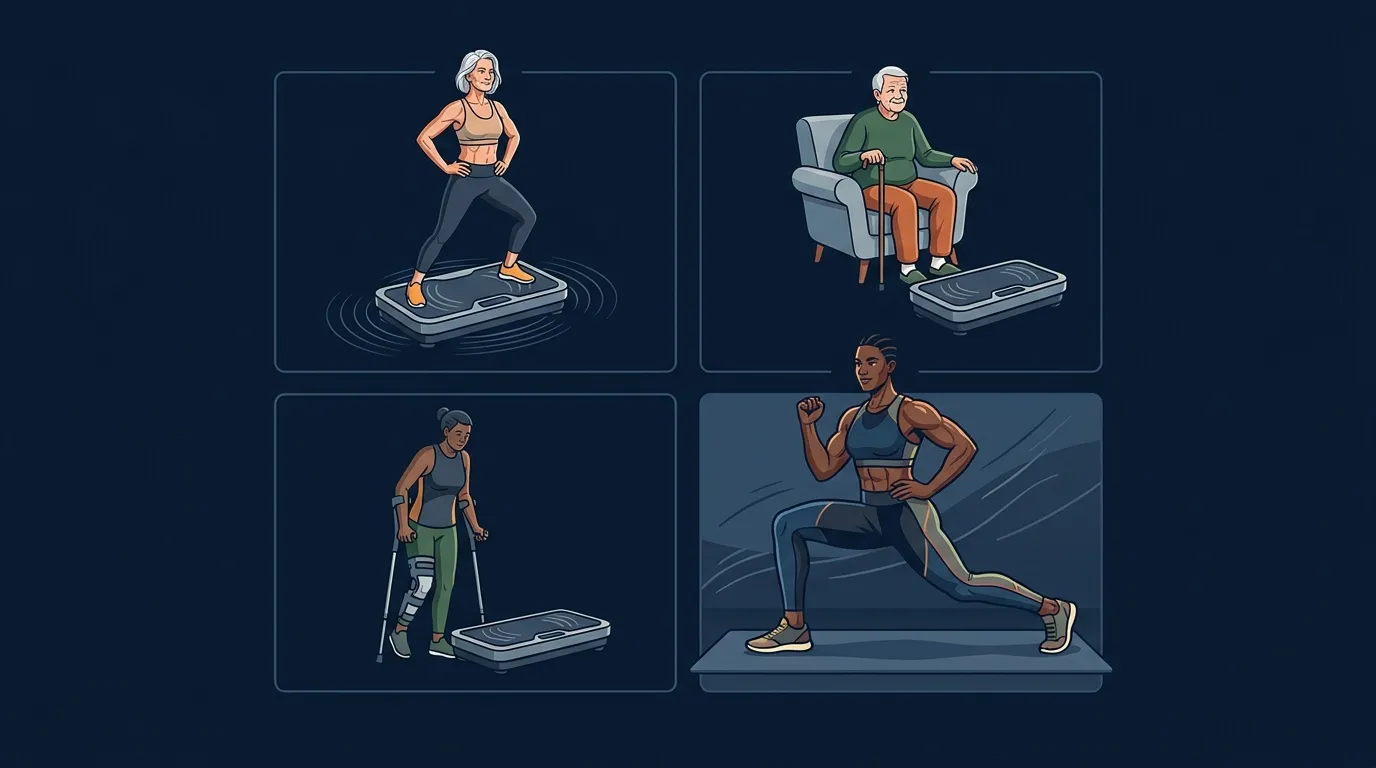
The frame that fits the evidence looks like this. If you're doing zero exercise for reasons that are hard to fix (severe deconditioning, mobility limitations, joint pain, cognitive impairment, chronic illness), a vibration plate is meaningfully better than continued zero. If you're doing regular exercise already, adding a vibration plate does very little on top. If you're using a vibration plate instead of exercise because it seems more convenient, the research does not support that swap.
There is also a real second-order effect worth naming. For someone genuinely intimidated by traditional exercise, or with gym anxiety, standing on a vibration plate for 10 minutes at home might feel more accessible than any other option. If that access point leads to trying more, that has value. If it becomes a permanent substitute for actual movement, it doesn't.
Get an evidence-based plan built for you
FitCraft, our mobile fitness app, pairs you with an AI coach who builds you a personalized plan around your goals, schedule, and fitness level. Every FitCraft program is designed by Domenic Angelino, MPH (Brown University) and NSCA-CSCS, with research published in the Journal of Strength and Conditioning Research and Medicine & Science in Sports & Exercise.
Take the Free Assessment Free • 2 minutes • No credit cardHow to Actually Use a Vibration Plate
If you own one, or you're deciding whether to, the research points toward a reasonable protocol.
Frequency and amplitude. Most trials in the meta-analyses above used 25 to 40 Hz with amplitudes of 2 to 6 mm. Lower frequencies (below 20 Hz) mostly failed to show effects. Very high frequencies with high amplitudes are uncomfortable and add little. Set your plate somewhere in the middle of what it offers.
Session structure. The trial protocols typically ran 30 to 60 seconds of vibration alternated with 30 to 60 seconds of rest, for a total of 5 to 20 minutes of vibration exposure per session. Longer sessions did not produce better outcomes and often produced discomfort (nausea, headaches, itching in some users at high amplitudes).
What to do while you're on it. Static squats (half squat, quarter squat), lunges, calf raises, and single-leg stances are the standard positions. Standing rigidly at attention on the plate is the least productive option and the one most heavily marketed. Adding a movement or a load-bearing position dramatically increases what the vibration actually contacts.
Frequency per week. The bone density trials in Li (2024) generally ran 3 sessions per week for 6 to 12 months. The strength trials in Qiu (2025) ran 2 to 3 sessions per week for 8 to 12 weeks. If you're going to use a plate, twice or three times a week is the well-supported dose. Daily is not necessary.
When to skip it entirely. If you're already training 3 to 5 times a week with a mix of resistance and cardio, a vibration plate is redundant. The additive effect over trained baseline is small and the trials that support it are in sedentary or low-training-history populations. Time and money spent on the plate would produce more if redirected into a better exercise program.
Common Misconceptions
"10 Minutes on a Vibration Plate Equals 30 Minutes of Cardio"
This is a marketing claim with no research support. Peng (2024) found VO2max change of −1.18 mL/kg/min (p=0.45) across 18 trials in athletes. A 30-minute moderate run typically produces a modest acute VO2 response and, across a training block, raises VO2max by measurable amounts. Vibration does neither. The two are not comparable in energy expenditure, cardiovascular strain, or long-term aerobic adaptation. If your goal is cardiovascular fitness, use our zone 2 training primer instead.
"Vibration Plates Burn Hundreds of Calories"
No. The energy cost of standing on a vibrating platform is only modestly higher than quiet standing. Calorimetry studies (not in the four meta-analyses above but well-documented elsewhere in the literature) put the energy cost of a 10-minute vibration session at roughly 30 to 60 kcal above resting metabolism, depending on posture. That is the same range as a slow walk around a large room. Any weight loss attributed to a vibration plate is either coincidence or reflects other changes made in parallel (usually diet).
"Vibration Plates Can Replace Resistance Training for Older Adults"
Partially true, but the framing matters. Sañudo (2024) found a medium effect on functional strength in nursing home residents over 80, a population where progressive resistance training is often not feasible. For that population, yes, a vibration plate is a genuine substitute for a program that isn't going to happen anyway. For a healthy 65-year-old who could do progressive resistance training for sarcopenia, the research strongly favors doing that instead. Vibration is the tool for the group that can't. It's not the preferred tool for the group that can.
"Vibration Plates Fix Cellulite / Reduce Belly Fat / Tone Muscles"
No, no, and toning isn't real (see our write-up on the "toned" myth). Li (2024) found no change in muscle mass or fat mass across 13 trials in the population where vibration effects are strongest. There is no plausible mechanism by which vibration would preferentially reduce fat from any body region, and no evidence it does. This claim is a marketing artifact, not a research finding.
What the Research Suggests Going Forward
The vibration plate literature is unusually consistent for a fitness-industry-adjacent topic. Four independent recent meta-analyses across athletes, healthy women, postmenopausal women with osteoporosis, and nursing home residents over 80 all point the same direction. There are small but real effects on strength (Peng 2024, Qiu 2025), bone mineral density in a specific population (Li 2024), and functional lower-body performance in another specific population (Sañudo 2024). The effects are more visible when the comparator is doing nothing, and largely disappear or become non-significant when the comparator is actual exercise. Body composition, VO2max, and calorie expenditure do not change meaningfully in any of the four analyses.
The honest limits worth naming. Trial durations in the strength and performance literature are usually 8 to 12 weeks. Long-duration data (12+ months) is thin and, where it exists (the Li 2024 lumbar and femoral neck follow-ups at 12 months), it shows the effect washing out without continued exposure. Vibration frequency, amplitude, session structure, and posture vary enormously across trials, which weakens direct dose-response conclusions. And the populations where vibration works best (very old, osteoporotic, severely deconditioned) are also the populations where nearly anything works better than baseline, so some of the effect is "any structured stimulus" rather than something specific to vibration.
Practical takeaway. If a vibration plate lowers the friction to any movement at all in your life, that has value. If it becomes a stand-in for a real training program, that has none of the value the marketing promises. The right frame is that a vibration plate is a small-effect adjunct with a real but narrow evidence base. It is not a cardio replacement, not a fat-loss tool, and not a substitute for progressive resistance training in anyone who can actually do progressive resistance training.
References
- Peng YC, Guo YT, Wu JC, Hou WH. "Effects of Whole-Body Vibration on Exercise Performance among Athletes: A Systematic Review and Meta-Analysis of Randomized Controlled Trials." Journal of Human Kinetics. 2024;97:5-22. doi:10.5114/jhk/193514 · PubMed: 40463323 · PMC12127932
- Qiu B, Wang Z, Yin M, Feng J, Diao P, Del Coso J, Taiar R. "Effects of whole-body vibration training on muscle performance in healthy women: A systematic review and meta-analysis of randomized controlled trials." PLOS One. 2025;20(5):e0322010. doi:10.1371/journal.pone.0322010 · PubMed: 40445930 · PMC12124539
- Li Q, Liang L, Gao C, Zong B. "Therapeutic effects of whole-body vibration on postmenopausal women with osteoporosis: a systematic review and meta-analysis." Brazilian Journal of Medical and Biological Research. 2024;57:e13996. doi:10.1590/1414-431X2024e13996 · PubMed: 39504068 · PMC11540256
- Sañudo B, Reverte-Pagola G, Seixas A, Masud T. "Whole-Body Vibration to Improve Physical Function Parameters in Nursing Home Residents Older Than 80 Years: A Systematic Review With Meta-Analysis." Physical Therapy. 2024;104(5):pzae025. doi:10.1093/ptj/pzae025
Frequently Asked Questions
Do vibration plates actually work?
Depends on what you want them to do and what you're comparing them to. Against doing nothing, the research shows modest benefits. Qiu et al. (2025) meta-analyzed 21 randomized controlled trials in 748 healthy women and found whole-body vibration produced a medium effect on knee extension strength (SMD 0.534, p<0.001) versus sedentary controls. Li et al. (2024) pooled 13 trials in 783 postmenopausal women with osteoporosis and found significant improvements in lumbar spine (WMD 0.018, p=0.011) and femoral neck (WMD 0.005, p=0.049) bone mineral density. But against actual exercise, the picture flips. Qiu (2025) found no significant strength advantage of vibration over exercise controls (SMD 0.274, p=0.118). Vibration plates are not a substitute for training. They're a mild adjunct with real but small effects on specific populations.
Is 10 minutes on a vibration plate really equal to 30 minutes of running?
No. This is a marketing claim, not a research finding. Peng et al. (2024) meta-analyzed 18 randomized controlled trials of whole-body vibration in athletes and found VO2max change was −1.18 mL/kg/min (not significant, p=0.45) compared to controls. Running at moderate intensity typically raises VO2max by 5-15% over training blocks and burns roughly 300-450 kcal per 30 minutes for a 70 kg adult. Standing on a plate for 10 minutes burns closer to 30-50 kcal above resting metabolism. The two are not equivalent by any measurable metric. Vibration plates can complement training, but they don't replace cardio.
Are vibration plates good for bone density?
Yes, modestly, especially in postmenopausal women with osteoporosis. Li et al. (2024) in the Brazilian Journal of Medical and Biological Research pooled 13 randomized controlled trials in 783 postmenopausal women with osteoporosis and found significant improvements at both the lumbar spine (WMD 0.018 g/cm², p=0.011) and femoral neck (WMD 0.005 g/cm², p=0.049). Effects were most apparent at 6-month follow-up and washed out by 12 months, which suggests bone benefits require sustained use. The intervention also reduced pain scores (WMD −0.786, p=0.003) but did not change muscle mass. If bone density is the goal, whole-body vibration is a real adjunct, but resistance training and impact loading remain the primary evidence-based tools.
Do vibration plates burn fat or help with weight loss?
No. The Li et al. (2024) meta-analysis in postmenopausal women found no significant change in muscle mass (WMD 0.547, p=0.52) or fat mass with whole-body vibration. Peng et al. (2024) in athletes found no VO2max change (p=0.45), which rules out cardio-adaptation as a fat-loss mechanism. Standing on a vibrating platform burns very few extra calories beyond resting metabolism. The energy cost of the vibration itself is small, and the involuntary muscle contractions add only a modest amount above sitting still. Weight loss requires an energy deficit produced by nutrition and higher-intensity movement. A vibration plate cannot deliver that.
Who should use a vibration plate?
The strongest evidence is in three populations. Postmenopausal women with osteoporosis, where Li et al. (2024) documented BMD and pain benefits across 13 trials. Nursing home residents over 80, where Sañudo et al. (2024) in Physical Therapy found a medium effect on functional lower-limb strength (SMD 0.59, p=0.007) as measured by the chair stand test. And people who cannot tolerate traditional exercise due to severe deconditioning, mobility limitations, or joint pain. For healthy adults who can already train, the research suggests vibration adds little on top of a real exercise program. Peng et al. (2024) in athletes found no consistent benefit for jump performance or VO2max, and Qiu et al. (2025) found no significant strength benefit over exercise controls.