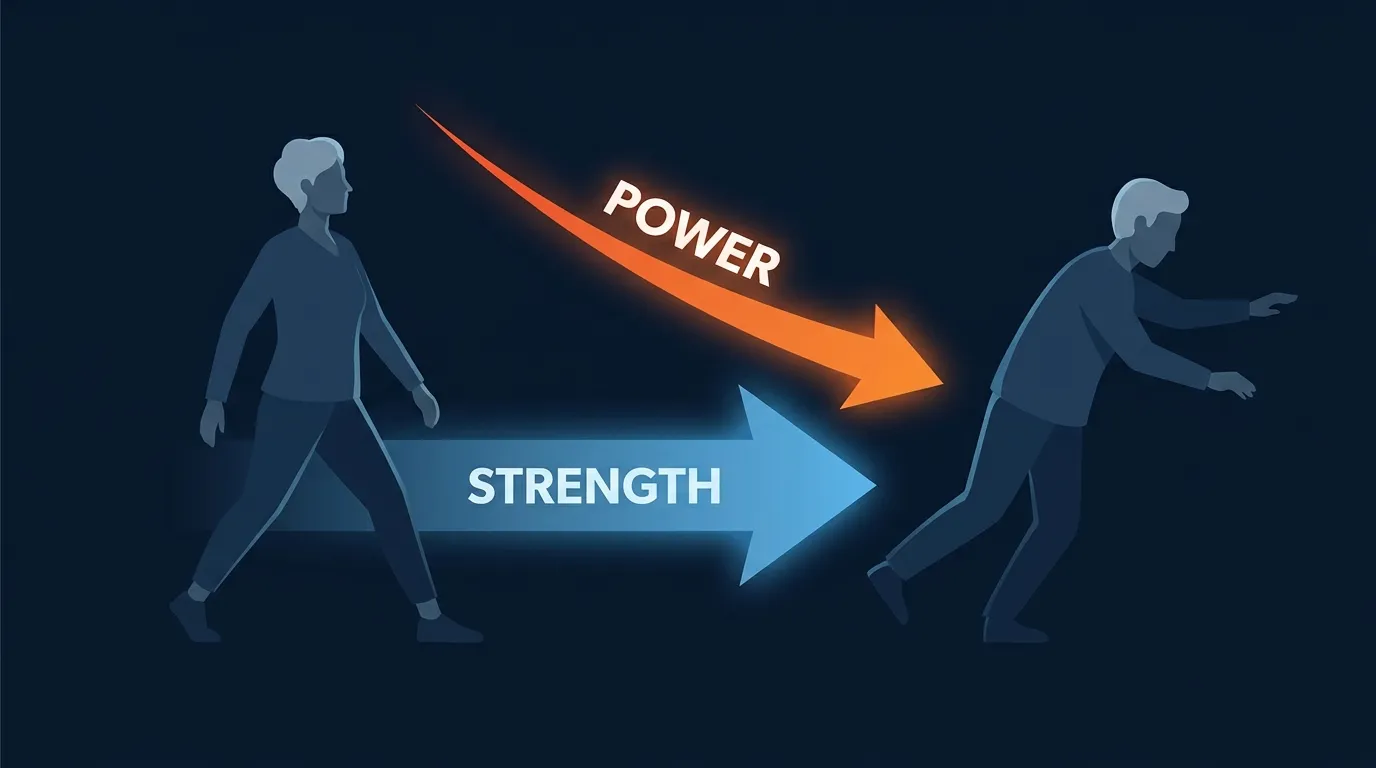
Most fitness advice for adults over 60 stops at "do strength training." That advice is not wrong, but it is missing the highest-value piece. The specific adaptation that predicts whether an older adult can climb stairs, get out of a chair, cross a street before the light changes, or catch themselves during a stumble is not maximum strength. It is muscle power, force multiplied by velocity, the ability to produce force quickly. And power declines earlier and faster than strength as we age.
The good news is that power responds to training just as reliably as strength does, using a specific method called high-velocity resistance training. Move a moderate load as fast as possible on the way up, control it on the way down, repeat. The intervention trials go back more than 20 years, and the most recent network meta-analysis (79 randomized trials, 3,575 participants) confirms that this specific method outperforms traditional slow-tempo strength training on the functional outcomes that matter most for aging.
This article walks through the research base: how power is defined, why it declines faster than strength, what the head-to-head trials actually show, how to translate the protocols to a home setting, and where the limits are. If you are training an aging parent, or you are the older adult in question, this is the evidence to weigh.
The Research: What Studies Show
Bean 2002: Power Predicts Function Better Than Strength
The pivotal observational paper is Bean, Kiely, Herman, Leveille, Mizer, Frontera, and Fielding (2002), published in the Journal of the American Geriatrics Society. The team measured leg strength (1RM on a pneumatic leg press) and leg power (peak power at 40 to 70 percent of 1RM) in 45 community-dwelling mobility-limited older adults (34 women, 11 men, aged 65 to 83). Then they measured stair climb time, chair-stand time, tandem gait, and habitual gait speed.
Both strength and power correlated with function. But when the two were entered into the same regression model, leg power was the stronger predictor. Power explained 2 to 8 percent more of the variance in stair climb, chair rise, and gait speed than strength did, and it remained significant after strength was controlled for. The finding sounds modest until you consider what it implies: two adults with the same 1RM can have very different real-world function, and the difference is largely about how fast they can produce force.
That paper did not prove causation. But it seeded the hypothesis that training the velocity component of the force equation, not just the force component, was the missing ingredient in older-adult resistance programs. The intervention trials that followed tested exactly that.
Fielding 2002: The First Head-to-Head RCT
Published in the same issue of the same journal as Bean, Fielding, LeBrasseur, Cuoco, Bean, Mizer, and Fiatarone Singh (2002) reported the first randomized comparison of fast versus slow resistance training in older women. 30 women with self-reported disability (average age 73, average BMI 30) were randomized to 16 weeks of leg press and knee extension training at 70 percent of 1RM, three days a week, three sets of eight repetitions. The only difference was velocity: the high-velocity group (HI) performed the concentric phase as fast as safely possible; the low-velocity group (LO) used a slow 2-second lift and 2-second lower tempo.
Both groups increased strength (1RM leg press up about 43 percent in HI, 46 percent in LO). But peak power, measured at loads from 40 to 90 percent of 1RM, increased substantially more in HI. At the loads most relevant to daily function (the lower end of the load range where velocity matters most), the HI group produced roughly twice the peak power gain of the LO group. Equal strength stimulus, same load, same total volume, radically different power outcomes. The velocity of the concentric phase mattered independently of load.
That result reframed the older-adult resistance training conversation. Strength training done slowly builds strength but under-develops power. The variable that most predicts function is the one traditional programs were leaving on the table.
Reid 2008: Replication with Broader Sample and Function Outcomes
Six years later, Reid, Callahan, Carabello, Phillips, Frontera, and Fielding (2008) published a larger replication in Aging Clinical and Experimental Research. 57 community-dwelling older adults (average age 74) were randomized to power training (POW), traditional strength training (STR), or a control group. The exercise groups trained bilateral leg press and knee extension three times a week for 12 weeks at 70 percent of 1RM, three sets of eight reps. POW performed the concentric phase as fast as possible with a controlled eccentric. STR used a 2-1-2 tempo.
Strength gains were similar in both training groups (knee extension 1RM up 41 percent in STR, 49 percent in POW, both significantly greater than control). But leg press peak power at 40 percent of 1RM (the load range where velocity dominates the power equation) improved 36 percent in POW versus 18 percent in STR and 19 percent in control. Neither group showed significant muscle hypertrophy, meaning the power gains were neural and velocity-driven, not mass-driven.
The interpretation was clean. When you train older adults with matched load, matched volume, and matched exercise selection, the only variable that separates the two protocols is concentric velocity. And that single variable roughly doubles the peak-power adaptation. If your goal is to preserve or restore the specific quality that predicts stair climbing, chair rises, and fall recovery, moving the load fast is not optional.
Reid and Fielding 2012: The Synthesis
A comprehensive review in Exercise and Sport Sciences Reviews by Reid and Fielding (2012) synthesized the accumulating evidence and staked the strong version of the claim. Skeletal muscle power declines earlier and more rapidly than muscle strength with advancing age. In mobility-limited older adults, those with low muscle power output had a 2 to 3 fold greater risk of significant mobility impairment than those with low strength. Leg power explained 2 to 8 percent more variance in physical performance measures than strength across multiple cohorts. Higher leg press contraction velocity was independently predictive of better balance and mobility.
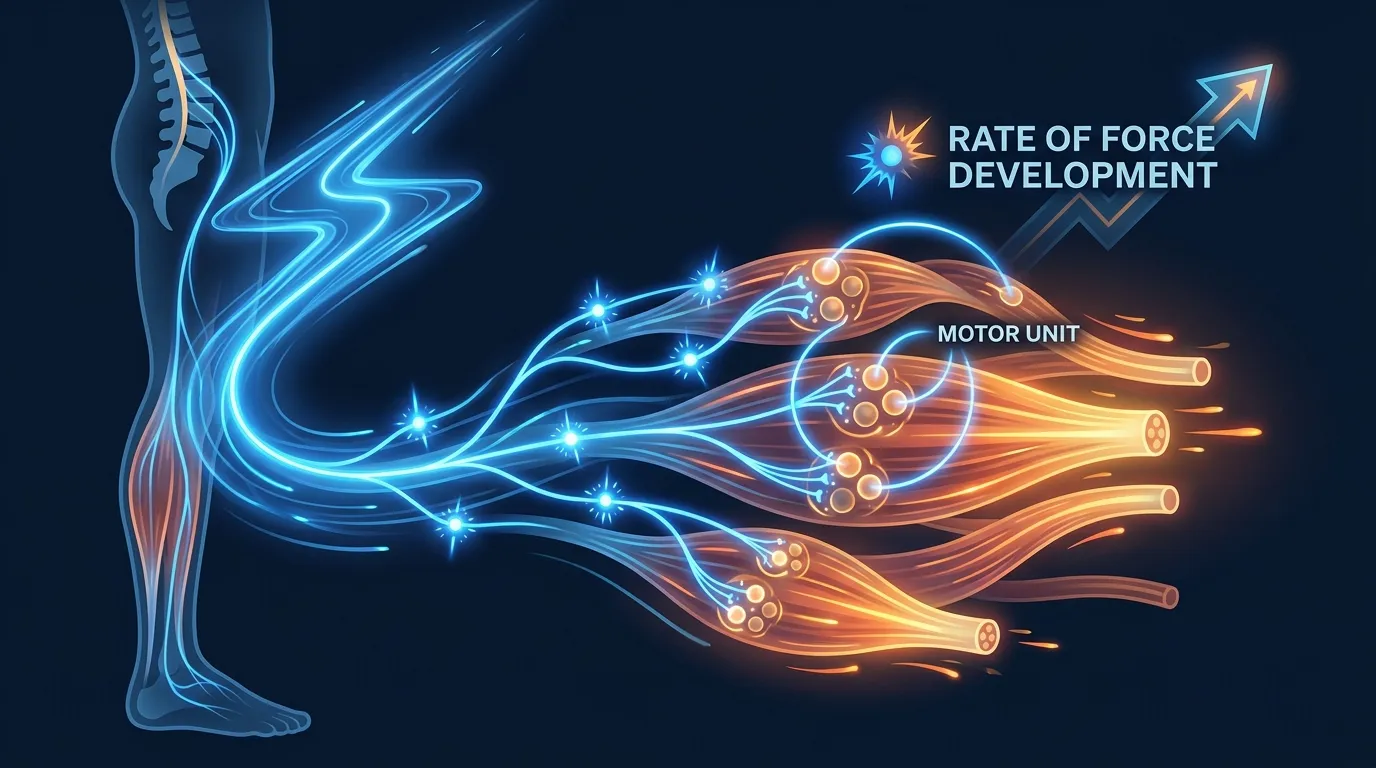
The review also cataloged the neural mechanisms driving the power gains. Rate of force development, motor unit firing rate, and coordination of agonist-antagonist activation all improve with high-velocity training in ways that traditional slow-tempo training does not target. This is why the power adaptation shows up even without measurable hypertrophy. The change is in how the nervous system recruits and paces motor units, not in muscle size.
The clinical framing that emerged from this review is now standard in geriatric rehabilitation: assess power (not just strength), train power specifically, and expect the biggest functional payoffs to come from that specificity rather than from more traditional strength volume.
Lopez 2023: The Network Meta-Analysis
The most recent and comprehensive synthesis is Lopez, Taaffe, Galvao, Newton, Nonemacher, Wendt, Bassanesi, Turella, and Rech (2023), published in the Journal of Gerontology: Series A. The team performed a network meta-analysis of 79 randomized controlled trials involving 3,575 older adults (median age 70.2), spanning 101 interventions (31 high-velocity, 70 traditional). The design allowed direct comparison of every training mode against every other on shared outcomes.
The headline results: high-velocity resistance training was the top-ranked mode for leg press muscle power (standardized mean difference 0.90, p-score 99.9 percent, essentially decisive), fast walking speed (SMD 0.44, p-score 92.8 percent), timed-up-and-go (SMD -0.76, p-score 89.5 percent), and 5-times sit-to-stand (SMD -0.74, p-score 82.1 percent). Traditional resistance training was the top-ranked mode for 30-second sit-to-stand (SMD 1.01, p-score 85.1 percent), 6-minute walking test (SMD 0.68, p-score 79.1 percent), and leg press 1RM strength (p-score 86.6 percent).
The takeaway is one of the cleanest specificity results in the exercise literature. Fast, velocity-dependent outcomes (moving quickly, changing direction, single explosive rises) respond best to high-velocity training. Endurance-dependent outcomes (30-second sit-to-stand and 6-minute walk both involve sustained repeated effort) and maximum strength respond best to traditional heavier, slower training. Neither mode is universally superior. The mode should match the outcome you care about. For most older adults concerned with fall prevention, stair climbing, and reactive balance, that means power training belongs in the program.
Why This Matters for Your Fitness
If you are over 60 and already doing resistance training, adding explicit power work is the single highest-value adjustment you can make. The reason is not exotic. The activities that actually determine whether you stay independent are speed-of-force activities. Getting out of a chair without using your hands. Climbing a flight of stairs at a normal pace. Recovering balance after a stumble. Stepping onto a curb. Carrying groceries up steps. Every one of these is a power task, not a maximum strength task.
The Bean and Reid data show that power is the variable most predictive of those functional outcomes, and the Fielding, Reid, and Lopez data show that the way to build power is to train with the concentric phase as fast as possible at moderate load. Doing heavy slow strength training and hoping power comes along for the ride underperforms doing power training directly, in every trial that has tested the comparison.
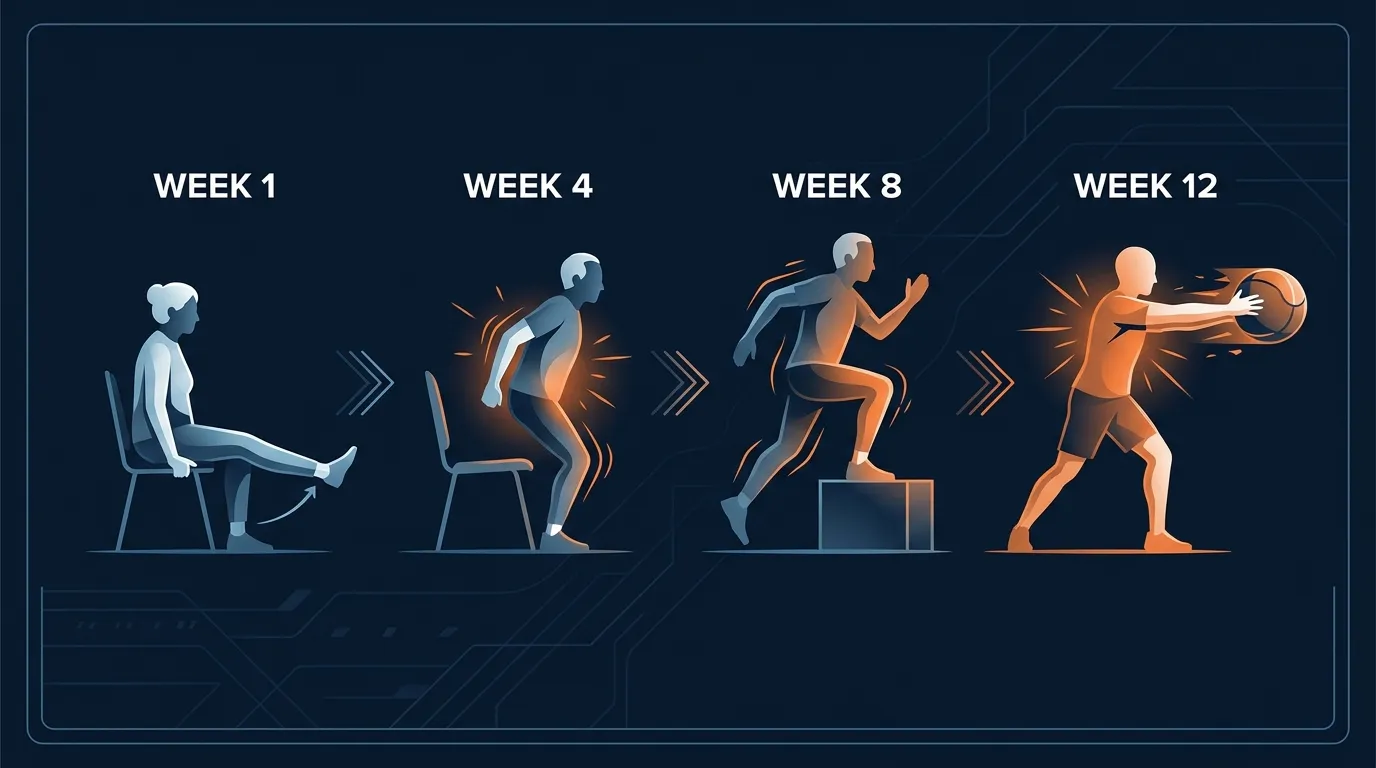
For adults who have never trained, the sequence usually starts with a base-building phase (4 to 8 weeks of general resistance training at slower tempos to build tolerance, tissue capacity, and pattern familiarity) before layering in explicit velocity work. This matches the way our fitness over 60 guide approaches the ramp for new starters. For adults who have been strength training for years, the addition is simpler: swap one of your traditional strength sessions per week for a power-focused session, keep the movement patterns familiar, and drop the load to 40 to 70 percent of what you would use for a slow set.
Two related bodies of research reinforce the practical picture. Our writeup on the sit-to-stand test and longevity explains why chair rise capacity is such a strong mortality signal (it is a compact expression of both leg power and coordination). Our strength training after 60 research page covers the broader muscle-mass and 1RM adaptations that traditional resistance work drives. Power training does not replace either. It is the missing third leg of the older-adult training stool: mass, strength, and power. The Lopez meta-analysis is the clearest evidence to date that these are separable adaptations requiring separable stimuli.
Get an evidence-based plan built for you
FitCraft, our mobile fitness app, pairs you with an AI coach who builds you a personalized plan around your goals, schedule, and fitness level. Every FitCraft program is designed by Domenic Angelino, MPH (Brown University) and NSCA-CSCS, with research published in the Journal of Strength and Conditioning Research and Medicine & Science in Sports & Exercise.
Take the Free Assessment Free • 2 minutes • No credit cardHow Power Training Works in Practice
The trial protocols are simpler than you would expect. Fielding (2002), Reid (2008), and the interventions pooled by Lopez (2023) converge on a common recipe:
- Load: 40 to 70 percent of your 1RM. Lighter than traditional strength training. The point is to move it fast, and above roughly 70 percent of 1RM, concentric velocity drops enough that the "power" stimulus disappears. Fielding and Reid used 70 percent; the Lopez pool included lower-load interventions with strong power outcomes at 40 to 60 percent.
- Concentric phase: as fast as safely possible. The lifting portion of every rep is done with maximum intent. Not sloppy, not out of control, but with the intent to accelerate the load. The nervous system reads intent, not just tempo.
- Eccentric phase: 2 to 3 seconds, controlled. Lower the load under control. This preserves joint safety, protects connective tissue, and prevents the momentum-based cheating that neutralizes the concentric stimulus.
- 3 sets of 8 to 10 reps per exercise. The trial protocols cluster around this range. Stop the set if bar velocity drops noticeably before rep 10; that is the practical marker that fatigue has cost you the power stimulus.
- 2 to 3 sessions per week. Fielding used three sessions per week, Reid used three, most of the Lopez pool used two to three. Twice a week is the practical floor for a busy older adult.
- Compound lower-body focus. Bilateral leg press and knee extension are the trial staples. At home, sit-to-stands from a chair (stand up as fast as you can, sit down slowly), fast step-ups onto a low step, quick-tempo band squats, and medicine ball throws are practical equivalents that transfer to the same movement patterns.
- Upper body: chest press, seated row, band pull-apart. Same velocity rule. Reaching to catch a fall, pushing yourself up off the floor, lifting a grandchild overhead all involve upper-body power. Include one push and one pull movement per session with the same fast-concentric approach.
- Progression via velocity, then load. When you can move the current load with clean, fast reps for all sets, add load slightly (2 to 5 percent) or keep the load and add a rep. Do not sacrifice velocity to lift more. The moment velocity drops, the power adaptation drops with it.
Individual Variation: Who Gains the Most
Adults Who Already Do Traditional Strength Training
The largest and fastest gains show up in people who already have a strength base but have never trained explicitly for velocity. The Lopez meta-analysis and the Reid trial both suggest that the neural adaptations underpinning power gains (motor unit firing rate, rate of force development) respond quickly to a new stimulus even in trained lifters, because the fast-tempo signal is genuinely new. A traditional lifter who adds one power session per week often sees a 20 to 30 percent gain in chair-rise speed within 8 weeks without any change in 1RM.
Mobility-Limited Older Adults
Both Fielding (2002) and Reid (2008) enrolled adults with self-reported disability or measured mobility limitation. The gains were the largest in absolute terms in these populations, partly because baseline power was lowest and partly because the neural adaptations transfer directly to the activities they most struggle with. Supervised programs are essential here, but the trial evidence shows that mobility-limited older adults are not too fragile for power training. They are the population that benefits most.
Adults Currently Sedentary
Sedentary older adults should not start with power training. The first 4 to 8 weeks should build general tolerance to resistance training using traditional slower-tempo work, then layer in power sessions once the tissue and coordination base is in place. Skipping the ramp does not accelerate results and does raise the risk of the tendon and joint irritation that any new training pattern can produce.
Adults With Osteoarthritis
Power training does not require heavy loads, which is why it can suit people with joint concerns better than heavy strength training. Bodyweight sit-to-stands, band-based movements, and machine-based leg press at moderate loads all allow full-effort velocity without the joint compression of heavy squats. The intervention literature includes trials with hip OA and knee OA populations without adverse events when programs are supervised. Anyone with acute joint pain should get medical clearance and start with a rehabilitation professional.
Common Misconceptions
Misconception 1: "Fast lifting is dangerous for older adults."
The trial evidence does not support this. Fielding (2002) trained women averaging 73 years with self-reported disability. Reid (2008) trained mobility-limited adults averaging 74. The Lopez (2023) meta-analysis pooled 3,575 older adults across dozens of high-velocity trials. Serious training-related adverse events were rare. The key qualifiers: loads are moderate (40 to 70 percent of 1RM, not maximum), programs are supervised or well-taught, and progression is gradual. The image of an 80-year-old ripping a heavy barbell off the floor is not power training. Power training is moving a chair-rise as fast as you can and controlling the descent.
Misconception 2: "Heavy strength training builds power automatically."
Fielding (2002) and Reid (2008) both randomized older adults to matched-load, matched-volume protocols where the only difference was concentric velocity. In both trials, the slow-tempo strength group built strength but underperformed the fast-tempo group on peak power by a factor of roughly 2. Strength and power are related but separable adaptations, and the specific velocity of the concentric phase determines which adaptation dominates. Heavy slow lifting builds strength; it does not efficiently build power.
Misconception 3: "You need machines and heavy weights to train power."
The trial protocols used machines because they are convenient for the leg press and knee extension movements the researchers measured, and machines control the load precisely. But the fundamental stimulus is fast concentric intent under moderate load, which can be produced with bodyweight sit-to-stands, band training, medicine balls, and step-ups. What matters is that the concentric phase is genuinely fast and the load is submaximal enough to allow that speed. A sit-to-stand from a chair done as fast as safely possible is a legitimate power training exercise, and it is what many of the community-dwelling adult trials converted to when they wanted a home-based translation.
Misconception 4: "Power training only matters for athletes."
The opposite is closer to true. Elite athletes need power for competition, but their strength base is usually already sufficient. Older adults need power for daily independence, and their strength base is often not the limiting factor either. Bean (2002) showed that among mobility-limited older adults with similar strength levels, the ones with higher leg power performed dramatically better on stair climbing and chair rises. The activities of daily living for a 70-year-old are more power-dependent than the activities of daily living for a 30-year-old, because the safety margin has shrunk. This is why power is arguably more important for aging adults than for young lifters.
Misconception 5: "If I do enough cardio and walking, I do not need to train power."
Cardio builds cardio, and walking builds walking. Neither builds fast-twitch motor unit recruitment or rate of force development. The Lopez (2023) meta-analysis pooled 79 trials across many training modes and found that high-velocity resistance training was the top-ranked intervention for the outcomes that predict fall recovery and functional independence. Walking and cardio are valuable and non-negotiable, but they do not substitute for the specific stimulus of moving a moderate load fast. Both are needed.
What the Research Suggests Going Forward
The power training literature is now mature enough to make firm practical recommendations. Two decades of head-to-head trials, converging on the Lopez network meta-analysis of 79 trials, show that high-velocity resistance training reliably outperforms traditional slow-tempo strength training on the functional outcomes that best predict aging independence. Peak power, stair climb, chair rise, timed-up-and-go, fast walking speed. The mechanism (neural, not primarily hypertrophic) explains why gains show up fast, why they are specific to trained velocities, and why they do not require heavy loads. The population it works in (mobility-limited older adults, adults with hip and knee OA, sedentary older adults after a base-building phase, active older adults adding a new stimulus) is broad. The trial safety record is reassuring.
What is still open:
- Long-term retention of power gains has not been well characterized beyond 12 to 24 weeks. Whether the neural adaptations are durable in the absence of continued high-velocity training, or whether they detrain fast and require indefinite maintenance work, is under-studied.
- The optimal weekly ratio of power training to traditional strength training for older adults trying to build both is not resolved. Most practitioners default to 1 power session plus 1 to 2 traditional strength sessions per week, but this ratio is more consensus-based than trial-validated.
- Fall reduction as an outcome is less directly established than functional-capacity improvement. Individual trials suggest fall risk goes down, but a large enough RCT specifically powered for fall incidence in community-dwelling older adults trained with high-velocity resistance training would strengthen the causal case.
- The transfer of gym-based power training to real-world reactive balance (the microsecond ankle strategy that determines whether you catch a stumble) is plausible from mechanism but not directly tested. Explicit reactive balance work may still be an important complement.
- Sex differences in response are unequally studied. The foundational Fielding trial enrolled only women; other trials have mixed cohorts. Whether men and women respond identically to matched protocols has not been rigorously characterized in the older-adult power literature specifically.
The practical bottom line for someone reading this and deciding whether to try it: if you are over 60, currently strength training or ready to start, and want the single training addition with the highest yield for daily independence, this is it. Two power-focused sessions per week, moderate loads, fast concentric intent, controlled eccentric, familiar movement patterns. Twelve weeks is the trial-tested time frame for meaningful adaptation. The gains should show up first on the timed sit-to-stand (fewer seconds), then on stair climb pace, then in reactive balance situations you may not test but will notice.
This is a good example of why consistency beats intensity and why the aerobic side of longevity training is best paired with a smart resistance program. Power training does not require heroic loads or heroic weeks. It requires the discipline to move a moderate load with real intent, twice a week, for enough weeks that the nervous system reorganizes. That is a program almost any older adult can execute at home.
References
- Fielding RA, LeBrasseur NK, Cuoco A, Bean J, Mizer K, Fiatarone Singh MA. "High-velocity resistance training increases skeletal muscle peak power in older women." J Am Geriatr Soc. 2002;50(4):655-662. doi:10.1046/j.1532-5415.2002.50159.x
- Bean JF, Kiely DK, Herman S, Leveille SG, Mizer K, Frontera WR, Fielding RA. "The relationship between leg power and physical performance in mobility-limited older people." J Am Geriatr Soc. 2002;50(3):461-467. doi:10.1046/j.1532-5415.2002.50111.x
- Reid KF, Callahan DM, Carabello RJ, Phillips EM, Frontera WR, Fielding RA. "Lower extremity power training in elderly subjects with mobility limitations: a randomized controlled trial." Aging Clin Exp Res. 2008;20(4):337-343. doi:10.1007/BF03324865
- Reid KF, Fielding RA. "Skeletal muscle power: a critical determinant of physical functioning in older adults." Exerc Sport Sci Rev. 2012;40(1):4-12. doi:10.1097/JES.0b013e31823b5f13
- Lopez P, Taaffe DR, Galvao DA, Newton RU, Nonemacher ER, Wendt VM, Bassanesi RN, Turella DJP, Rech A. "Does high-velocity resistance exercise elicit greater physical function benefits than traditional resistance exercise in older adults? A systematic review and network meta-analysis of 79 trials." J Gerontol A Biol Sci Med Sci. 2023;78(8):1471-1482. doi:10.1093/gerona/glac230
Frequently Asked Questions
What is muscle power and how is it different from strength?
Strength is how much force a muscle can produce. Power is force multiplied by velocity, so it is how much force you can produce quickly. Strength lets you stand up from a low chair. Power lets you catch yourself when you trip. After age 60, power declines earlier and faster than strength, which is why some strong older adults still struggle with stairs or falls. Reid and Fielding (2012) summarized the evidence in Exercise and Sport Sciences Reviews and showed that low muscle power carried a 2 to 3 fold greater risk of significant mobility impairment than low strength in mobility-limited older adults.
Does high-velocity resistance training work for older adults?
Yes, with a clear and consistent evidence base. Fielding and colleagues (2002, J Am Geriatr Soc) randomized 30 older women with self-reported disability to 16 weeks of high-velocity or low-velocity resistance training at 70 percent of 1RM. The high-velocity group increased leg press peak power roughly twice as much as the low-velocity group across the tested loads, with similar strength gains. Reid and colleagues (2008) later replicated the pattern in 57 mobility-limited older adults: 12 weeks of power training produced a 36 percent gain in leg press peak power versus 18 percent for traditional slow-tempo training. Lopez and colleagues (2023) pooled 79 trials of 3,575 older adults and confirmed that high-velocity training is the single most effective mode for improving leg press muscle power (SMD 0.90, p-score 99.9 percent) and outperforms traditional resistance training on timed-up-and-go, 5-times sit-to-stand, and fast walking speed.
What does a power training session actually look like?
The core rule is move light-to-moderate loads as fast as possible on the way up, then lower under control. A typical session uses 3 sets of 8 to 10 reps at roughly 40 to 70 percent of the load you could handle for a single all-out rep, with the concentric (lifting) phase performed as explosively as safely possible and the eccentric (lowering) phase controlled over about 2 seconds. Fielding (2002) and Reid (2008) both used the leg press and knee extension at 70 percent of 1RM. At home, sit-to-stands from a chair (stand up as fast as you can, sit down slowly), fast step-ups, medicine ball chest pushes, and quick-tempo band rows are practical equivalents. Twice a week is the typical dose in the trial literature.
Is power training safe for someone in their 70s or 80s?
The intervention trials that generated the evidence were done in adults averaging 70 to 74 years old, many with self-reported disability or mobility limitation, and adverse events were rare when programs were supervised and progressed sensibly. Fielding (2002) worked with older women aged 73 on average with self-reported disability. Reid (2008) trained community-dwelling adults averaging 74 years. Neither study reported serious training-related injuries. That said, high-velocity work does load joints and connective tissue quickly, so the standard rules apply: start with lighter loads and slower velocities for the first 2 to 3 weeks, progress velocity before load, and stop any exercise that produces sharp pain. Anyone with cardiovascular disease, uncontrolled hypertension, balance disorders, or a recent fragility fracture should get medical clearance before starting.
How is this different from traditional strength training?
Traditional strength training uses heavier loads (typically 70 to 85 percent of 1RM) moved slowly and controlled through both phases. It builds maximum force production. Power training uses lighter to moderate loads (40 to 70 percent of 1RM) moved as fast as possible on the concentric phase. It builds the ability to produce force quickly. Lopez and colleagues (2023) showed the two modes produce specific adaptations: traditional strength training was best for 30-second sit-to-stand and 6-minute walking test (endurance-flavored outcomes), while high-velocity power training was best for timed-up-and-go, 5-times sit-to-stand, fast walking speed, and leg press peak power (velocity-dependent outcomes). Most older adults benefit from a mix, but if you already do traditional strength training and struggle with stairs, curbs, or fast reactions, adding power work is where the biggest gains are hiding.