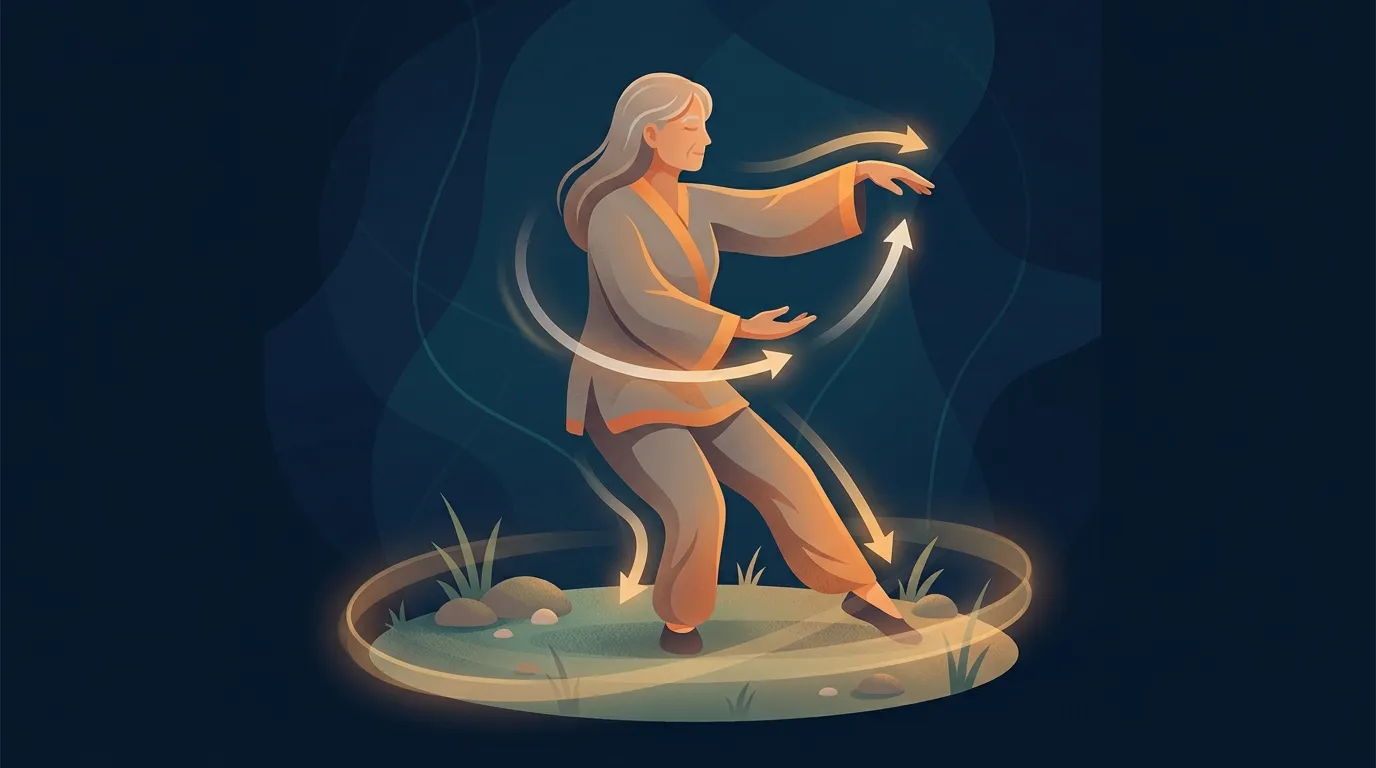
You've probably seen the parks-at-dawn footage. Rows of older adults moving slowly in unison, arms tracing arcs, weight shifting from one leg to the other. The framing is usually "gentle stretching for seniors." That framing has been wrong for at least 30 years.
Tai chi is one of the most rigorously studied balance interventions in the medical literature. The trial base spans four continents, 25 years, and thousands of participants. And the effect size on falls, the metric that actually matters for people over 65, is unusually large. Bigger than walking. Bigger than resistance training alone. In the highest-quality head-to-head trials, bigger than a matched-dose multimodal exercise program that already includes balance work.
Falls are the leading cause of injury death in adults 65 and older in the United States. One in three older adults falls each year. About one in five falls causes serious injury like a broken hip or a head trauma, the kind that often starts a cascade most people never fully recover from. So an intervention that cuts falls by even 20 percent is worth taking seriously. One that cuts them by 58 percent under trial conditions is worth paying attention to.
Here's what a Cochrane review, a JAMA trial, and 25 years of RCTs actually show.
The Research: What the Trials Actually Tested
Li et al. 2018: The Best Head-to-Head Evidence
The most rigorous single trial on tai chi and falls is the Li and colleagues 2018 JAMA Internal Medicine study. The team randomized 670 community-dwelling adults aged 70 or older, all with a history of falls or documented mobility impairment, to one of three groups: a Therapeutic Tai Ji Quan program, a conventional multimodal exercise program (aerobics, strength, balance, flexibility), or a stretching control. All groups trained twice a week for one hour, for six months. That's a rare feature in fall-prevention research. Same dose, same duration, three genuinely different interventions.
The tai chi group had 58 percent fewer falls than the stretching control (incidence rate ratio 0.42, 95% CI 0.31 to 0.56, P<.001) and 31 percent fewer falls than the multimodal exercise group (IRR 0.69, 95% CI 0.52 to 0.94, P=.01). Both differences were statistically significant. The multimodal exercise group also outperformed stretching (IRR 0.60, 95% CI 0.45 to 0.80, P=.001), which is roughly what other trials of general balance-plus-strength programs report.
Two things make this trial unusual. First, the head-to-head design cuts through the "any exercise helps" story. When you match dose and duration, tai chi still beats a program that already contains balance training. Second, the intervention was specifically Therapeutic Tai Ji Quan, an eight-form set developed by Fuzhong Li at the Oregon Research Institute and designed for older adults with fall risk. That matters because the trial isn't testing "tai chi in general." It's testing a specific, teachable, dose-controlled protocol.
Wolf et al. 1996: The Trial That Started It All
The tai chi and falls story starts at Emory University. The Wolf et al. 1996 Atlanta FICSIT trial in the Journal of the American Geriatrics Society enrolled 200 community-dwelling adults aged 70 or older into a three-arm study: tai chi, computerized balance training, or a health-education control. The tai chi arm met twice a week for 15 weeks and learned a simplified Yang-style form.
The result made the medical world pay attention. Tai chi reduced the risk of multiple falls by 47.5 percent compared to control (relative risk 0.525, p = 0.01). It also reduced systolic blood pressure and, notably, reduced the fear of falling, a psychological outcome that predicts activity restriction and further deconditioning in older adults. The computerized balance training arm improved postural stability on the testing device but did not translate to a fall reduction, an early signal that lab-based balance training and real-world balance are different things.
The FICSIT program was one of the first large multi-site randomized studies to test whether any exercise could reduce falls. Tai chi was the only intervention across the multi-site network that produced a statistically significant reduction in the primary outcome. That result, published in 1996, is what put tai chi on the map for geriatric medicine.
Sherrington et al. 2019: The Meta-View
The 2019 Cochrane review by Sherrington and colleagues is the most comprehensive synthesis of exercise and fall prevention ever conducted. It pooled 108 randomized trials of 23,407 community-dwelling adults 60 or older. The team categorized each trial by exercise type and reported pooled effects for each category, alongside GRADE certainty ratings.
Tai chi as a category cut the rate of falls by 19 percent (RaR 0.81, 95% CI 0.67 to 0.99, low-certainty evidence). It also reduced the number of people who fell at least once by 20 percent (RR 0.80, 95% CI 0.70 to 0.91, high-certainty evidence). The gap between the two effect sizes reflects the difference between "how many falls occur" and "how many people fall," and both are clinically meaningful.
The reason the tai chi effect looks smaller in the Cochrane pool than in the Li 2018 trial is dilution. Cochrane included every eligible tai chi RCT, including many that used a lower dose (one session per week), a shorter duration (eight to twelve weeks), or a recreational rather than therapeutic form. When you dilute the intervention, you dilute the effect. Trials that used a dose matched to Li 2018 consistently produced larger reductions.
Huang 2017 and Voukelatos 2007: Consistency Across Meta and Community
The Huang et al. 2017 meta-analysis in BMJ Open pooled 18 RCTs of 3,824 older adults. Tai chi reduced the number of people who fell at least once by 20 percent (RR 0.80, 95% CI 0.72 to 0.88) and cut the rate of falls by 31 percent (IRR 0.69, 95% CI 0.60 to 0.80). Subgroup analyses found that higher exercise frequency and Yang style produced larger effects. The direction and magnitude line up with the Sherrington Cochrane pool.
The community angle matters too. Voukelatos and colleagues randomized 702 adults aged 60 or older to a 16-week community tai chi program or a wait-list control in the Central Sydney tai chi trial, published in the Journal of the American Geriatrics Society in 2007. The program cut the number of falls per person by roughly 33 percent over the six-month follow-up window. What makes this trial useful is the ecological validity. The classes were delivered by local instructors in local venues at modest cost. The effect showed up anyway.
Why Slow Movement Beats Fast Movement for Balance
The tai chi effect looks strange at first glance. It's not a strength-heavy movement. It's not a cardiovascular workout. It doesn't use equipment. It doesn't even move very fast. And yet it consistently outperforms interventions that check more of those boxes for the specific outcome of falls.
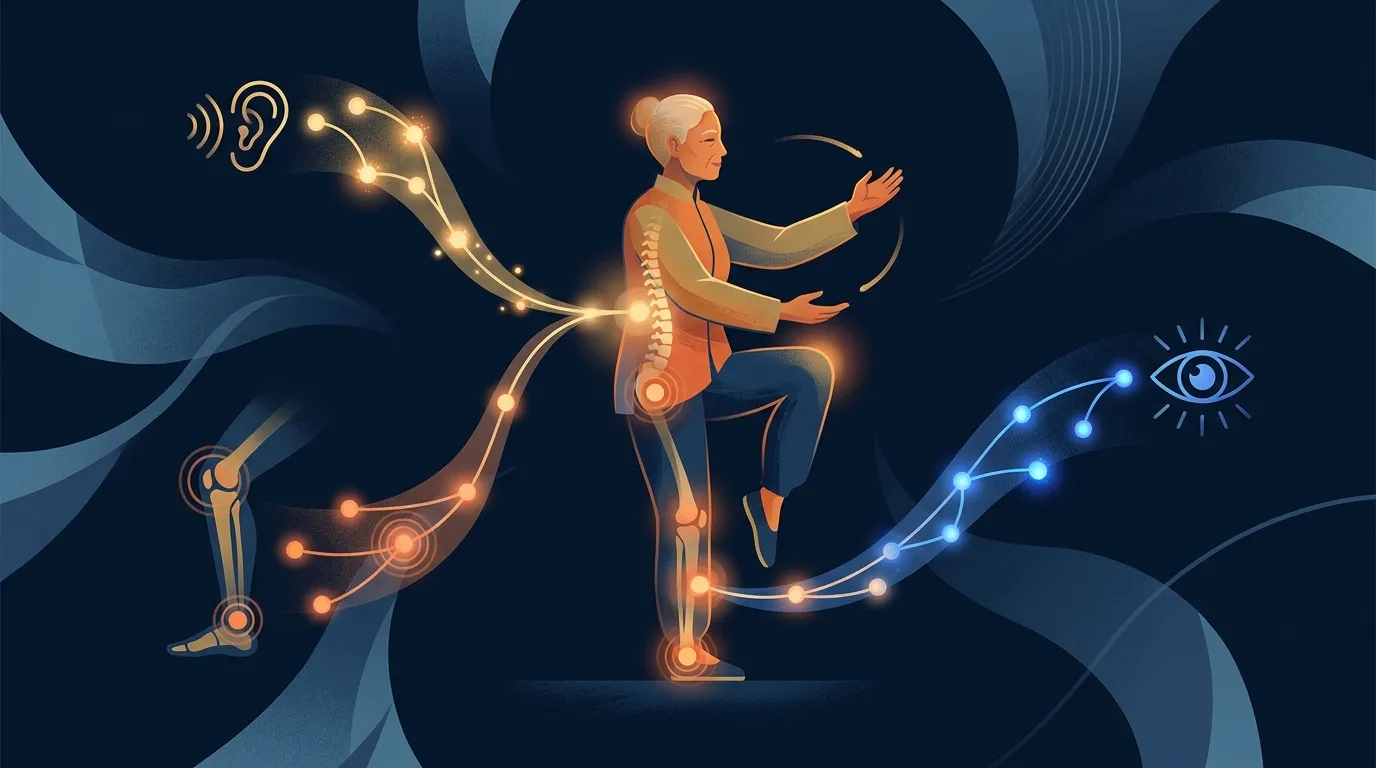
The explanation is that balance is a nervous-system skill produced by a bundle of overlapping systems: vestibular input from the inner ear, proprioception from joint and muscle receptors, vision, central integration in the cerebellum and brainstem, and rapid motor output to the postural muscles. Each of those systems adapts to what you challenge it with. Fast movement lets the nervous system coast on momentum. A quick step forward doesn't require much active postural control because your body is already moving in the direction of the next foot placement. The trip-and-catch reflex fires briefly, if at all.
Slow movement is the opposite. Every weight shift in tai chi happens over several seconds. There is no momentum to lean on. The nervous system has to hold the body over a shrinking base of support while the sensory systems track subtle changes in ankle angle, joint pressure, and visual field. That's the exact loading pattern that trains reactive balance. The slower the tempo, the more postural work per second of movement.
The Li 2018 protocol makes this explicit. The eight-form Therapeutic Tai Ji Quan sequence emphasizes weight transitions performed at deliberate speed, single-leg holds during arm movements, and controlled turns. It is not a general fitness class. It's a targeted balance intervention with the aesthetic of a martial art. The head-to-head win over multimodal exercise happens because the multimodal program spends most of its time at normal or fast tempo. Tai chi never does.
The broader story on balance training and falls lines up with this. Sherrington's Cochrane review found that balance and functional training cut falls 24 percent while walking-only programs did nothing measurable. Tai chi is one specific version of the general principle. It just happens to be one of the best-tested versions.
How Much Tai Chi Is Enough
The dose matters. Across the trials that produced clinically meaningful fall reductions, three parameters cluster together.
Frequency: two to three sessions per week. The Li 2018 protocol used twice weekly. Wolf 1996 also used twice weekly. Voukelatos 2007 used once weekly and still produced a fall reduction, but the effect size was smaller than in the twice-weekly trials. Programs that met less than once a week rarely produced significant effects.
Session length: about one hour. All three landmark trials used 60-minute sessions. Shorter sessions of 30 to 45 minutes appear in some community programs and correlate with smaller effects in the Cochrane subgroup analyses.
Duration: at least three to six months. This is the parameter most programs get wrong. Balance adaptation is slow. The neural changes that translate to fewer real-world falls take months to consolidate. Programs that end at eight to twelve weeks may show improvements on balance-testing devices, but the effect on actual falls typically requires a longer commitment. The Li 2018 trial's 24-week duration is on the longer end of what's been tested and produced the largest published head-to-head effect.
Style matters less than protocol. The literature includes trials of Yang-style, Sun-style, Chen-style, and simplified therapeutic forms like Tai Ji Quan Moving for Better Balance. Effect sizes cluster within a similar range across styles when dose is matched. The therapeutic forms designed for older adults (Sun-style and the eight-form TJQMBB) tend to be recommended first because they avoid deep stances that can be uncomfortable for people with knee arthritis or hip stiffness.
Get an evidence-based plan built for you
FitCraft, our mobile fitness app, pairs you with an AI coach who builds you a personalized plan around your goals, schedule, and fitness level. Every FitCraft program is designed by Domenic Angelino, MPH (Brown University) and NSCA-CSCS, with research published in the Journal of Strength and Conditioning Research and Medicine & Science in Sports & Exercise.
Take the Free Assessment Free • 2 minutes • No credit cardCommon Misconceptions
Tai chi carries a lot of cultural baggage that gets in the way of clean scientific communication. Three misconceptions come up over and over.
Misconception 1: "Tai chi is just gentle stretching"
It's not. Stretching, in the Li 2018 trial, was the control condition. The tai chi group had 58 percent fewer falls than the stretching group over six months of matched-dose training. Stretching is passive muscle lengthening. Tai chi is active postural control performed continuously against gravity. The neuromuscular demand is not comparable. Confusing the two is like confusing a warmup with a workout.
Misconception 2: "Tai chi is only for the elderly"
Most trials focus on adults 60 or older because that's where fall risk becomes a public-health issue. But reactive balance control peaks in your 20s and starts measurably declining around 40. The tai chi mechanism (slow-tempo, high-postural-control loading) is a legitimate training stimulus at any age, and the neural adaptations you build in midlife carry into your 70s and 80s with reserve to spare. Younger athletes sometimes use tai chi work as active recovery for the same reason yoga is used, which is that low-load slow-tempo movement improves proprioception without adding fatigue.
Misconception 3: "If I lift weights I don't need balance work"
Strength is necessary but not sufficient for fall prevention. In the Sherrington Cochrane review, resistance training alone did not significantly reduce falls. Most real-world falls aren't a strength problem, they're a reaction-time and postural-recovery problem. A person with plenty of leg strength can still fall if the postural reflex that should have caught the stumble is too slow or too small. Strength training after 60 remains essential for muscle mass, bone density, metabolic health, and the ability to actually push back from a near-fall. But it has to be paired with balance-specific work to translate into falls prevention. Tai chi is one of the best-documented ways to add that balance layer.
Where the Research Is Still Thin
It's worth flagging the limits of this evidence base.
First, most trials studied community-dwelling older adults. The generalization to people in nursing facilities or with advanced cognitive decline is reasonable but less directly tested. A few studies in cognitively impaired populations show smaller effects, likely because the ability to learn and rehearse a form is part of the mechanism.
Second, effect sizes are pooled statistical averages. Some people in the tai chi groups still fell. The intervention doesn't eliminate falls. It tilts the odds. A 58 percent reduction in a trial that would otherwise see 100 falls means the intervention arm sees around 42.
Third, protection depends on continued practice. The Wolf 1996 team followed participants after the trial ended and found the effect faded once training stopped. Adherence is the rate-limiting step for the population-level benefit, which is where community classes, home practice, and app-delivered follow-up programs matter.
Fourth, the comparator conditions varied. Some trials used waitlist controls, some used stretching, some used general health education. This adds noise to the pooled estimates. The head-to-head Li 2018 design remains unusual and important because it isolates tai chi's contribution beyond "any exercise helps."
Finally, direct comparisons to newer modalities like exergaming, VR balance training, and app-delivered slow-tempo programs are limited. Small trials suggest the underlying mechanism (slow, sustained postural control) is what does the work regardless of delivery format, but the population-level pooling isn't there yet.
What This Means for Your Plan
If you're in your 50s or older and you're not doing any deliberate balance training, the research suggests you should add it. Tai chi is one of the best-supported ways to do so, especially if you have a history of falls, a fear of falling, or a family member who has fallen.
The pragmatic version of the protocol: find a class that meets at least twice a week for a full hour, commit for six months, and pick a therapeutic form (Sun-style or Tai Ji Quan Moving for Better Balance) if you're new to the practice or have joint concerns. If no local class exists, the same slow-tempo balance mechanism can be replicated at home with a structured program that emphasizes single-leg holds, controlled weight shifts, and standing-balance progressions. Pair it with strength training for muscle preservation and general activity like walking for cardiovascular health. Layer, don't substitute.
If you're younger, you don't need to sign up for a tai chi class. But treating balance as a trainable skill from your 40s onward, rather than something you notice when it's already fading, is one of the cleanest longevity moves in the literature. Add short balance-challenge blocks to your existing routine. A structured general fitness plan for the second half of life should include them by default.
How FitCraft Handles Slow-Tempo Balance Work
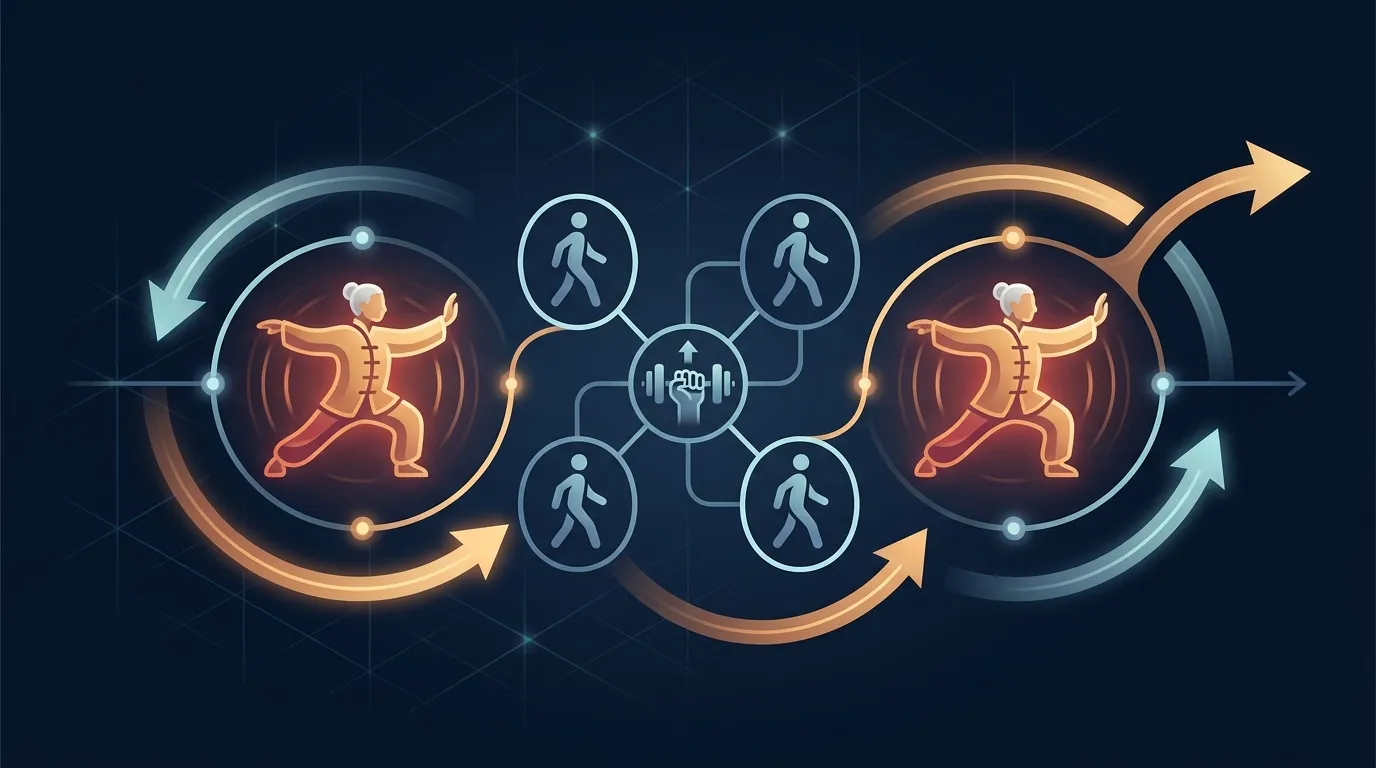
Most fitness apps either ignore balance entirely or bury it in a five-minute cool-down. That's not the dose the research describes. FitCraft's mobility and yoga programs include slow-tempo balance work as core training. Single-leg holds. Controlled weight shifts. Standing-balance progressions. Dynamic reach drills. The tempo and the postural-control demand are the mechanism the tai chi research describes.
An AI coach guides you through each session in 3D, demonstrating the position from multiple angles so you can match the form on your own. The interactive 3D exercise demos let you rotate the view and zoom in if a stance or transition is unfamiliar. As you progress through the program, the balance demand goes up. Harder stances. Longer holds. Less external support. The progression is intentional because balance training done at the wrong dose either fails to produce adaptation (too easy) or risks a fall during the session itself (too hard).
Every FitCraft program is designed by an exercise scientist with a graduate degree in kinesiology and an NSCA strength certification. Balance is one of the categories where design matters most.
References
- Sherrington C, Fairhall NJ, Wallbank GK, Tiedemann A, Michaleff ZA, Howard K, Clemson L, Hopewell S, Lamb SE. "Exercise for preventing falls in older people living in the community." Cochrane Database of Systematic Reviews. 2019;1:CD012424. doi:10.1002/14651858.CD012424.pub2
- Li F, Harmer P, Fitzgerald K, Eckstrom E, Akers L, Chou L-S, Pidgeon D, Voit J, Winters-Stone K. "Effectiveness of a Therapeutic Tai Ji Quan Intervention vs a Multimodal Exercise Intervention to Prevent Falls Among Older Adults at High Risk of Falling: A Randomized Clinical Trial." JAMA Internal Medicine. 2018;178(10):1301-1310. doi:10.1001/jamainternmed.2018.3915
- Wolf SL, Barnhart HX, Kutner NG, McNeely E, Coogler C, Xu T. "Reducing frailty and falls in older persons: an investigation of Tai Chi and computerized balance training. Atlanta FICSIT Group." Journal of the American Geriatrics Society. 1996;44(5):489-497. doi:10.1111/j.1532-5415.1996.tb01432.x
- Huang ZG, Feng YH, Li YH, Lv CS. "Systematic review and meta-analysis: Tai Chi for preventing falls in older adults." BMJ Open. 2017;7(2):e013661. doi:10.1136/bmjopen-2016-013661
- Voukelatos A, Cumming RG, Lord SR, Rissel C. "A randomized, controlled trial of tai chi for the prevention of falls: the Central Sydney tai chi trial." Journal of the American Geriatrics Society. 2007;55(8):1185-1191. doi:10.1111/j.1532-5415.2007.01244.x
Frequently Asked Questions
Does tai chi actually prevent falls in older adults?
Yes. In the Li et al. (2018) JAMA Internal Medicine trial of 670 adults aged 70 or older with a history of falls or impaired mobility, six months of twice-weekly Therapeutic Tai Ji Quan cut falls by 58 percent versus a stretching control and 31 percent versus a standard multimodal exercise program. The 2019 Cochrane review by Sherrington and colleagues pooled 108 trials and found tai chi reduced the rate of falls by 19 percent overall and the number of fallers by 20 percent (high-certainty evidence). The landmark Wolf et al. (1996) Atlanta FICSIT trial found a 47.5 percent reduction in the risk of multiple falls after 15 weeks of tai chi.
How often do you need to do tai chi to get the balance benefit?
The trials that produced the largest fall reductions delivered two to three sessions per week of about one hour each, sustained for at least six months. The Li 2018 JAMA trial used two 60-minute sessions weekly for 24 weeks. Wolf 1996 used 15 weeks of two weekly sessions. Community programs of one hour per week can improve balance measures but produce smaller reductions in actual falls.
Is tai chi better than regular exercise for balance?
For fall prevention in higher-risk older adults, the direct head-to-head evidence favors tai chi. In Li et al. (2018), tai chi reduced falls 31 percent more than a matched-dose multimodal exercise program that already included strength, balance, aerobics, and flexibility. The likely reason is that tai chi is essentially continuous slow-tempo balance work. Every weight shift demands deliberate postural control. A conventional workout mixes higher-tempo movement that lets the nervous system coast on momentum.
Can beginners do tai chi safely?
Yes. Tai chi is one of the lowest-injury interventions in the exercise literature. The trials in the Sherrington 2019 Cochrane review reported very few adverse events across 108 pooled trials. Beginners typically start with a simplified form such as Sun-style or Tai Ji Quan Moving for Better Balance, both of which were designed specifically for older adults with a history of falls.
Does FitCraft include tai chi style balance work?
FitCraft's mobility and yoga programs use slow-tempo balance work in the same style tai chi is built on: single-leg holds, controlled weight shifts, standing-balance progressions, and dynamic reach drills. An AI coach walks you through each session in 3D, demonstrating the position from multiple angles so you can match the form on your own. The demands increase as your program progresses. It is not a certified tai chi class, but the balance-training mechanism is the same.