You've got a medicine ball in the corner, or you're eyeing one, and every video shows a different blur of slams and twists. Nobody says how heavy the ball should be, how many reps to do, or whether you're meant to end up out of breath. So you do a few random sets, feel a bit silly, and the ball rolls back under the bench.
This guide turns the ball into a plan. You get 10 med ball exercises with exact sets, reps and rest, a printable medicine ball workout you can do at home in about 25 minutes, the right ball weight for each move, and the form cues that keep a rebounding ball away from your face.
10 Medicine Ball Exercises and What Each One Trains
The first six are throws and slams, the work a medicine ball does better than any dumbbell. The last four use the ball as a weight you hold, for your core and arms between throws.
| # | Exercise | Ball | What it trains | Sets x reps |
|---|---|---|---|---|
| 1 | Overhead slam | Slam ball | Lats, abs and hips | 3 x 6 |
| 2 | Rotational wall throw | Rubber or soft ball | Obliques and hips | 3 x 5 per side |
| 3 | Chest pass | Rubber or soft ball | Chest, shoulders and triceps | 3 x 8 |
| 4 | Squat to wall throw | Soft wall ball | Legs, shoulders and heart rate | 4-6 rounds of 20 sec |
| 5 | Side slam | Slam ball | Obliques and lats | 3 x 4 per side |
| 6 | Overhead forward throw | Rubber or soft ball | Lats, abs and triceps | 3 x 6 |
| 7 | Reverse lunge with a twist | Any ball | Legs, obliques and balance | 3 x 5 per side |
| 8 | Russian twist with the ball | Any ball | Obliques | 2 x 8 per side |
| 9 | Ball push-up | Rubber or slam ball | Chest, triceps and shoulders | 3 x 5 per side |
| 10 | Dead bug with the ball | Any light ball | Deep abs | 3 x 6 per side |
1. Overhead slam
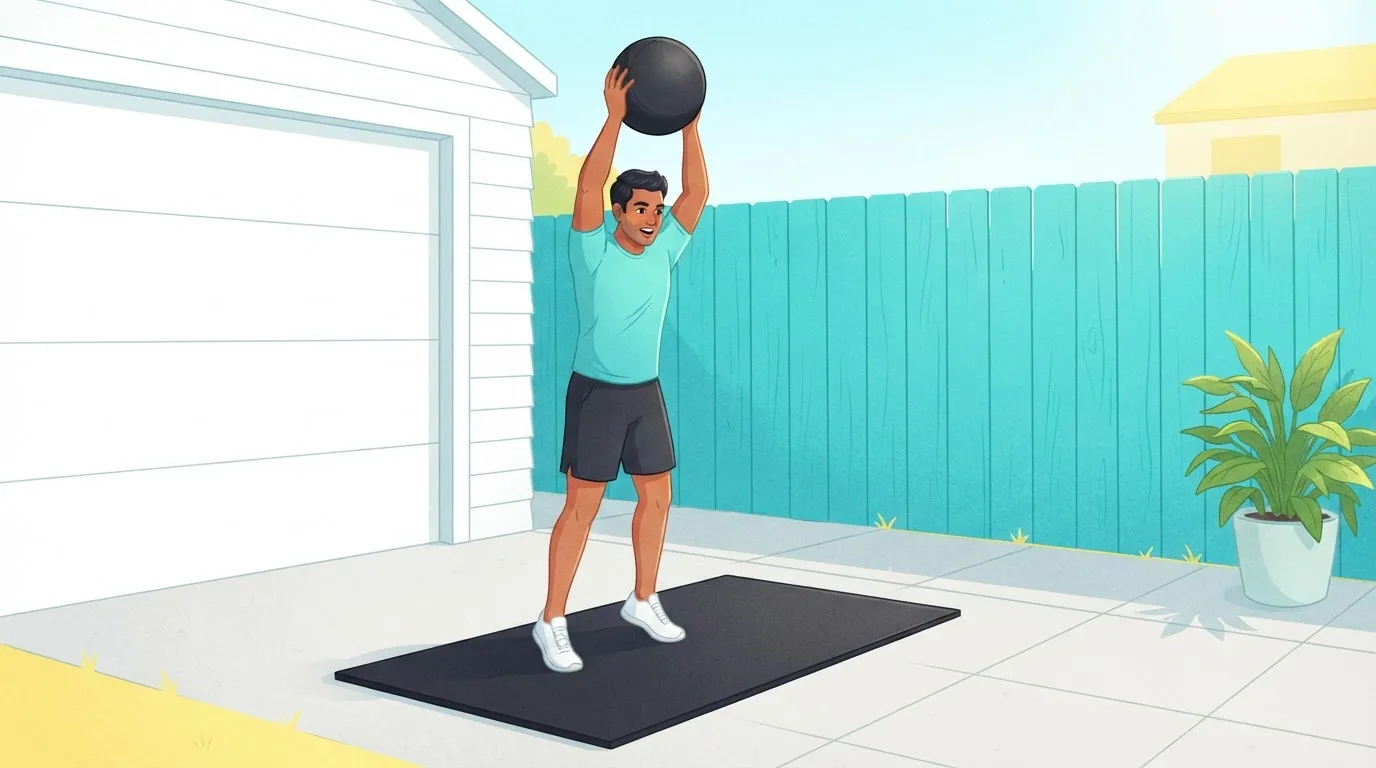
Stand with your feet shoulder-width apart and lift the ball overhead, rising onto the balls of your feet. Pull it down hard in front of your toes, bending your hips and knees as it goes, and let it land between your feet rather than on them. Squat to pick it up with a flat back. Use a slam ball, which barely bounces.
2. Rotational wall throw
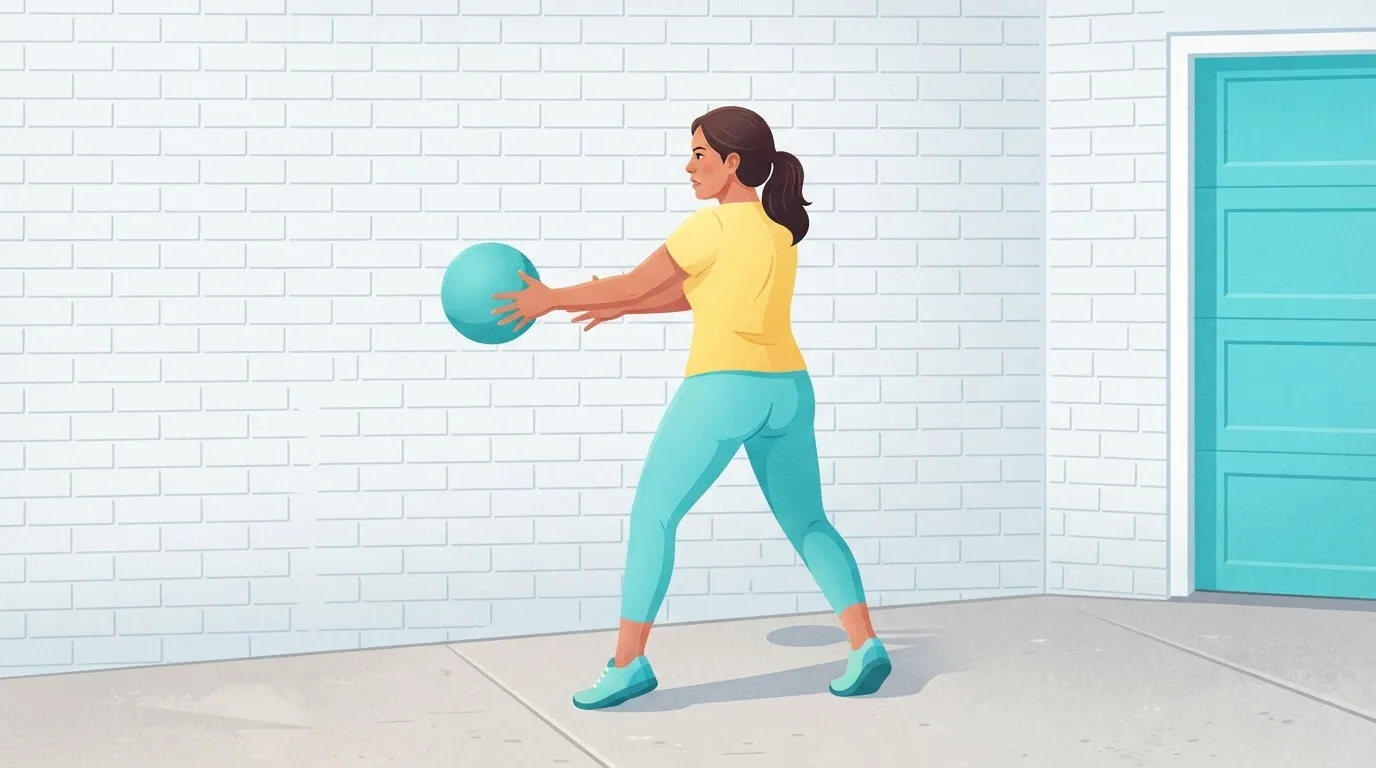
Stand side-on to a brick or concrete wall, 3 to 6 feet away, with the ball at your back hip. Turn your hips and chest toward the wall together, pivot on your back foot and throw the ball into the wall at chest height. Catch it on the rebound, or let it drop and reset. In 30 athletes, Ikeda and colleagues (2009) found the five longest side throwers worked their external obliques harder than the five shortest, so turn from your trunk instead of flinging with your arms.
3. Chest pass
Face the wall from 3 to 6 feet away, hold the ball at your chest and push it into the wall as fast as you can, stepping forward as you throw. Catch it with soft elbows, close to your chest. If standing is hard, sit on a sturdy chair facing the wall and pass from there. A seated chest throw is the test researchers use to measure upper-body power in older adults (Harris 2011).
4. Squat to wall throw
Hold a soft wall ball at your chest and face the wall from about an arm's length plus a step. Squat until your thighs are about parallel to the floor, then stand fast and throw the ball up to a spot a few feet above your head. Catch it and sink straight into the next squat. Use only a soft ball here, because a hard ball dropping into your hands hurts.
5. Side slam
Lift the ball overhead, turn your chest to one side and slam the ball to the floor just outside your front foot, pivoting your back foot as you turn. Do all your reps on one side, then switch. It trains the same turning power as the rotational throw when you don't have a wall.
6. Overhead forward throw
Face the wall from 6 to 10 feet away, hold the ball overhead with both hands slightly behind your head, and step forward as you throw it like a soccer throw-in. Keep your ribs down so the throw comes from your abs and lats instead of an arch in your lower back.
7. Reverse lunge with a twist
Hold the ball at your chest with bent elbows, step back into a lunge and turn your chest toward your front leg. Turn back to the middle as you stand. The ball adds just enough weight to make your trunk control the turn.
8. Russian twist with the ball
Sit with your knees bent and your heels on the floor, lean back a little with a long back, and turn your chest from side to side, touching the ball to the floor beside each hip. Go slowly. This is the one move on the list that shouldn't be fast.
9. Ball push-up
Set up in a push-up, knees down if you need it, with one hand on the ball and the other on the floor. Lower your chest, press back up, then roll the ball to the other hand. In 12 men, de Oliveira and colleagues (2008) found push-ups on a medicine ball raised activity in the front of the shoulder and the chest compared with push-ups on a stable surface.
10. Dead bug with the ball
Lie on your back with your knees bent over your hips and hold the ball above your chest with straight arms. Press your lower back into the floor, lower one leg until your heel nearly touches it, then bring it back and switch. Keep the ball still and your back flat the whole time. Our core stability exercises guide has more moves that train your trunk to stay still.
The Printable 25-Minute Medicine Ball Workout
Print this table or save a screenshot. You'll need a slam ball, a lighter rubber or soft ball, and a solid wall of brick or concrete. Do the power pairs first while you're fresh. For each pair, do one set of the first move, rest, do one set of the second move, rest, and repeat until you've done three rounds.
| Block | Exercise | Sets x reps | Rest after | Form cue |
|---|---|---|---|---|
| Warm-up | Marching, arm circles, 10 bodyweight squats, 5 easy chest passes, 5 easy slams | 3 min | None | Build up to full speed |
| Pair A | Overhead slam | 3 x 6 | 30 sec | Slam in front of your toes |
| Pair A | Dead bug with the ball | 3 x 6 per side | 30 sec | Lower back stays down |
| Pair B | Rotational wall throw | 3 x 5 per side | 30 sec | Pivot your back foot |
| Pair B | Reverse lunge with a twist | 3 x 5 per side | 30 sec | Turn from your ribs |
| Pair C | Chest pass | 3 x 8 | 30 sec | Throw fast, catch soft |
| Pair C | Ball push-up | 3 x 5 per side | 30 sec | Hand under your shoulder |
| Finisher | Squat to wall throw | 4 rounds of 20 sec | 40 sec | Throw as you stand |
| Cool-down | Russian twist with the ball | 2 x 8 per side | None | Heels down, go slowly |
Pairing a throw with a hold gives each throw about 90 seconds to 2 minutes before its next set, and that's what keeps every rep fast. If the ball slows down anyway, rest longer. No wall? Swap the side slam in for the rotational throw, do overhead slams in place of the chest pass, and run the finisher as slam intervals. If you do have a wall, try the overhead forward throw in place of the chest pass every other session.
What Weight Medicine Ball Should I Get?
Get a 4 to 8 lb (2 to 4 kg) medicine ball for throws and a 10 to 15 lb (4.5 to 7 kg) slam ball for slams, because speed is what a throw trains. A ball you can throw fast beats a heavier one that you push.
| Exercise type | Start with | Move up to | Why |
|---|---|---|---|
| Chest pass, rotational and overhead throws | 4-6 lb (2-3 kg) | 6-8 lb (3-4 kg) | Light enough to throw fast |
| Overhead and side slams | 10 lb (4.5 kg) | 15 lb (7 kg) | The ball only travels down, so it can be heavier |
| Squat to wall throw | 6-8 lb (3-4 kg) soft ball | 10-14 lb (4.5-6 kg) | It has to reach the target on every rep |
| Holds and twists | 4-6 lb (2-3 kg) | 6-8 lb (3-4 kg) | Control matters more than load |
When 17 men did bench throws with loads from 15 to 100 percent of their one-rep max, Newton and colleagues (1997) found power peaked at 30 and 45 percent. A 2025 study by Degot and colleagues found that 1 kg and 3 kg balls reflected athletes' maximal power in a seated one-arm throw. A 5 kg ball brought their strength into the result as well. So go light for throws. For slams, the ball only travels down, so a heavier ball is fine as long as you can lift it overhead fast.
Use the five-throw test to check your ball. Do five chest passes as fast as you can. If the fifth one is clearly slower or lower than the first, the ball is too heavy for throws.
Find out what's really holding you back
FitCraft, our mobile fitness app, pairs you with an AI coach who builds you a personalized plan around your goals, schedule, and fitness level. Every FitCraft program is designed by Domenic Angelino, MPH (Brown University) and NSCA-CSCS, with research published in the Journal of Strength and Conditioning Research and Medicine & Science in Sports & Exercise.
Take the Free Assessment Free • 2 minutes • No credit cardWall Throws vs Slams: Pick the Ball, Then the Surface
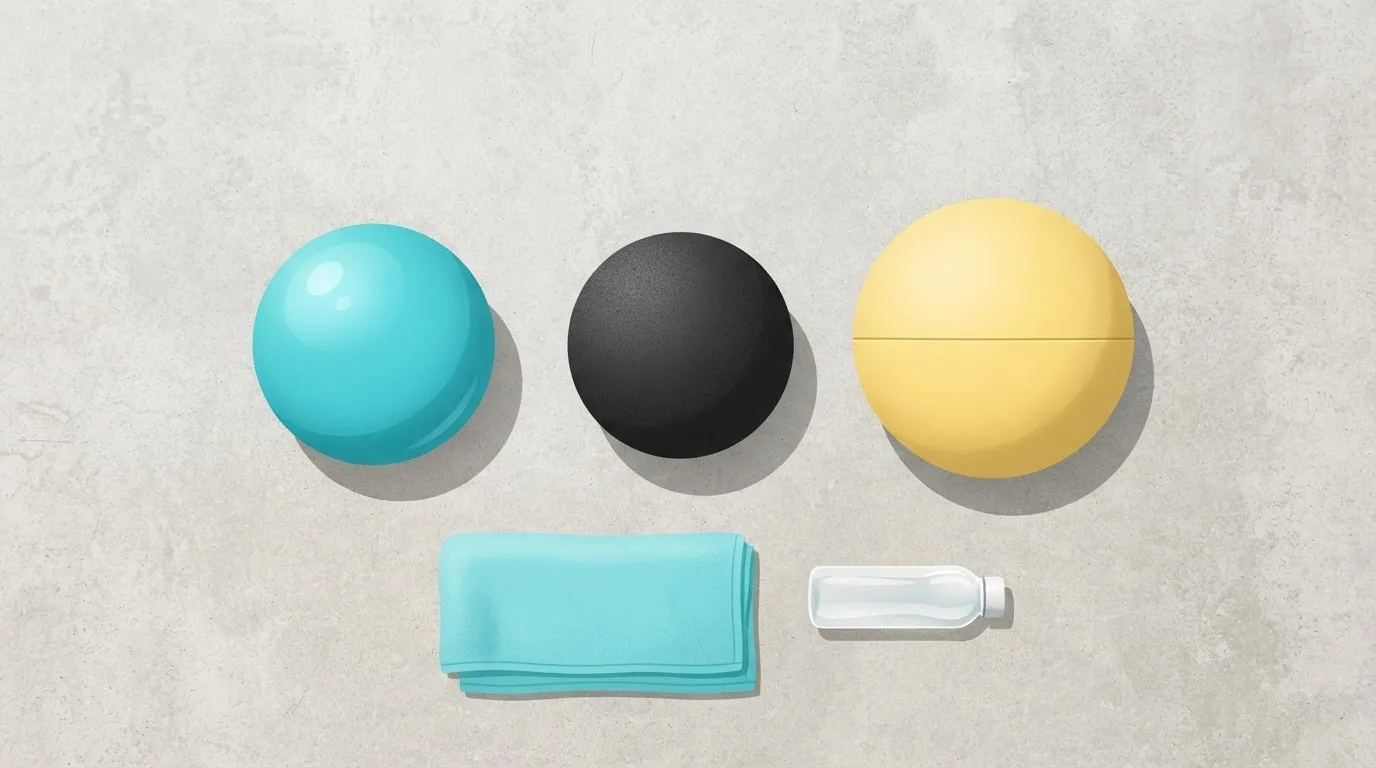
Medicine balls come in three types that look alike and behave very differently. Match the ball to the move before you throw anything.
| Ball | Bounce | Use it for | Don't use it for |
|---|---|---|---|
| Slam ball, a thick rubber shell filled with sand | Almost none | Overhead and side slams, holds and twists | Wall throws, because it barely rebounds |
| Rubber medicine ball | Bounces | Chest passes and rotational throws against a solid wall | Hard slams, because it can bounce back into your face |
| Soft medicine ball, often called a wall ball | Very little | Squat to wall throws, catches and indoor walls | Hard slams on concrete, which can split its seams |
Throw only against brick, concrete or concrete block. Drywall, windows and wooden fences won't stand up to it. Slam onto concrete, rubber flooring or a thick mat over a solid floor rather than tile or hardwood, and keep a clear circle around you. If you can buy only one ball, get a slam ball if you train on a patio or in a garage, and a soft ball if you train indoors next to a solid wall.
How Many Rounds and How Much Rest?
For power, do 2 to 4 sets of 5 to 8 throws, rest about 2 minutes before you repeat the same throw, and end each set as soon as the ball slows down. Throws done tired are slower, so they train less power.
The clearest data on rest come from a bench press study. When 10 men did 10 sets of 6 reps at 70 percent of their max, Abdessemed and colleagues (1999) found that with 1-minute rests, power from the fourth set on was 27 percent lower than with 3- or 5-minute rests, which kept it steady. A medicine ball is far lighter than that bar, but short rests still leave your muscles too little time to recover for fast reps.
Let rep speed decide your rounds. Beginners do 3 rounds of each pair, and add a fourth only when every rep in the third round stays fast. Two sessions a week on non-consecutive days is plenty when you're starting. Two of the training studies below added medicine ball work three times a week on top of regular training.
The conditioning version
If you want to end up out of breath, use the finisher format for the whole session, with 20 to 30 seconds of work and 30 to 40 seconds of rest for 4 to 6 rounds of each move. The only lab data on medicine ball intervals come from children. In 14 kids doing 30-second intervals with a 2.3 kg ball, Faigenbaum and colleagues (2018) recorded heart rates of about 90 percent of peak by the last exercise, double-arm slams. We found no study that measured slams alone in adults.
Why Throws Build Power That Lifting Misses
When you press a weight, you have to slow it down before your arms lock out. When you throw a ball, you can keep speeding up until it leaves your hands. Newton and colleagues (1996) compared the two in 17 men using the same bar at 45 percent of their max. The thrown bar moved faster, with more force and more power, and the chest, shoulder and arm muscles worked harder during the throw.
A quick dip before you throw helps as well. In the 1997 study by the same team, throws that started with a fast countermovement produced more force and power than throws from a dead stop. That's why you catch the ball and send it straight back on a wall pass.
This matters more after 40. Among 1,305 Danish adults aged 20 to 93, Alcazar and colleagues (2020) found that leg power relative to body weight began to decline above age 40 in both women and men. In the Baltimore Longitudinal Study of Aging, upper-body strength and power both started falling by age 40, and men lost about 10 percent more power than strength (Metter 1997). Our review of power training for older adults covers what decades of that decline do, and our plyometric training review covers jumps, the lower-body cousin of throws.
What Medicine Ball Training Studies Show
- Rotational strength. Szymanski and colleagues (2007) randomized 49 high school baseball players to a lifting program with or without medicine ball throws three days a week for 12 weeks. The medicine ball group gained more torso rotation strength, about 17 to 18 percent against 10 percent, and improved more on a rotational medicine ball throw test, 10.6 percent against 3.0 percent. Squat and bench press gains were the same in both groups.
- Upper-body power. In 21 young female handball players, 12 weeks of added medicine ball training raised bench press and shoulder press power more than regular training did, while one-rep max strength rose equally in both groups (Ignjatovic 2012).
- Throwing speed. Six weeks of medicine ball training three times a week raised throwing velocity by 14 percent in female handball players, against 3.7 percent in the control group (Raeder 2015).
Across these trials, medicine ball work added power and turning strength on top of regular lifting. In the two trials that tested one-rep maxes, it didn't add maximal strength. Use the ball for speed, and keep a strength routine for muscle. Every one of these trials used teenagers and young adults, ages 15 to 21 on average. We didn't find a medicine ball training trial in adults in their 30s and 40s, so the case for you rests on these results plus the power data above.
Medicine Ball Workout for Beginners: The First Four Weeks
Learn the moves at part speed before you throw hard. This four-week ramp uses the printable workout above.
| Week | How hard to throw | Rounds per pair | Finisher |
|---|---|---|---|
| 1 | About 70 percent effort while you learn the moves | 2 | None |
| 2 | About 80 percent effort | 3 | 2 rounds |
| 3 | Full speed | 3 | 4 rounds |
| 4 | Full speed | 3-4 | 4-6 rounds |
If standing for a long time is hard, start with the seated chest pass and a seated twist on a sturdy chair, then add the standing throws as you get stronger. Move to the next ball size only after a week where every rep of the third round stayed fast.
Medicine Ball Arm Exercises
The best medicine ball arm exercises are the chest pass, the overhead forward throw and the ball push-up. They train your triceps, chest and shoulders to work fast, which a slow dumbbell press can't do. They won't build much arm size, because a ball light enough to throw is too light for that.
For bigger arms, use dumbbells and our dumbbell arm workout. If you'd like that strength side planned for you, a personalized training program can take it off your plate. FitCraft builds bodyweight and dumbbell workouts around your goals and schedule, your AI coach demonstrates each exercise on an interactive 3D model, and streaks and leaderboards help you keep showing up. FitCraft doesn't program medicine balls, so keep these sessions as your own on two other days of the week.
Medicine Ball Form Cues and Safety
- Check the ball before you slam. Slam only a slam ball. A rubber ball slammed hard can bounce straight back into your face.
- Stand at the right distance. Use a solid wall and stand where the rebound comes back to your chest, usually 3 to 6 feet away.
- Catch with soft elbows. Keep your hands up and your eyes on the ball, and let your arms give as you catch.
- Turn from your hips. Pivot your back foot on every rotational throw so your lower back doesn't twist on its own. Keep floor twists slow, and see our oblique exercises guide for why.
- Keep slams in front. Let the ball land between your feet, not on them, and squat to pick it up.
- Stop when the speed goes. End the set when the ball slows down or your form slips, and breathe out on every throw and slam.
The Bottom Line
A medicine ball workout earns its place when you use the ball for throws and slams, done fast, with real rest between sets. Choose a light ball for throws and a heavier slam ball for slams, train twice a week, and leave muscle building to dumbbells or bodyweight.
Sticking with it matters more than finding the perfect ball. As Katie put it, "I've tried everything. This is the first time I've stuck with something past two weeks." Print the table, pick your two days, and do your first round of slams this week.
Frequently Asked Questions
What are the top 3 core strengthening exercises?
The curl-up, the side plank and the bird dog, known as the McGill big three, are the core exercises coaches most often name as the top three. They train your core to stay still under load. A medicine ball adds the fast, turning side with rotational throws and slams, and our core stability exercises guide covers the holds in detail.
Are medicine ball slams good cardio?
Medicine ball slams make good cardio when you do them in short intervals, such as 20 to 30 seconds of work and 30 to 40 seconds of rest. In children doing medicine ball intervals with a 2.3 kg ball, heart rate reached about 90 percent of peak by the slams (Faigenbaum 2018). No study has measured slams alone in adults, so use them as a finisher rather than your only cardio.
What is the difference between a medicine ball and a slam ball?
A slam ball has a thick rubber shell filled with sand, so it barely bounces and is safe to slam. A medicine ball either bounces, for wall throws, or has a soft shell for catching. Never slam a bouncy ball hard, because it can rebound into your face.
How often should you do a medicine ball workout?
Twice a week on non-consecutive days suits most beginners. Power work needs fresh muscles, so leave at least a day between sessions, and do your throws before any other training on days you combine them.
Can you build muscle with a medicine ball?
A medicine ball builds a little muscle if you're new to exercise, but it's mainly a power tool. In the trials on this page that tested one-rep maxes, medicine ball training added power without raising maximal strength more than regular lifting did. Pair it with dumbbell or bodyweight strength work for muscle.