You've done hundreds of crunches, and the sides of your waist still feel like an afterthought. Then someone warns you that training your obliques will make your waist wider. So you stop, start again later, and never know whether you're helping or hurting.
These oblique exercises settle it. You'll get 10 moves for your obliques, or side abs, grouped by the job each one does. You'll also see what the oblique muscles are, how the moves compare on EMG, which measures how hard a muscle works, and a 10-minute routine for your living room floor.
10 Oblique Exercises by the Job Each One Does
The first four bend your trunk sideways or stop it from bending, the next four turn it, and the last two stop it from turning. All but the last need only a floor.
| # | Exercise | Its job | Sets x reps or time |
|---|---|---|---|
| 1 | Side plank | Stops your trunk bending sideways | 3 x 20-40 sec per side |
| 2 | Side plank raise | Bends your trunk sideways | 2-3 x 8-12 per side |
| 3 | Heel taps | Bends your trunk sideways | 2-3 x 10-15 per side |
| 4 | Standing twists | Bends your trunk sideways with a small turn | 2-3 x 10-12 per side |
| 5 | Twist crunch | Turns your trunk | 2-3 x 8-12 per side |
| 6 | Bicycle crunch | Turns your trunk | 2-3 x 10-15 per side |
| 7 | Russian twist | Turns your trunk | 2-3 x 10-12 per side |
| 8 | Floor wipers | Turns your hips under your ribs | 2-3 x 6-10 per side |
| 9 | Spider plank | Stops your hips twisting | 2-3 x 6-10 per side |
| 10 | Renegade row | Stops your trunk twisting under load | 2-3 x 6-8 per side |
1. Side plank
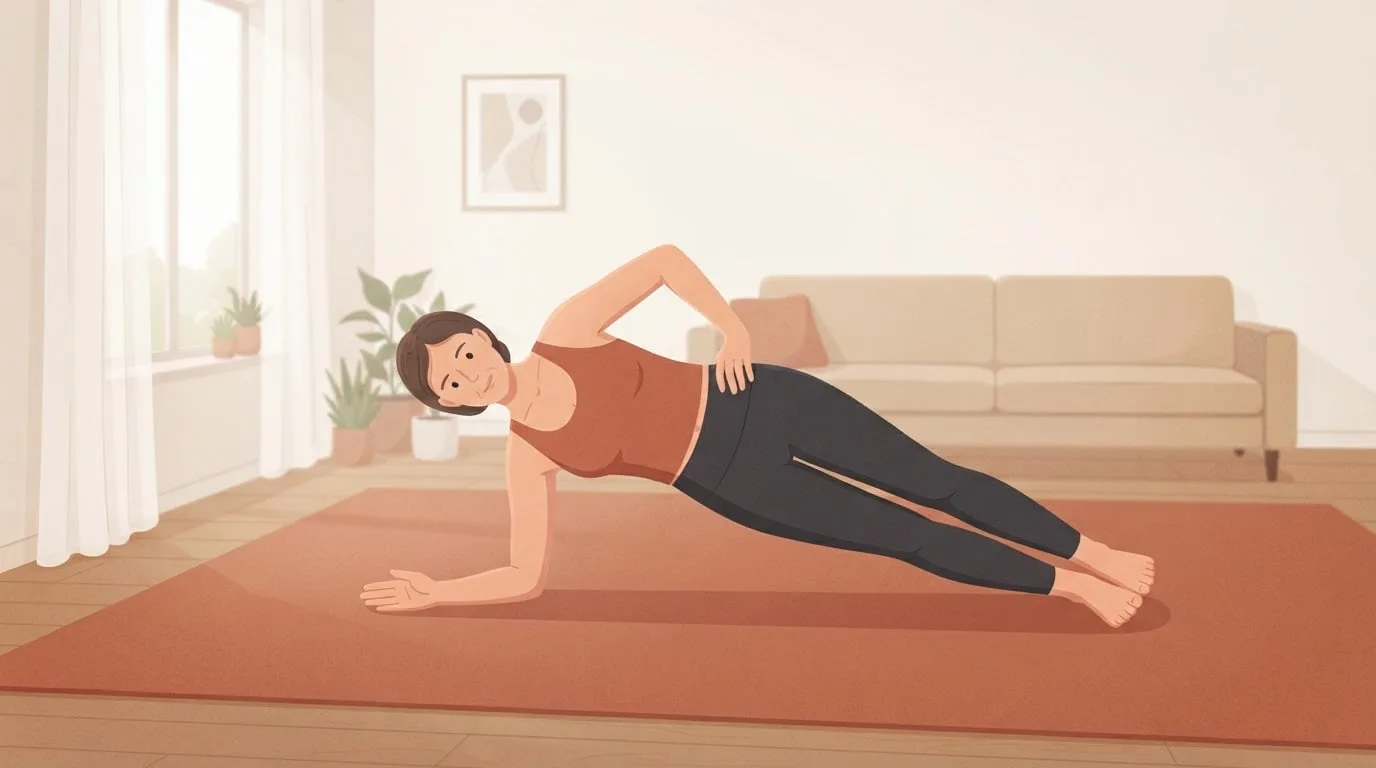
Lie on your side with your elbow under your shoulder and lift your hips until your body makes one straight line. If your hips drop, rest your bottom knee on the floor. When both sides hold clean, the side plank reach-through adds a turn. Start here: our side plank page shows each step.
2. Side plank raise
From a forearm side plank, lower your hips toward the floor, then lift them back to a straight line. Keep your chest open and your elbow under your shoulder. The side plank raise turns a hold into a rep, and a version of it scored near the top of the EMG table below.
3. Heel taps
Lie on your back with your knees bent and curl your shoulder blades off the floor. Bend from side to side so each hand reaches toward the same-side heel. Heel taps are a side bend rather than a twist, and they're the easiest move on this list.
4. Standing twists
Stand with your hands resting behind your head, lift one knee up and out to the side, and bend the same elbow toward it. Standing twists suit you if getting down on the floor is hard, and our standing ab workout has more moves like it.
5. Twist crunch
Lie with your feet flat, curl up and aim one shoulder toward the opposite knee, keeping your hips down. Lower until your shoulders touch the floor, then switch. The twist crunch is the simplest oblique crunch.
6. Bicycle crunch
With both feet off the floor, turn your ribcage so one elbow moves toward the opposite knee as that knee draws in, then switch sides slowly. A bicycle crunch also trains your hip flexors and the front of your abs. Turn from your ribs instead of swinging your elbow.
7. Russian twist
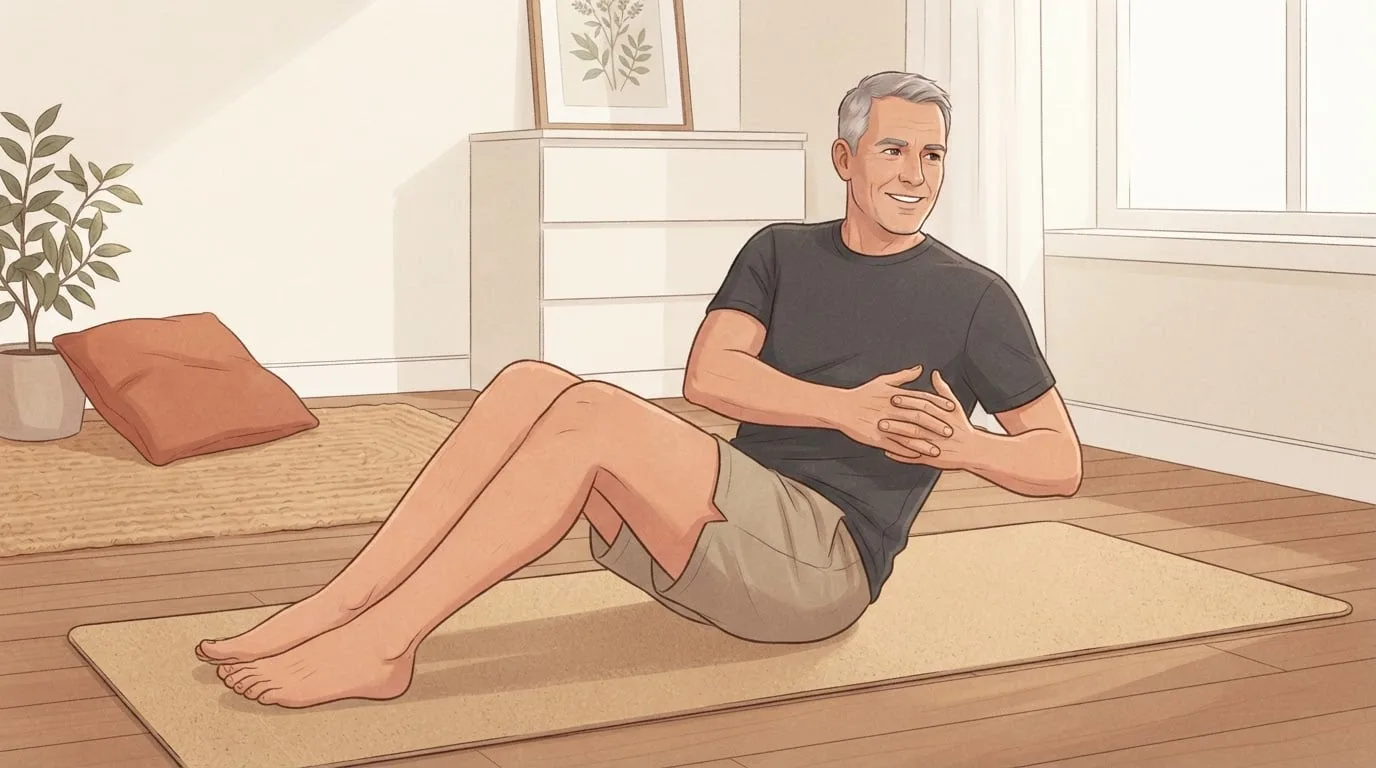
Sit with your knees bent, lean back to about 45 degrees and turn your chest and shoulders from side to side with your back long. Rest your heels on the floor for an easier Russian twist, and go slowly.
8. Floor wipers
Lie on your back with your arms out and your bent knees over your hips. Lower both legs to one side, bring them back, and go to the other side with both shoulders down. Floor wipers are hard, so keep the sweep small at first.
9. Spider plank
From a forearm plank, bring one knee out toward the same elbow and keep your hips low and level. In a spider plank, your obliques work to stop your hips from twisting as the knee moves.
10. Renegade row
From a push-up plank with your hands on two dumbbells that won't roll, row one dumbbell to your ribs with your hips square. The renegade row is the only move here that needs equipment, and it doubles as one of our dumbbell back exercises.
What Are the Obliques and Where Are They?
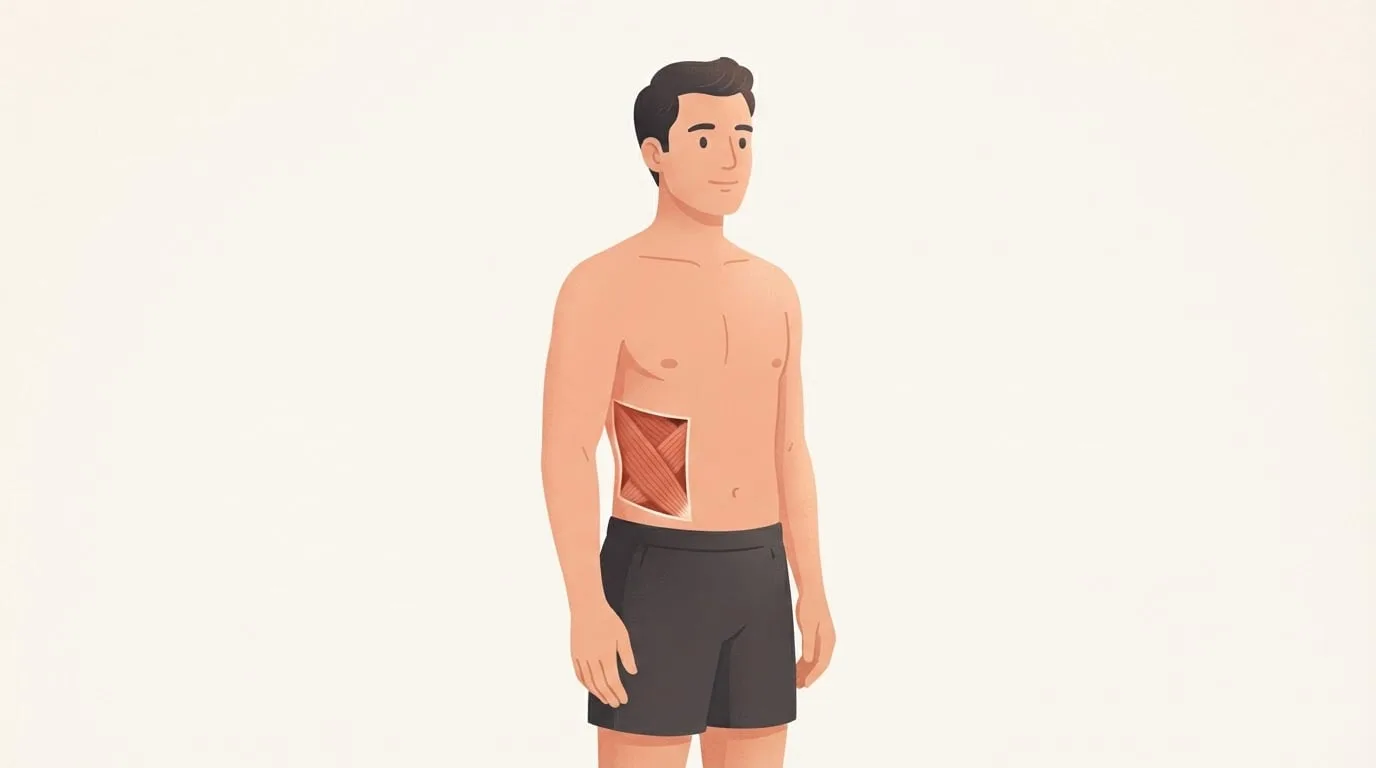
The obliques are two layers of muscle on each side of your waist, between your lower ribs and your hip. The external oblique sits on top and the internal oblique sits under it. Their fibers cross: the external oblique runs the way your fingers go when you slide them into your front pockets, and the internal oblique runs the way your thumbs point (OpenStax Anatomy and Physiology).
Internal vs External Obliques: What Each One Does
The external oblique turns your trunk toward the opposite side, and the internal oblique turns it toward the same side.
| Feature | External oblique | Internal oblique |
|---|---|---|
| Position | Outer layer | Under the external oblique |
| Fibers run | Down and inward | Up and inward |
| Turns your trunk | Toward the opposite side | Toward the same side |
| Resting thickness in men who train | About 5 mm | About 9 mm |
Between them, the obliques do three jobs:
- Rotation. To turn right, your left external oblique and your right internal oblique work together. Fan and colleagues (2014) found that pairing in 24 healthy men on a rotation machine.
- Side bend. The obliques on one side pull your ribs toward your hip. Konrad and colleagues (2001) found that side-bending tasks targeted the external oblique above all.
- Anti-rotation. The obliques stop your trunk from turning when a load pulls it. Saeterbakken and colleagues (2015) found more external oblique activity in one-arm rows than in two-arm rows, and Fenwick and colleagues (2009) found that a one-arm row challenged the trunk's resistance to twisting. Our core stability exercises guide covers this kind of training in depth.
Find out what's really holding you back
FitCraft, our mobile fitness app, pairs you with an AI coach who builds you a personalized plan around your goals, schedule, and fitness level. Every FitCraft program is designed by Domenic Angelino, MPH (Brown University) and NSCA-CSCS, with research published in the Journal of Strength and Conditioning Research and Medicine & Science in Sports & Exercise.
Take the Free Assessment Free • 2 minutes • No credit cardWhat Is the Most Effective Oblique Exercise?
The most effective oblique exercise is the side plank, or its hip-lift version, the side plank raise. On the numbers below, those moves produced about twice the external oblique activity of a crunch with a twist.
| Exercise | External oblique activity (% of maximum) | Study |
|---|---|---|
| Side-lying trunk raise, feet held down | 98 | Konrad 2001 |
| Side plank hip lift | 81 | Konrad 2001 |
| Side plank on toes | 62 | Escamilla 2016 |
| Side crunch on a ball | 50 | Escamilla 2016 |
| Front plank on toes | 40 | Escamilla 2016 |
| Side plank on knees | 37 | Escamilla 2016 |
| Twisting curl-up | 36 | Konrad 2001 |
| Straight curl-up | 29 | Konrad 2001 |
| Crunch | 28 | Escamilla 2016 |
Adding a twist barely helped. In the Konrad study, turning a curl-up into a twisting curl-up raised activity from 29 to 36 percent, a change that wasn't significant. Your position matters more: in the data from Escamilla and colleagues (2016), moving a side plank from your toes to your knees cut activity from 62 to 37 percent.
Read these numbers as a guide. They come from two small studies, of 10 and 18 people, in different labs, and EMG shows how hard a muscle works rather than how much it grows. We couldn't find comparable peer-reviewed numbers for the bicycle crunch or the Russian twist, so they're left out.
Best exercise for external obliques
Side plank raises come first, followed by side planks on your toes. The side-lying trunk raise tops the table, but it needs your feet held down.
Best exercise for internal obliques
The internal oblique follows a different pattern. In the Escamilla data it scored 28 percent in a side plank and 33 percent in a crunch. Maeo and colleagues (2013) found it reached about 60 percent of maximum when 10 men simply braced their abs hard. A 2020 systematic review by Oliva-Lozano and Muyor also found its highest activity in core stability exercises, while the external oblique peaked in free-weight lifts. So brace hard in every plank, and keep your loaded lifts in your plan.
The 10-Minute Oblique Routine
This ab and oblique workout needs only a mat and a timer. Do each move for 40 seconds, rest for 20 seconds, then go through the whole list a second time.
| Order | Exercise | Work | Rest |
|---|---|---|---|
| 1 | Side plank, left side | 40 sec | 20 sec |
| 2 | Side plank, right side | 40 sec | 20 sec |
| 3 | Twist crunch | 40 sec | 20 sec |
| 4 | Heel taps | 40 sec | 20 sec |
| 5 | Bicycle crunch, slow | 40 sec | 20 sec |
If you can't hold a side plank for 40 seconds, drop to your knees. To make it harder, swap the side plank for side plank raises and the heel taps for Russian twists. Our abs workout at home shows how a routine like this fits into a full core week.
If you'd rather have someone run the session, a home workout app with no equipment can do that. FitCraft's 3D AI coaches demonstrate each exercise on an interactive model and say your name during workouts. Your workouts adjust as you progress, and streaks and leaderboards help you keep showing up.
Will Oblique Training Thicken Your Waist?
Oblique training can thicken your waist, but by millimeters. These muscles are thin. In 64 men who trained at least three times a week, Courtaut García and colleagues (2024) measured the external oblique at about 5 mm and the internal oblique at about 9 mm at rest.
Lee (2025) ran the closest trial we could find, with 57 healthy adults doing reformer Pilates or walking three times a week for six weeks. The Pilates group's internal oblique went from 9.2 to 10.3 mm and their external oblique from 7.5 to 8.2 mm, and the walking group didn't change. That's under 2 mm per side.
Heavy loaded side bends can add more over months, so skip them if a narrower tape measure is your main goal. Oblique exercises also leave the fat on top of the muscle where it is. Our guide on how to get rid of love handles covers what changes that layer.
Why Do People Say Not to Train Obliques?
People say not to train obliques for two reasons: they fear a wider waist, and they worry about twisting the spine. The numbers above answer the first. The second has some basis. In a lab study of pig spines, Marshall and McGill (2010) found that twisting combined with repeated bending caused layered disc damage in 67.5 percent of samples, while twisting alone didn't start a herniation.
Pig spines in a test machine aren't people doing Russian twists, so this doesn't show the exercise injures anyone. It's still a good reason to twist slowly, keep your back long and leave heavy weights out of rotation work.
The Bottom Line
Oblique exercises work best when they cover all three jobs: bending, turning and holding still. Side planks and side plank raises give your external obliques the most work, hard bracing trains your internal obliques, and 10 minutes two or three times a week is enough to start.
Working out consistently is hard, but it doesn't have to be. As Matt put it, "The real win is I actually want to work out now. That's never happened before." Put your first 10-minute session on your calendar for this week.
Frequently Asked Questions
What are the signs of a strained oblique?
A strained oblique usually causes pain at the side of your trunk and one tender spot, often near the lower ribs, that shows up during a swing, throw or twist. In pro baseball, where these injuries are tracked closely, players needed three to four weeks to return (Komatsu 2022, Tenner 2024). Stop the exercise that caused it, and see a clinician if the pain is sharp or doesn't ease.
What does a strong oblique look like?
A strong oblique shows up as a steady trunk more than a visible line. In a study by Juan-Recio and colleagues (2025), recreational athletes averaged about two minutes in a side bridge, so a clean two-minute side plank is a solid target. Whether you can see your obliques depends mostly on body fat.
What exercises give you a bigger waist?
Eating more than you burn widens a waist far more than any exercise does. Among exercises, heavy loaded side bends and weighted twists are the most likely to thicken the obliques, and even that adds millimeters.
What are the best oblique exercises for beginners?
Start with heel taps, twist crunches and a side plank from your knees. Those three cover side bending, turning and holding still. Move to a full side plank once you can hold the knee version for 40 seconds on each side.
How often should you train your obliques?
Two or three short sessions a week on non-consecutive days is enough for most people. Your obliques also work during planks, rows and other one-sided exercises, so 10 minutes at a time is plenty.