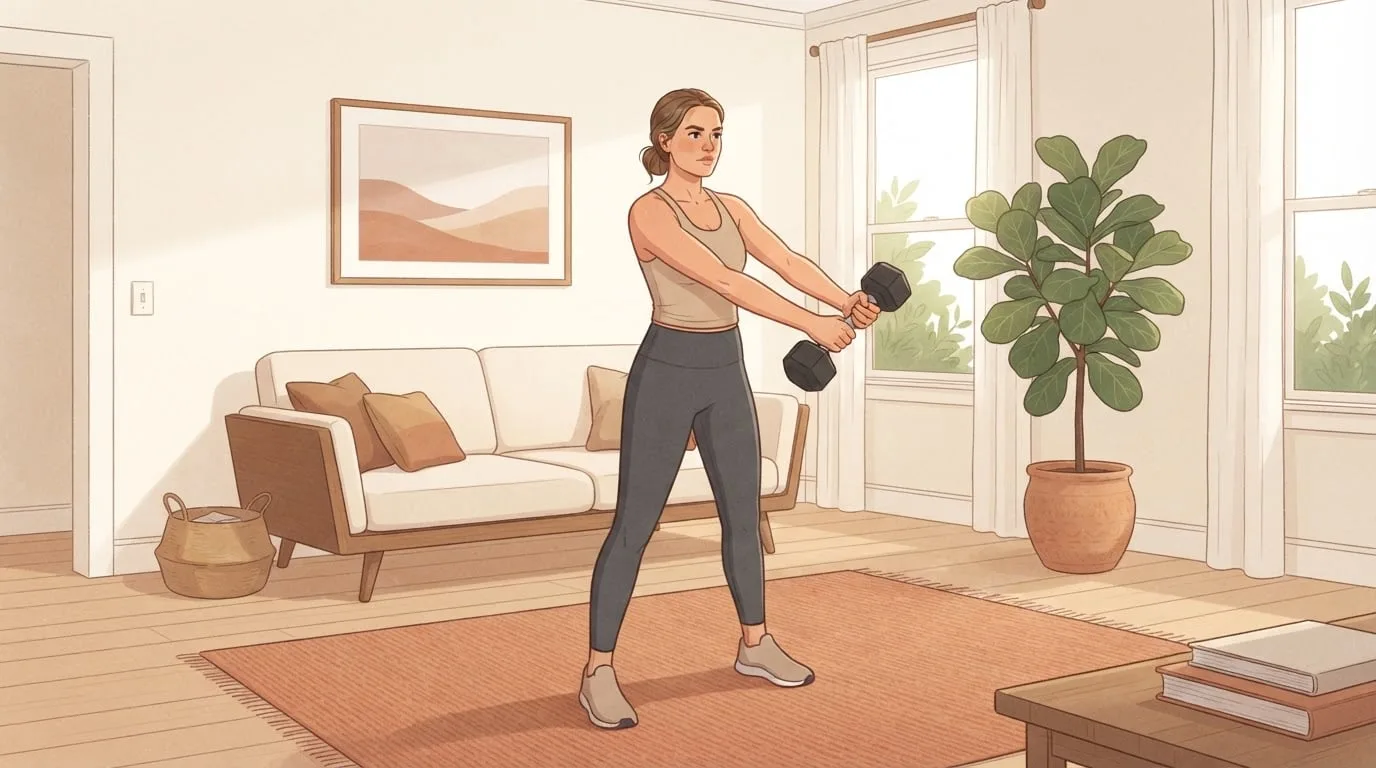
Maybe your wrists ache in a plank. Maybe getting down to the floor and back up takes more effort than the workout itself. Maybe you're pregnant, or at the office, or you just don't want your face on the carpet. Whatever the reason, you went looking for an abs workout standing up, and most of what came back was ten minutes of swinging elbows at knees.
That's frustrating, because the standing moves that look most like ab work are often the weakest. The ones that work best look like nothing much: walking with a dumbbell in one hand, or standing on one leg and refusing to twist. So you do the flashy ones, feel very little, and start to wonder whether standing ab exercises are a waste of time.
They aren't, as long as you pick the right ones and know what they leave out. This guide gives you a standing abs workout routine built on the moves the research supports, a 10-minute and a 20-minute version, who it suits best and how to keep making it harder.
The Standing Ab Workout: 8 Moves in Order
Do the moves in this order. Each one has a bodyweight version and a one-dumbbell version, and each gives your trunk a specific job. Go straight from one exercise to the next. One round takes about 5 minutes.
| # | Exercise | Bodyweight | One dumbbell | Core job |
|---|---|---|---|---|
| 1 | Standing brace march | 30 sec | 30 sec, dumbbell overhead | Bracing (anti-extension) |
| 2 | Standing side crunch | 8 per side | 8 per side as a side bend | Side bending (obliques shorten) |
| 3 | Wood chop | 8 per side | 8 per side | Controlled rotation |
| 4 | Suitcase march | 20 sec per side with a jug or bag | 20 sec per side | Resisting a sideways pull (anti-lateral flexion) |
| 5 | Standing bird dog | 6 per side, 2-sec hold | 6 per side | Resisting rotation, balance |
| 6 | Reverse lunge with a twist | 6 per side | 6 per side | Rotation over one leg |
| 7 | Knee press hold or one-arm press | 2 x 10 sec per side | 8 per side | Bracing against a push, resisting a lean |
| 8 | Standing crunch pull-down | 30 sec | 30 sec, no weight | Trunk flexion with a knee drive |
1. Standing brace march
Stand tall with your feet hip-width apart. Brace your midsection the way you would if someone were about to poke you in the stomach: firm all the way around, without sucking in or holding your breath. That standing brace is the skill under every other move here. Keep it while you raise both arms overhead and march slowly, lifting each knee to hip height. Your ribs stay stacked over your pelvis. If your lower back arches when your arms go up, bring your arms forward until it stops. With a dumbbell, hold it overhead in both hands.
2. Standing side crunch
Put your hands behind your head with your elbows wide. Lift your right knee up and out to the side and bring your right elbow down to meet it, shortening the right side of your waist, then lower and repeat. Our standing twists page shows this move in detail. For the dumbbell version, do a side bend instead: hold the dumbbell in your right hand, lean slowly toward it, then pull yourself upright with the left side of your waist. It's the one move on the list where your spine bends sideways on purpose, so keep it slow.
3. Wood chop
Stand with your feet a little wider than your hips. Start with your hands together above your right shoulder and pull them diagonally down across your body toward your left hip, letting your hips and knees turn with you. Return under control. Turn from your hips and upper back rather than wringing out your lower back. With a dumbbell, hold it by both ends and start light, because the weight sits far from your body at the top of each rep.
4. Suitcase march
Hold a dumbbell in one hand at your side, stand tall and march slowly in place, or walk the length of the room and back. The weight tries to pull you sideways, and your job is to stay vertical with level shoulders. No dumbbell? A full water jug, a loaded grocery bag or a backpack held by one strap does the same job. This is the move with the strongest research case, which is covered further down.
5. Standing bird dog
Stand on your left leg with a soft knee. Hinge forward a little, then reach your left arm forward as your right leg reaches back, keeping both hips pointing at the floor. Hold for two seconds and return. The usual mistake is letting the hip of the lifted leg open toward the ceiling, so keep the reach small until your hips stay square. Rest a fingertip on a counter or chair if your balance wobbles. With a dumbbell, hold a light one in the reaching hand.
6. Reverse lunge with a twist
Step back with your right foot into a lunge. As you lower, turn your chest and arms toward your left knee, the front one. Turn back to the middle as you stand up, then switch legs. For the dumbbell version, hold the dumbbell at your chest with both hands and turn it over your front thigh. Your front knee keeps pointing forward while your upper body turns.
7. Knee press hold or one-arm press
For the bodyweight version, lift your right knee to hip height and press your left hand down into it as hard as you can while the knee pushes up. Nothing moves. Your abs have to lock your ribs to your pelvis so the push doesn't fold you forward. Hold for 10 seconds and keep breathing. For the dumbbell version, hold the dumbbell at your right shoulder and press it straight overhead without leaning away from it. That one-arm standing press is the exact exercise the research below measured.
8. Standing crunch pull-down
Reach both arms overhead. Drive your right knee up as you pull both elbows down toward it, curling your ribs toward your pelvis, then reach back up and switch sides at a steady pace. This is the high knee crunch, and it works your hip flexors as hard as your abs, which is why it's the finisher rather than the main event. Both versions are bodyweight.
10-Minute and 20-Minute Standing Ab Workouts
Both versions use the same 8 moves. The 10-minute version is bodyweight only. The 20-minute version adds one dumbbell, a warm-up and a cool-down.
10-minute standing ab workout for beginners, no equipment
- Do one round of the bodyweight column, moves 1 to 8.
- Rest 30 to 60 seconds.
- Do a second round.
That's about 10 minutes. On your first day, one round is enough. Adding the second round the next week is the easiest progression you'll ever make, and two rounds is still a real workout.
20-minute standing ab workout with one dumbbell
| Minutes | What you do |
|---|---|
| 0 to 2 | Warm-up: march in place, arm circles and slow hip circles |
| 2 to 18 | Three rounds of the dumbbell column, with 60 seconds of rest between rounds |
| 18 to 20 | Standing stretch: a side reach for 30 seconds per side, then 3 slow, gentle back bends with your hands on your hips |
Pick one dumbbell you can press overhead 8 times with one arm while you still have two reps left in the tank. For most beginners that's somewhere around 5 to 15 pounds (2 to 7 kilograms). The suitcase march can take a heavier weight than anything else here, so if you own two dumbbells, use the heavier one for that move.
Find out what's really holding you back
FitCraft, our mobile fitness app, pairs you with an AI coach who builds you a personalized plan around your goals, schedule, and fitness level. Every FitCraft program is designed by Domenic Angelino, MPH (Brown University) and NSCA-CSCS, with research published in the Journal of Strength and Conditioning Research and Medicine & Science in Sports & Exercise.
Take the Free Assessment Free • 2 minutes • No credit cardWhat Standing Ab Exercises Train That Floor Work Doesn't
In daily life your core rarely crunches. Mostly it keeps your spine still while your arms and legs move and the load sits off to one side: a bag in one hand, a toddler on one hip, a heavy door you're pushing open. The general model of those jobs, resisting extension, rotation and sideways bending, is laid out in our guide to core stability exercises, along with the floor drills that train them. Here's what the research adds about doing that work on your feet.
Standing up makes the same exercise harder for your core
Saeterbakken and Fimland (2012), in the European Journal of Applied Physiology, recorded the surface core muscles of 15 men doing dumbbell shoulder presses at 80 percent of their maximum. With both arms pressing, rectus abdominis activity was about 81 percent lower seated than standing, and external oblique activity was about 58 percent lower. Standing, the two-arm press produced about 68 percent less external oblique activity than the one-arm press. The authors concluded that standing and one-arm exercises should replace seated and two-arm ones when the goal is more core activation.
The reason is simple. When you sit, the bench does part of the bracing for you. When you stand, your trunk does all of it, and when the weight is in one hand, it also has to stop you leaning. The study used heavy loads, so a light dumbbell will produce less activity, but the direction holds.
One-sided loads train the side of your trunk
The suitcase march works because a weight in one hand is harder on the trunk than the same weight split between two. McGill, Marshall and Andersen (2013), in Ergonomics, had six people walk while carrying buckets and fed their muscle activity and movement into a spine model. Carrying 30 kilograms in one hand pushed lower back compression past 2,800 newtons. Splitting the same 30 kilograms between both hands cut it to 1,570 newtons, and even 30 kilograms in each hand, double the total, loaded the spine less than 30 kilograms in one. Most of that extra load is muscle force, because your trunk has to hold itself upright against a weight that pulls to one side. For training, that muscle work is the point. For a sore back, it's a reason to start light.
Moving matters too. Ellestad and colleagues (2024), in the International Journal of Exercise Science, compared a suitcase carry with simply holding the same dumbbell still. Walking with it raised activity in the deep back muscles, the longissimus and multifidus, on both sides, and in the rectus abdominis and external oblique on the loaded side. So march or walk with the weight rather than standing still with it.
Free weights reach the small back muscles
A systematic review by Martuscello and colleagues (2013), in the Journal of Strength and Conditioning Research, pooled 17 studies with 252 people. It found moderate evidence that the lumbar multifidus, the small muscles that steady each vertebra, worked harder during free-weight exercises than during ball and device exercises. The authors advised using multi-joint free-weight exercises rather than core-only drills to train the core. A one-arm press, a suitcase march and a lunge with a dumbbell at your chest are small versions of exactly that.
Where the evidence runs out
No good study has compared a standing anti-rotation drill with a floor one. The standing bird dog and the chop are on this list for the balance and control they demand, not for a measured activation number, and you should treat them that way.
What a Standing Ab Workout Doesn't Train Well
The honest limit is the rectus abdominis, the six-pack muscle. Comfort, Pearson and Mather (2011), in the Journal of Strength and Conditioning Research, recorded 10 young adults doing a plank, a superman hold, back squats, front squats and a standing overhead press. The plank produced more rectus abdominis activity than every other exercise, while the front squat and the superman led for the lower back muscles. Standing lifts at light to moderate loads train the back and sides of your core well and the front of it less.
Gravity explains the rest. When you stand, gravity pulls straight down your spine, so a standing crunch has almost nothing to curl against, and knee-to-elbow moves end up working your hip flexors at least as hard as your abs. If a stronger rectus abdominis is your goal, you need trunk flexion against resistance. Our abs workout at home covers that with a six-week floor plan, so a good week mixes the two if the floor is an option for you: standing work on most days, and two or three floor sessions.
Who a Standing Ab Workout Suits
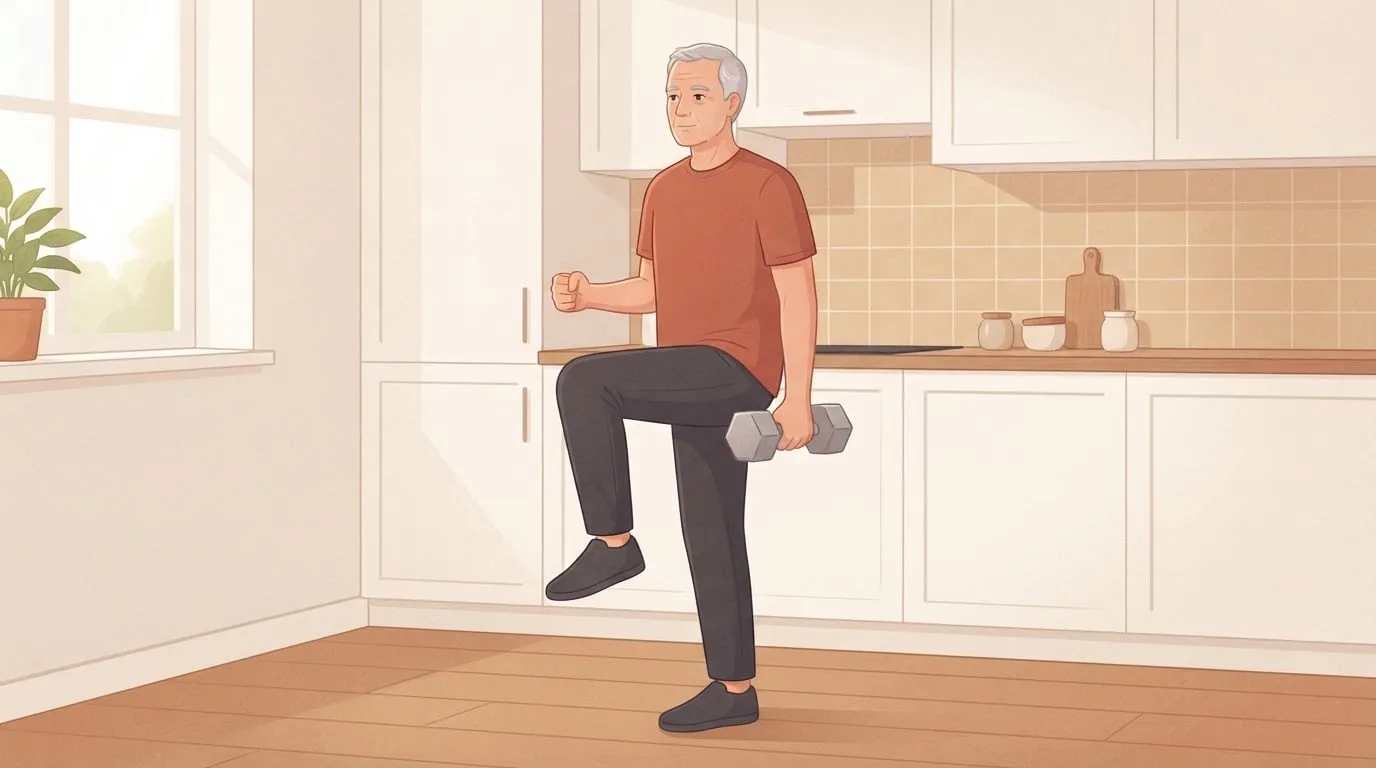
Anyone can use it, but five groups get the most from it.
People with sore or weak wrists
Planks, side planks and mountain climbers load the wrist bent back under your body weight. Standing moves keep it straight, and at most it holds a dumbbell handle. If your wrists hurt on the floor, standing core work lets you keep training while you sort them out.
Anyone who finds the floor hard
Stiff hips, sore knees, a bigger body or a hard floor can make getting down the reason you skip the session. A standing workout removes that barrier. Don't give up on the floor for good if you can help it, though. In a study by Brito and colleagues (2014), 2,002 adults aged 51 to 80 were scored on sitting down on the floor and getting back up with as little support as possible. Each one-point gain on that 10-point score was linked to a 21 percent improvement in survival over a median of about six years. It's an association, not proof, but getting down and up is worth practicing on its own, with a chair beside you for support.
Pregnancy, once your provider has cleared you
The 2019 Canadian guideline for physical activity throughout pregnancy (Mottola 2018), in the British Journal of Sports Medicine, recommends at least 150 minutes of moderate activity a week spread over at least three days, a mix of aerobic and resistance training, and pelvic floor training, which may be done daily to reduce the risk of urinary incontinence. It also says women who feel light-headed, nauseous or unwell when they exercise flat on their back should change position. A standing routine sidesteps that. Keep the twists gentle, skip anything that makes you hold your breath to brace, and stop if something feels wrong.
Older adults and anyone with low bone density
Standing core work is balance work in disguise, and balance work prevents falls. A Cochrane review by Sherrington and colleagues (2019) pooled 108 trials with 23,407 people aged 60 and over living in the community. Balance and functional exercise cut the rate of falls by 24 percent compared with control. Our list of the best balance exercises for seniors pairs well with the standing moves here.
If you have osteoporosis, choose your moves with care. In a small study of 59 women with spinal osteoporosis, Sinaki and Mikkelsen (1984) found new vertebral fractures in 89 percent of the flexion-exercise group and 16 percent of the extension-exercise group. The flexion group had only nine women, but that signal is why bone-health advice steers away from repeated loaded bending. The international Too Fit To Fracture consensus (Giangregorio 2014) strongly recommends a program that combines resistance and balance training for people with osteoporosis. So keep the brace march, the suitcase march, the standing bird dog with a hand on a counter and the knee press hold. Leave out the side crunch, the side bend, the chop, the lunge twist and the crunch pull-down unless your doctor or physical therapist clears them. Four moves is still a full workout.
People at work
A standing desk or a quiet corner is enough. The brace march, the knee press hold and a suitcase march with a full water jug or your work bag need no change of clothes and barely raise a sweat. Two minutes between meetings, three or four times a day, adds up to a full round.
How to Progress a Standing Ab Workout
Change one thing at a time, and only when the current version feels controlled on every rep.
- Narrow your base. Go from feet hip-width, to feet together, to a split stance, to one leg. A chop on one leg is a different exercise from a chop on two.
- Load one side more. The suitcase march handles the heaviest weight, so it's the first move to get a heavier dumbbell.
- Lengthen the lever. Arms overhead are harder than arms at your chest for the brace march and the chop.
- Slow down. Take three seconds on the return of each chop and side bend.
- Add rounds. Two rounds, then three, then four.
| Weeks | Rounds | Load | Days per week |
|---|---|---|---|
| 1 to 2 | 1 to 2 | Bodyweight | 3 |
| 3 to 4 | 2 to 3 | Dumbbell for the suitcase march and the press | 3 to 4 |
| 5 to 6 | 3 | Dumbbell for every move, split stance for the chops | 3 to 4 |
When three rounds with your heaviest dumbbell feel easy, the standing routine has done its job. Turn the suitcase march into a real carry across the house with more weight, and add a floor session if you can, rather than piling on a fifth round.
FitCraft's workouts include standing core moves like the standing twists and high knee crunch above, and an AI coach demonstrates every exercise on an interactive 3D model you can rotate and zoom, so you can check the form from any angle. If you'd rather have the routine planned and progressed for you, a home workout app with no equipment needed keeps it on a schedule, the workouts adjust as you progress, and streaks reward the days you show up.
Is 20 Minutes of Abs a Day Enough?
Yes. For core strength and endurance, 20 minutes a day is more than enough, and 10 minutes on most days is plenty. The light standing moves, the brace march, suitcase march and standing bird dog, are fine every day because they leave little fatigue behind. The loaded chops, presses and side bends work better on three or four days a week with easier days in between. Our post on whether you can do abs every day explains how to split hard and light days across a week.
Will a Standing Ab Workout Give You a Six-Pack?
Not on its own, and neither will 100 sit-ups a day. Ab exercises build the muscle under the fat. They don't burn off the fat on top of it: in a trial by Vispute and colleagues (2011), six weeks of ab exercise five days a week improved endurance but didn't reduce belly fat. Whether your abs show depends mostly on your body fat, which comes down to what you eat and how much you move overall. Our guide on how to get abs covers that side.
To make your abs stand out once they're close to showing, do two things at the same time. Build the rectus abdominis with loaded crunches or reverse crunches two or three times a week, and bring your body fat down slowly. Standing work keeps your waist strong and your posture tall while that happens. There's no reliable data on how many people have visible abs, so ignore claims about how rare a six-pack is and compare yourself with where you started.
The Bottom Line
A standing ab workout trains the parts of your core that hold you steady: bracing, resisting a sideways pull and controlling rotation over one leg. The research backs one-arm and one-sided loads in particular, and it's clear about the limit, because the floor still trains the six-pack muscle better. Do the 8 moves for two or three rounds, keep the suitcase march heavy, and add floor work if you can.
If the floor has been your reason to skip ab work, it doesn't have to be anymore. Ten minutes on your feet, most days of the week, beats the perfect floor routine you never start.
Frequently Asked Questions
What is the best standing ab workout?
The best standing ab workout mixes bracing, a one-sided carry, controlled rotation and a one-arm press: for example a brace march, a suitcase march, a wood chop and a one-arm dumbbell press, plus a standing bird dog for balance. Two rounds of 8 moves take about 10 minutes. The suitcase march and the one-arm press have the strongest research support of the standing options.
Do standing ab exercises actually work?
Yes, especially for the sides and back of the core. In a 2012 study, a standing one-arm dumbbell press produced far more rectus abdominis and external oblique activity than the same press seated, and carrying a weight in one hand loads the trunk more than splitting it between two. A plank still activates the rectus abdominis more than standing lifts, so standing work complements floor work rather than replacing it for a six-pack.
Can I get a 6 pack in 2 weeks?
Almost certainly not, unless you're already lean and close to it. Two weeks of training makes your core noticeably stronger, but visible abs depend on body fat, and a safe rate of fat loss changes body fat only a little in two weeks. For most people it takes several months.
Will 100 sit-ups a day give me abs?
No. A hundred sit-ups burn very little energy and don't remove the fat over your abs, and repeating the same loaded spine bend every day isn't kind to your lower back. A few hard sets of loaded crunches two or three times a week, plus fat loss from your overall diet and activity, works better.
What are the big 3 core exercises?
The big three usually means the curl-up, the side bridge and the bird dog, a set chosen by spine researcher Stuart McGill because they train the core with little load on the spine. All three are floor exercises. The closest standing stand-ins are the knee press hold, the suitcase march and the standing bird dog.
Is a standing ab workout good for seniors?
Yes. Standing core moves double as balance training, and balance and functional exercise cut the rate of falls by 24 percent in a 2019 Cochrane review of older adults. Start with a brace march, a suitcase march and a standing bird dog with a hand on a counter, and skip loaded bending and twisting if you have osteoporosis.
What is a good standing ab stretch?
A standing side reach and a gentle standing back bend cover it. For the side reach, raise one arm overhead and lean away from it for 20 to 30 seconds per side. For the back bend, put your hands on your hips, lift your chest and lean back slightly for 3 slow breaths, stopping well before any pinch in your lower back.
Is there a different standing ab workout for men and women?
No. Men and women have the same core muscles and respond to training in much the same way, so the same standing ab workout fits both. Adjust the dumbbell weight and the number of rounds to your strength, not your sex.