The side plank reach through starts as a side plank, then asks you to rotate without losing height. That combination is what makes it useful. Your trunk has to resist side bending, your ribs have to rotate smoothly, and your shoulder has to stay stacked enough to support the position.
It is a demanding core exercise. Start with the standard side plank if you cannot keep your hips up yet. Once that base is steady, the reach through teaches your obliques to control motion instead of just holding still.
Use it when you want lateral core strength, rotation control, and a more athletic plank progression without equipment.
Quick Facts: Side Plank Reach Through
- Equipment needed: None
- Difficulty: Advanced
- Modality: Strength
- Body region: Core
- FitCraft quest category: Strength
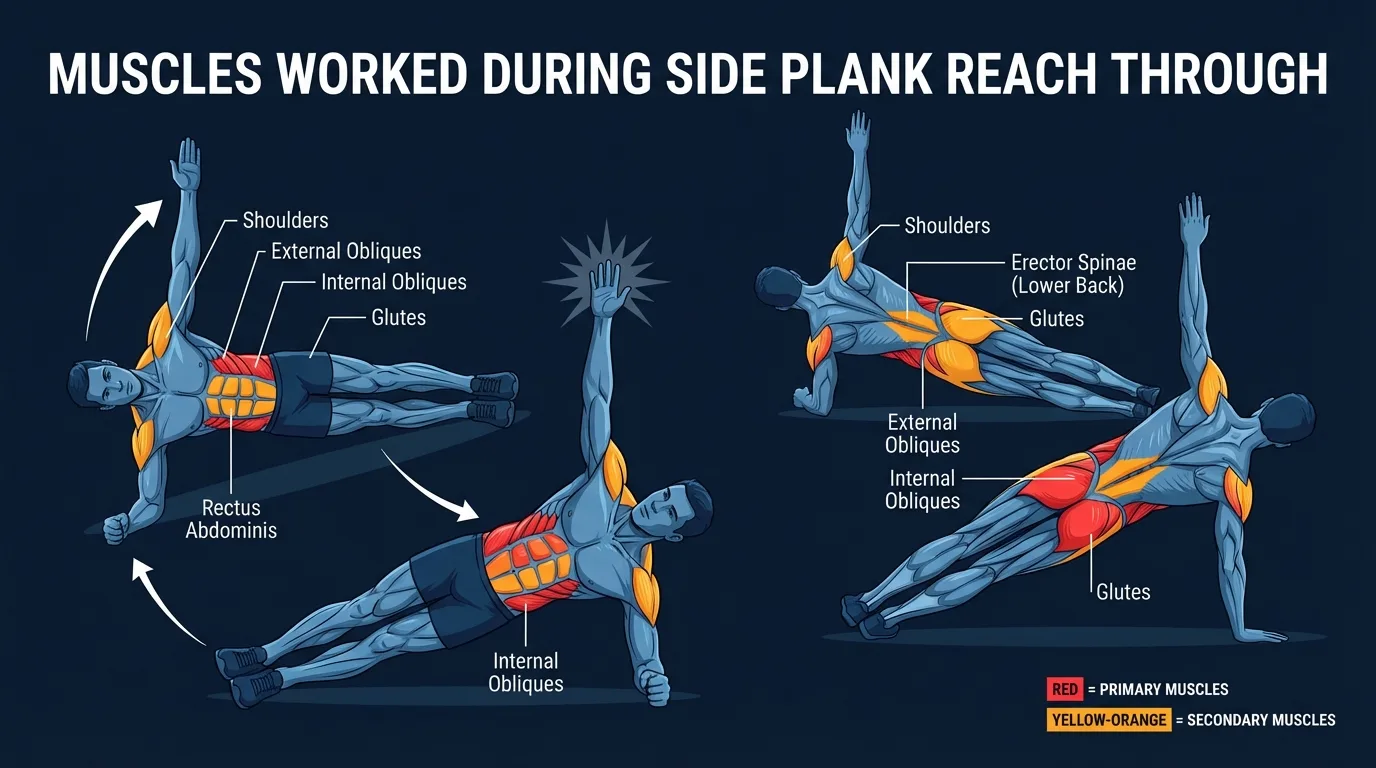
Muscles Worked
Primary movers: the internal obliques, external obliques, transverse abdominis, and gluteus medius. The obliques control the reach-through and opening phases, while the transverse abdominis and lateral hip keep the pelvis from dropping.
Secondary movers: the serratus anterior, rhomboids, thoracic spine rotators, hip abductors, and adductors. They help the rib cage rotate, keep the shoulder blade stable, and stop the legs from drifting as the top arm moves.
Stabilizers: the diaphragm and pelvic floor help build the deep-core canister, the spinal erectors keep the torso long, and the support-side shoulder girdle holds the forearm plank base. Exhaling during the reach through can make the brace stronger because it reinforces deep abdominal tension.
Why the movement works: a regular side plank is mostly an isometric anti-lateral-flexion drill. The reach through keeps that side-plank demand and adds controlled thoracic rotation. That makes the exercise a dynamic core stability pattern rather than a simple hold. No exercise-specific PubMed, PMC, or DOI citation is included in the verified FitCraft citation library for this movement, so this section uses mechanism-based biomechanics instead of a proxy citation.
Step-by-Step: How to Perform the Side Plank Reach Through
The rep should feel slow and controlled. Rotate through your upper back, keep the hips high, and end the set before the support shoulder or lower back starts taking over.
Step 1: Set Up in a Side Plank
Lie on your side with your forearm flat on the floor and your elbow directly beneath your shoulder. Stack your feet, or stagger them slightly if balance is the limiter. Extend your top arm toward the ceiling.
Coach Ty's cue: "Elbow under shoulder first. Build the whole rep from that base."
Step 2: Lift Your Hips and Brace
Press through your forearm and bottom foot to lift your hips off the ground. Make a straight line from your head to your heels. Squeeze your glutes and brace before the arm moves.
Coach Ty's cue: "Hips high before you rotate. Lock the position in."
Step 3: Reach Through Under Your Body
Rotate your torso forward and thread your top arm underneath your body. Reach only as far as your upper back can rotate while your hips stay lifted. Your chest can turn toward the floor, but your pelvis should not collapse toward it.
Coach Ty's cue: "Thread the arm slowly. If the hips dip, stop the rep."
Step 4: Open Back to the Ceiling
Reverse the rotation with control. Open your chest toward the ceiling and return the top arm overhead. Pause briefly at the top so the side of your waist finishes the rep instead of your arm swinging into place.
Coach Ty's cue: "Open tall. Finish with your ribs stacked and your hips still up."
Step 5: Finish the Side, Then Switch
Complete all reps on one side, lower with control, and repeat on the other side. Match the lower-rep side. If your left side can do 6 clean reps and your right side can do 10, train both at 6 until the gap closes.
Get this exercise in a personalized workout
FitCraft, our mobile fitness app, uses its AI coach Ty to program core stability work like this into your plan at the right volume and intensity, based on your level, goals, and equipment. Ty was designed and trained by Domenic Angelino, MPH (Brown University) and NSCA-CSCS, with research published in the Journal of Strength and Conditioning Research and Medicine & Science in Sports & Exercise.
Take the Free Assessment Free · 2 minutes · No credit card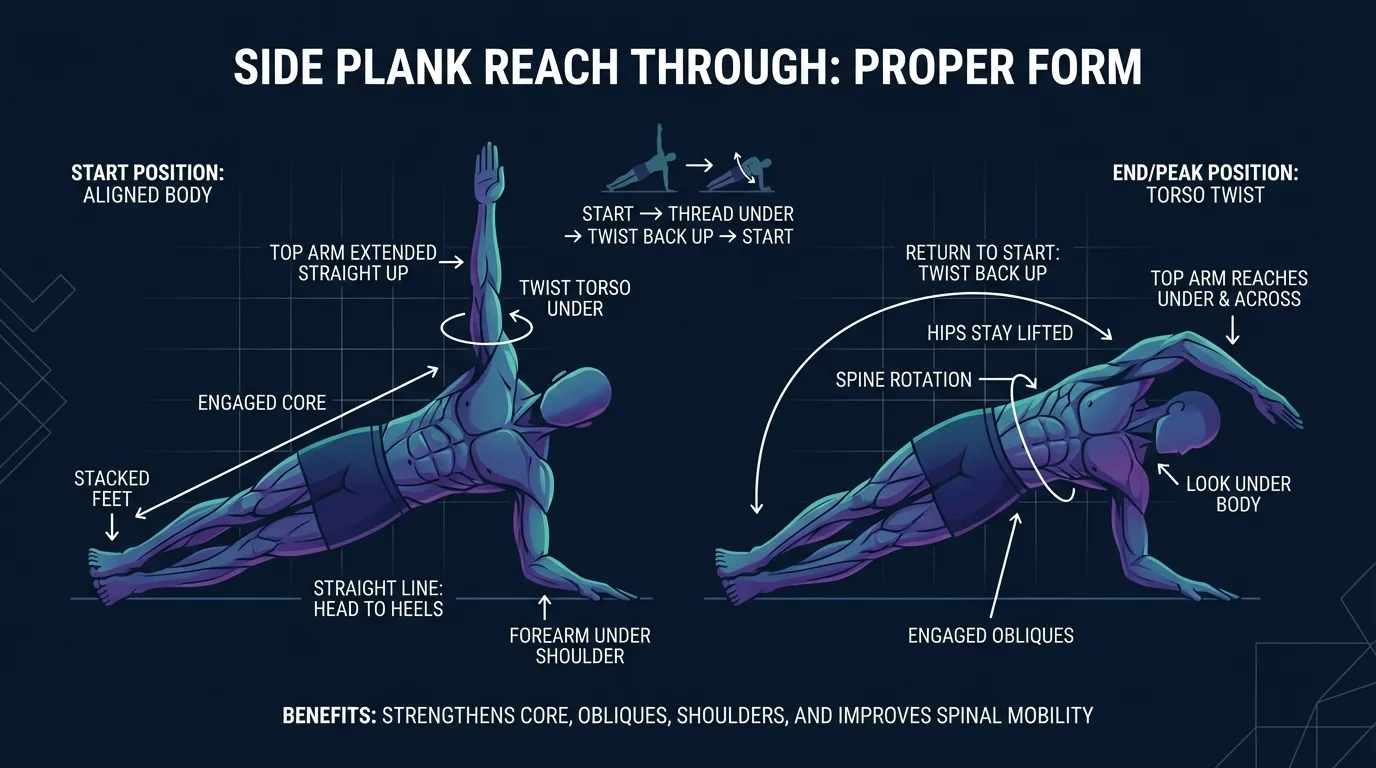
Common Mistakes (and How to Fix Them)
Most errors come from treating the reach through like an arm swing. The arm moves, but the useful training effect comes from the trunk controlling that motion.
- Letting the hips drop. This turns the exercise into a sagging side plank with rotation added. Drive the bottom hip away from the floor before every rep. If it keeps dropping, use the knee-supported version.
- Rotating too fast. Momentum makes the rep easier and less useful. Count two seconds to reach through and two seconds to open back up.
- Reaching from the shoulder only. A small arm sweep misses the thoracic rotation. Turn the rib cage as the arm threads under, while keeping the pelvis controlled.
- Setting the elbow too far from the shoulder. A long or short base can irritate the support shoulder. Reset with the elbow directly under the shoulder before you lift.
- Holding your breath. Breath-holding can spike pressure and make the rep rigid. Exhale as you reach through, inhale as you open, and keep the brace active.
- Chasing extra reps after form breaks. Once the hips sag, the shoulder shrugs, or the twist gets jerky, the set is done. Clean reps are the progression.
Side Plank Reach Through Variations
Use the easiest version that lets you rotate while keeping the hip line steady. Progress only when both sides can stay clean.
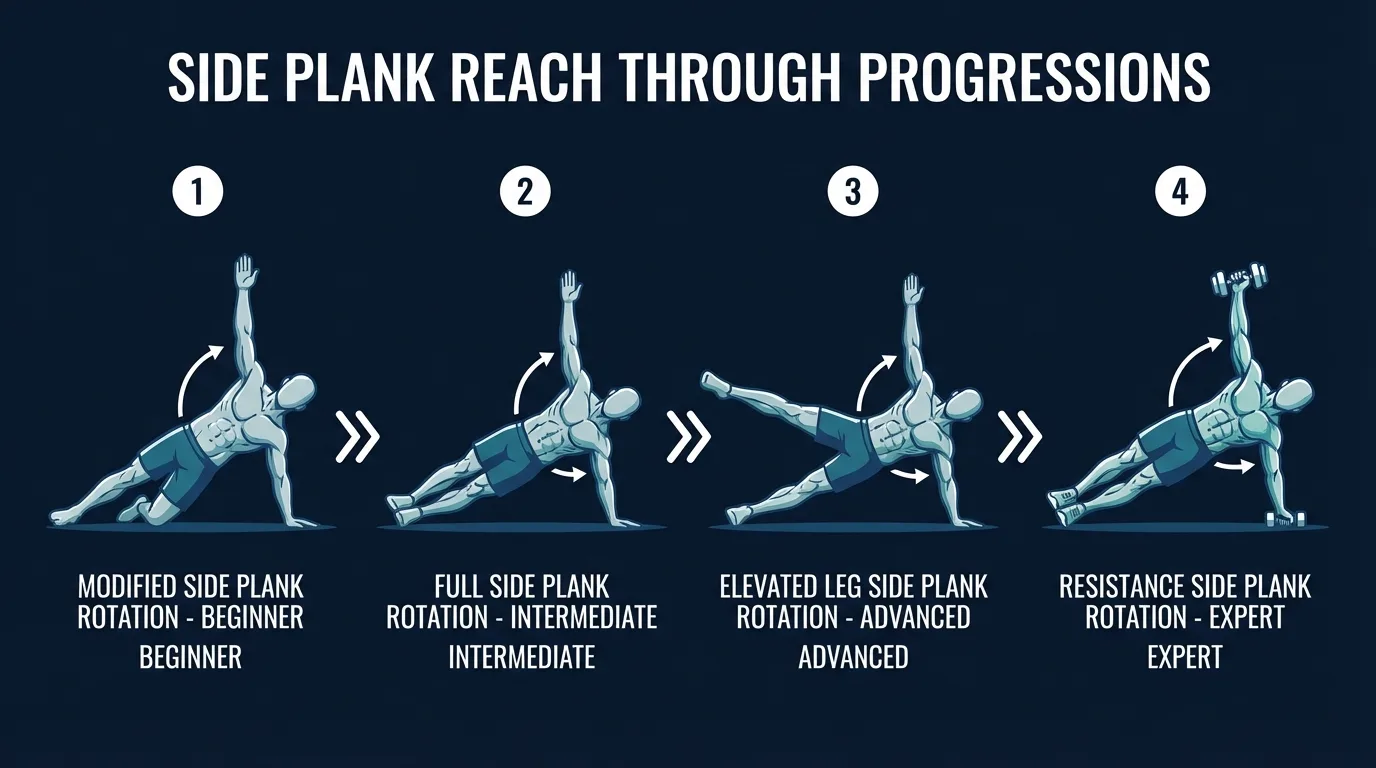
Knee Side Plank Reach Through
Bend the bottom knee to 90 degrees and support yourself from the knee and forearm. This shortens the lever arm so you can practice the reach-through pattern without losing the side plank.
Standard Side Plank
Hold the side plank without rotating. This is the prerequisite. Build toward 30 to 45 seconds per side with steady breathing before adding reach-through reps.
Standard Side Plank Reach Through
Use the full side plank position from the step-by-step section. Rotate slowly, open fully, and stop the set when the support side loses height.
Paused Side Plank Reach Through
Pause for 1 to 2 seconds at the bottom of the reach through. The pause removes momentum and makes the obliques control the hardest position.
Light Loaded Side Plank Reach Through
Hold a very light dumbbell in the top hand. Start lighter than you think. Even 2 to 5 pounds can change the shoulder and rotation demand quickly.
When to Avoid or Modify Side Plank Reach Throughs
Side plank reach throughs are safe for many healthy adults, but the rotation and side-plank load make a few situations worth modifying. Always consult your physician or physical therapist before starting or returning to exercise if pain, surgery, pregnancy, or a medical condition changes your normal training tolerance.
- Acute lower-back pain or known disc pathology. Rotation plus hip sag can irritate symptoms. Use deadbugs, bird-dogs, or short side plank holds until pain settles.
- Shoulder pain on the support side. The forearm base loads the shoulder isometrically. Try a knee-supported side plank, shorten the set, or use forearm planks while symptoms calm down.
- First 6 to 8 weeks postpartum or active diastasis recti. Rotation and bracing can overload the abdominal wall early. Restore breathing, gentle bracing, and foundational patterns first.
- Recent abdominal surgery or hernia. Get medical clearance before braced rotational core work. Start with breathing drills, gentle bracing, and clinician-approved progressions.
- Pregnancy in the second or third trimester. Side-lying positions can be useful, but rotating under load may be poorly tolerated. Use clinician-approved side-lying or upright core work.
- Pelvic-floor dysfunction or pelvic-organ prolapse. Avoid bearing down. Exhale through effort and choose lower-pressure alternatives until a pelvic-floor specialist clears progression.
Related Exercises
- Prerequisite hold: Side Planks teach the lateral brace before rotation.
- Same plane progression: Side Plank Raise trains the obliques through hip elevation instead of rib rotation.
- Anti-extension foundation: Forearm Planks build the front-side brace that supports all plank variations.
- Low-back-friendly core base: Deadbugs and Bird-Dogs train trunk control with less shoulder load.
- Dynamic plank cousin: Plank Twists add rotation from a front plank position.
- Hip support pairing: Glute Bridges strengthen the hip extension that helps keep the pelvis tall.
How to Program Side Plank Reach Throughs
Ratamess et al. (2009), the ACSM Position Stand on resistance-training progression, supports matching volume, rest, and frequency to training status. For side plank reach throughs, use rep-based core programming and let form quality cap the set.
| Level | Sets × Reps | Rest between sets | Frequency |
|---|---|---|---|
| Beginner | 2-3 × 6-8 per side from knees or standard side plank holds first | 45-60s | 2-4 sessions/week |
| Intermediate | 3 × 8-12 per side | 45-60s | 3-5 sessions/week |
| Advanced | 3-4 × 10-15 per side with slow tempo, pauses, or light load | 60s | 4-6 sessions/week |
Where in your workout: place side plank reach throughs near the end of a strength session, in a dedicated core block, or after heavier compound lifts. Avoid using them before exercises like single-leg deadlifts if trunk fatigue would compromise balance and spinal control.
Form floor over rep targets: stop when hips sag, the support shoulder shrugs, the twist becomes fast, or the lower back feels pinchy. The cleanest rep count is the right rep count.
Frequently Asked Questions
What muscles do side plank reach throughs work?
Side plank reach throughs primarily work the internal and external obliques, transverse abdominis, and gluteus medius. The movement also trains the serratus anterior, rhomboids, thoracic rotators, shoulder stabilizers, adductors, and hip abductors as they keep the body lifted during rotation.
How many side plank reach throughs should I do?
Start with 2 to 3 sets of 6 to 8 controlled reps per side. Intermediate exercisers can use 3 sets of 8 to 12 reps per side, and advanced exercisers can use 3 to 4 sets of 10 to 15 reps per side with a pause or light load. Stop the set when your hips sag or your twist turns into a fast arm swing.
Are side plank reach throughs better than regular side planks?
They train a harder skill. A regular side plank builds static anti-lateral-flexion strength. A side plank reach through keeps that lateral brace and adds rotation, so it trains dynamic control through the ribs, pelvis, and shoulder girdle. Keep regular side planks in your program if they still challenge your alignment.
Can beginners do side plank reach throughs?
Most beginners should build up with knee side planks, standard side planks, and short controlled reach throughs from the knee-supported position first. Try the full version after you can hold a standard side plank for about 30 to 45 seconds per side without hip sag or shoulder shrug.
Can I do side plank reach throughs with lower-back pain?
Avoid the full version during acute lower-back pain or known disc irritation. The rotation and lateral brace can feel fine for some people but aggravate others when the hips drop or the ribs twist too far. Use deadbugs, bird-dogs, or short side plank holds instead, and get guidance from a qualified clinician if symptoms persist.