The renegade row is what happens when you stack a single-arm dumbbell row on top of a push-up plank. Each arm gets a row, and the trunk has to fight off rotation the entire time. Done right, it builds back strength, anti-rotation core stiffness, and shoulder stability in a single movement.
Done wrong, it turns into a wobbly torso twist where the hips snake from side to side and the back muscles barely fire. The fix is almost entirely about the plank. If you can hold a stiff plank and execute a clean single-arm dumbbell row separately, the renegade row is just those two things on top of each other. If either one breaks down on its own, the combined movement multiplies the problem.
This guide walks through the form, the most common reasons the plank rotates, the regression that fixes it, and how to program the renegade row at the right point in your training week.
Quick Facts: Renegade Row
- Equipment needed: Pair of hexagonal dumbbells (10-30 lb per hand for most lifters)
- Difficulty: Advanced
- Modality: Strength
- Body region: Full body (back- and core-dominant)
- FitCraft quest category: Strength
Muscles Worked
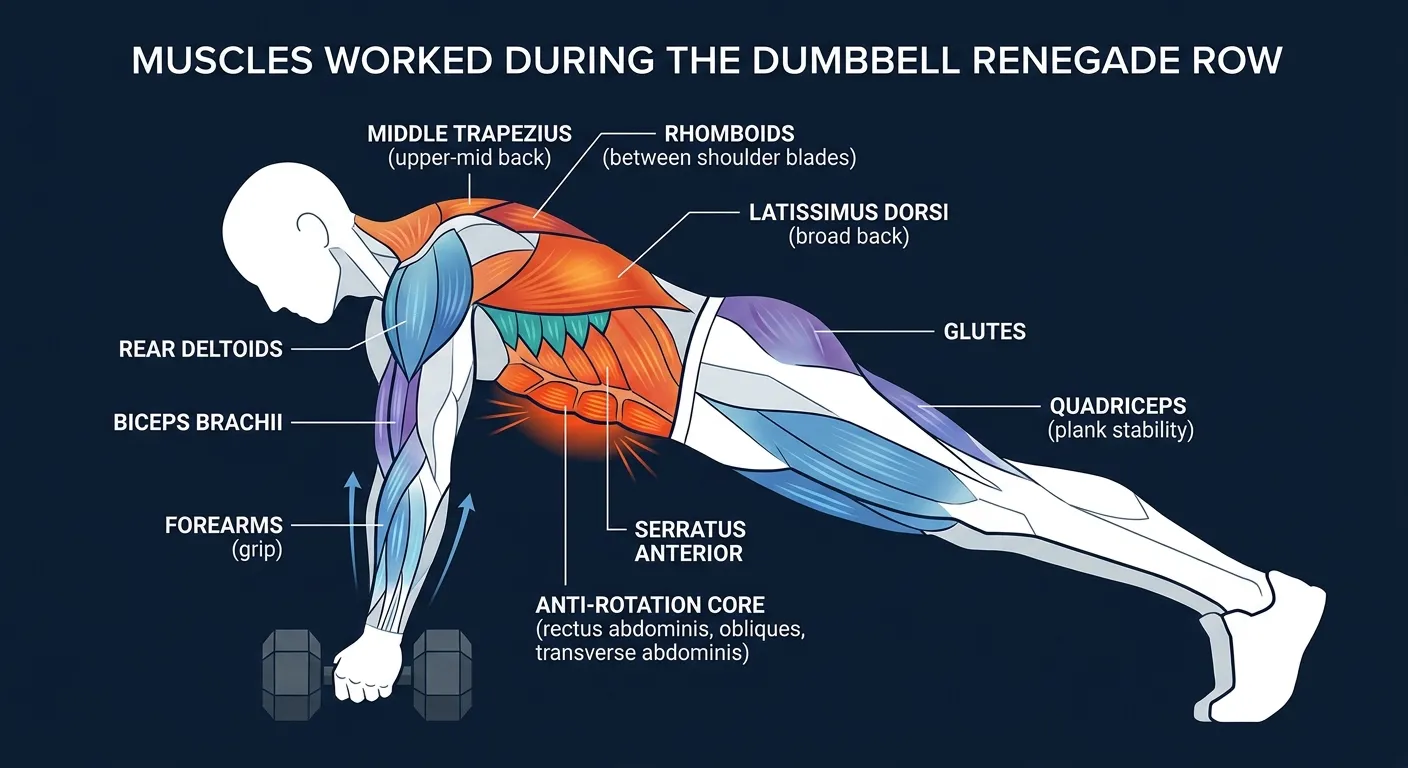
Primary movers: the latissimus dorsi, rhomboids, and middle trapezius on the rowing side. The lats drive shoulder extension as the elbow travels back past the torso. The rhomboids and middle traps retract the scapula at the top of every rep. The rectus abdominis, obliques, and transverse abdominis on both sides work as primary anti-rotation movers, fighting the torque created by lifting load from one side of the body while planted on the other. On most exercises the core gets classified as a stabilizer, but on the renegade row the anti-rotation work is the entire reason the exercise exists, so the core moves into the primary role.
Secondary movers: the rear deltoids assist on shoulder extension and external rotation at the top of the row. The biceps brachii and brachialis flex the elbow. The forearm flexors grip the dumbbell handle. The serratus anterior on the supporting side keeps the scapula protracted and the shoulder stable through the plank.
Stabilizers: the glutes and quadriceps hold the hip and knee position throughout the plank. The erector spinae hold spinal neutral against the rotational torque. The posterior deltoid and rotator cuff on the supporting side stabilize the shoulder under load while the rowing arm is in motion. A clean renegade row is a whole-body exercise even on the static side.
How the renegade row differs from a single-arm row: a single-arm dumbbell row off a bench loads the back through the rowing pattern with the trunk fully supported by the free hand on the bench. The renegade row removes that support and forces the trunk to hold itself square. The biomechanical consequence is that the rowing load is necessarily lighter, because the anti-rotation core is the new limiter. That's the trade: less back load per rep, but a much higher full-body integration demand. Programming the two together (renegade rows for the integration stimulus, single-arm rows off a bench for the heavier back load) covers both bases.
Step-by-Step: How to Perform a Renegade Row
The cues below assume the standard dumbbell version. Use hexagonal dumbbells so they don't roll under load.
Step 1: Set Up the Plank
Place a pair of hexagonal dumbbells on the floor shoulder-width apart. Get into a high push-up plank position with hands gripping the dumbbells directly under your shoulders. Feet wider than hip-width for a stable base. Body in a rigid straight line from head to heels.
Coach Ty's cue: "Feet wider than you think. The wider your base, the easier the anti-rotation. Beginners can start as wide as 3 feet apart."
Step 2: Brace the Core and Lock the Hips
Squeeze your glutes and brace your core hard. Square your hips to the floor. Imagine a glass of water balanced on your lower back that cannot spill. This anti-rotation lock is the entire point of the exercise.
Ty's cue: "Hips square, glutes tight. Lock the trunk before the row starts, not during."
Step 3: Row One Dumbbell to the Rib Cage
Shift your weight slightly toward the supporting arm. Pull the opposite dumbbell up toward your rib cage, driving the elbow back past the torso. Keep your hips level. Do not let the rowing side rotate up toward the ceiling.
Ty's key cue: "Pull the elbow back, not up. If your hips rotate to compensate, the row is too heavy. Drop the weight."
Step 4: Lower with Control and Switch Sides
Lower the dumbbell back to the floor under control over about 1-2 seconds. Reset your plank, re-square the hips, then row with the other arm. Alternate arms each rep.
As Ty coaches it: "The reset between sides is the hardest part. Most people rush it and the plank breaks. Pause for a beat before the next row."
Step 5: Stop the Set When the Plank Breaks
The set ends when your hips start rotating, sagging, or piking. Quality of the anti-rotation plank matters more than the rep count.
Ty's reminder: "If form goes, the set is over. Half a rep with a square plank beats a full rep with a twisted hip every time."
Get this exercise in a personalized workout
FitCraft, our mobile fitness app, uses its AI coach Ty to program compound strength exercises like this into your plan at the right volume and intensity, based on your level, goals, and equipment. Ty was designed and trained by Domenic Angelino, MPH (Brown University) and NSCA-CSCS, with research published in the Journal of Strength and Conditioning Research and Medicine & Science in Sports & Exercise.
Take the Free Assessment Free · 2 minutes · No credit card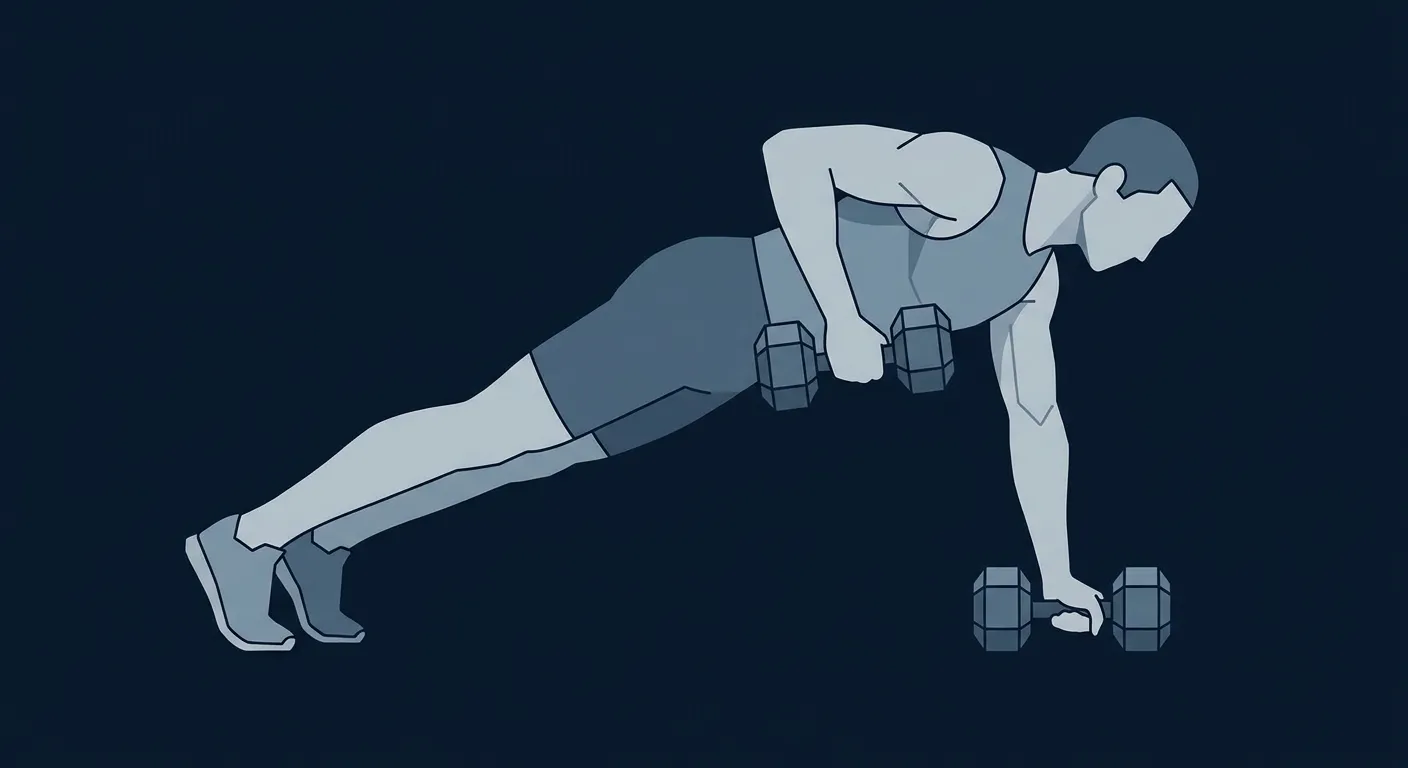
Common Mistakes (and How to Fix Them)
Here are the mistakes Ty corrects most often.
- Hips rotating to the rowing side. When the rowing-side hip lifts toward the ceiling, the anti-rotation work is gone and the lower back takes the load. Fix: widen your foot stance, drop the weight, and pause to re-square the hips before each row.
- Feet too narrow. A narrow base makes anti-rotation almost impossible. Most lifters need their feet wider than shoulder-width, and beginners can go as wide as 3 feet apart. Wider equals easier.
- Sagging hips. Lower back drops when the core disengages. Fix: squeeze glutes and brace abs before every rep, and end the set the moment you feel the sag start.
- Pike hips (butt too high). Hiking your hips turns the plank into a downward-dog and shifts the row away from the lats. Fix: head-to-heel straight line, no exceptions.
- Going too heavy. Renegade rows are limited by anti-rotation core strength, not by row strength. Use about half the dumbbell load you'd use for a single-arm dumbbell row off a bench. If your hips rotate at all, you're too heavy.
- Rolling dumbbells. Round dumbbells will roll under your hand and dump you sideways. Use hexagonal dumbbells so the base stays planted.
Renegade Row Variations: Regressions and Progressions
Start where you are and progress when your form is solid at the current level.
Plank Dumbbell Pull-Through (Beginner Regression)
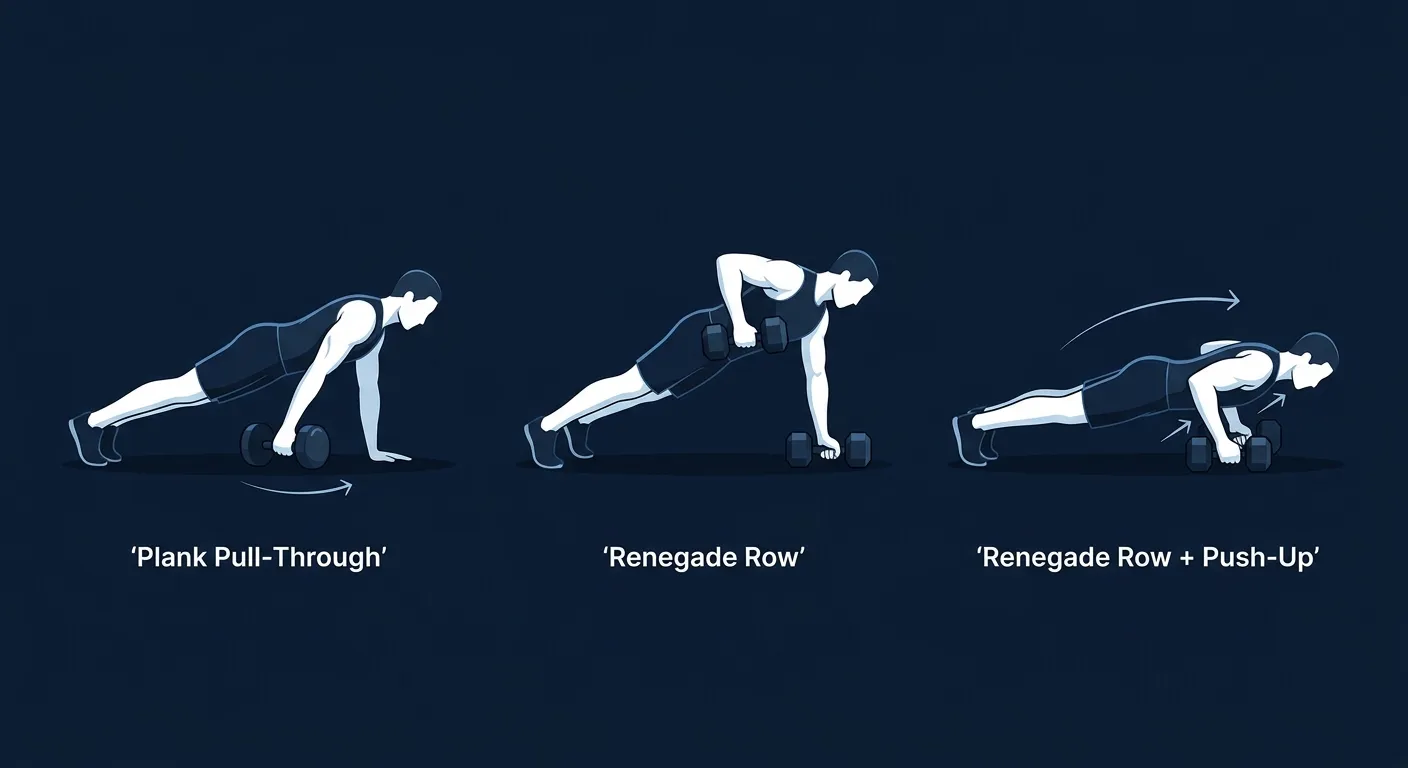
From a wide-stance plank with one dumbbell on the floor outside one hand, reach the opposite hand under the body and slide (don't lift) the dumbbell to the other side. No vertical row at all, just the anti-rotation challenge of moving load across the body. Master this before adding the row. If you can't hold the plank square through the pull-through, you aren't ready for the renegade row.
Renegade Row (Standard)
The standard version described above. Hexagonal dumbbells, push-up plank, alternating single-arm rows with hips locked square. This is the version Coach Ty programs most often once a lifter has the anti-rotation control to hold the plank square through the full set.
Renegade Row with Push-Up (Advanced Progression)
After every two rows (one per side), perform a full push-up on the dumbbells before the next row. Adds upper-body pressing volume and challenges the bottom-of-plank position. Only attempt this when you can do 3 sets of 10 standard renegade rows per side cleanly.
Renegade Row to T-Raise (Mobility-Focused Progression)
After completing the row, rotate the torso open and extend the rowing arm straight up to the ceiling, ending in a side plank. Adds a thoracic-spine rotation challenge to the anti-rotation work. Drop the load (use very light dumbbells) and emphasize shoulder and t-spine mobility.
When to Avoid or Modify Renegade Rows
The dumbbell renegade row is a multi-joint compound movement with external load that loads the wrists in a planted plank position and demands serious anti-rotation core control. It's safe and effective for healthy intermediate-to-advanced lifters, but a few conditions call for modification or a different exercise. None of these are permanent restrictions. They're starting points. Always consult your physician or physical therapist for personalized guidance.
- Acute wrist pain, carpal tunnel, or recent wrist injury. Even though the dumbbell handle keeps the wrist more neutral than a flat-palm plank, gripping under bodyweight load still aggravates inflamed wrist tissue. Swap to a supported row or bent-over row until the wrist recovers. If pain persists for more than a week or two, see a physical therapist or occupational therapist.
- Acute lower-back pain or known disc pathology. The anti-rotation demand is heavy on the spinal erectors and obliques, and any rotation through the trunk under load is risky for irritated discs. Drop to the plank dumbbell pull-through or skip rowing variations entirely until cleared. Rebuild bracing with deadbugs, bird-dogs, and forearm planks first.
- Recent shoulder, wrist, or elbow surgery. Get clearance from your surgeon. The plank-on-dumbbells position loads three joints simultaneously on the supporting side. Most post-surgical protocols delay this pattern until later in the return-to-training timeline.
- Uncontrolled hypertension or known cardiovascular disease. The braced plank position spikes intrathoracic pressure during heavy rows. Use lighter loads, avoid breath-holding through reps, and follow your cardiologist's guidance.
- First 6-8 weeks postpartum or active diastasis recti. The anti-rotation demand is exactly the deep-core challenge that can widen abdominal separation if the core isn't ready. Restore deep-core function with deadbugs and bird-dogs first. Return through the plank dumbbell pull-through before the standard renegade row.
- Inability to hold a stable plank for 30 seconds. If you can't hold a clean forearm or hand plank for 30 seconds, the renegade row is too advanced. Build the plank foundation first with forearm planks and hand planks.
Related Exercises
If renegade rows are part of your routine, these movements complement or extend the same training pattern:
- Same muscle group (pull): Bent-Over Rows, Supported Row, and Reverse Row load the same horizontal pull pattern with the trunk fully supported, allowing heavier back loads than the renegade row's anti-rotation constraint permits.
- Same movement integration (plank + press): Push-Ups and Hand Planks share the supporting-side plank pattern of the renegade row, and they're the prerequisites for the renegade row with push-up progression.
- Anti-rotation core foundation: Deadbugs, Bird-Dogs, and Side Planks isolate the anti-rotation pattern the renegade row demands.
- Rotational counterpoint: Russian Twists and Standing Twists train the obliques through controlled rotation, complementing the renegade row's anti-rotation focus.
- Pulling-pattern accessory: Hammer Curls and Band Pull-Apart support the smaller assisting muscles the renegade row hits.
- Hinge complement: Romanian Deadlift trains the posterior chain through the hip-hinge pattern that the renegade row's plank position doesn't load, balancing the back program.
How to Program Renegade Rows
Renegade row programming follows the same evidence-based ranges as any compound back exercise, but with the volume capped lower because anti-rotation core fatigue tends to break form before back fatigue does. The American College of Sports Medicine (ACSM) Position Stand on resistance training recommends roughly 8-12 reps per set for strength and hypertrophy, with at least 48 hours between sessions training the same muscle group (Ratamess et al., 2009).
| Level | Sets × Reps | Rest between sets | Frequency |
|---|---|---|---|
| Beginner (plank pull-through regression) | 2-3 × 6-8 per side | 90-120 seconds | 2 sessions/week |
| Intermediate (standard renegade row, light dumbbells) | 3 × 8-10 per side | 120-180 seconds | 2-3 sessions/week |
| Advanced (renegade row with push-up, heavier dumbbells) | 3-4 × 6-10 per side | 120-180 seconds | 2-3 sessions/week |
Where in your workout: Renegade rows belong in the middle of a pulling or full-body session, after you've trained the heavier compound back work (like the bent-over row or supported row) but before isolation accessories. Doing them first costs you core stiffness for the rest of the session. Doing them last means the anti-rotation core is already fatigued and form breaks down. Mid-session is the sweet spot. Pair pulls with pushes for balanced upper-body development.
Form floor over rep targets: if your hips rotate or sag on the last 2 reps of a set, stop the set there. The renegade row's value comes from the anti-rotation lock, not from the row volume. A set of 6 clean reps per side beats a set of 10 with twisted hips every time.
How FitCraft Programs This Exercise
Knowing how to do a renegade row is step one. Knowing when to do it, which variation, how much load, and when to progress is where most people get stuck.
FitCraft's AI coach Ty handles that. During your personalized diagnostic assessment, Ty maps your fitness level, goals, available equipment, and core stability. Then Ty builds a personalized program that slots the renegade row into a balanced training plan at the right variation for your level: pull-through, standard, or push-up combo based on your anti-rotation control.
As you get stronger, Ty adjusts the variation and load to match. Pull-through becomes standard. Standard progresses to the push-up combo. Load and volume adjust based on your recovery and consistency. Every program is designed by an Ivy League-trained exercise scientist and NSCA-certified strength coach using evidence-based periodization, then adapted to you by the AI.
Frequently Asked Questions
Can I do renegade rows if I have wrist pain?
Renegade rows are gentler on the wrists than regular push-up planks because gripping a dumbbell handle keeps the wrist neutral instead of at 90 degrees of extension. Use hexagonal dumbbells so they don't roll under load. If you still have wrist pain, swap to a chest-supported row or supported row until the wrist recovers. If the pain persists for more than a week or two, see a physical therapist or occupational therapist.
How many renegade rows should a beginner do?
Start with 3 sets of 6-8 reps per side using light dumbbells (10-15 lb). Quality of the plank matters more than the rep count. If your hips start rotating, end the set. Build up to 10-12 reps per side before adding weight.
What muscles does the renegade row work?
Renegade rows target the latissimus dorsi, rhomboids, and middle trapezius (the rowing pattern) plus the entire anti-rotation core (rectus abdominis, obliques, transverse abdominis) holding the plank square. Secondary muscles include the rear deltoids, biceps, forearms, glutes, and quadriceps. It's one of the most complete full-body strength exercises in any dumbbell program.
Why do my hips keep rotating during renegade rows?
Two reasons. First, your feet are too close together. Widen your stance to shoulder-width or beyond for a bigger base. Second, the weight is too heavy for your anti-rotation core to control. Drop the dumbbells by half. If the hips still rotate, regress to a plank dumbbell pull-through (sliding the dumbbell across the floor under the body) until your core catches up.
How heavy should I go on renegade rows?
Use about half the dumbbell weight you'd use for a single-arm dumbbell row off a bench. Renegade rows are limited by anti-rotation core strength, not by row strength. Most beginners stay at 10-15 lb per hand for a long time. Intermediate lifters typically use 20-30 lb per hand. If your hips rotate at all, the weight is too heavy regardless of how strong your back is.