You own a pair of dumbbells, but your back gets a few rushed rows at the end of the session. When you look up back exercises with dumbbells, you find lists of 15 or 20 moves with no word on what each one does. So you guess, the plan changes every week, the sessions slip, and you blame yourself.
These 10 dumbbell back exercises each have a job, backed by EMG studies, which measure how hard a muscle works, or by what the muscle is built to do. A 30-minute dumbbell back workout follows the list. If you have no dumbbells yet, start with our back workout at home.
10 Dumbbell Back Exercises and What Each One Trains
The first five are rows, the next two cover what rows miss, and the last three are hinges for your lower back and upper traps.
| # | Exercise | What it trains most | Sets x reps |
|---|---|---|---|
| 1 | One-arm dumbbell row | Lats, middle traps, rhomboids | 3 x 8-12 per side |
| 2 | Bent-over dumbbell row | Lats, middle traps, rear delts, with the lower back holding the hinge | 3 x 8-12 |
| 3 | Reverse-grip dumbbell row | Lats, biceps | 3 x 8-12 |
| 4 | Dumbbell Pendlay row | Lats, middle traps, rear delts | 3 x 6-10 |
| 5 | Renegade row | Abs, obliques, lats | 3 x 6-8 per side |
| 6 | Dumbbell pullover | Chest and lats | 2-3 x 10-12 |
| 7 | Rear delt raise | Rear delts, middle traps, rhomboids | 2-3 x 12-15 |
| 8 | Dumbbell Romanian deadlift | Hamstrings, glutes, lower back | 3 x 8-12 |
| 9 | Dumbbell deadlift | Glutes, hamstrings, lower back, grip | 3 x 8-10 |
| 10 | Deadlift to shrug | Upper traps, lower back, glutes | 3 x 8-10 |
1. One-arm dumbbell row
Put one hand and the same-side knee on a bench or sturdy chair, then drive your elbow back past your body toward your hip. The support holds your torso, so your back can pull hard before your lower back tires. The FitCraft app calls this the supported row, and it's the best row to learn first.
2. Bent-over dumbbell row
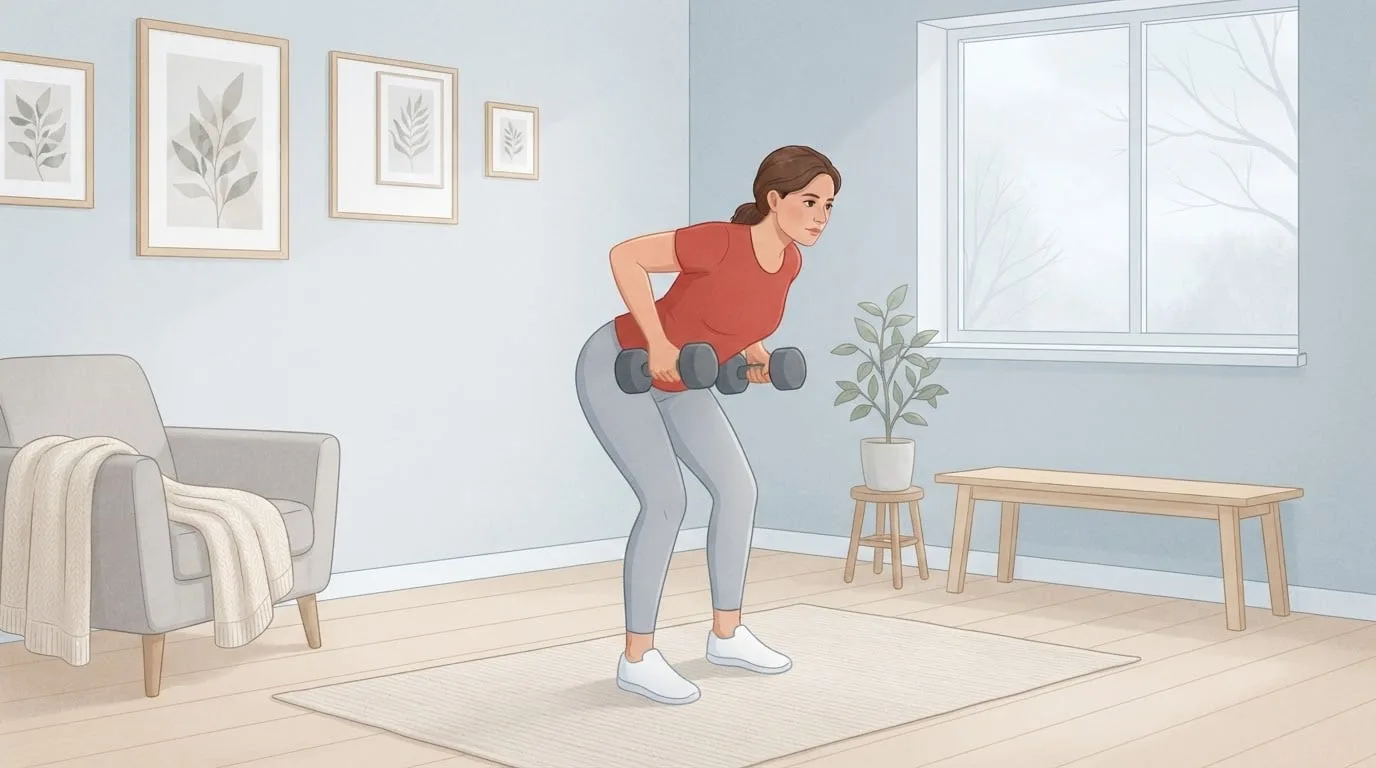
Hold a dumbbell in each hand, hinge at the hips with a flat back, and row your elbows back until they're level with your back. The bent-over row trains nearly your whole back at once, but your lower back holds the hinge for the entire set.
3. Reverse-grip dumbbell row
Set up like a bent-over row, turn your palms forward, and pull your elbows back along your sides. The reverse row keeps your elbows close, but your biceps may share more of the load. In a pulldown study by Lehman and colleagues (2004), an underhand grip cut the ratio of lat to biceps activity by about a third.
4. Dumbbell Pendlay row
Start with the dumbbells on the floor and your torso about level with it, pull smoothly to your lower ribs, then set the dumbbells down to a full stop. The Pendlay row lets you reset your flat back between reps, which helps if your form fades late in a set.
5. Renegade row
From a push-up plank with your hands on two dumbbells that won't roll, row one dumbbell to your ribs with your hips level. The renegade row is as much a core exercise as a back exercise, because your abs and obliques have to stop you from twisting.
6. Dumbbell pullover
Lie on the floor with one dumbbell held in both hands above your chest and your elbows slightly bent. Lower it in an arc behind your head, then pull it back. Go light on the dumbbell pullover, which trains your chest as well as your lats.
7. Rear delt raise
Hinge until your chest is close to parallel with the floor, then raise your arms out to shoulder height so your body makes a T. The rear delt raise needs very little weight, and the FitCraft app teaches it with none, so add light dumbbells only when that feels easy.
8. Dumbbell Romanian deadlift
Stand with the dumbbells in front of your thighs and push your hips back until you feel a firm stretch behind your thighs, then drive your hips forward. In the Romanian deadlift, the muscles along your spine work by holding your back flat.
9. Dumbbell deadlift
Hold a dumbbell at each side, hinge down only as far as your back stays flat, and stand with your hips and shoulders rising together. The dumbbell deadlift is the easiest loaded hinge to learn, and it trains your grip too.
10. Deadlift to shrug
Do a deadlift, stand all the way up, then shrug straight up toward your ears with no rolling. The deadlift to shrug is the only move on this list that trains your upper traps directly, so add it once the plain deadlift feels solid.
Find out what's really holding you back
FitCraft, our mobile fitness app, pairs you with an AI coach who builds you a personalized plan around your goals, schedule, and fitness level. Every FitCraft program is designed by Domenic Angelino, MPH (Brown University) and NSCA-CSCS, with research published in the Journal of Strength and Conditioning Research and Medicine & Science in Sports & Exercise.
Take the Free Assessment Free • 2 minutes • No credit cardWhich Part of the Back Each Exercise Hits
Your back is several muscles with different jobs, and dumbbells let you shift the work between them by changing where your elbows go.
| Back muscle | Its job | Best dumbbell exercises |
|---|---|---|
| Lats | Pull your upper arm down and back toward your ribs | One-arm row, reverse-grip row |
| Middle traps and rhomboids | Draw your shoulder blades together | Bent-over row or Pendlay row with your elbows out |
| Rear delts | Pull your arm out and back | Rear delt raise |
| Upper traps | Lift your shoulder blades toward your ears | Deadlift to shrug |
| Erector spinae | Hold your spine straight while your hips hinge | Romanian deadlift, dumbbell deadlift |
Few EMG studies test dumbbell rows directly, so most of this evidence comes from cable and barbell work, where your shoulder moves the same way. EMG shows how hard a muscle works, not how much it grows, so use it to choose exercises rather than to rank them.
Lats: keep your elbows close
Padovan and colleagues (2026) recorded 14 resistance-trained men on a seated row, and a narrow grip produced more lat activity than a wide grip. de Abreu Vasconcelos and colleagues (2023) tested 21 men and women with their upper arms at different angles from the body. Lat activity and peak force rose as the upper arm came closer to the ribs. So keep your elbow near your side on a one-arm row. One barbell study in a 2026 review by Di Fonza and colleagues found the reverse on a bent-over row, so treat this as a lean, not a rule.
Traps and rear delts: let your elbows go wide
The same two studies found the opposite pattern here. The wide grip raised upper and middle trap activity, and upper arms held 60 to 90 degrees from the body raised the traps and rear delts. So run one row with your elbows out in every workout. For the rear delts alone, try keeping your palms facing each other. On a reverse-fly machine, Schoenfeld and colleagues (2013) found slightly more rear delt activity in 19 trained men with that grip than with palms down.
One arm or two: what changes
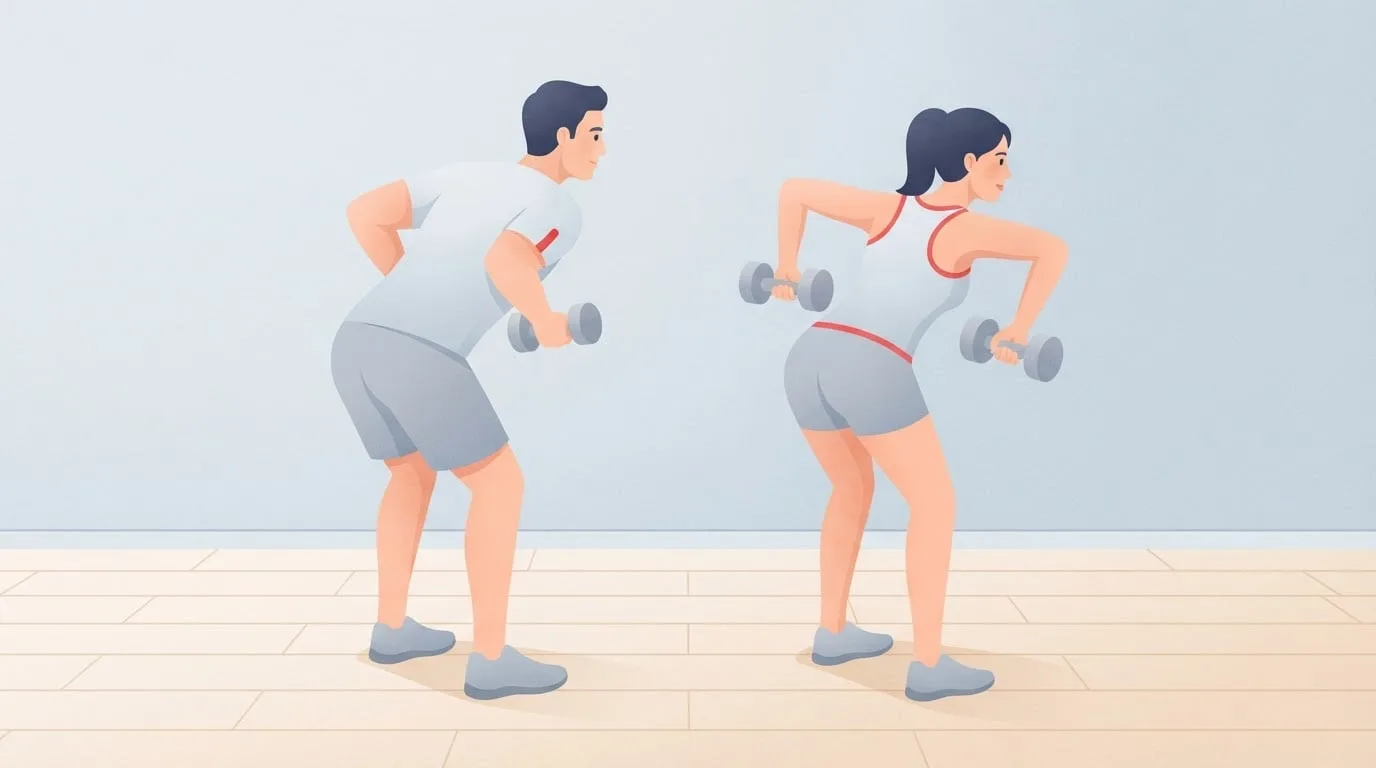
Saeterbakken and colleagues (2015) compared one-arm and two-arm rows in 15 resistance-trained men. Two-arm rows generally produced more activity in the muscles along your spine, and one-arm rows produced more activity in the external oblique, the outer muscle at the side of your waist.
The pullover: more chest than lats
Marchetti and Uchida (2011) recorded 8 men doing barbell pullovers and found the pectoralis major more active than the lats, and the Di Fonza review concluded that the pullover isn't a first-choice lat exercise. Keep it as a second lat move if it feels good on your shoulders, but don't let it replace a row.
The 30-Minute Dumbbell Back Workout
This dumbbell back workout uses one row for your lats, one for your upper back, one hinge and two moves for what rows miss. It takes about 30 minutes, including the warm-up.
| Order | Exercise | Sets x reps | Rest |
|---|---|---|---|
| Warm-up | Marching, arm circles and 1 light set of rows | 5 min | None |
| 1 | One-arm dumbbell row, elbow close | 3 x 8-12 per side | 60 sec |
| 2 | Dumbbell Romanian deadlift | 3 x 8-12 | 90 sec |
| 3 | Bent-over dumbbell row, elbows out | 3 x 10-12 | 60 sec |
| 4 | Dumbbell pullover | 2 x 10-12 | 60 sec |
| 5 | Rear delt raise | 2 x 12-15 | 45 sec |
Stop each set with 2 or 3 good reps left. That's 13 sets, and two sessions a week give your lats and upper back about 16 sets each. The 2026 ACSM position stand by Currier and colleagues linked muscle growth to 10 or more sets a week and found that equipment type didn't consistently change results. Our back workout at home guide explains why two sessions beat one, and the pull day workout adds biceps work if you train on a split.
Back Exercises With Dumbbells at Home: Making One Pair Work
All 10 exercises work with one pair of dumbbells, a sturdy chair and some floor. For the one-arm row, push the chair against a wall so it can't slide. One pair is rarely right for every exercise, though, because your hinges want more weight and your raises want far less. These fixes close the gap:
| Exercise | If the dumbbells feel light | If they feel heavy |
|---|---|---|
| One-arm row | Lower over 3 seconds and pause at the top | Use a higher support |
| Bent-over row | Alternate arms and pause each rep at the top | Switch to the one-arm row |
| Romanian deadlift | Switch to the single leg deadlift | Shorten the range |
| Rear delt raise | Hold for 2 seconds at the top | Put the dumbbells down and use no weight |
Light dumbbells build muscle only up to a point, as our full body dumbbell workout explains, so make the exercise harder before you buy more weight. If you'd rather have the sessions planned for you, a dumbbell workout app can take that part off your plate. FitCraft's strength workouts use dumbbells and bodyweight, your AI coach demonstrates each exercise on an interactive 3D model, your workouts adjust as you progress, and streaks and leaderboards help you keep showing up.
Lower Back Exercises With Dumbbells
The best lower back exercises with dumbbells are hinges: the Romanian deadlift and the plain deadlift. In a 2020 systematic review of 19 deadlift EMG studies, Martín-Fuentes and colleagues found the erector spinae more active than the glutes and the biceps femoris, one of the hamstrings.
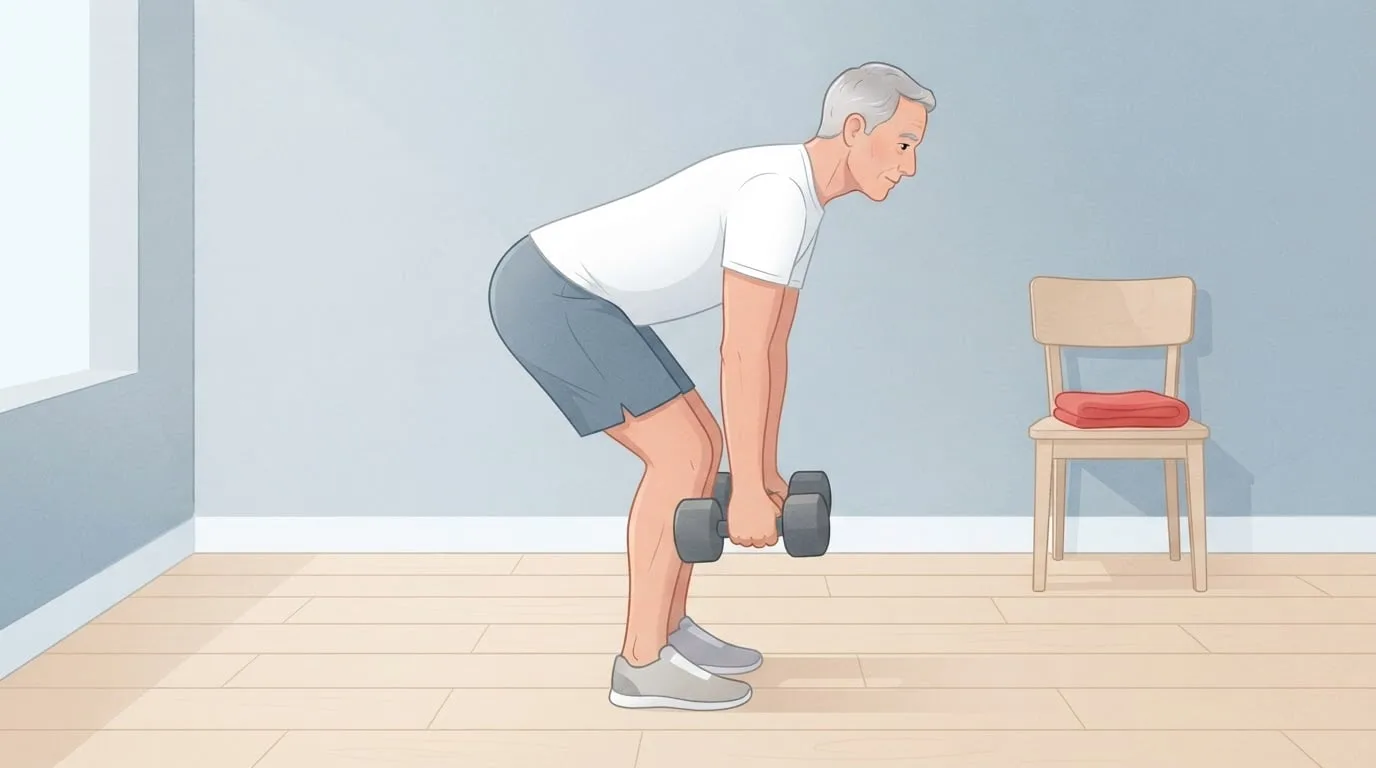
Rows load your lower back too: Fenwick and colleagues (2009) found the largest lumbar spine load of three rows in the standing bent-over row. Do your hinge early in the session, start light, and end the set when your back can't stay flat. If your lower back already hurts, read our guide to the best exercises for lower back pain first.
Dumbbell Back Exercise Form Errors
Most bad sets come from a dumbbell that's too heavy for the job. Check for these four errors first.
- Pulling with your arm. Drive your elbow back and let your hand follow. Snyder and Leech (2009) coached 8 women with little lifting experience to use their lats on a pulldown, and lat activity rose while biceps activity didn't change.
- Pinching your shoulder blades hard. The Lehman team had 12 men row with and without a hard pinch, and it made no significant difference to middle trap and rhomboid activity.
- Heaving the weight up. If your chest rises on every rep, your hips are lifting the dumbbell, so go lighter.
- Rounding your lower back to reach lower. End each hinge where your back stays flat, even if that's above your knees.
The Bottom Line
Dumbbell back exercises work best when each one has a job: elbows close for your lats, elbows out for your traps and rear delts, and hinges for your lower back. Two 30-minute sessions a week cover all of it.
Working out consistently is hard, but it doesn't have to be. As Tim put it, "I didn't think an app could replace my trainer. My AI coach proved me wrong." Pick your next two training days, put them on your calendar, and start with the one-arm row.
Frequently Asked Questions
What are the 3 best dumbbell back exercises?
The one-arm dumbbell row, the dumbbell Romanian deadlift and the rear delt raise are the best three. Together they train your lats and middle traps, the muscles along your spine, and your rear delts. Do 3 sets of each, twice a week.
Can you build a big back with only dumbbells?
Yes. The 2026 ACSM position stand found that equipment type didn't consistently change results, while 10 or more sets a week improved muscle growth. Dumbbells run out of weight sooner than a barbell, so keep progressing with one-arm rows, slower lowering and extra reps.
How do you do dumbbell back exercises without a bench?
Use a sturdy chair pushed against a wall for the one-arm row, with one hand and the same-side knee on the seat. The other exercises on this page are done standing or on the floor, so none of them needs a bench.
What are the best dumbbell back exercises for beginners?
Start with the dumbbell deadlift, the one-arm row with your hand on a chair and the rear delt raise with no weight. Add the bent-over row once you can hold a flat back for a full set.
What is a good dumbbell back workout for women?
The 30-minute workout on this page works for women and men, because the muscles and the exercises are the same. Choose dumbbells that leave 2 or 3 good reps at the end of each set.