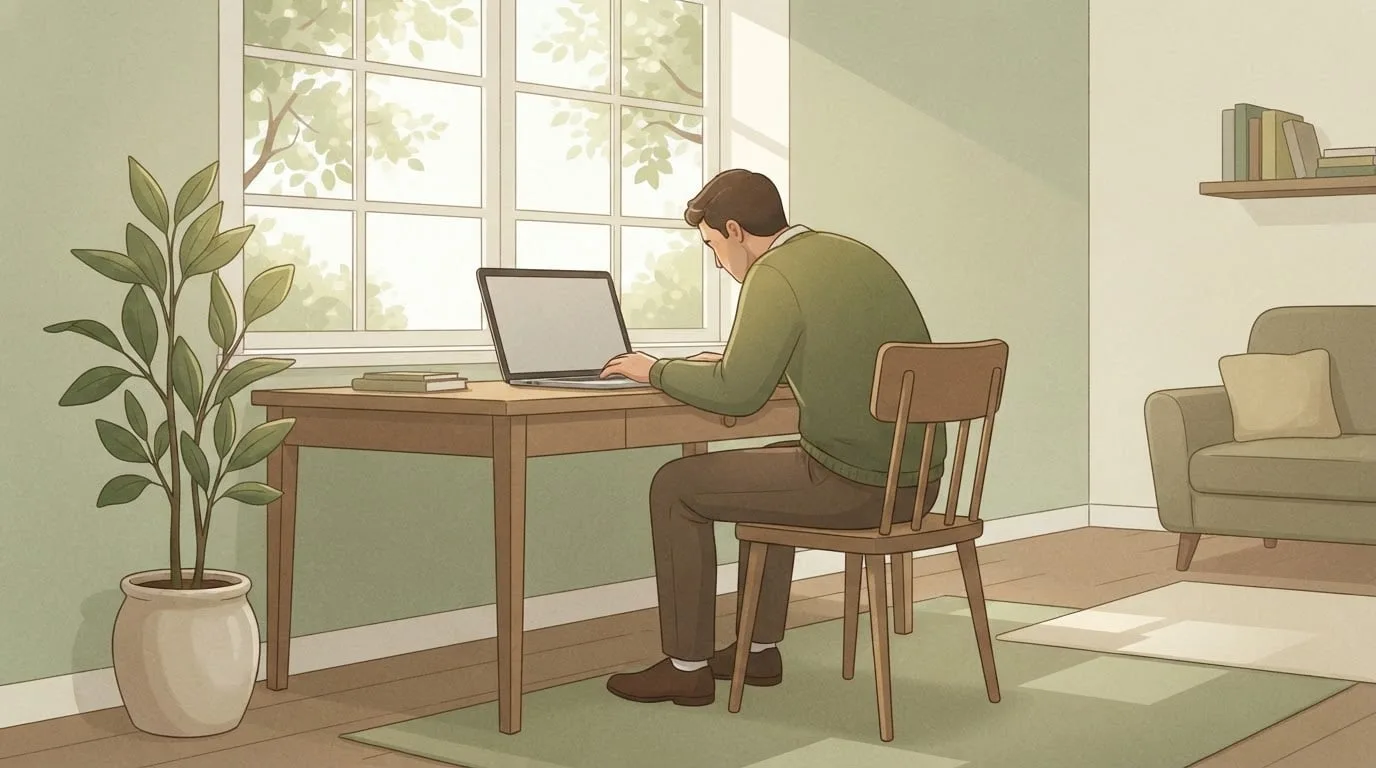
You catch yourself in a window reflection or a video call: shoulders rounded, head pushed forward, curled around the screen like a question mark. You sit up straight, hold it for a minute, and the next time you notice, you're slumped again.
It's easy to read that as a character flaw. Bad posture gets talked about as laziness, and every reminder to "sit up straight" lands as a small telling-off. Poor posture after a long day isn't a moral failing, though. Your body is doing the sensible thing in the environment you've given it.
That's good news, because environments and habits can be changed. This guide explains why you slouch, how to set up your desk, screen and phone, how to build a cue-based posture habit, a short daily routine, what the evidence says about slouched posture and pain, and how long it takes to fix.
Why Do I Slouch So Much?
Four things push most people into a slouch, and none of them is a lack of discipline.
Slouching takes less effort
Sitting upright is active work. O'Sullivan and colleagues (2002) recorded muscle activity in 20 healthy adults and found that three trunk muscles, the internal oblique, the lumbar multifidus and the thoracic erector spinae, were significantly less active in slump sitting than in upright sitting. Slumping lets the ligaments and discs take more of the load so the muscles can rest. When you're tired or concentrating, your body chooses the cheaper option.
Screens pull your head down and forward
Where your eyes go, your head follows, and your upper back follows your head. A laptop on a desk or a phone in your lap puts the screen well below eye level for hours. Caneiro and colleagues (2010) found the chain also runs from the bottom up. When 20 adults slumped through the lower and mid back, their heads moved further forward and the muscles at the back of the neck worked harder than in upright sitting. That's why fixing slouching usually starts with the base of the spine and the height of the screen, not with the neck.
You sit more than ever
Long sitting gives slouching more time to settle in. Using national survey data, Yang and colleagues (2019) found that total daily sitting time for US adults rose from about 5.5 hours in 2007 to 6.4 hours in 2016. Over a similar period, the share of adults using a computer for at least an hour a day outside work or school rose from 29% to 50%. Any position held for hours starts to feel uncomfortable, and the one you sink into when you stop paying attention is usually a slump.
Tiredness and mood show up in your posture
Posture and mood seem to run in both directions. Wilkes and colleagues (2017) studied 61 people with mild to moderate depressive symptoms and found that at the start they were all significantly more slumped than normal reference data. When half of them were taped into an upright posture for a stressful speech task, they reported more positive feelings and less fatigue than the group who sat as usual. A slump after a long, draining day is partly your energy and mood showing on the outside.
Does Slouching Actually Cause Pain?
Probably much less than you've been told. Our guide to exercises for posture walks through the main reviews: an umbrella review of 41 systematic reviews found no consensus that spinal posture causes low back pain, and 1,108 teenagers sorted into four sitting postures showed no difference in neck pain between them. Even experts don't agree on one correct way to sit. When Korakakis and colleagues (2019) asked 544 physiotherapists to pick the best sitting posture from seven drawings, their choices split across three different upright postures, and they used the same reasons to defend different answers. In a 2019 viewpoint titled "Sit Up Straight": Time to Re-evaluate, Slater and colleagues pointed out that a large posture-correction industry has grown up without strong evidence that sitting or standing "incorrectly" causes spinal pain.
That doesn't make slouching pointless to fix. It just changes the reasons:
- Breathing. Lin and colleagues (2006) tested 70 adults in four positions and found that slumped sitting significantly reduced lung capacity and how fast they could breathe out, compared with sitting back in the chair with support.
- Mood under stress. In a randomized study of 74 adults, Nair and colleagues (2015) taped people into a slumped or upright seated posture before a stressful speech. The upright group reported higher self-esteem, better mood and less fear. These were short lab studies, so treat them as a nudge rather than a treatment.
- Comfort and range. Any single position gets uncomfortable after a while, and moving between positions keeps your back and neck from stiffening into one.
- How you feel about it. If you don't like how slouching looks or feels, that's a good enough reason to change it.
So aim for a better-supported default and plenty of movement, rather than a perfect upright line held all day.
How to Stop Slouching While Sitting: Set Up Your Desk
Fix the setup before you try to fix yourself. If the screen is low and the chair doesn't support you, you'll slump again the moment you stop concentrating. OSHA's computer workstation guidance gives specific numbers:
| Part of the setup | What to aim for |
|---|---|
| Screen height | Top line of the screen at or slightly below eye level, with the center about 15 to 20 degrees below your eyes |
| Screen distance | About 20 to 40 inches (50 to 100 cm) from your eyes, directly in front of you |
| Elbows | Close to your body and bent between 90 and 120 degrees, with the keyboard near elbow height |
| Thighs and knees | Thighs roughly parallel to the floor, knees at about hip height |
| Feet | Flat on the floor, or on a footrest if the desk can't come down |
| Back | Fully supported by the backrest, with lumbar support, sitting upright or leaning back slightly |
The popular 90-90-90 rule, with hips, knees and elbows each at about 90 degrees, is a fine starting point, but you don't need to hit those angles exactly. OSHA's own range for the elbows runs up to 120 degrees, and leaning back a little against a good backrest is allowed. The backrest matters more than people think. In the Lin study, perching in the middle of the seat and slumping against the backrest reduced lung capacity, while sitting all the way back with support for the pelvis and lower back gave better breathing numbers and kept the natural curve of the lower back.
Three changes cover most home and office setups:
- Raise the laptop. A laptop forces a choice between a screen that's too low and a keyboard that's too high. Put it on a stand or a stack of books with the top of the screen near eye level, and add a separate keyboard and mouse.
- Slide your hips all the way back. Sit so your lower back touches the backrest. A small cushion or rolled towel behind your lower back helps if the chair has no lumbar support.
- Lower your shoulders with the desk. If the desk is too high for relaxed elbows, raise the chair and add a footrest, so your shoulders aren't hitched up all day.

Phone Height: Raise the Screen Instead of Dropping Your Head
Phones are the other screen that pulls you into a slouch, and you probably hold yours in your lap or at your waist. A widely quoted 2014 estimate by the spine surgeon Kenneth Hansraj modeled the load on the neck rising from about 10 to 12 pounds with the head upright to about 27 pounds at a 15-degree forward tilt and about 60 pounds at 60 degrees. That's a computer model, not a measurement. And when Damasceno and colleagues (2018) assessed 150 young adults while they texted, they found no link between neck posture and neck pain. So "text neck" isn't a proven injury. It's still hours of your day spent in one curled position, and it's the easiest one to change:
- Bring the phone to chest height or higher, with your elbows resting against your ribs or on a table so your arms don't tire.
- Prop it up for anything long, such as a video, a recipe or a call, instead of holding it in your lap.
- Look down with your eyes more than your neck when you do glance at it low.
- Use voice input or a computer for long messages and emails.
- Lie on your back or sit supported for long reading sessions on the couch, rather than curling forward over the screen.
Break Up Sitting Every 30 Minutes
The best posture is a changing one, so the most useful anti-slouch habit is getting up regularly. The Cochrane review of workplace interventions by Shrestha and colleagues (2018) pooled 34 studies with 3,397 workers. Its findings on what actually reduces sitting:
- Sit-stand desks cut sitting at work by about 100 minutes a day over the first three months, and by about 57 minutes a day at 3 to 12 months.
- Short, frequent breaks of 1 to 2 minutes every half hour cut sitting by about 40 minutes a day, compared with two 15-minute breaks, in one study.
- Computer prompts combined with information cut sitting by about 55 minutes a day at medium-term follow-up in one study.
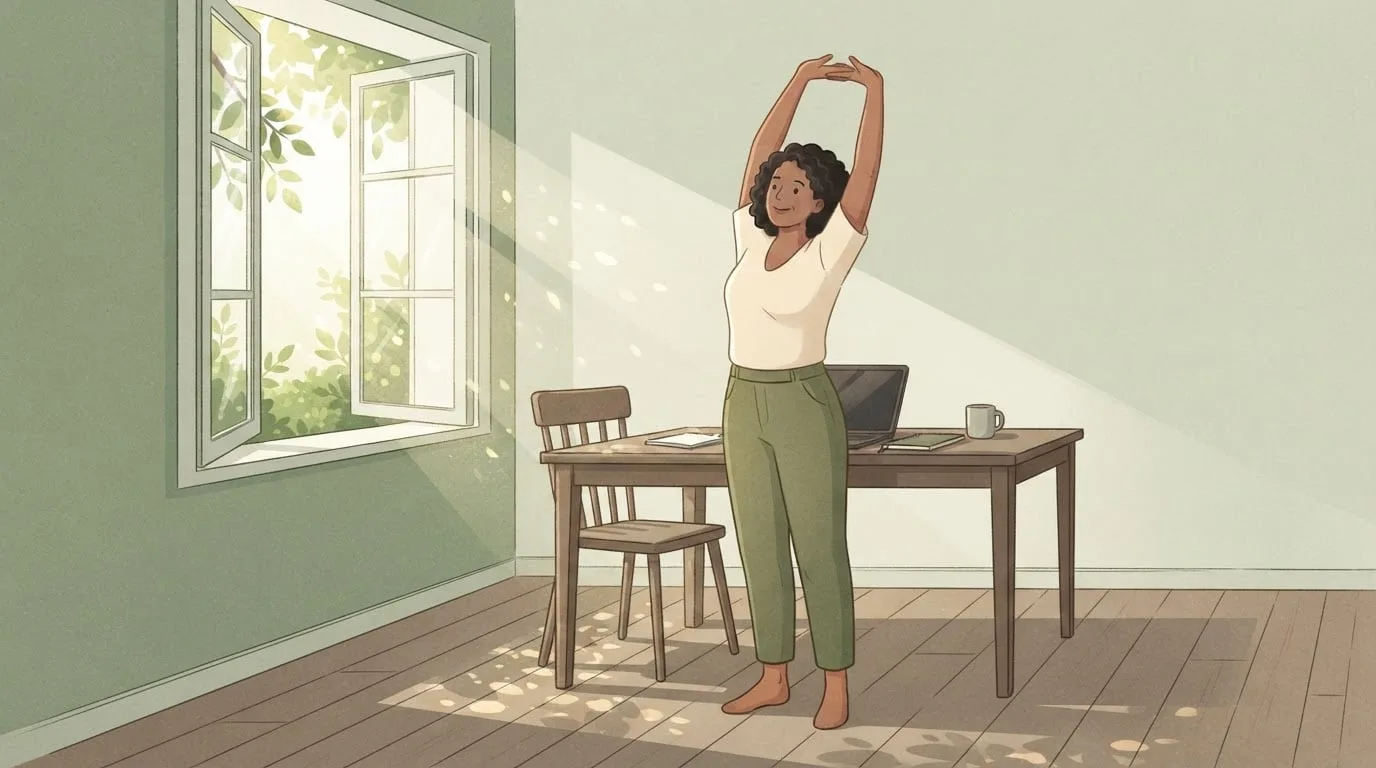
The reviewers rated most of this evidence as low quality, but it all points the same way: small, frequent breaks are easier to keep than big ones. Set a 30-minute timer. When it goes off, stand up, walk to refill your water, roll your shoulders and reach both arms overhead. These short exercise snacks take a minute or two. A standing desk helps as a way to switch positions, not as a place to stand all day, which our posture guide covers too.
Find out what's really holding you back
FitCraft, our mobile fitness app, pairs you with an AI coach who builds you a personalized plan around your goals, schedule, and fitness level. Every FitCraft program is designed by Domenic Angelino, MPH (Brown University) and NSCA-CSCS, with research published in the Journal of Strength and Conditioning Research and Medicine & Science in Sports & Exercise.
Take the Free Assessment Free • 2 minutes • No credit cardHow to Train Yourself to Stand Up Straight: Build a Posture Cue
Reminding yourself to sit up straight all day doesn't work, because you can't think about posture and your work at the same time. A habit works better, because it runs without attention once it's formed. Habits form by repeating a behavior after the same cue. In Lally and colleagues (2010), 96 adults practicing a new daily habit took a median of 66 days to reach peak automaticity, with a range of 18 to 254 days. Our review of how long it takes to form a habit covers the newer studies.
The cue matters less than repeating it. Keller and colleagues (2021) randomized 192 adults to tie a new habit either to a daily routine or to a set time. Both worked about equally well, and the strongest predictor of the habit forming was carrying out the plan again and again after the cue. Writing the plan as an if-then sentence helps too: a meta-analysis of 94 tests by Gollwitzer and Sheeran (2006) found these "implementation intentions" had a medium-to-large effect on people reaching their goals.
Here's how to build one for posture:
- Pick a five-second reset. Slide your hips back, let your ribs stack over your pelvis, breathe out and let your shoulders drop, and bring your eyes level. Don't brace or lift your chest high. Just reset.
- Attach it to something you already do many times a day, such as sending an email, joining a video call, unlocking your phone or sitting back down after a break. This is called habit stacking.
- Write the if-then plan: "When I hit send, I slide back and drop my shoulders."
- Add a 30-minute timer for the first few weeks as a backup cue, and use it for your movement break as well.
- Reset and then let go. You don't have to hold the position. Drifting is normal, and the reset is the habit.
Is there a posture corrector that actually works?
Strap-on braces hold you in place while you wear them and do nothing for the muscles once they come off, which our rounded shoulders guide explains in more detail. Wearable sensors that vibrate when you slouch work differently, as a cue rather than a support. Kuo and colleagues (2021) had 21 young adults type for an hour with and without one. With the sensor on, they bent their necks less and rounded their upper backs less. That was one hour in a lab with no long-term follow-up and no pain outcome. A device like that does the same job as your 30-minute timer.
A Short Daily Routine to Stop Slouching
Put the pieces together and the whole thing takes a few minutes spread across the day, plus a short strength session a few times a week.
| When | What to do | Time |
|---|---|---|
| Before you sit down to work | Check the screen height, slide your hips back in the chair and get your feet flat | 30 seconds |
| At each cue (email sent, call joined) | The five-second reset: hips back, breathe out, shoulders drop, eyes level | 5 seconds |
| Every 30 minutes | Stand up, walk, roll your shoulders and reach overhead | 1 to 2 minutes |
| Whenever you pick up your phone | Bring it to chest height with your elbows supported | None |
| 3 to 5 days a week | The strength block below | 10 minutes |
If fitting in the strength sessions is the hard part, our roundup of the best workout apps for busy professionals compares how fast each one gets you into a short session and what happens when you miss a day. FitCraft is one of them: its yoga, mobility and strength workouts are led by a 3D AI coach who demonstrates each move and says your name, and streaks give a daily routine like this one a visible chain to protect. As one user, Matt, put it: "The real win is I actually want to work out now. That's never happened before."
Exercises That Make Sitting Up Easier
Strength makes a better default position easier to hold, and the evidence and full routines are already on this site. Our guide to exercises for posture has a 10-minute routine of chin tucks, wall slides, band pull-aparts, prone Y raises, a thoracic extension and a hip flexor stretch, with the trial data behind it. Our guide on how to fix rounded shoulders turns the upper-back half into a 4-week plan with dosing. If you notice one shoulder sitting higher than the other while you check your posture, our guide on how to fix uneven shoulders covers the one-sided causes and training. And for the rest of the body a desk job deconditions, see our list of the best exercises for desk workers.
How Long Does It Take to Fix Bad Posture?
There are two clocks running, and the habit clock is usually the slower one to feel.
- The habit: expect about two months of daily practice before the reset happens without thinking, based on the 66-day median in the Lally study and the 59-day median in the Keller trial. Some people get there in weeks, and some take longer.
- The strength: the posture trials summarized in our exercises for posture guide measured changes after 8 to 12 weeks of regular training, and you'll usually feel more upright within the first two or three weeks.
- A spine that has stiffened over decades: changes more slowly. In a six-month supervised program for adults over 60 (Katzman and colleagues, 2017), the upper-back curve improved by about 3 degrees compared with a control group, which is real and modest.
So can poor posture be fixed after years of slouching? For most people, yes. Bad posture usually isn't permanent, because most of it is habit and strength rather than bone. If your back stays rounded even when you try to stand tall, if it's getting worse, or if it comes with pain, numbness or a visible curve, get it checked.
The Bottom Line
To stop slouching, start with your environment: raise the screen to eye level, sit all the way back with your feet flat, and bring your phone up instead of your head down. Then get up for a minute or two every half hour, tie a five-second posture reset to something you already do, and add a short upper-back strength routine a few times a week.
Don't chase a perfect, rigid posture held all day. The evidence doesn't support one correct way to sit, and the link between slouching and pain is weaker than the posture industry suggests. Aim for a better default and more movement, give the habit about two months, and the slouch stops being where you end up every afternoon.
Frequently Asked Questions
What is the 90-90-90 rule for sitting?
The 90-90-90 rule says to sit with your hips, knees and elbows each bent at about 90 degrees, with your feet flat on the floor. It's a useful starting point for setting chair and desk height. OSHA's workstation guidance is a little looser: elbows bent anywhere from 90 to 120 degrees, thighs roughly parallel to the floor, and the back supported whether you sit upright or lean back slightly.
How do you stop your shoulders from slouching forward?
Raise your screen so the top sits at about eye level, keep your elbows close to your body, and strengthen the muscles between your shoulder blades with rows, band pull-aparts and prone Y raises two or three times a week. A daily doorway chest stretch helps the front of the shoulder feel more open. Shoulders that roll forward are a strength and setup problem more than a willpower one.
Is there a posture corrector that actually works?
No brace has evidence that it fixes posture once you take it off. Wearable sensors that vibrate when you slouch have short-term evidence: in a lab study of 21 young adults typing for an hour, wearing one reduced neck bending and upper-back rounding. Nobody has shown lasting change, so treat any device as a reminder, the same job a free 30-minute timer does.
Can I correct years of bad posture?
Yes, for most people. The habit side usually takes about two months of daily practice to feel automatic, and the strength side takes 8 to 12 weeks of training to show up in posture measurements. Spines that have stiffened over decades change more slowly: a six-month supervised program in adults over 60 improved their upper-back curve by about 3 degrees, which is real but modest.
Is bad posture permanent?
Usually not. Most slouching is a habit and a strength gap, and both change with practice and training. A small number of people have a structural cause, such as a sideways curve of the spine or an upper-back curve that has stiffened with age, and those change little with exercise. If your posture looks fixed even when you try to stand tall, or it's getting worse, see a doctor or physical therapist.
Why is my posture so bad?
Mostly because slouching is the easiest way to sit and modern life gives you hours to practice it. In lab studies, slumped sitting turns down trunk muscles that upright sitting uses, and US adults were sitting about 6.4 hours a day by 2016. A low screen, a chair that doesn't fit and tiredness add to it. That makes it a setup and habit problem you can change.