- The best single exercise for desk workers is the standing hip flexor lunge stretch. Sitting shortens the hip flexors more than any other tissue, and that shortening is what drags the pelvis forward and loads the low back. Glute bridges and calf raises take second and third.
- Frequency beats duration. Five minutes of light movement every 30 minutes was the only break pattern that significantly blunted post-meal glucose in a 2023 dose-response trial (Duran et al., Medicine and Science in Sports and Exercise).
- Two minutes a day of resistance work cut neck and shoulder pain meaningfully over 10 weeks in office workers (Andersen et al., 2011, Pain). The floor is very low.
- Ten of the twelve moves below need no mat, no equipment, and no change of clothes. Use the hourly table further down.
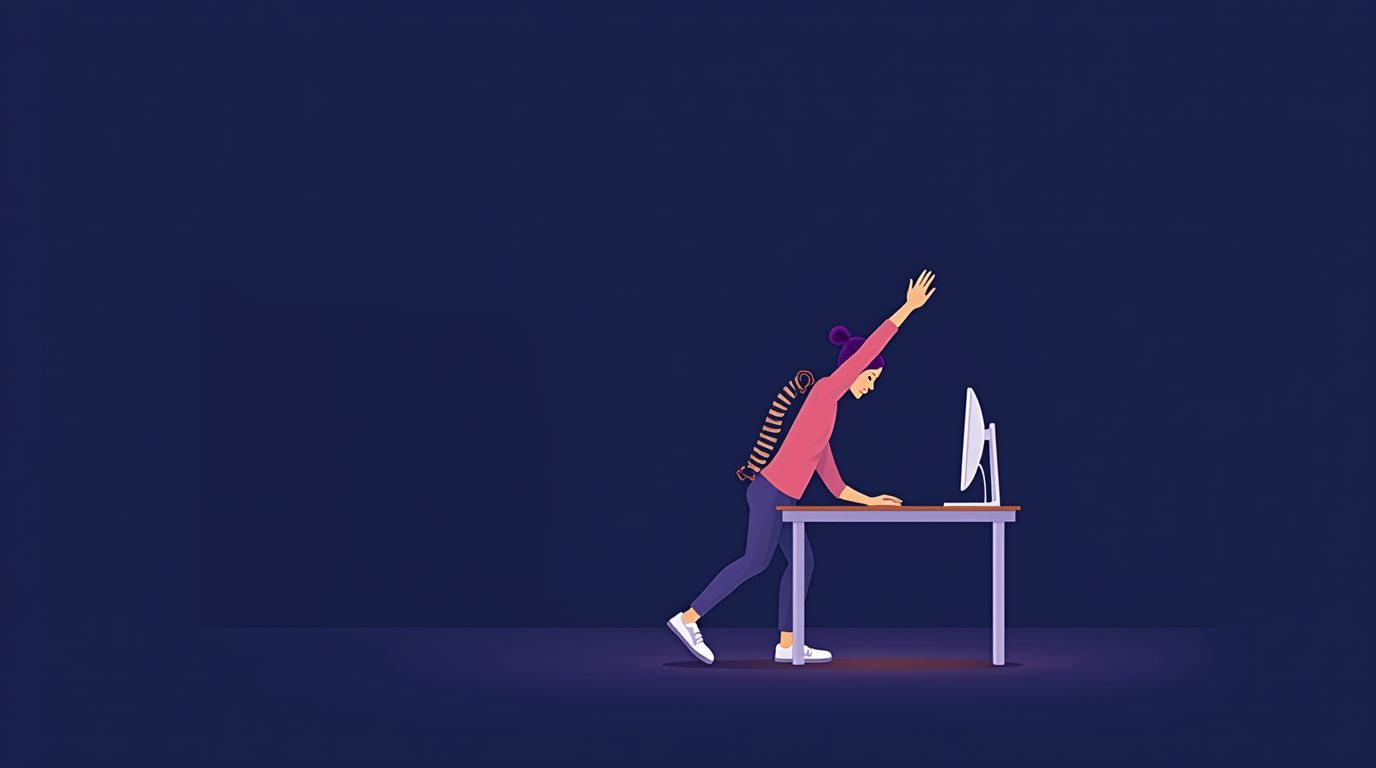
Nobody sits down at 9am planning to spend eight hours folded into the same shape. It happens one meeting at a time, and by 4pm the hips feel welded and the shoulders have crept toward the monitor. Better posture won't fix that. Interrupting the position often enough that nothing settles into it will, especially if the moves you pick undo what the chair actually does. That's how this list is ordered: biggest problem sitting causes, solved first.
Quick Comparison
| Move | Sitting problem it solves | Time | Where |
|---|---|---|---|
| 1. Standing hip flexor lunge stretch | Shortened hip flexors, forward pelvic tilt | 60 sec | Standing, office clothes |
| 2. Glute bridges | Glutes that stop firing after hours of compression | 60 sec | Floor |
| 3. Calf raises | Pooled blood in the legs, flat post-meal glucose clearance | 45 sec | Standing or seated |
| 4. Bird dogs | Low-back endurance lost to chair support | 90 sec | Floor |
| 5. Deadbugs | Deep core that holds the ribcage over the pelvis | 90 sec | Floor |
| 6. Cat-cow | Spine stuck in one fixed curve all day | 45 sec | Floor |
| 7. Quadruped thread the needle | Lost mid-back rotation from facing one screen | 60 sec | Floor |
| 8. Rear delt raises | Rounded shoulders, weak upper back | 60 sec | Standing, light weights |
| 9. Wall sits | Legs that do nothing between the car and the chair | 45 sec | Any wall |
| 10. Shoulder rolls | Upper traps locked in a shrug | 20 sec | Seated |
| 11. Full wrist stretch out | Forearms held in one typing position | 30 sec | Seated |
| 12. Forearm planks | Trunk endurance that carries into long sitting bouts | 60 sec | Floor |
What should a desk worker do every hour?
Most desk-exercise articles hand you a pile of stretches and no schedule, so nothing gets done. Here's the protocol.
Every hour, on the hour, pick a tier. The 2-minute tier runs without leaving your desk area, in work clothes, between calls. The 5-minute tier adds floor work and walking for when you have a real gap. Two tiers exist because the failure mode isn't laziness. It's an all-or-nothing rule that collapses the first time a meeting runs long.
The hourly desk protocol
Set a repeating alarm. When it fires, run the 2-minute version, or the 5-minute version if you have the gap. The focus rotates each hour so nothing gets neglected and nothing gets boring.
| Hour | 2-minute version | 5-minute version (2-min block plus this) |
|---|---|---|
| 9:00 (hips) | 30-sec hip flexor lunge stretch each side, 20 calf raises | 10 glute bridges, 60-sec walk |
| 10:00 (spine) | 10 shoulder rolls back, 30-sec wrist stretch out | 8 cat-cows, 5 thread the needle each side |
| 11:00 (legs) | 45-sec wall sit, 20 calf raises | 10 bodyweight squats, 90-sec walk |
| 12:00 (post-lunch) | 25 calf raises, standing tall for one call | 5-min walk outside, ideally within 30 min of eating |
| 13:00 (hips) | 30-sec hip flexor lunge stretch each side | 10 glute bridges, 6 bird dogs each side |
| 14:00 (upper back) | 15 rear delt raises with anything light, 10 shoulder rolls | 6 thread the needle each side, 30-sec forearm plank |
| 15:00 (core) | 45-sec wall sit, 10 shoulder rolls | 8 deadbugs each side, 45-sec forearm plank |
| 16:00 (reset) | 30-sec hip flexor lunge stretch each side, 20 calf raises | 8 cat-cows, 90-sec walk |
The frequency isn't arbitrary. Duran and colleagues (2023) ran a randomised crossover trial in Medicine and Science in Sports and Exercise comparing four break doses across 8-hour sitting days: 1 minute every 30, 5 minutes every 30, 1 minute every 60, and 5 minutes every 60. Only the 5-minutes-every-30 dose significantly blunted the glucose curve. Every dose lowered systolic blood pressure by roughly 4 to 5 mmHg. Cheap breaks buy you something. Frequent ones buy you more.
Knowing what to do is the easy part.
FitCraft, our mobile fitness app, pairs you with an AI coach who builds you a personalized plan around your goals, schedule, and fitness level. Every FitCraft program is designed by Domenic Angelino, MPH (Brown University) and NSCA-CSCS, with research published in the Journal of Strength and Conditioning Research and Medicine & Science in Sports & Exercise.
Take the Free Assessment Free • 2 minutes • No credit card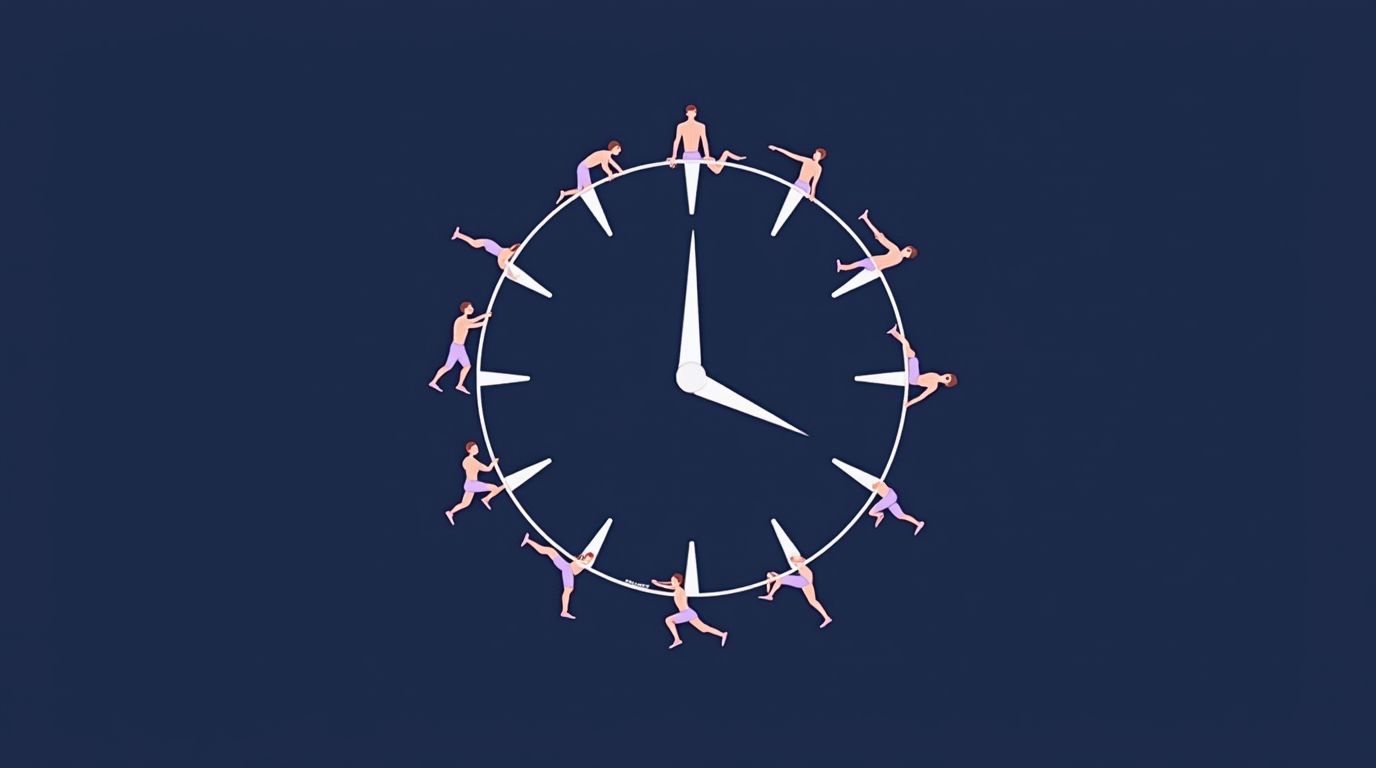
The 12 Best Exercises for Desk Workers, Ranked
1. Standing hip flexor lunge stretch: best for the thing sitting damages most
Rationale: hip flexors spend the workday held short, and short hip flexors tilt the pelvis forward. That tilt is what turns "I sit a lot" into a nagging low back. Step one foot back into a shallow rear lunge, tuck the pelvis under, stand tall. Hold 30 seconds each side.
Honest limitation: stretching gives you a temporary window. Without the glute work below, the hips are back where they started by the next meeting.
2. Glute bridges: best for waking up muscles the chair switches off
Rationale: you sit on your glutes all day and they respond by contributing less. Glute bridges restore the hip extension a shortened front side has been stealing, which takes load off the low back when you stand. Ten slow reps, two-second squeeze at the top.
Honest limitation: needs floor space, so it's a home move unless your office has a spare room.
3. Calf raises: best for circulation without leaving your chair
Rationale: the calves pump blood back up out of your legs, and they're idle the whole time you sit. Calf raises recruit the soleus, the muscle behind Hamilton and colleagues (2022) in iScience, which reported a 52% smaller post-meal glucose excursion during sustained soleus contraction. Full breakdown in our soleus pushup research piece.
Honest limitation: that protocol ran for hours, not 20 reps. Treat calf raises as circulation and a habit anchor, not a glucose intervention.
4. Bird dogs: best for low-back endurance
Rationale: a chair back does the postural work your spinal stabilisers should be doing, and they get lazy. Bird dogs train them to hold a neutral spine while the limbs move, which is the demand of carrying groceries or reaching across a desk. Six per side, slow.
Honest limitation: easy to do badly. If your hips rotate as the leg lifts, you're training the compensation.
5. Deadbugs: best for the deep core that stops the slump
Rationale: slumping is partly a strength problem. Deadbugs teach the deep abdominal wall to keep the ribcage stacked over the pelvis while the limbs move independently. Eight per side with the low back pressed flat.
Honest limitation: the moment your back arches off the floor the exercise stops working, and most people never notice.
6. Cat-cow: best 45-second spine reset
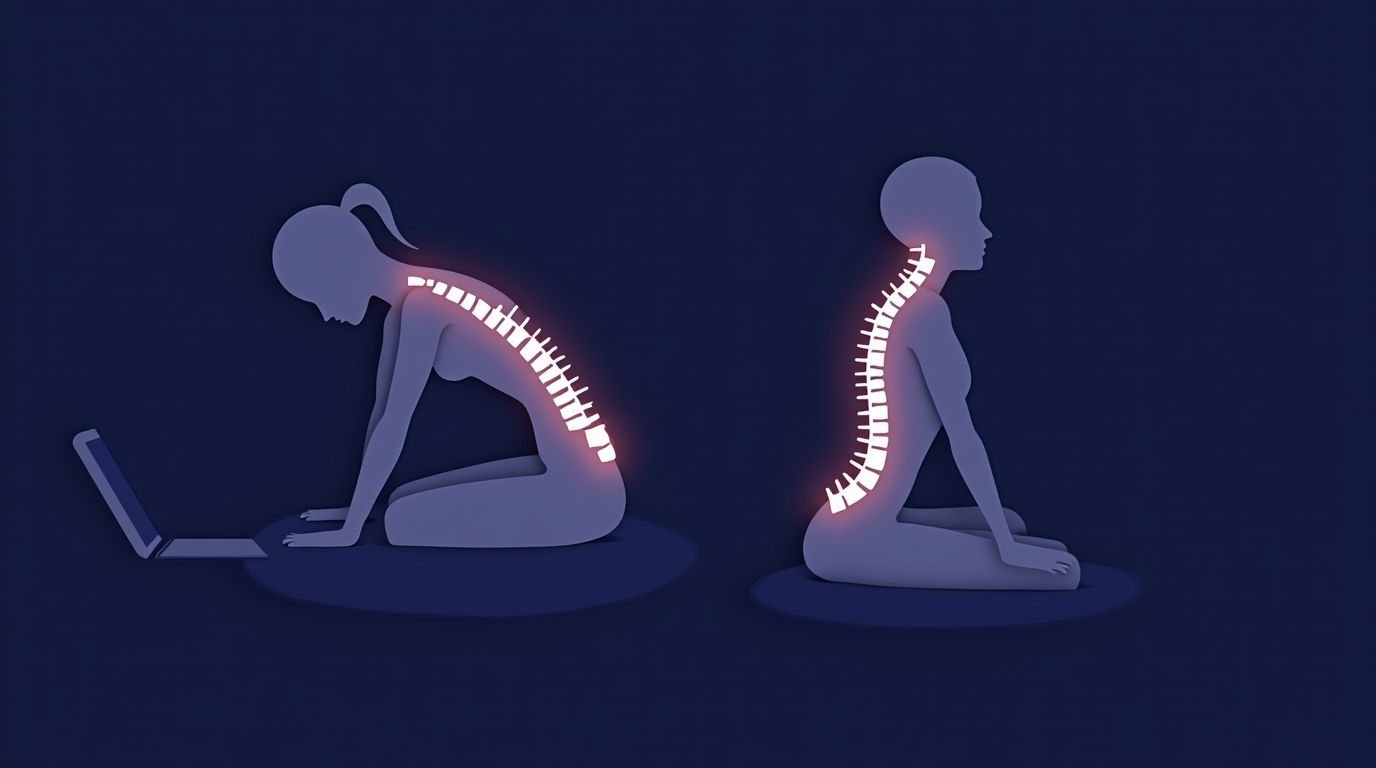
Rationale: your spine holds one shape for hours. Cat-cow moves every segment through flexion and extension, which restores a spine that bends everywhere instead of hinging at one sore spot. Eight slow cycles on the breath.
Honest limitation: mobility, not strength. Feels great, changes nothing structural on its own.
7. Quadruped thread the needle: best for the rotation a single monitor steals
Rationale: mid-back rotation is the first quality to go when you face one direction for years, and losing it pushes the shoulder and low back into covering. Thread the needle restores thoracic rotation directly. Five per side.
Honest limitation: floor move, and the range fades within hours unless you repeat it.
8. Rear delt raises: best for rounded shoulders
Rationale: reaching forward for a keyboard leaves the upper back long and weak. Rear delt raises strengthen what pulls the shoulder blades back. This is the closest move here to what actually worked in office trials: Chen et al. (2018) in Physical Therapy pooled nine trials and found workplace strengthening reduced neck pain in symptomatic office workers, with bigger effects when the exercise targeted the neck and shoulder region specifically.
Honest limitation: needs resistance. Water bottles work briefly, but the pooled effects came from progressive loading over 10 weeks or more.
9. Wall sits: best leg work you can do in a hallway
Rationale: quads and glutes do almost nothing between the car seat and the office chair. A wall sit is an isometric needing no equipment, space, or coordination, and the same family shows up throughout blood pressure research. Hold 45 seconds.
Honest limitation: isometric strength is angle-specific, so wall sits won't do much for how you move through a full squat.
10. Shoulder rolls: best 20-second micro-break
Rationale: the upper traps hold a low-grade shrug for hours, which is the tension people call "carrying stress in my shoulders". Ten slow shoulder rolls backward reset the position.
Honest limitation: the relief is short. A symptom manager, not a fix, which is why it ranks below rear delt raises.
11. Full wrist stretch out: best for hands that type all day
Rationale: the forearms hold one position all day and get no counter-movement. The full wrist stretch out takes the wrist through ranges typing never uses. Fifteen seconds each direction.
Honest limitation: if you already have persistent numbness or tingling, this isn't the intervention. See a clinician.
12. Forearm planks: best for carryover into long sitting bouts
Rationale: trunk endurance, not maximal strength, is what keeps you upright at hour six. A forearm plank trains that. Two sets of 30 to 45 seconds.
Honest limitation: ranked last for being the least specific move here. Good general training that helps desk workers, rather than a targeted answer to sitting.
How We Evaluated These Exercises
Generic "best exercise" criteria don't work here, because the constraint isn't fitness level. It's the workday. Four filters, in this order.
- Does it undo something sitting specifically causes? Moves unrelated to hip flexor length, glute activity, spinal position, or circulation ranked lower no matter how good they are in general.
- Can you do it without changing clothes? Anything needing a mat, a shower, or privacy got a penalty. Friction is what kills workday habits. Ten of the twelve pass.
- Is there trial evidence in office workers, not gym populations? Rear delt raises and the movement-break protocol both carry it. Most desk-stretch content cites nothing.
- Does it survive being done at 3pm in a shared office? Shoulder rolls survive. Deadbugs don't, which is why they're scheduled at home.
What wasn't tested: nobody has run a head-to-head trial of these twelve against each other. This ranking is a judgment about mechanism plus the workplace evidence that exists for the categories, not a bake-off.
Which Should You Choose?
You do not need all twelve. Pick by symptom.
- Low back aches by mid-afternoon: hip flexor lunge stretch, glute bridges, bird dogs. In that order, daily.
- Hips feel locked when you stand up: hip flexor lunge stretch plus thread the needle. Twice a day beats once.
- Neck and shoulders are the problem: rear delt raises are the highest-evidence choice on this page. Shoulder rolls are the between-meeting patch.
- You sit through lunch and worry about blood sugar: calf raises hourly plus a 5-minute walk within 30 minutes of eating. Our piece on walking after meals covers the timing.
- You have almost no time: run the 2-minute tier only, at 10:00, 13:00 and 15:00. Six minutes a day, and it's a real intervention.
None of this replaces training. Ekelund and colleagues (2016) pooled more than a million adults in The Lancet and found roughly 60 to 75 minutes of daily moderate activity eliminated the mortality risk tied to sitting over eight hours. That's a big number. It's why desk breaks and NEAT are the floor rather than the plan. Two or three structured sessions a week still do the heavy lifting, and our quick workouts guide is built for the schedule that makes them hard to fit.
Frequently Asked Questions
What is the single best exercise for desk workers?
The standing hip flexor lunge stretch. Sitting holds the hip flexors in a shortened position for six to nine hours a day, and that shortening is what tips the pelvis forward and loads the low back once you stand up. Thirty seconds per side, done a few times a day, targets the tissue that sitting affects most directly.
How often should desk workers get up and move?
Every 30 minutes, for about five minutes of light walking or movement. A 2023 dose-response crossover trial in Medicine and Science in Sports and Exercise tested four break patterns and found that only the five-minutes-every-30-minutes dose significantly blunted post-meal glucose, while shorter or less frequent breaks still lowered systolic blood pressure. If five minutes every half hour is not realistic, hourly breaks still beat none.
Can exercise undo the damage of sitting all day?
Mostly, if the dose is high enough. A 2016 Lancet harmonised meta-analysis of more than one million adults found that roughly 60 to 75 minutes a day of moderate activity eliminated the excess mortality risk linked to sitting more than eight hours. That is a large daily commitment, which is why breaking up the sitting itself matters alongside a training session.
What exercises fix posture from sitting at a desk?
Pair one move that opens the front of the body with one that strengthens the back of it. The standing hip flexor lunge stretch and glute bridges handle the pelvis, and rear delt raises plus quadruped thread the needle handle the upper back and shoulders. Stretching alone tends to feel good for an hour and then fade, because the position you return to has not changed.
Are two-minute movement breaks actually enough?
They are enough to matter, and they are far better than the break you skip. A 2011 randomised controlled trial in Pain found that two minutes a day of progressive resistance training for 10 weeks produced clinically meaningful reductions in neck and shoulder pain in adults with frequent symptoms. Two minutes is a floor, not a ceiling.
Can you do these desk exercises in office clothes?
Ten of the twelve can be done standing or seated in work clothes with no mat. Only glute bridges, bird dogs, deadbugs, cat-cow, quadruped thread the needle and forearm planks need floor space, which is why they belong in the before-work or after-work block rather than the hourly break.