Quick Facts: Full Wrist Stretch Out
- Equipment needed: None (bodyweight only; optional light resistance band for advanced variations)
- Difficulty: Beginner
- Modality: Static stretch and active mobility
- Body region: Wrists and forearms (upper body)
- FitCraft quest category: Mobility and warm-up
Your wrists do more work than you probably give them credit for. Typing, scrolling, gripping a steering wheel, holding a phone, lifting groceries, pushing yourself up from the floor. All of it runs through your wrists. And most people never stretch them until something starts hurting.
The full wrist stretch out exists because partial stretches miss half the picture. Most wrist stretches you will find online only cover extension (fingers up) or flexion (fingers down). But your wrist moves in four directions, and stiffness in any one of them can cause compensations in the others. This exercise covers all four in a single sequence that takes about three minutes.
If you type for a living, play video games, do yoga, or lift weights, your wrists need this. And if you have ever had that dull ache on the top or bottom of your forearm after a long day at a keyboard, this is the exercise that directly addresses it.
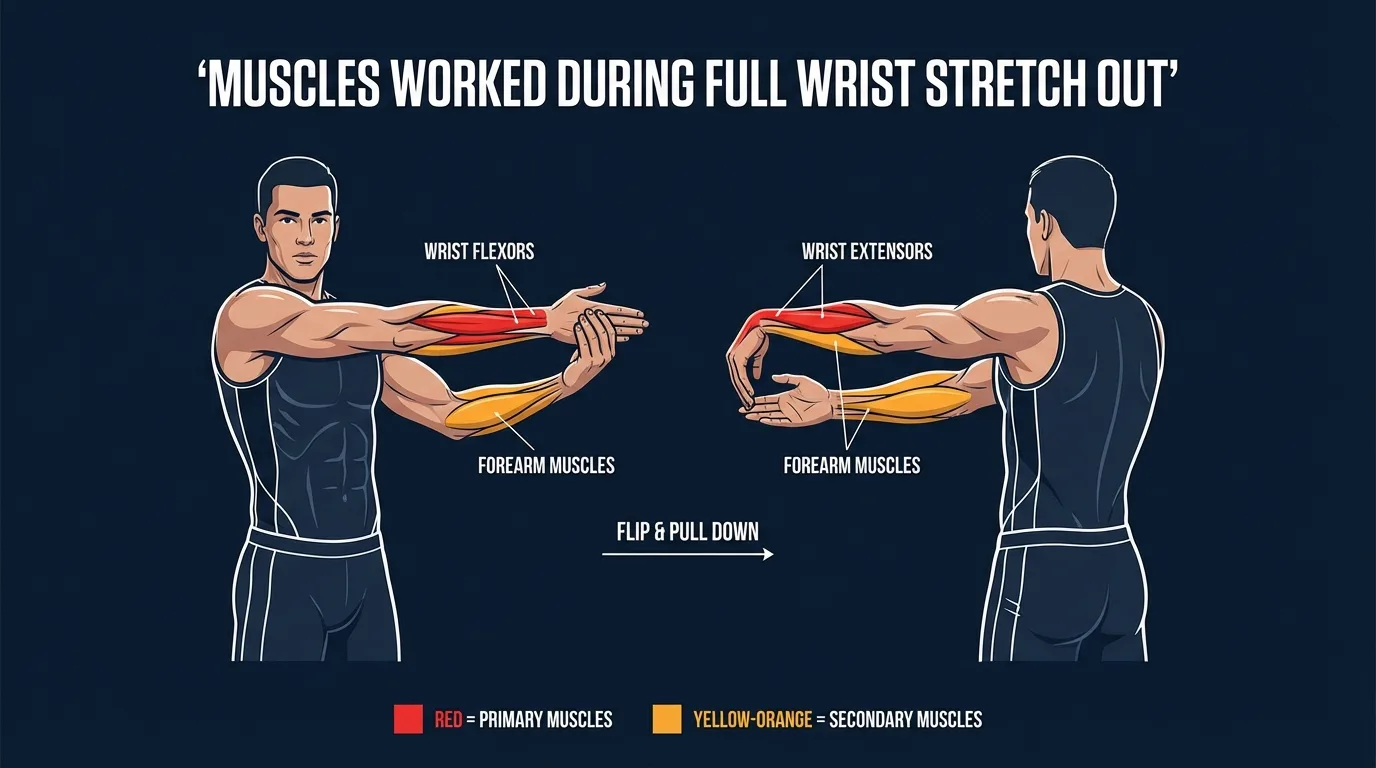
Areas Stretched and Mobilized
Primary areas stretched. Two muscle groups do most of the work. During the extension phase (fingers pointing up, palm away), the wrist flexors on the underside of the forearm lengthen: flexor carpi radialis, flexor carpi ulnaris, and palmaris longus. During the flexion phase (fingers pointing down, palm toward you), the wrist extensors on the top of the forearm lengthen: extensor carpi radialis longus, extensor carpi radialis brevis, and extensor carpi ulnaris. These two muscle groups are reciprocal, so stretching one isolates the other.
Secondary areas stretched. The finger flexors (flexor digitorum superficialis and profundus) and finger extensors share fascial connections with the wrist muscles and get a lighter stretch through both phases. The pronator teres and supinator are mildly mobilized when the forearm rotates between palm-down and palm-up positions. The brachioradialis, which runs along the radial side of the forearm, takes the deepest stretch during ulnar deviation.
Stabilizers. Stretching does not require active stabilization the way loaded movements do. The opposite hand provides the external pull, and the shoulder of the working arm holds the arm at shoulder height isometrically. If you stand to perform the sequence, the core holds the trunk upright; if you sit, the core demand drops to almost zero.
Mechanism: why four directions matter. The wrist is a complex joint with eight carpal bones and at least six muscle groups crossing it. Each direction of wrist movement (extension, flexion, radial deviation, ulnar deviation) loads a different combination of these tissues. Single-direction stretching (the typical "fingers up, hold, switch" routine) only lengthens the flexors and extensors. The radial and ulnar deviation phases address the lateral and medial fascial structures that contribute to grip strength, club and bat control, and wrist stability under load. People who skip the deviations almost always have the worst mobility in those exact directions, which is why a complete sequence delivers more functional return than a partial one.
How to Do the Full Wrist Stretch Out (Step-by-Step)
- Extend your arm. Stand or sit with good posture. Extend your right arm straight out in front of you at shoulder height, palm facing down. Keep your elbow straight but not locked. Your shoulder stays relaxed and down, away from your ear. If you are standing, your feet should be about hip-width apart.
Coach Ty's cue: "Shoulder down before you start. If your trap is bunched up by your ear, the stretch shifts away from your forearm."
- Stretch into extension (fingers up). Bend your wrist upward so your fingers point toward the ceiling, palm facing away from you. Use your left hand to gently pull your fingers back toward your body. You should feel a moderate stretch along the underside of your forearm, from your wrist to your inner elbow. Hold for 15-30 seconds. This stretches the wrist flexor muscles.
Coach Ty's cue: "Gentle pressure only. Your opposite hand is just there to assist; if you feel sharp pain or tingling, back off."
- Stretch into flexion (fingers down). Flip your hand so your fingers point toward the floor, back of hand facing you. Use your left hand to gently press the back of your fingers toward your body. You should feel a stretch along the top of your forearm. Hold for 15-30 seconds. This stretches the wrist extensor muscles.
- Stretch into radial deviation (thumb side). Return to a neutral position, palm down. Tilt your whole hand toward the thumb side, as if you are trying to bring your thumb closer to the top of your forearm. Use your opposite hand to gently assist the stretch. Hold for 10-15 seconds. Most people have never consciously stretched in this direction, so the range of motion may feel limited at first.
- Stretch into ulnar deviation (pinky side). From the same position, tilt your hand toward the pinky side, trying to bring your pinky closer to the outside of your forearm. Assist gently with your opposite hand. Hold for 10-15 seconds. This is the direction your wrist moves when you swing a golf club, throw a ball, or hammer a nail.
- Repeat on the other side. Switch arms and go through the same four-direction sequence with your left wrist. Perform 2-3 complete rounds per side. The whole thing should take about three minutes once you have the sequence memorized.
Coach Ty's cue: "Don't skip the deviations. Extension and flexion get all the attention, but radial and ulnar is where most hidden stiffness lives."
Common Mistakes to Avoid
The full wrist stretch out is forgiving. It is hard to injure yourself. But these mistakes reduce its effectiveness or create discomfort that makes people stop doing it:
- Yanking into the stretch. Pulling your fingers back aggressively does not stretch the muscle faster. It triggers a protective reflex that actually tightens the muscle you are trying to loosen. Ease into each position over 2-3 seconds. The stretch should feel like a pull, not a pinch.
- Bending the elbow. When your elbow bends, the stretch shifts from your wrist and forearm to your elbow and upper arm. That is a different exercise. Keep your elbow straight (gently, not hyperextended) so the stretch stays where you want it. This is the single most common form error Ty corrects in the app.
- Holding for too little time. Five-second holds do almost nothing for tissue extensibility. Aim for a minimum of 15 seconds per position to achieve meaningful range of motion improvements. If you are touching each position and moving on, you are going through the motions without getting the benefit.
- Shrugging your shoulder. When people extend their arm out in front, they tend to hike their shoulder up toward their ear. This creates neck tension and shifts the stretch away from the forearm. Before each hold, consciously drop your shoulder down and back. Your arm is at shoulder height, but your shoulder itself stays relaxed.
- Holding your breath. Breath-holding during stretches is an automatic response for a lot of people. It tenses the muscles you are trying to relax. Slow, steady breathing through each hold lets the muscle release more fully. Try inhaling before each position and exhaling as you deepen into the stretch.
- Ignoring one side. Your dominant hand is usually tighter than your non-dominant hand, especially if you type or use a mouse all day. Stretching both sides equally matters, but you may need to spend extra time on your dominant wrist. Some people benefit from doing 3 rounds on their dominant side and 2 on the other.
Get this exercise in a personalized workout
FitCraft, our mobile fitness app, uses its AI coach Ty to program mobility work like this into your plan at the right volume and intensity, based on your level, goals, and equipment. Ty was designed and trained by Domenic Angelino, MPH (Brown University) and NSCA-CSCS, with research published in the Journal of Strength and Conditioning Research and Medicine & Science in Sports & Exercise.
Take the Free Assessment Free · 2 minutes · No credit card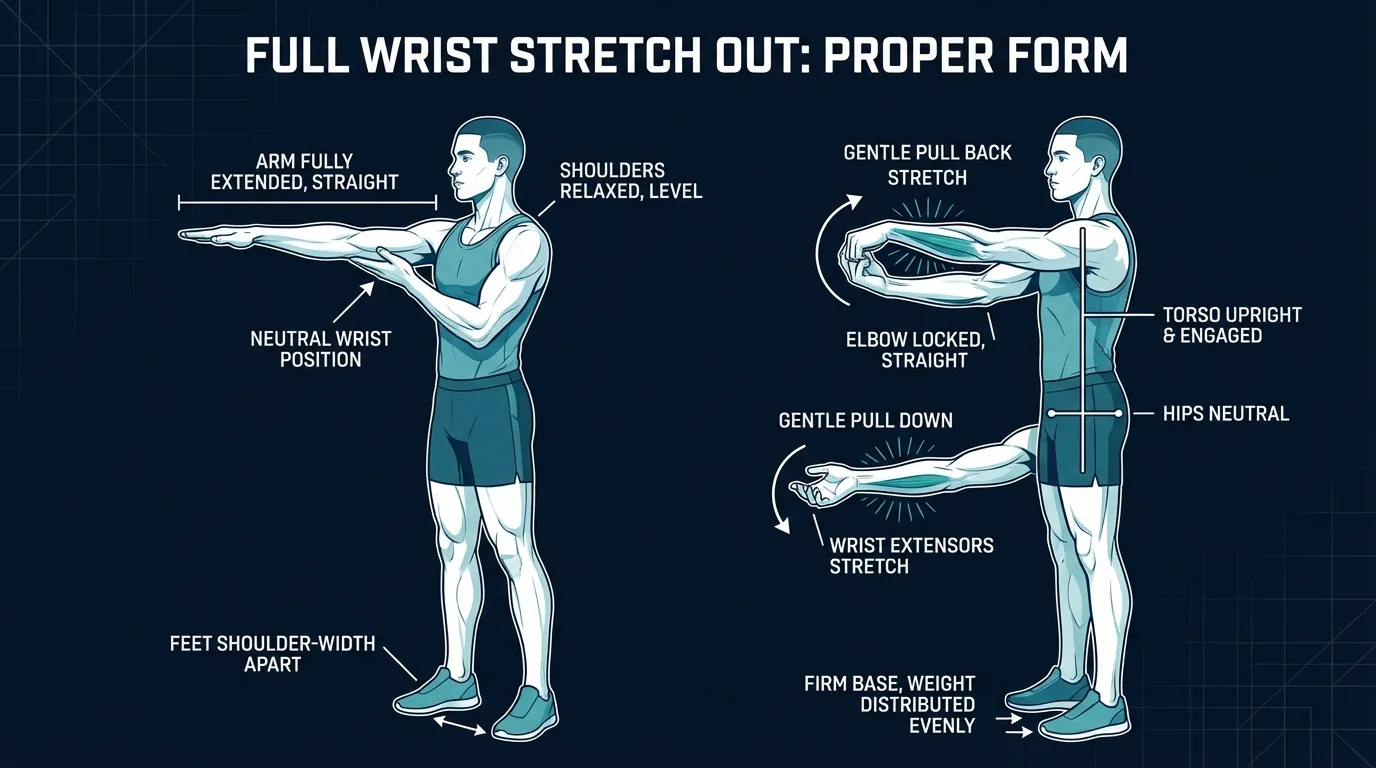
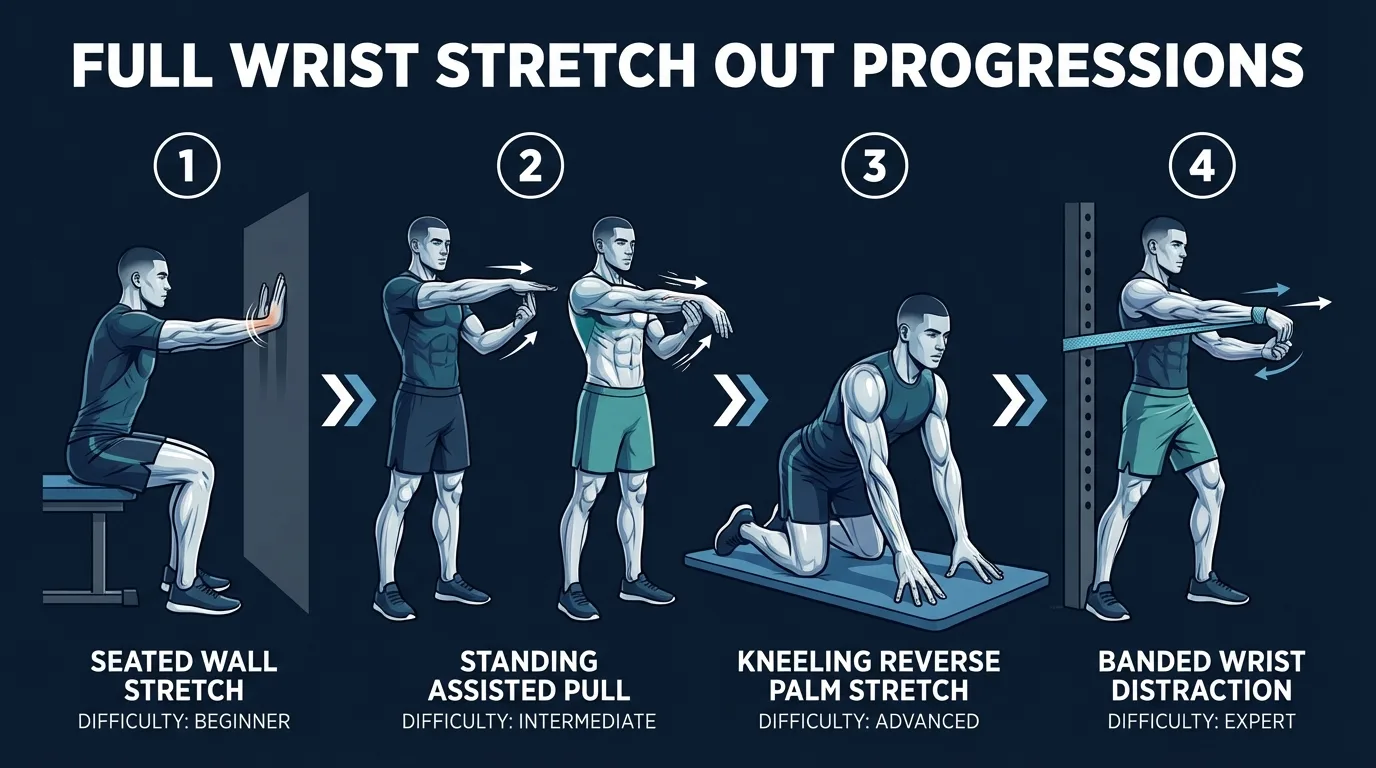
Variations and Progressions
Prayer Stretch (Beginner / Seated)
Press your palms together in front of your chest, fingers pointing upward, like a prayer position. Slowly lower your hands toward your waist while keeping your palms pressed together. Stop when you feel a moderate stretch in your wrists and inner forearms. Hold 15-30 seconds. This is a gentler version that stretches both wrists simultaneously and works well at a desk. See the namaste hand position for a related seated variation.
Tabletop Wrist Loading (Intermediate)
Get on all fours. Place your hands flat on the floor with your fingers pointing toward your knees (reversed from normal tabletop position). Gently lean back until you feel a deep stretch in your wrist flexors and forearms. Hold 15-20 seconds. This version adds body weight as a gentle load, which deepens the stretch beyond what your opposite hand can provide. Common in yoga warm-ups and calisthenics prep.
Wrist Circles with Resistance Band (Advanced)
Loop a light resistance band around your fingers. Extend your arm in front of you and slowly circle your wrist through its full range of motion against the band's resistance. 10 circles clockwise, 10 counterclockwise, each side. This transitions from pure stretching into active mobility and light strengthening, which is the next step for people who have already developed good passive range of motion.
Alternative Exercises
If you want additional wrist and forearm work:
- Standard wrist stretch: A simpler two-direction version covering extension and flexion only. Good entry point if the full four-direction sequence feels like too much to remember.
- Finger extensions with rubber band: Place a rubber band around your fingertips and spread them apart against the resistance. This strengthens the finger and wrist extensors, which are chronically weak in people who grip and type all day.
When to Avoid or Modify the Full Wrist Stretch Out
The full wrist stretch out is one of the safer exercises in any program, but a few situations warrant modification or temporary avoidance. Always consult a qualified healthcare provider or physical therapist before starting or returning to any exercise program, especially if any of the following apply to you:
- Acute wrist injury or recent wrist or hand surgery. Sprains, fractures, ligament tears, and post-surgical wrists need clearance before stretching. Aggressive mobility work on healing tissue can re-injure the joint. Wait for medical clearance and follow the rehab program your provider prescribes.
- Acute carpal tunnel flare or severe median nerve symptoms. Mild tingling that improves with stretching is one thing; sharp, sustained numbness or hand weakness is another. If wrist extension reproduces shooting symptoms into your fingers, stop and get evaluated. In a managed, non-acute case, nerve-gliding exercises are often beneficial, but the call belongs to your hand therapist or physician.
- Hypermobility, Ehlers-Danlos, or other connective tissue disorders. Passive end-range stretching can destabilize already-loose joints. Emphasize controlled active mobility instead (band circles, slow self-resisted movement) and avoid pulling into the deepest available range. Consult a PT with hypermobility expertise.
- Acute forearm muscle strain. Stretching a recently strained muscle can worsen the tear. Use rest, ice, and clinical guidance during the acute phase; reintroduce gentle stretching only after the acute symptoms resolve.
- Active tendinopathy in the wrist or elbow (e.g., tennis elbow, golfer's elbow). Stretching can sometimes irritate inflamed tendons. Most tendinopathies respond better to graded loading (isometrics, then eccentric work) than to aggressive stretching. Discuss with a physical therapist before adding stretches to a tendinopathy rehab plan.
- Pregnancy (second and third trimesters). Relaxin loosens ligaments throughout the body, including the small wrist ligaments. Stay within a comfortable range, skip the deepest assisted holds, and treat the sequence as gentle daily mobility rather than maximum range work.
Related Exercises
- Same area, simpler version: Wrist stretch. The two-direction (extension and flexion only) version of this sequence. A good entry point.
- Hand and forearm pairing: Namaste. A related seated hand and forearm mobility position commonly used in yoga warm-ups.
- Active mobility pairing: Shoulder rolls. Pair with wrist work for a complete desk-break upper body sequence.
- Adjacent joint to mobilize together: Rotator cuff stretch. Pairs naturally with wrist mobility before any pressing, gripping, or overhead work.
- Spinal mobility pairing for desk breaks: Cat-cow. The most common spinal complement to wrist mobility in a complete desk-break sequence.
- Wrist-loaded strength prerequisite: Push-ups. The full wrist stretch out is the standard prep for any pressing work that loads the wrists.
- Wrist-loaded isometric: Forearm planks. For people whose wrists cannot yet tolerate full hand-supported plank positions, forearm planks bypass the wrist entirely while you build mobility.
How to Program the Full Wrist Stretch Out
Mobility programming is different from resistance training. Frequency matters more than intensity, and consistency over weeks matters more than any single session. Hold times and weekly dose come from ACSM-aligned static-stretching guidance (Ratamess et al., 2009), adapted for the low-load, low-risk profile of wrist mobility.
| Level | Hold time per position | Rounds per side | Frequency |
|---|---|---|---|
| Beginner | 15-20 seconds | 1-2 rounds | 5-7 sessions per week |
| Intermediate | 20-30 seconds | 2-3 rounds | 5-7 sessions per week |
| Advanced | 30 seconds (or add active band circles for 8-10 reps per side) | 2-3 rounds plus active mobility | Daily (often 2-3 times per day for desk workers) |
Where in your workout. Use the full wrist stretch out in three slots. (1) Pre-workout warm-up: 1-2 rounds per side before any pressing, gripping, or overhead work (push-ups, deadlifts, pull-ups, kettlebells, yoga). Your grip will feel more secure and your wrists will move more freely under load. (2) Desk breaks: 1 round per side every 1-2 hours during computer work. This is where the sequence delivers the most cumulative benefit for most people; the daily-typing-and-mousing dose is what leads to chronic wrist issues, and regular micro-breaks interrupt that cycle. (3) Post-workout cooldown: 2-3 rounds per side after upper body training, climbing, or any activity that grips hard. Post-workout stretching when the tissue is warm produces the best range of motion gains.
Form floor over duration targets. A 15-second hold done well (elbow straight, shoulder down, breath flowing, gentle assistance) beats a 60-second hold done with the elbow bent and the shoulder shrugged. Hit form on every position before chasing longer holds.
FitCraft's AI coach Ty includes the full wrist stretch out in personalized warm-up and cooldown routines. Ty's 3D demonstrations show each wrist position from multiple angles, which helps you match the exact hand and forearm alignment for each direction. The app also surfaces desk-break reminders to users whose profile indicates sedentary work, and includes wrist mobility in those micro-sessions when appropriate.
Frequently Asked Questions
Can I do the full wrist stretch out if I have wrist pain or carpal tunnel symptoms?
In most non-acute cases, yes. Gentle wrist stretching is one of the first interventions hand therapists prescribe for tingling, mild numbness, and forearm tightness associated with carpal tunnel syndrome. Clinical research shows that wrist stretching and nerve-gliding exercises can reduce pressure inside the carpal tunnel by up to 30% (Wolny and Linek, 2020). Stay well within a painless range, never push into tingling or sharp pain, and stop immediately if symptoms worsen. If your symptoms are acute, recent in onset, or include weakness in the hand, see a physician or hand therapist before starting any wrist mobility program.
What muscles does the full wrist stretch out work?
It targets the wrist flexors (flexor carpi radialis, flexor carpi ulnaris, palmaris longus) during the extension phase and the wrist extensors (extensor carpi radialis longus and brevis, extensor carpi ulnaris) during the flexion phase. The radial and ulnar deviation phases stretch the lateral and medial forearm muscles, including the brachioradialis. It is a mobility exercise, not a strength builder.
How long should I hold a wrist stretch?
Hold each position for 15-30 seconds. ACSM-aligned recommendations suggest at least 15 seconds per position for meaningful range of motion gains. If your wrists are particularly stiff, start with 10-second holds and work up to 30 seconds over a few weeks.
Can wrist stretches help prevent carpal tunnel syndrome?
Regular wrist stretching can reduce pressure inside the carpal tunnel by up to 30% and improve circulation to the median nerve. Stretching alone does not guarantee prevention, but daily wrist mobility work is one of the most commonly recommended habits by hand therapists and orthopedic specialists for people who type, game, or perform repetitive hand tasks.
Can I do wrist stretches every day?
Yes. Wrist stretches are low-intensity mobility work with low injury risk when performed gently. Daily practice is recommended, especially for desk workers, gamers, and anyone who performs repetitive hand motions. Many physical therapists suggest stretching wrists 2-3 times per day for the best results.
Is the full wrist stretch out good for beginners?
It is one of the most beginner-friendly exercises available. No equipment, no strength requirement, no prior experience needed. The only instruction is to stretch gently and never push into pain. It is commonly the first wrist exercise prescribed in physical therapy and yoga programs.