You know that feeling when you stand up from your desk and your back cracks in three places? Yeah. That's your body filing a complaint. Eight hours of hunched shoulders, a forward head, and a collapsed chest does something to you, and no amount of weekend workouts fully undoes it. Namaste pose is one of the cheapest fixes out there. Sixty seconds, no equipment, you can do it in the bathroom at work.
Also called pranamasana in Sanskrit, prayer pose is the opening and closing posture of Sun Salutations and one of the most fundamental shapes in yoga. It looks like you're not doing anything. That's kind of the point. Under the stillness, your core is engaged, your legs are stabilizing your whole body against gravity, and your chest and shoulders are holding a light isometric contraction as your palms press together.
The trick is that most people treat it like a throwaway. They stand there with slumped shoulders and a dropped chin, thinking about what they're going to do next. That's not the pose. Let's actually do it.
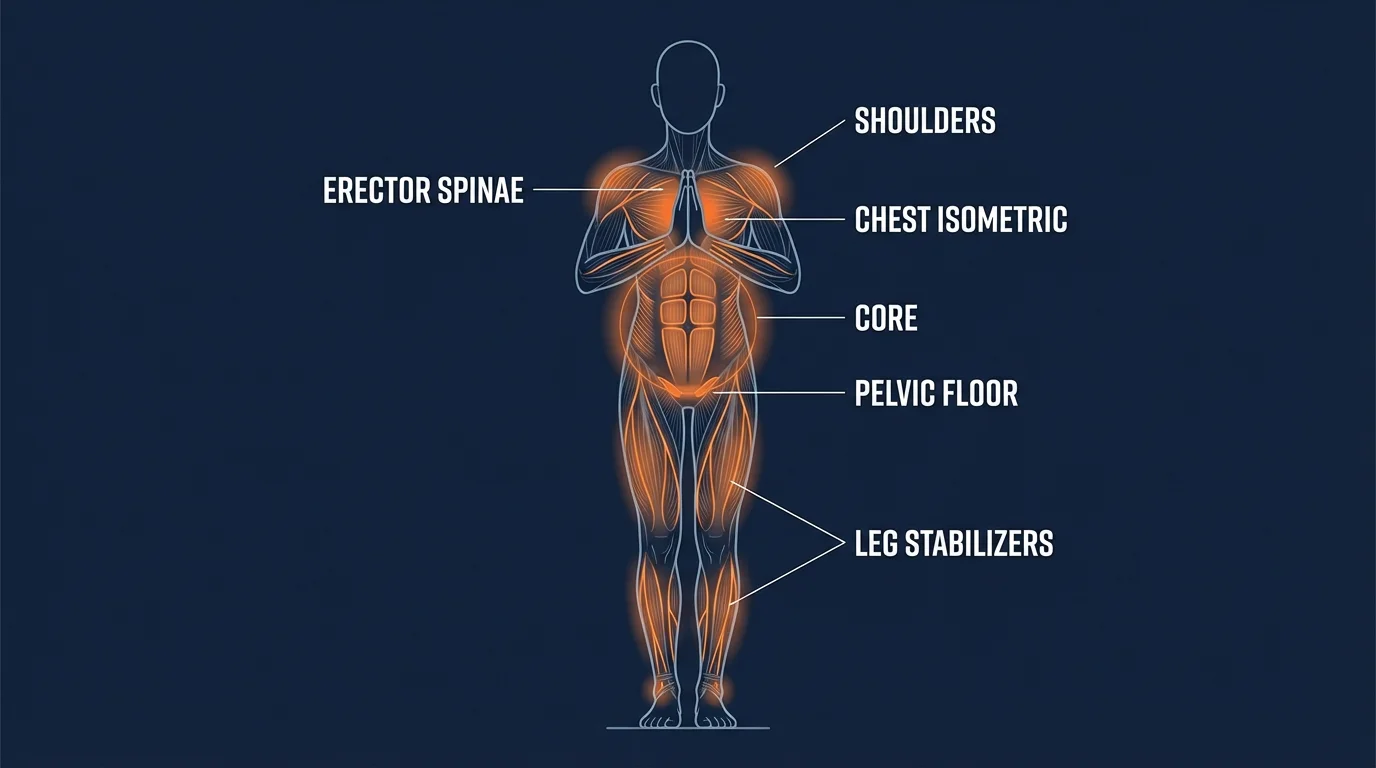
Muscles Engaged & Stretched
Primary movers (isometric stabilizers). Namaste is a hold, not a dynamic rep, so there are no concentric or eccentric phases to speak of. The primary work happens isometrically. The deep core stabilizers (transverse abdominis, multifidus, and the diaphragm) fire continuously to keep the spine tall against gravity. The erector spinae runs the length of the back column to resist the slump pattern most desk workers default to. In the legs, the quadriceps, gluteus medius, and the small intrinsic foot muscles co-contract to keep the pelvis level and the weight balanced through the soles of the feet.
Secondary movers (the palm-press isometric). When you press your palms firmly together at heart center, you create a closed-chain isometric contraction across the chest and shoulders. The pectoralis major (sternal head) fires to drive horizontal adduction. The anterior deltoids assist by stabilizing the shoulder joint at neutral. The forearm flexors and intrinsic hand muscles work to maintain the pressed-palms shape. None of this is heavy load, but holding it for a full minute generates real metabolic work in those small muscles.
Stabilizers and the breath. The pelvic floor co-contracts with the deep core to support the spine from below. The serratus anterior keeps the shoulder blades drawn slightly forward and down on the ribcage. The breath itself is a stabilizer: diaphragmatic breathing pressurizes the trunk and supports both the postural muscles and the parasympathetic shift this pose is famous for. If you watch an experienced practitioner, you'll see the ribs expand sideways on the inhale rather than the chest puffing forward. That's the diaphragm doing its job.
Mechanism: why a static hold trains anything at all. Postural muscles are dominated by slow-twitch type I fibers built for endurance rather than peak force. They fatigue gradually over minutes, not seconds. Holding namaste for 30 to 120 seconds asks the postural chain to maintain low-grade tension exactly where it normally fails first: the lower back, deep abdominals, and the muscles that pin the shoulder blades down. The palm-press adds a quiet contraction across the chest and forearms that wouldn't qualify as a strength stimulus on its own but adds up across daily practice. The pose is not a substitute for resistance training. It is a substitute for the slouch.
Get this exercise in a personalized workout
FitCraft, our mobile fitness app, uses its AI coach Ty to program yoga poses like this into your plan at the right volume and intensity, based on your level, goals, and equipment. Ty was designed and trained by Domenic Angelino, MPH (Brown University) and NSCA-CSCS, with research published in the Journal of Strength and Conditioning Research and Medicine & Science in Sports & Exercise.
Take the Free Assessment Free version available · 2 minutes · No credit cardQuick Facts: Namaste Pose
- Equipment needed: None
- Difficulty: Beginner (standing namaste); intermediate to advanced for overhead and reverse variations
- Modality: Isometric hold, bilateral, posture training
- Body region: Full-body posture (core, spine, legs, chest, shoulders)
- FitCraft quest category: Yoga · Mobility · Mindfulness
How to Do Namaste Pose (Step-by-Step)
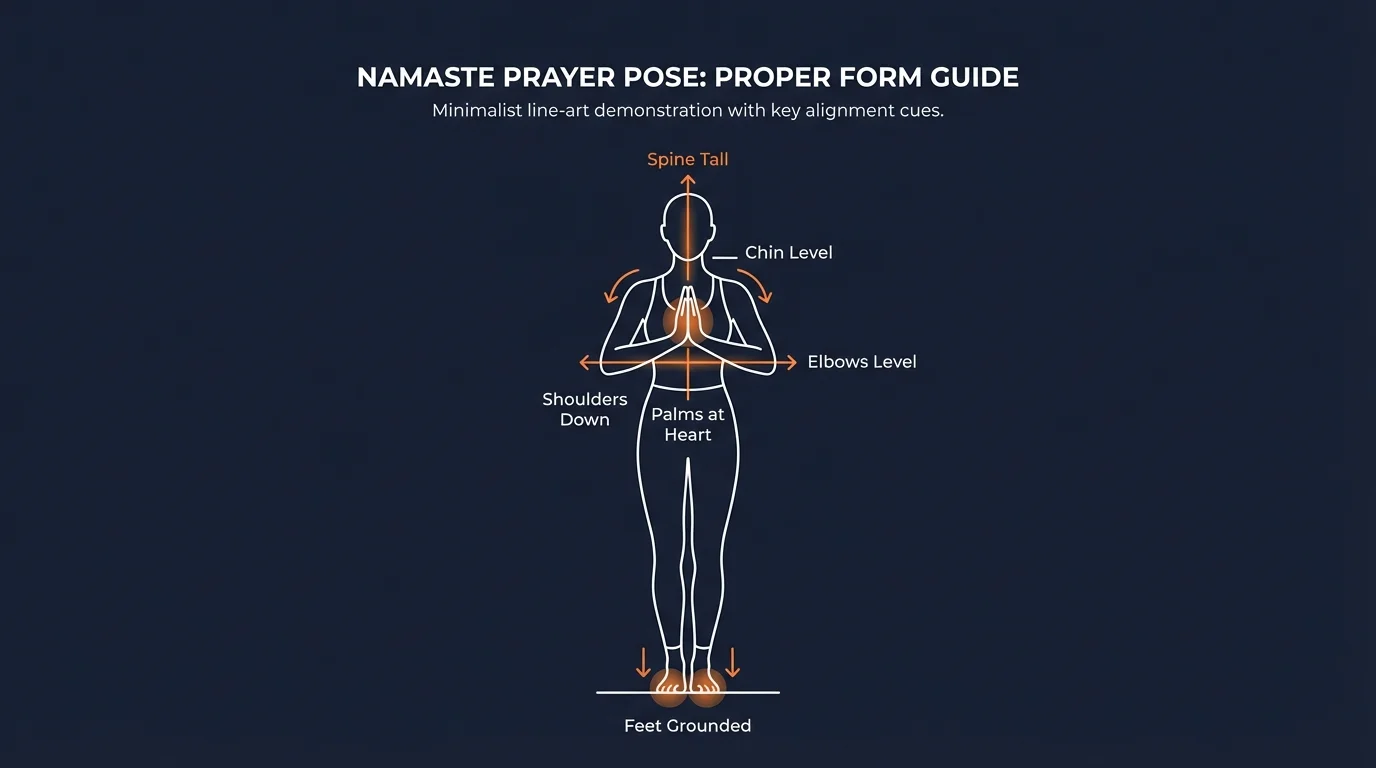
- Stand tall with feet hip-width apart. Plant your feet hip-width apart, not wider. Weight should be evenly spread across both feet. Try to feel all four corners of each foot touching the ground: big toe mound, little toe mound, inner heel, outer heel. Soften your knees a tiny bit so they're not locked. Your arms hang naturally at your sides. This is the foundation. If your feet are sloppy, everything above them will be too. Coach Ty's cue: "Spread the toes wide and grip the floor gently. That tells your nervous system you're rooted before you even think about the upper body."
- Lengthen through your spine. Imagine a thread pulling you up from the crown of your head. Stack your shoulders directly over your hips, and your hips over your ankles. Slightly tuck your tailbone so your pelvis is neutral, not tipped forward into a swayback. Roll your shoulders back and then down, away from your ears. Your chest opens naturally when your shoulders drop. Don't puff it out.
- Bring your palms together at heart center. Press your palms together in front of your chest, at the level of your sternum. Thumbs lightly touch the center of your chest. Press your palms firmly into each other. You should feel a quiet isometric squeeze across your chest and through your forearms. Lift your elbows so your forearms form a horizontal line parallel to the floor. Don't let your elbows drop toward your ribs, which collapses the whole shape. Coach Ty's cue: "Press the palms like you're trying to squeeze water out from between them. Not a death grip, just real pressure."
- Level your head and soften your gaze. Chin parallel to the floor, not tilted up, not dropped down. Lengthen the back of your neck as if you're making space between your skull and your shoulders. Close your eyes or soften your gaze at a point a few feet in front of you on the floor. Unclench your jaw. Relax the space between your eyebrows. Small details. Big difference.
- Breathe and hold. Slow breaths through the nose, in and out. On each inhale, feel your ribs expand sideways. On each exhale, feel your shoulders soften a little more. Hold for 30 seconds to 2 minutes. The goal is not to tough it out. It's to settle in. To come out, lower your hands to your sides and take one final full breath before moving on.
Common Mistakes to Avoid
Namaste looks easy, which is exactly why it usually gets butchered. Here is what goes wrong.
- Dropping the elbows. When your elbows sag toward your ribs, your forearms lose their horizontal line and the whole shape collapses. You also lose the light isometric engagement through your chest and shoulders. Fix: lift your elbows until your forearms are parallel to the floor. It should feel like a small, deliberate effort and not a strain.
- Letting the palms barely touch. Most people rest their palms together without any pressure. That turns the pose into a pose-shaped pause. Fix: press your palms firmly into each other. Not a death grip, but enough that you feel your pecs and forearms quietly switch on.
- Slouching or puffing the chest. Two opposite mistakes that happen constantly. Slouching means your shoulders round forward and your chest caves in. Puffing means you overcorrect by thrusting your ribcage forward, which flares the front ribs and pinches the lower back. Fix: roll your shoulders back and down, then let your chest open on its own. Ribs stay stacked over hips.
- Chin jutting forward. A forward head is the default posture of the modern desk worker, and it shows up in namaste constantly. Your chin pokes out, the back of your neck shortens, and you lose the whole point of the reset. Fix: imagine sliding your head straight back over your spine. Chin level. Back of neck long.
- Locked knees. Hyperextending your knees tilts your pelvis forward and loads your lower back. Fix: keep a tiny, almost invisible bend in your knees. Just enough to engage your quads without visibly softening the leg.
- Rushing it. People hold the pose for 3 seconds and call it done. That's not enough time for your breath or nervous system to shift. Fix: commit to at least 30 seconds, ideally a full minute. Count breaths if it helps. Five to ten slow breaths is usually the sweet spot.
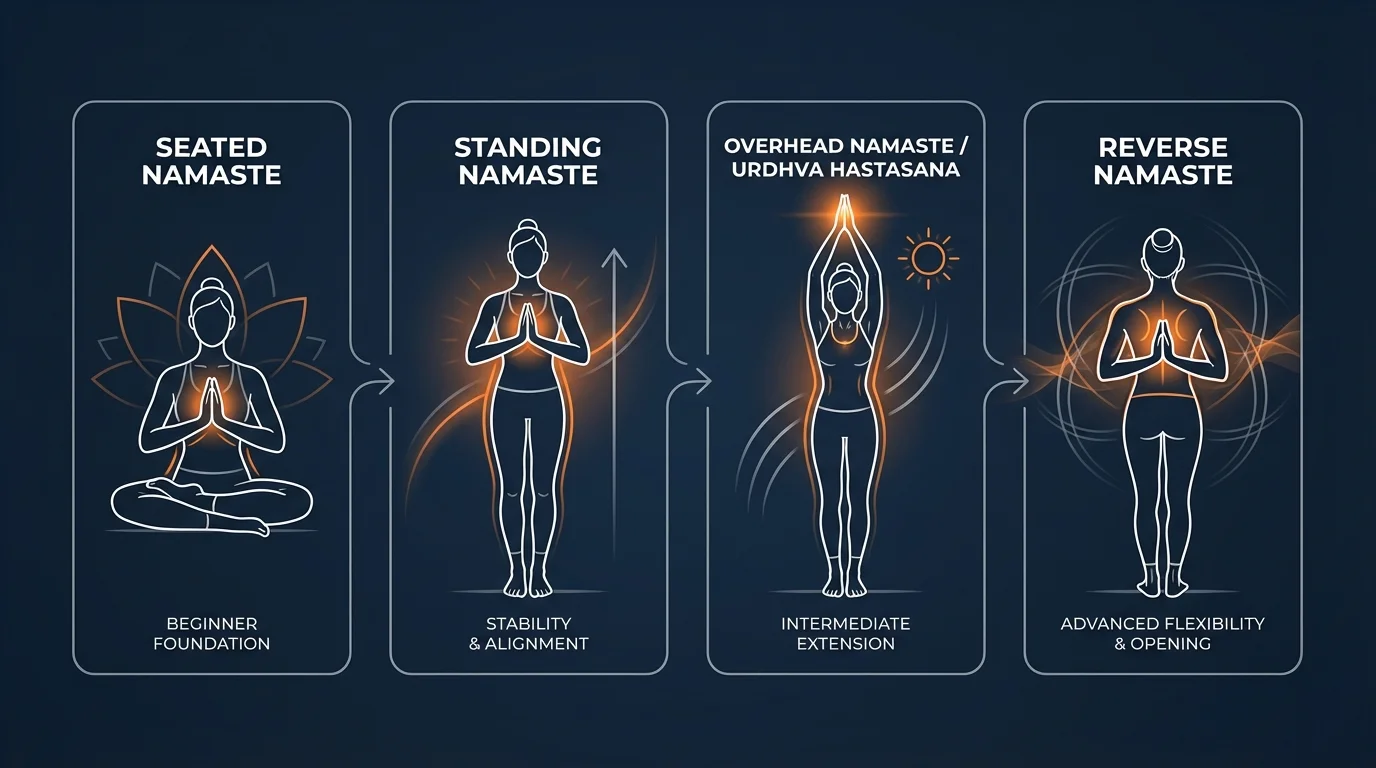
Variations: From Seated to Overhead
Seated Namaste (Beginner)
Sit cross-legged on the floor or on the edge of a chair with your feet flat on the ground. Bring your palms together at heart center and follow the same spine, shoulder, and elbow cues. The seated version takes the leg stabilizers out of the equation, so it's a good starting point if standing still for a minute feels like a lot. It's also the most common variation used at the start and end of a yoga class.
Standing Namaste / Pranamasana (Beginner)
The default. This is the version covered in the step-by-step above. It's the opening and closing posture of Sun Salutations and the one most people mean when they say "namaste pose." Works as a standalone posture reset any time of day.
Overhead Namaste / Urdhva Hastasana (Intermediate)
From standing namaste, keep your palms pressed together and raise your arms straight up overhead. Your arms should end up alongside your ears, biceps framing your face. Keep your ribs stacked. Don't let them flare forward as your arms go up. This variation adds shoulder mobility, lengthens the sides of your torso, and lightly engages your upper back. Great as a morning stretch.
Reverse Namaste / Pashchima Namaskarasana (Intermediate-Advanced)
Bring your hands behind your back and press your palms together between your shoulder blades, fingers pointing up. This is a serious shoulder and wrist mobility test. Most people cannot do the full version on day one. If your palms won't meet, grab opposite elbows behind your back instead, or try pressing the backs of your hands together with fingers pointing down. Work toward the full version over weeks. It's an excellent counter-stretch for rounded shoulders.
When to Avoid or Modify Namaste Pose
Namaste pose is one of the safest postures in yoga and is well-tolerated by almost everyone. A few situations still warrant modification rather than the standard standing version. Always consult your physician or physical therapist before starting a new exercise practice, especially if any of the following apply.
- Acute wrist injury or recent carpal tunnel surgery. Pressing the palms flat together loads the wrists very lightly, but if even that feels uncomfortable, switch to fingertip-to-fingertip contact with palms apart (Anjali mudra), or rest one hand in the other in your lap.
- Recent shoulder surgery or rotator cuff injury. Standard namaste is shoulder-friendly, but the overhead and reverse variations load the shoulder through end ranges. Stay with the seated or standing version and skip overhead namaste until cleared by your surgeon or physical therapist.
- Vertigo, balance disorders, or vestibular conditions. Standing still with the eyes closed (or even with a softened gaze) can trigger dizziness in people with vestibular issues. Practice the seated version, or do the standing version near a wall and keep your eyes open and focused on a fixed point. Foundation work in tree pose with wall support or chair-based balance drills should precede progression to closed-eye standing holds.
- Late pregnancy. Standing namaste is generally fine throughout pregnancy, but the closed-eye version is best avoided in the third trimester as the shifting center of gravity raises fall risk. Keep eyes soft but open, and feel free to widen your stance.
- Lower-back pain that worsens with standing still. Some people with lumbar issues find prolonged static standing aggravating. Switch to seated namaste on a chair with feet flat. Pair with cat-cow as a gentle mobility prep that decompresses the lumbar spine.
- Hypermobility or connective tissue disorders. If your elbows or shoulders hyperextend, focus on muscular engagement (press the palms hard, lift the elbows actively) rather than passive depth. Don't sink into any joint.
Related Exercises
Namaste fits into a larger network of standing and seated yoga poses. These pair well as you build a practice.
- Same body region, similar isometric demand: Tree pose takes the namaste posture and adds a single-leg balance challenge, often done with the hands in namaste at heart center.
- Standing pose progression: Chair pose is a more demanding standing hold that fires the quads and glutes while you keep the torso tall, building on the alignment habit namaste develops.
- Hip and leg stability: Warrior pose opens the hips and builds leg stability. A natural progression from namaste in any yoga flow.
- Spine and shoulder mobility: Cat-cow is the canonical spinal warm-up and pairs well with namaste at the start of a session to mobilize the spine before holding it still.
- Full-body opener with shoulder demand: Downward dog follows namaste in the standard Sun Salutation sequence and gives the shoulders and posterior chain a meaningful stretch.
- Standing balance partner: Warrior 3 turns namaste's single-axis posture into a horizontal balance, often entered with palms still pressed together at heart center.
How to Program Namaste Pose
Yoga programming differs from resistance training because the stimulus is mobility and isometric endurance rather than progressive overload. Frequency can be daily without compromising recovery. The American College of Sports Medicine's resistance training guidelines (Ratamess et al., 2009) inform the broader training framework, but for static yoga holds the operative variables are hold time, breath count, and session frequency rather than load and rep ranges.
| Level | Hold time | Rounds per session | Frequency |
|---|---|---|---|
| Beginner | 15-30 seconds (3-5 slow breaths) | 1-2 holds | 3-5 sessions/week, plus daily desk breaks |
| Intermediate | 30-60 seconds (5-10 breaths) | 2-3 holds, layering in overhead namaste | 4-6 sessions/week, plus daily desk breaks |
| Advanced | 60-90+ seconds standing; 30-60 seconds reverse namaste per side | 3-5 holds across variations, integrated into Sun Salutation flows | 5-7 sessions/week |
Where in your workout. Namaste fits in three places. As a session opener at the start of a yoga or mobility practice, it sets posture and breath. As a warm-up before resistance training, one 30-second hold mobilizes the upper back and signals to the nervous system that focused work is starting. As a cool-down after any session, a one-minute hold downregulates heart rate and helps shift toward parasympathetic recovery. Outside of training, the highest-leverage use is as a desk break: every 45 to 60 minutes of sitting, stand up and hold for one full minute. That interrupts the slouch pattern before it ossifies.
Form floor over rep targets. If your shoulders are around your ears, your chin is jutting forward, or your elbows have collapsed into your ribs, stop the clock. A 30-second hold with clean alignment beats a 2-minute hold in poor position every time. The pose works through repeated exposure to good posture, not through grinding out time.
Frequently Asked Questions
Can I do namaste pose with wrist pain or carpal tunnel?
Yes, in most cases. Standard namaste with palms pressed at heart center loads the wrists very lightly, far less than push-ups or downward dog. If pressing your palms together flat is painful, try pressing the fingertips together with palms apart (Anjali mudra variation), or rest the back of one hand in the palm of the other in your lap. Always consult your physician or physical therapist before practicing if you have an acute wrist injury, are recovering from carpal tunnel surgery, or have severe joint inflammation.
What does the namaste pose do?
Namaste pose (pranamasana) is a standing or seated posture that builds upright alignment, activates the core and leg stabilizers, and engages the chest and shoulders isometrically as the palms press together. It's used as the opening and closing posture of Sun Salutations and is one of the simplest full-body posture resets available. It also serves as a mindfulness cue that links breath, body, and attention in under a minute.
What muscles does prayer pose work?
Prayer pose works the deep core stabilizers (transverse abdominis, multifidus), pelvic floor, erector spinae along the spine, and the small postural muscles of the legs. The palms pressing together creates an isometric contraction across the pectoralis major, anterior deltoids, and forearm flexors. While the contractions are light, holding the pose for one to two minutes meaningfully trains postural endurance.
How long should you hold namaste pose?
Hold namaste pose for 30 seconds to 2 minutes. Beginners should start with 30-second holds focused on alignment and breath. Intermediate practitioners can extend to 60 to 90 seconds. As a posture reset during the workday, even 3 full breaths (about 20 seconds) is enough to interrupt slouching. As a mindfulness practice at the start or end of a workout, 1 to 2 minutes is ideal.
Is namaste pose a real exercise?
Yes. While it looks simple, namaste pose is a legitimate isometric posture exercise. Holding the spine tall against gravity trains the deep core and erector spinae muscles, and pressing the palms together engages the chest, shoulders, and forearms. It's most valuable as a posture reset and as a gateway to longer mindfulness practice, not as a standalone strength stimulus.
Can I do namaste pose every day?
Yes. Namaste pose is low-intensity, requires no equipment, and is safe to practice daily. Daily practice is actually ideal because the pose works best as a habitual posture reset. Try it first thing in the morning, between desk work sessions, or as a one-minute transition before bed. There is no recovery window needed, so frequency is only limited by how often you remember to do it.