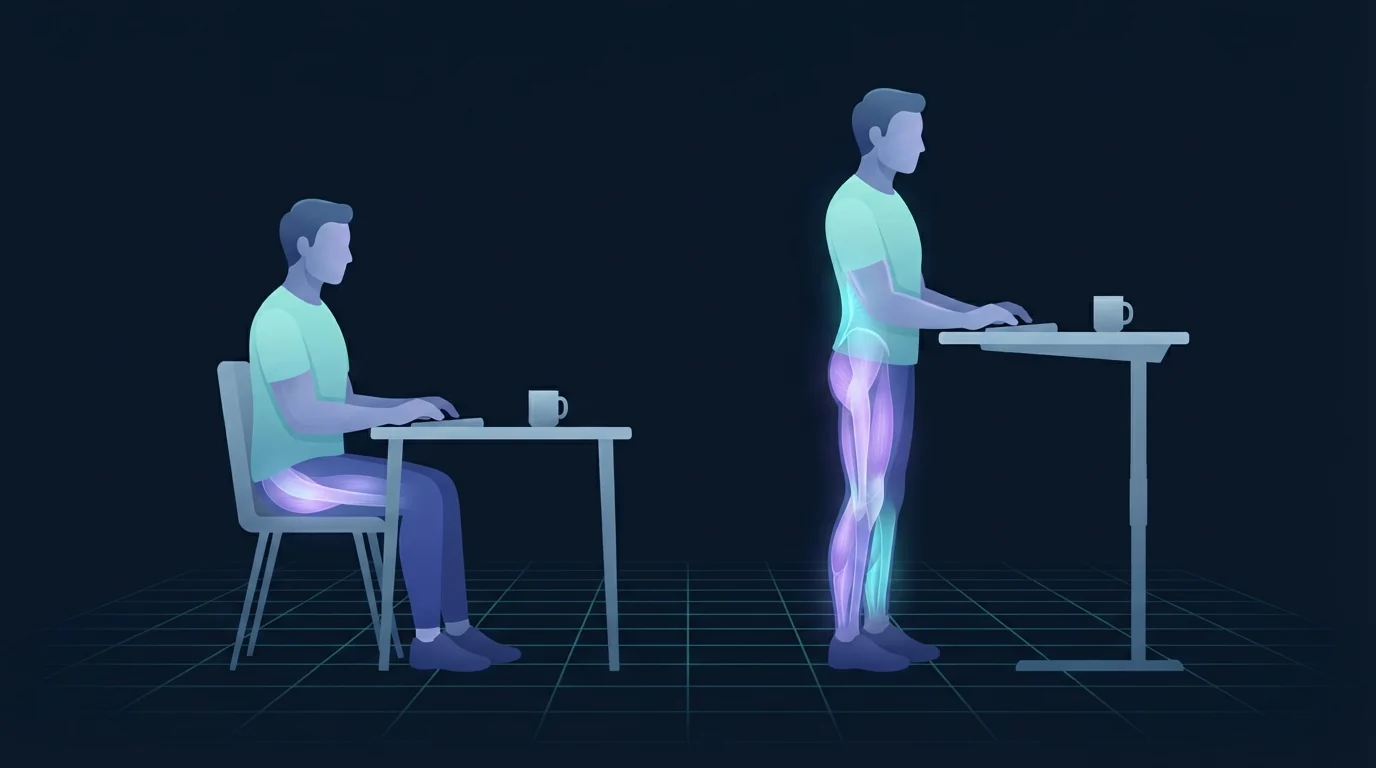
The standing desk arrived with a number attached. Depending on which article you read first, it was 50 calories an hour, or 100, or 200, and it was going to quietly dissolve a few pounds a year while you answered email. Six years later a lot of those desks are permanently in the low position, and the people who bought them are not noticeably leaner.
That gap between the promise and the outcome is worth understanding, because the underlying research is real and it isn't disappointing. It just answers a different question than the headline implied. Standing does cost more energy than sitting. The measurement has been done carefully, many times, and the number is consistent. The number is simply much smaller than a calorie-burning claim needs it to be.
So here is the honest version, in order: what the pooled measurements say, how many calories you personally burn standing at your own body weight, where standing sits inside the four ways a human spends energy, what happened in the standing desk trials that tracked weight, and what to do with the desk you already own.
Does standing burn more calories than sitting?
Yes, and the size of the difference is one of the better settled numbers in this corner of exercise science. Saeidifard and colleagues (2018) in the European Journal of Preventive Cardiology ran the systematic review, screening the literature and pooling 46 studies covering 1,184 participants who had their energy expenditure measured in both postures.
The pooled difference was 0.15 kcal per minute (95% CI 0.12 to 0.17). Split by sex, it was 0.19 kcal/min in men (95% CI 0.05 to 0.33) and 0.1 kcal/min in women (95% CI 0.0 to 0.21). Randomised trials produced a slightly larger estimate than observational ones, 0.2 versus 0.11 kcal/min, which is the usual pattern when a controlled protocol enforces genuine standing rather than recording whatever people did.
Multiply 0.15 by 60 and you get 9 calories an hour. The authors ran the practical extrapolation themselves: a 65 kg (143 lb) person who replaces six hours of sitting with six hours of standing every day spends an additional 54 calories a day, and if nothing else changed, that would add up to the energy content of about 2.5 kg of body fat over a year.
Hold onto that "if nothing else changed". It's doing an enormous amount of work in that sentence, and the rest of this article is about what happens to it.
How many calories do I burn standing? A table by body weight
The extra burn scales with how much body you are holding up, so the number is personal. The table below uses the measured 0.15 kcal/min increment anchored at 65 kg and scaled by body mass, alongside a baseline for desk work in a chair.
| Body weight | Sitting at a desk | Standing at a desk | Extra per hour | Extra over 6 hours |
|---|---|---|---|---|
| 130 lb (59 kg) | 77 kcal/hr | 85 kcal/hr | 8 kcal | 49 kcal |
| 150 lb (68 kg) | 88 kcal/hr | 97 kcal/hr | 9 kcal | 57 kcal |
| 170 lb (77 kg) | 100 kcal/hr | 111 kcal/hr | 11 kcal | 64 kcal |
| 190 lb (86 kg) | 112 kcal/hr | 124 kcal/hr | 12 kcal | 71 kcal |
| 220 lb (100 kg) | 130 kcal/hr | 144 kcal/hr | 14 kcal | 83 kcal |
Calories burned standing vs sitting: read the right column
Look at the 170 lb row. Standing at a desk costs about 111 calories an hour, which sounds respectable until you notice that sitting in a chair costs 100. The 111 is almost entirely the price of being a living human for sixty minutes. Only 11 of it belongs to standing.
This is the single most common way the standing desk number gets inflated online. An article measures the total energy cost of standing, reports it as "standing burns 100 to 200 calories an hour", and readers reasonably assume that is 100 to 200 calories they would not otherwise have spent. It isn't. Most of it is your BMR, and you would have spent it in a chair, in bed, or in a meeting.
Why the compendium gives sitting and standing desk work the same value
The reference document for this kind of arithmetic is the compendium of physical activities, most recently updated by Herrmann and colleagues (2024) in the Journal of Sport and Health Science, which catalogues 1,114 activities after screening 32,173 abstracts and extracting 2,356 measured energy expenditure values from 701 papers.
It rates "sitting: writing, desk work, typing" at 1.3 METs. It rates "standing: talking in person, on the phone, computer, text messaging, writing" at 1.3 METs. Identical. Quiet standing in a line is also 1.3. Standing while fidgeting climbs to 1.5, which is the same value as sitting and fidgeting with your hands, and lower than sitting while fidgeting your feet at 1.8.
Read those rows together and the point lands hard. To the measurement, what matters is whether you are moving, not whether you are vertical. A compendium that resolves activities to one decimal place has decided the sit-versus-stand distinction is not worth its own code for office work.
One more caveat on any MET table, including the one above. Byrne and colleagues (2005) measured resting metabolic rate in 769 adults and found the conventional 1 MET value overestimates real resting energy expenditure by about 20% on a per-calorie basis, and by 35% when expressed as oxygen uptake. The convention was originally derived from a single 70 kg, 40-year-old man. So treat every calorie figure on this page, and on every calculator you have used, as a reasonable central estimate with a wide margin either side.
How you actually burn calories, and where standing fits
Your total daily energy expenditure has four components, and standing lives in the smallest one that you can influence.
- Resting metabolic rate, roughly 60 to 70% of the total. The cost of organs, tissue repair and staying warm. Largely fixed by your body size and composition.
- The thermic effect of food, about 10%. Digestion is not free. Protein charges the most for it.
- Exercise activity thermogenesis, the deliberate stuff. For most adults this is a surprisingly small slice, because most adults do not train for very long.
- NEAT, everything else you do while awake. Walking to the printer, carrying groceries, cooking, pacing during calls, fidgeting, and yes, standing.
NEAT is where the interesting variance lives, and the classic demonstration is Levine, Eberhardt and Jensen (1999) in Science. They overfed 16 non-obese volunteers by 1,000 calories a day for eight weeks and watched what happened. Two thirds of the rise in total daily energy expenditure came from NEAT, and the differences in how much people ramped their NEAT predicted a ten-fold spread in how much fat they stored, with a correlation of 0.77.
Six years later the same group measured posture itself. Levine and colleagues (2005) put motion sensors on 10 lean and 10 mildly obese sedentary volunteers and logged their body position every half second for ten days. The obese participants sat about two hours longer per day. If they had adopted the lean group's pattern of posture and movement, the authors estimated it would be worth roughly 350 extra calories a day.
That 350 gets quoted constantly as the case for standing desks, and it is a misreading. The lean group was not standing still for two extra hours. They were up and moving: walking, shifting, changing rooms, doing things. Posture allocation in that study is a proxy for ambulation, not for verticality. Which is why the standing desk, when it was tested directly, delivered a fraction of it.
Knowing what to do is the easy part.
FitCraft, our mobile fitness app, pairs you with an AI coach who builds you a personalized plan around your goals, schedule, and fitness level. Every FitCraft program is designed by Domenic Angelino, MPH (Brown University) and NSCA-CSCS, with research published in the Journal of Strength and Conditioning Research and Medicine & Science in Sports & Exercise.
Take the Free Assessment Free • 2 minutes • No credit cardStanding desk weight loss: what the trials actually found
The extrapolation says 2.5 kg of fat a year. The trials are the place to check it, and the same research group did that too. Saeidifard and colleagues (2020) in Mayo Clinic Proceedings: Innovations, Quality & Outcomes screened 3,507 abstracts and pooled nine clinical trials, eight of them randomised, covering 877 participants with a mean age of 45 and a mean follow-up of 3.8 months. The intervention groups stood an average of 1.33 hours a day more than controls.
What moved: body fat mass fell by 0.75 kg (95% CI 0.59 to 0.91) and fasting blood glucose fell by 2.53 mg/dL (95% CI 0.79 to 4.27). Both statistically significant, both described by the authors as very small.
What did not move: body weight. Waist circumference. Blood pressure. Fasting insulin. Lipids. All non-significant. The authors' own conclusion is worth quoting for its bluntness: replacing sitting with standing can be used as an adjunctive intervention, but not as an alternative to physical activity.
A single trial shows the texture behind those pooled numbers. MacEwen, Saunders, MacDonald and Burr (2017) in the Journal of Physical Activity and Health gave 25 office workers with abdominal obesity either a sit-stand workstation or their usual desk for 12 weeks. The intervention worked exactly as designed: workday sitting fell from 344 to 186 minutes, standing rose from 154 to 301. Total daily sitting dropped by about two hours. And there was no change in any marker of cardiometabolic risk, in either group.
Notice what that trial also rules out. Sitting and standing outside work hours did not change, and daily step counts did not change, so these people weren't compensating by collapsing onto the sofa afterwards. They genuinely stood more, and the standing genuinely did not do much.
Why the arithmetic does not survive contact with a year
Small daily deficits tend not to accumulate the way a spreadsheet predicts, and the most interesting explanation comes from Pontzer and colleagues (2016) in Current Biology. Measuring total energy expenditure with doubly labelled water across 332 adults on five populations, they found that expenditure rose with physical activity at the low end and then flattened. Above moderate activity levels the body appears to hold total spending inside a fairly narrow band, trimming elsewhere to pay for what you add.
A 54 calorie daily increment is small enough to be absorbed without you ever noticing where it went: a slightly quieter evening, a fractionally lower resting rate, a few hundred fewer unconscious fidgets. That's not a reason to sit down. It's a reason to stop treating posture as a weight-loss lever, and to put the lever where it works, which is the plate and the training session. Our research review of what a calorie deficit actually is works through the size a deficit has to be before it shows up on a scale.
The thing that does change the number: walk instead
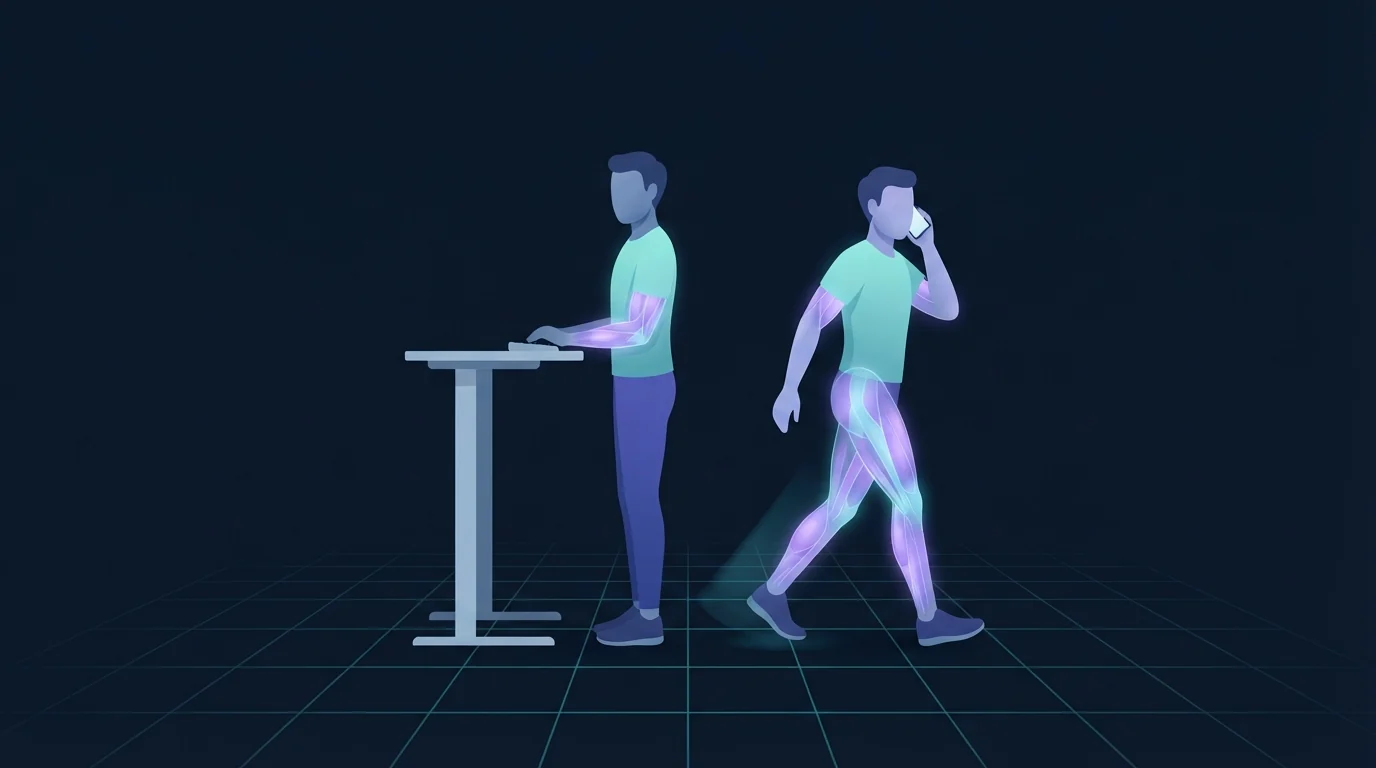
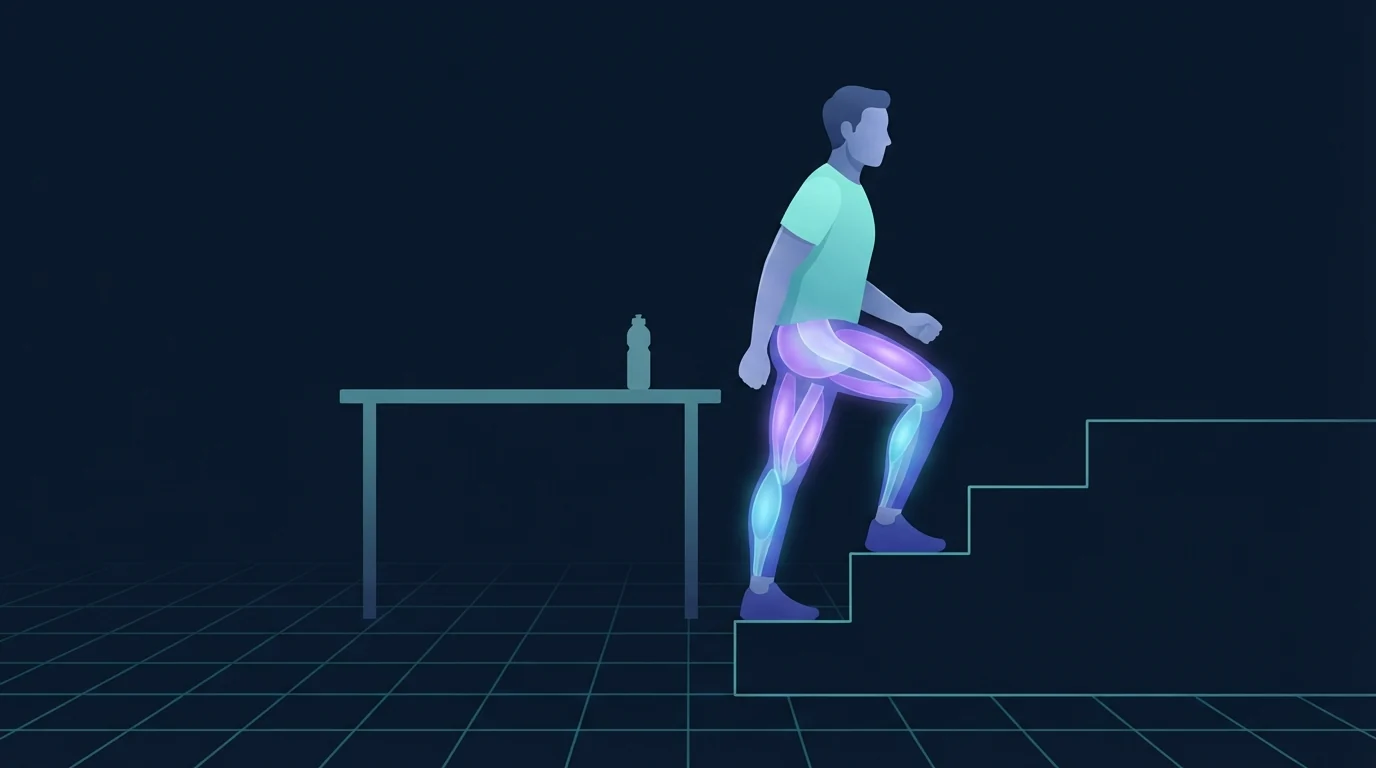
Go back to the compendium for a moment. Desk work is 1.3 METs sitting or standing. Walking at a moderate 2.8 to 3.4 mph is 3.8 METs. Walking briskly at 3.5 to 3.9 mph is 4.8. Stair climbing is 6.8.
For a 170 lb (77 kg) adult that is roughly 100 calories an hour at a desk, in either posture, against about 290 for a moderate walk and 370 for a brisk one. Once you subtract the resting cost you would have paid anyway, one moderate walking hour is worth about seventeen standing hours. This is why the under-desk treadmill exists, and the measurements back it up more convincingly than the standing desk ones do: our review of the walking pad research covers the trials, including the typing accuracy cost you should know about before you buy one.
You don't need equipment for the version that works. Three to five minutes of walking every hour, taken as a hard rule rather than a good intention, adds 30 to 45 minutes of ambulation to a workday and costs more calories than eight hours of standing. It also breaks up sitting time, which is the mechanism most of the sitting research actually points at. Our post on whether walking counts as exercise covers where the threshold sits, and our guide to how many miles to walk a day gives you a target to aim the hourly breaks at.
What standing is genuinely good for
None of this makes the desk a bad purchase. It makes it a bad calorie strategy and a decent postural one, and there is one metabolic finding worth keeping.
Buckley, Mellor, Morris and Joseph (2014) in Occupational and Environmental Medicine ran ten office workers through two afternoons of identical work, one seated and one at a standing desk, after an identical lunch. Standing for 185 minutes cut the area under the postprandial glucose curve by 43%. That is a large effect for such a small intervention, and it lines up with the 2.53 mg/dL fasting glucose drop in the pooled trials.
So the honest case for a standing desk is: it blunts the post-lunch glucose spike, it gives your hips a break from six unbroken hours of flexion, it makes you more likely to step away from the desk because you are already on your feet, and it costs you about a medium apple a day. All four of those are worth having. None of them is weight loss.
What this means for you
If you already own the desk, use it as a trigger rather than a treatment. Stand for the second half of every hour, and let standing be the state you are in when the hourly alarm goes off, because the step from standing to walking is much easier to take than the step from seated. The desk earns its keep by making movement one decision cheaper, not by burning calories while you stand still at it.
If you are buying one hoping it will handle the weight, buy the cheapest one and put the difference into something that moves you. Two or three short strength sessions a week and a deliberate walking habit will do more in a month than the desk does in a year, and the research is not close on that point. If the problem is that the workday has eaten your training time, our roundup of the best workout apps for busy professionals compares the options built around short sessions.
And if you take one number away, make it this one: 9 calories an hour. It is small, it is real, and it is finally an honest answer to a question the internet has been fudging for a decade.
Frequently Asked Questions
Does standing burn calories?
Yes, but only slightly more than sitting does. Saeidifard and colleagues (2018) pooled 46 studies covering 1,184 participants and found standing expended 0.15 kcal per minute more than sitting, which works out to about 9 extra calories an hour. The gap was 0.19 kcal/min in men and 0.1 kcal/min in women. Standing is not a calorie-burning activity in any meaningful sense. It's a slightly less still version of being still.
How many calories do I burn standing for 8 hours?
A 170 lb (77 kg) adult standing at a desk for 8 hours burns roughly 890 calories in total, of which about 85 are extra compared with sitting for those same 8 hours. The total looks large because most of it is your resting metabolism, which you would have spent lying on the sofa. The number that actually belongs to standing is the 85.
Does standing burn more calories than sitting?
It does, by about 0.15 calories per minute (Saeidifard et al., 2018). Over a six-hour stretch that is roughly 54 extra calories for a 65 kg adult, close to the energy in a medium apple. Notably, the 2024 Adult Compendium of Physical Activities assigns desk work the same 1.3 METs whether you do it sitting or standing, because in most measurements the difference is too small to separate the two categories.
Can a standing desk help you lose weight?
Not on its own. Saeidifard and colleagues (2020) pooled nine clinical trials with 877 participants and found that replacing sitting with standing produced a small drop in body fat mass of 0.75 kg and in fasting glucose of 2.53 mg/dL, with no significant change in body weight, waist circumference, blood pressure or lipids. A standing desk is a useful adjunct to a plan that creates a calorie deficit. It isn't the plan.
How many calories does a 1 hour walk burn?
Far more than an hour of standing. Walking at a moderate 3 mph is 3.8 METs in the 2024 Adult Compendium, so a 170 lb (77 kg) adult burns roughly 290 calories in an hour, against about 100 for standing at a desk. Even after subtracting the resting metabolism you would have spent anyway, the walk clears the standing hour by about 180 calories. Movement is what changes the arithmetic, not posture.
What exercise burns the most calories?
Per minute, the highest values in the 2024 Adult Compendium belong to running stairs (15.0 METs), butterfly swimming (13.8), running at 8 mph (12.0) and rope skipping (11.0). For a 170 lb (77 kg) adult, an hour at 12 METs is roughly 920 calories. The practical answer is different from the arithmetic answer, though. The activity that burns the most calories for you is the one you will still be doing in six months.
How many calories do planks burn?
Very few, for the same reason standing burns few. The 2024 Adult Compendium rates light calisthenics including planks at 2.8 METs, so a 170 lb (77 kg) adult holding a plank burns about 3.6 calories a minute, or roughly 7 calories in a two-minute hold. Planks are worth doing for trunk stiffness and shoulder position. They are not worth doing as a calorie strategy.
Does studying burn calories?
Barely more than sitting still does. The 2024 Adult Compendium rates sitting and studying at 1.5 METs against 1.0 for sitting quietly, a difference of roughly 0.5 calories per kilogram per hour. For a 70 kg student that is about 35 extra calories across a full hour of work, and most of it comes from fidgeting and posture changes rather than from the brain itself. Your brain runs at a fairly fixed cost whether it is bored or not.