
Chewing gum is about as low-effort as an activity gets, which is exactly why the question keeps coming up. If your jaw is working, surely something is burning, and if it burns while you sit at your desk, it sounds like free calories.
Something does burn. Your jaw muscles are real muscles, and researchers have measured what they cost in the lab several times since 1999. The numbers are small, they depend on how hard and how fast you chew, and they have to be set against the calories in the gum itself. The more promising question is whether gum changes what you eat, and a handful of randomized trials have tested that.
This page covers the original measurement, what normal chewing burns, whether gum burns off its own calories, what happens when you chew while walking or after a meal, the snacking and weight loss trials, and whether chewing gum every day is healthy.
How many calories does chewing gum burn?
The first direct measurement found that fast, steady chewing burns about 11 extra calories an hour. Levine, Baukol and Pavlidis (1999) at the Mayo Clinic published it as a short report in the New England Journal of Medicine. Seven non-obese volunteers with stable weight sat in a chair and chewed a sugar-free, calorie-free gum (8.4 grams) at 100 chews a minute, kept on pace by a metronome, for 12 minutes while the researchers measured their energy expenditure.
Sitting quietly in the chair, the volunteers burned an average of 58 calories an hour. While chewing, that rose to 70. The average increase was 11 calories an hour, or 19% above their resting rate. For comparison, in the same people standing raised energy use by about 11% and walking at 1 mph raised it by about 106%.
The authors also ran the arithmetic forward. If someone chewed calorie-free gum through every waking hour and changed nothing else, they calculated, the extra burn would add up to about 5 kilograms of fat a year. Nobody chews like that, and the pace in the experiment was much faster than normal chewing, which is why the later studies below matter.
Why 100 chews a minute isn't a normal pace
A hundred chews a minute is close to two chews every second, held without a break. When volunteers in a 2022 study chewed at a pace they chose themselves, they settled at a little over one chew per second. So the 11-calorie figure is best read as the top of the range for a quick, determined chew, rather than what a pack of gum on your desk is doing for you.
Calories burned chewing gum at a normal pace
At an everyday pace, chewing gum burns about 2 to 4 extra calories an hour. Kresge and Melanson (2015) in Applied Physiology, Nutrition, and Metabolism tested 30 young adults on two mornings. On one, they chewed sugar-free gum for three 20-minute sessions, an hour in total, before and after a breakfast shake. On the other, they didn't chew. Fasting energy expenditure was 1.23 calories a minute on the gum day against 1.17 on the no-gum day, and after breakfast it was 1.46 against 1.42. That works out to 0.06 and 0.04 calories a minute, or roughly 2 to 4 calories an hour. Blood glucose and the mix of fat and carbohydrate being burned didn't change.
The most careful look at what drives the cost comes from van Casteren and colleagues (2022) in Science Advances. They had 21 adults chew two tasteless, odourless gum bases, one soft and one stiff, for 15 minutes each while lying still under a ventilated hood that measured their breathing gases. Chewing raised metabolic rate by about 10% above basal levels with the soft gum and about 15% with the stiff one. Muscle recordings showed the stiff gum was chewed slightly more slowly but much harder, so force rather than speed set the cost.
That matters if you want the most out of a habit this small, because a firmer gum costs more than a soft one. The authors put the cost of chewing their stiffer gum at roughly 9 calories an hour. Their main interest was human evolution, since our ancestors chewed tough raw food for hours a day, and they concluded that for modern people chewing is only a small part of the daily energy budget.
| How the gum was chewed | Study | Extra energy use |
|---|---|---|
| Normal pace, sugar-free gum, 30 adults | Kresge and Melanson, 2015 | About 2 to 4 calories an hour |
| Soft gum base, self-chosen pace, 21 adults | van Casteren and colleagues, 2022 | About 10% above resting |
| Stiff gum base, self-chosen pace | van Casteren and colleagues, 2022 | About 15% above resting, roughly 9 calories an hour |
| Fast pace, 100 chews a minute, 7 adults | Levine, Baukol and Pavlidis, 1999 | About 11 calories an hour, 19% above resting |
Does chewing gum burn more calories than it contains?
Usually not by much. Sugar-free gum still carries a few calories from its sweeteners and flavourings. The gum pellets used in a 2021 Japanese walking study, for example, held 3 calories each. Sugared gum carries more, because sugar makes up much of what dissolves as you chew. Chew a 3-calorie piece for an hour at a normal pace and you'll burn roughly what it contained. Chew it hard and fast and you'll come out a few calories ahead.
A common question is whether the label calories count if you don't swallow the gum. The gum base, the rubbery part you eventually spit out, isn't digested. The calories on the label come from the sweeteners and flavourings, and those dissolve into your saliva and get swallowed while you chew. So most of the label calories end up inside you, whether or not the gum does.
Sugar-free gums are usually sweetened with sugar alcohols such as sorbitol and xylitol, which your gut absorbs only partly. That keeps their calories low, and it's also behind the main side effect covered later on this page.
Chewing gum while walking
Chewing gum while you walk seems to nudge your pace up, and a few extra calories come with it. A Japanese research group ran a series of crossover trials on this. In the largest, Hamada and colleagues (2021) had 50 adults aged 22 to 69 walk at a natural pace for 15 minutes on two occasions: once while chewing two pellets of gum, and once after taking tablets with the same ingredients minus the gum base.
With gum, they covered 1,138 metres on average against 1,121 without, took slightly more steps and walked a little faster. Heart rate during the walk was 104 beats a minute against 102. Energy expenditure over the 15 minutes was 63.4 calories with gum and 60.3 without, a difference of about 3 calories. The effects were clearest in participants aged 40 and over. An earlier trial from the same group with 46 participants (Hamada and colleagues, 2018) found the extra distance and energy use mainly in men aged 40 and over, and a 15-person trial (Kanno and colleagues, 2019) also measured more fat burned during the walk.
Keep two things in mind. The gains are small: about 17 extra metres and 3 extra calories in a quarter of an hour. And a gum manufacturer helped design the 2021 study. Three of its authors worked for the company and the lead researcher received a research grant from it, all of which the paper discloses. The results are plausible, since a steady chewing rhythm can set a walking rhythm, but they're a reason to go for the walk rather than a reason to buy gum.
Does chewing gum after a meal burn more calories?
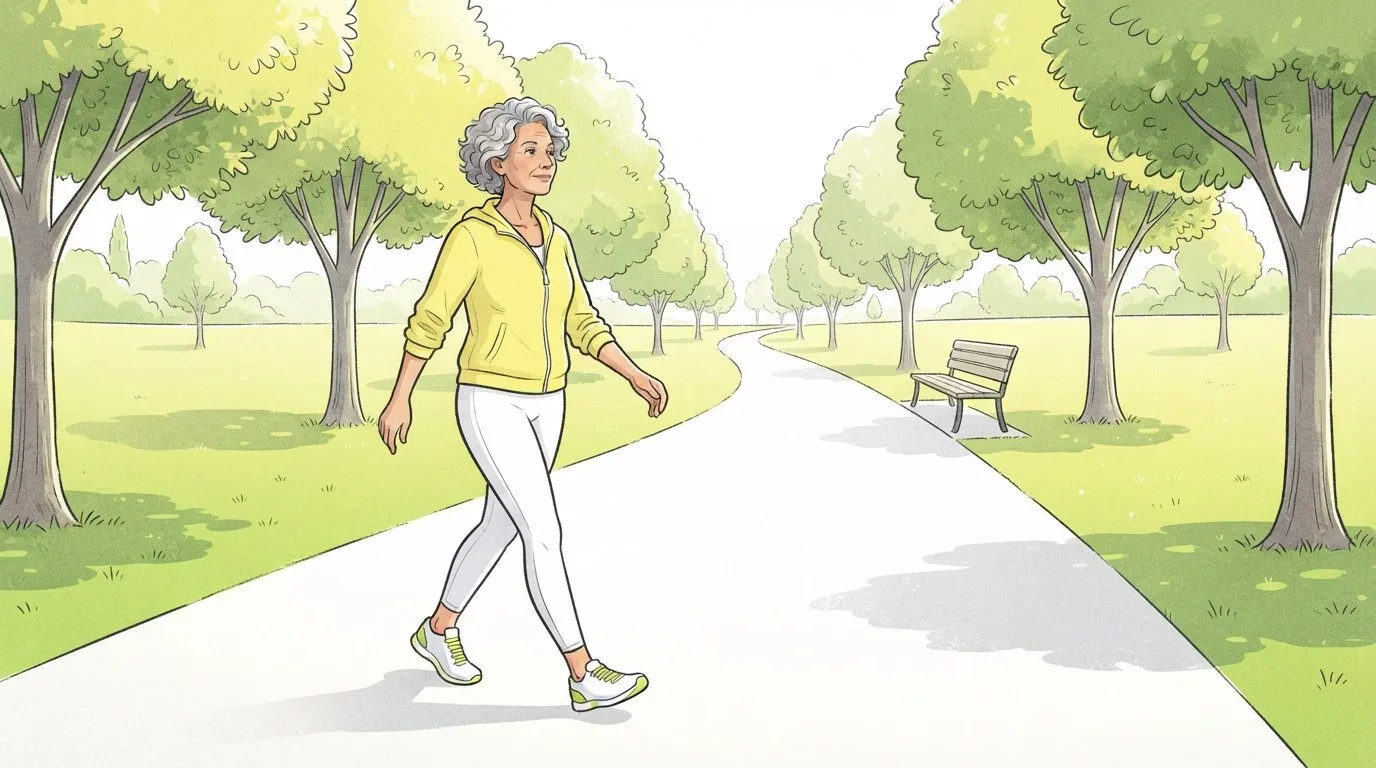
A little. Digesting a meal raises your energy use for a few hours, a cost called diet-induced thermogenesis, and chewing appears to add to it. Hamada, Miyaji and Hayashi (2016) in Obesity gave 12 healthy men the same 621-calorie meal on four days. They ate it either quickly or slowly, and afterwards they either chewed a 3-calorie gum for 15 minutes or took the same 3 calories as sugar with the meal. Post-meal thermogenesis was greater on the gum days whether they had eaten fast or slow.
The same study found that eating the meal slowly, with many chews per bite, raised thermogenesis by more than the gum did. If you want the chewing effect, you'll get more of it from chewing your food thoroughly than from a stick of gum afterwards. A short walk after eating is a better use of that window still, and our post on walking after meals covers what it does for blood sugar.
Knowing what to do is the easy part.
FitCraft, our mobile fitness app, pairs you with an AI coach who builds you a personalized plan around your goals, schedule, and fitness level. Every FitCraft program is designed by Domenic Angelino, MPH (Brown University) and NSCA-CSCS, with research published in the Journal of Strength and Conditioning Research and Medicine & Science in Sports & Exercise.
Take the Free Assessment Free • 2 minutes • No credit cardDoes chewing gum reduce snacking?
Sometimes, by a small amount. This is the part of the gum story with the most trials, and the results lean modestly positive for appetite and mixed for how much people actually eat.
Hetherington and Boyland (2007) brought 60 young adults into the lab four times for lunch. On some days they chewed gum for 15 minutes every hour afterwards, and on others they didn't. Three hours later they were offered sweet or salty snacks. After gum they ate 402 calories of snacks on average against 438 without, a reduction of 36 calories. Hunger rose less across the afternoon on gum days, and so did the desire for sweet snacks, though the desire for salty ones didn't change.
A follow-up with 60 moderately restrained eaters, Hetherington and Regan (2011), found that chewing gum for at least 45 minutes across the afternoon cut the weight of snack eaten by 10% and lowered hunger and cravings. Park and colleagues (2016) tested 50 women, half of them with obesity. Gum suppressed hunger and trimmed snack calories by about 9%, a difference that fell just short of statistical significance, while carbohydrate intake did drop.
Other trials found nothing. In Julis and Mattes (2007), 47 people chewed sweetened gum after a fixed lunch, either at a set time or when they felt hungry, and their appetite, meal timing and food intake matched the days without gum. In Swoboda and Temple (2013), people who chewed gum before every eating occasion for two weeks ate fewer meals but larger ones, so their total intake didn't change. Mint gum also put them off fruit, and the overall quality of their diet fell.
A 2025 systematic review by Jiménez-Ten Hoevel and colleagues in Nutrients pulled nine randomized trials together. Five of the seven that measured hunger found gum suppressed it, and three of four found it reduced the desire for a sweet snack. Effects on fullness, total calories eaten and body weight weren't conclusive.
How to use gum against snacking
- Time it. Chew when your snacking usually starts, such as mid-afternoon or after dinner, instead of all day.
- Mind the flavour. Pick one that won't clash with food you want to eat, since mint made fruit less appealing in one trial.
- Use it as a pause. Gum can carry you past a craving. It can't replace a meal, so if you're truly hungry, eat.

Can chewing gum help you lose weight?
Not on its own, according to the largest weight-loss trial. Shikany and colleagues (2012) in Obesity randomized 201 adults with overweight or obesity to eight weeks of printed nutrition advice, with or without chewing gum for at least 90 minutes a day. More than 95% of the gum group stuck to the chewing schedule. Neither group's weight or BMI changed meaningfully, and the gum group's small drops in waist size and blood pressure weren't different from the control group's.
Compare that with the 5 kilograms a year the 1999 calculation suggested. Even with people chewing faithfully for an hour and a half every day, no weight loss showed up over two months. At a normal pace, 90 minutes of chewing burns only about 3 to 6 extra calories, so the result isn't surprising.
Is it healthy to chew gum every day?
For most people it is, in normal amounts. The main side effect comes from the sweeteners. Sorbitol, a common sugar alcohol in sugar-free gum, pulls water into the gut, and large amounts act as a laxative. Bauditz and colleagues (2008) described two patients in the BMJ who developed chronic diarrhoea and lost about 20% of their body weight without trying, traced to sugar-free gum and sweets. One was taking in 18 to 20 grams of sorbitol a day from gum, at about 1.25 grams per stick. The other got about 30 grams a day from 20 sticks of gum plus sweets. Both recovered on a sorbitol-free diet, and the authors noted that about 20 grams of sorbitol causes diarrhoea in roughly half of healthy people.
That puts ordinary use in perspective. Two pieces of gum a day carry around 2.5 grams of sorbitol, far below the amounts in those cases. An hour of chewing mostly leaves your jaw a little tired. If you have jaw pain or clicking, check with a dentist before making gum an hours-long habit.
Sugar-free gum also has a dental upside. A 2020 meta-analysis by Newton and colleagues of 12 trials found that chewing sugar-free gum reduced the growth of tooth decay by 28%, though the trials varied a lot in quality. Gum sweetened with sugar doesn't share that benefit, because it keeps your teeth in contact with sugar for as long as you chew.
Lazy ways to burn calories that beat chewing gum
Gum, standing and fidgeting all belong to the same category: small movements that add to the part of your daily burn researchers call NEAT, the energy you spend moving around outside of exercise. Our post on whether standing burns calories covers how much posture adds to it, and our look at whether thinking burns calories explains why mental effort barely registers at all.
If you want low-effort options that outperform an hour of gum, these do it in minutes:
- Walk during phone calls. In the 1999 Mayo Clinic study, a 1 mph stroll added about 60 calories an hour, more than five times the fastest chewing.
- Take the stairs. Climbing a few flights works the largest muscles in your body instead of the smallest.
- Add a few bodyweight moves between tasks. A minute of squats, wall push-ups or lunges every hour or two adds up across a day.
- Walk after you eat. Ten minutes after a meal does more than a stick of gum in the same slot.
If "lazy" is an honest description of how you feel about exercise, you're not alone, and it's usually a design problem more than a character flaw. Our roundup of the best workout apps for lazy people compares the options that make starting easiest, and our guide to losing weight without exercise covers the eating side for weeks when workouts aren't happening.
Where gum fits in your routine
Chew gum if you like it. It burns a few calories an hour, it may take the edge off an afternoon craving, and the sugar-free kind is good for your teeth. Just don't expect it to show up on the scale. The largest trial that tested it for weight loss found nothing, and the calories involved are smaller than a single bite of most snacks.
The habits that do move the number are the ones gum can't stand in for: regular strength and cardio sessions, more walking, and meals you've planned ahead. Stacy, 41, explained what made the difference for her: "After my second kid, I needed something stupidly simple." That's the right test for any habit you want to keep.
FitCraft is built around that idea. Its 3D AI coaches demonstrate each exercise and coach you through dumbbell and bodyweight workouts at home, and leaderboards and streaks give you a reason to come back the next day.
Frequently Asked Questions
Does chewing burn calories?
Yes. Chewing works your jaw muscles, and chewing gum raised energy use 10 to 15% above resting in a 2022 study and 19% at a fast 100 chews a minute in a 1999 study. That's roughly 2 to 11 extra calories an hour, depending on your pace and how firm the gum is. Chewing a meal thoroughly also raises the calories you burn digesting it.
What happens if I chew gum for 1 hour?
You'll burn about 2 to 11 extra calories, depending on how fast and how hard you chew, and your jaw may feel tired. An hour of sugar-free gum also means swallowing its sweeteners. At around 1.25 grams of sorbitol per stick, a few sticks are fine, but very large daily amounts can cause diarrhoea.
Is 2 pieces of gum a day too much?
No. Two pieces of sugar-free gum contain roughly 2.5 grams of sorbitol, far below the 20 grams that causes diarrhoea in about half of people. Two pieces also add only a few calories. The problems in published case reports came from 18 grams or more of sorbitol a day.
What is the unhealthiest gum?
Gum sweetened with sugar is the worst choice for your teeth, because it keeps sugar in contact with them for as long as you chew. Sugar-free gum reduced tooth decay by 28% in a 2020 meta-analysis of 12 trials. With sugar-free gum, the thing to watch is quantity, because large amounts of sugar alcohols can upset your stomach.
Does the calorie count in gum assume you swallow it?
No. The calories on the label come from the sweeteners and flavourings, which dissolve into your saliva and get swallowed as you chew. The gum base you spit out isn't digested. So you take in most of the label calories even if you never swallow the gum itself.
What are some lazy ways to burn calories?
Walking during phone calls, taking the stairs, a short walk after meals and a few minutes of bodyweight moves between tasks all beat chewing gum. In the 1999 Mayo Clinic study, a 1 mph stroll added about 60 calories an hour, more than five times what fast chewing burned.