The reverse lunge to knee drive (the rear lunge knee drive in the FitCraft app) combines a reverse lunge with a controlled knee lift, so it trains quads, glutes, hamstrings, hip flexors, lower abs, and single-leg balance. The defining cue is simple: step back under control, drive through the front heel, then pause tall with the knee lifted before the next rep. Use it after you already own basic reverse lunges. Beginners should split it into reverse lunges and standing knee drives; advanced athletes can use continuous intervals, light dumbbells, or a hop progression.
Most lunge variations ask you to step back, stand up, and reset. The rear lunge knee drive keeps the rep moving. You lower into the lunge, push the floor away, drive the rear knee up, and hold your balance before you step back again.
Quick Facts: Rear Lunge Knee Drive
- Equipment needed: None
- Difficulty: Intermediate to Advanced
- Modality: Conditioning, strength, balance
- Body region: Lower body and core
- FitCraft quest category: Cardio
Muscles & Systems Worked
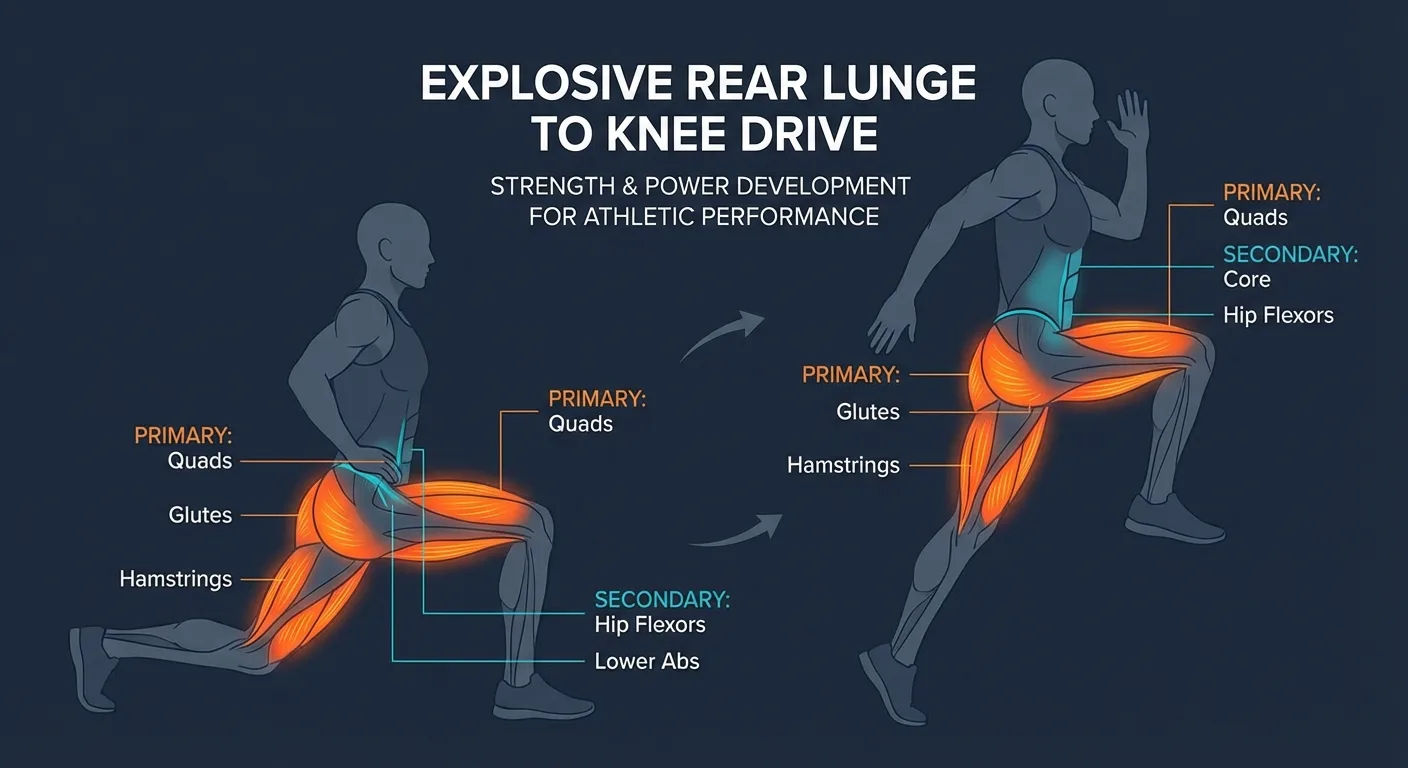
Primary movers: the quadriceps, gluteus maximus, and hamstrings drive the reverse-lunge phase. They lengthen under tension as you lower, then shorten as you push back to standing.
Secondary movers: the hip flexors, especially the iliopsoas and rectus femoris, lift the knee at the top. The lower abs help control pelvic position so the knee drive comes from the hip instead of a backward lean.
Stabilizers: the gluteus medius keeps the pelvis from dropping, the calves and ankle stabilizers control foot pressure, and the core muscles resist side-to-side sway. Spinal erectors keep the torso tall while the working leg changes from braking to driving.
Conditioning mechanism: this exercise alternates eccentric braking, concentric leg drive, and brief single-leg balance. Repeated quickly, that combination taxes the phosphocreatine and glycolytic systems first, then pulls more heavily on breathing and aerobic recovery as the interval continues.
Think of it as a reverse lunge and a standing knee raise fused into one movement. The first half builds lower-body force. The second half tests whether you can control that force on one leg.
Step-by-Step: How to Do a Rear Lunge Knee Drive
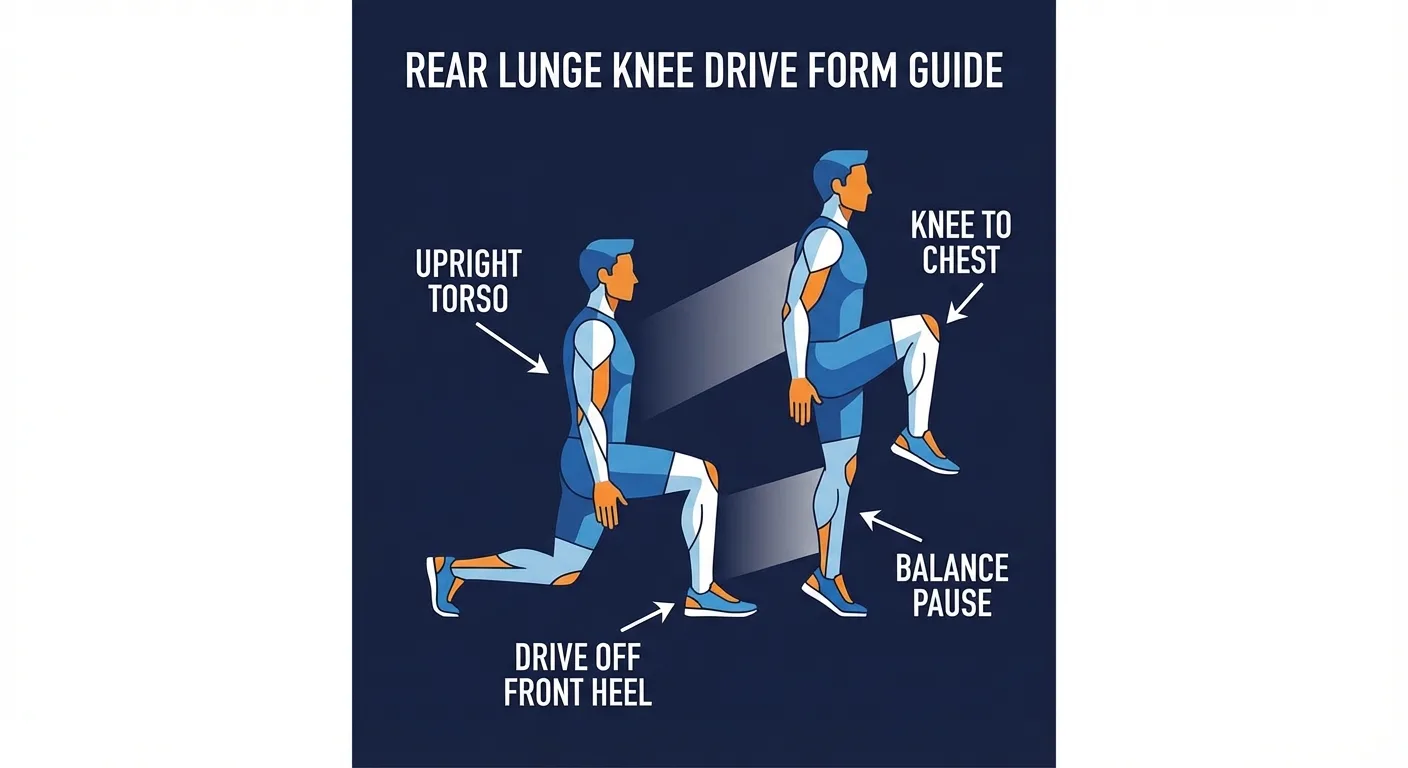
- Start standing tall. Feet hip-width apart, core braced, shoulders stacked over hips. Hands can stay at your sides or in front of your chest for balance.
- Step back into a reverse lunge. Take a controlled step back with one leg. Lower your back knee toward the floor until your front thigh is close to parallel. Keep the front heel heavy and the front knee tracking over the middle toes.
- Drive through the front foot. Push the floor away through the front heel and midfoot. Coach Ty's cue: "Down quiet, up sharp."
- Drive the back knee up. Sweep the back leg forward and lift the knee toward your chest. Hold for a beat at the top, keeping your ribs down and your standing knee soft.
- Return and repeat. Lower the lifted knee and step back into the next rep. Finish all reps on one side before switching, or alternate legs for a faster conditioning set.
Common Mistakes (And How to Fix Them)
Pushing Off the Toes
What it looks like: You rise from the lunge by rolling onto the ball of the front foot.
Why it's a problem: Toe-dominant push-off shifts the rep toward the quad and calf while reducing glute drive.
The fix: Keep the front heel heavy as you stand. Feel pressure through the heel and big-toe base together.
Letting the Knee Cave In
What it looks like: The front knee drifts toward the midline as you lower or drive up.
Why it's a problem: Poor knee tracking adds stress to the knee and usually means the hip is losing control.
The fix: Aim the knee over the second and third toes. Slow the rep down until that line stays steady.
Rushing the Knee Drive
What it looks like: The knee snaps up and drops immediately.
Why it's a problem: Momentum does the work, and you miss the hip-flexor and core-control benefit.
The fix: Pause for one full beat at the top. If you can't hold the top position, use the regression.
Leaning Back at the Top
What it looks like: You drive the knee high by arching your lower back and pushing the ribs forward.
Why it's a problem: It turns the knee drive into a compensation pattern and can irritate the low back.
The fix: Keep ribs stacked over hips. Lift the knee only as high as you can without changing torso position.
Get this exercise in a personalized workout
FitCraft, our mobile fitness app, uses its AI coach Ty to program conditioning work like this into your plan at the right volume and intensity, based on your level, goals, and equipment. Ty was designed and trained by Domenic Angelino, MPH (Brown University) and NSCA-CSCS, with research published in the Journal of Strength and Conditioning Research and Medicine & Science in Sports & Exercise.
Take the Free Assessment Free • 2 minutes • No credit cardRear Lunge Knee Drive Variations: Regressions and Progressions
Reverse Lunge + Reset
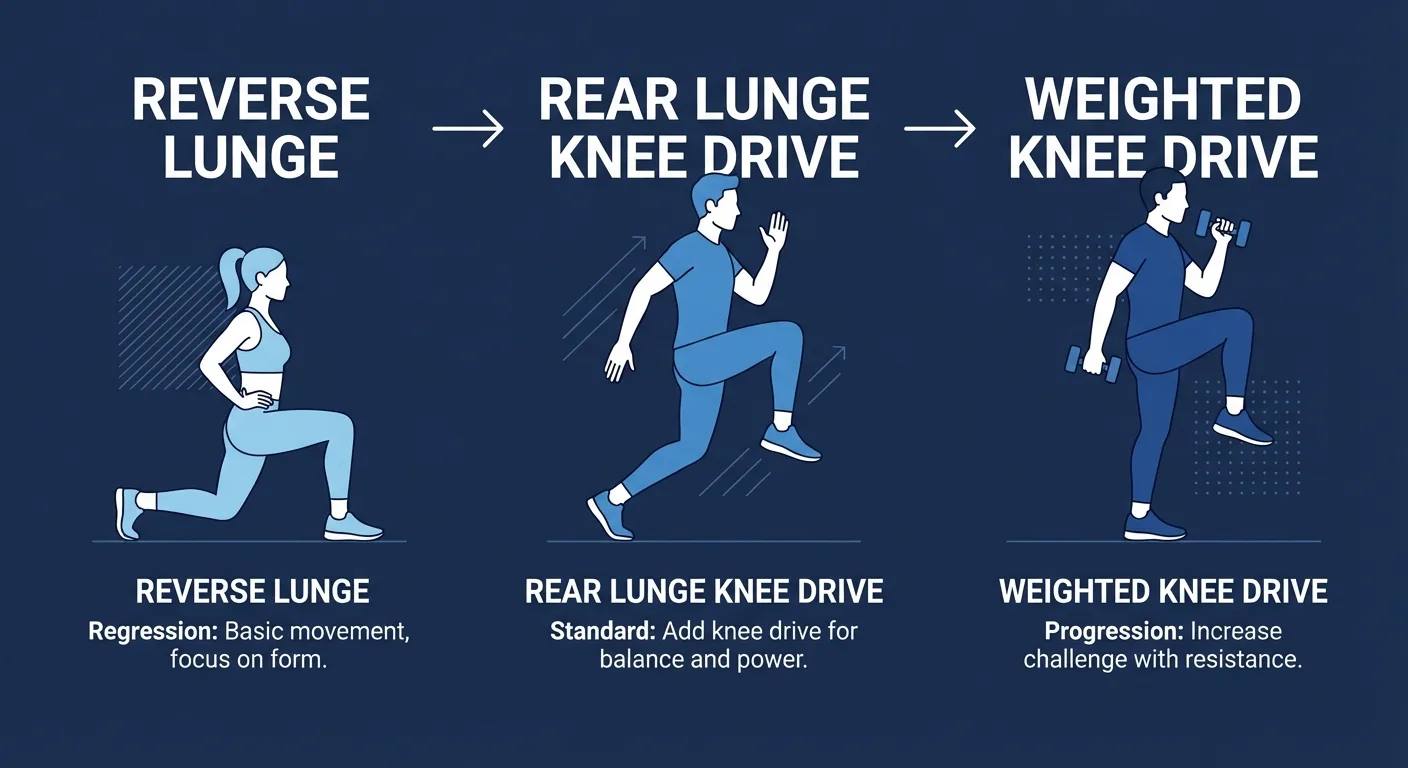
Step back, stand up, and place both feet on the floor before the next rep. Use this when balance is the limiting factor.
Standing Knee Drive
Practice the top half by itself. Stand tall, drive one knee up, pause, and lower with control. This pairs well with marching in place if you need a lower-impact conditioning option.
Standard Rear Lunge Knee Drive
Link the reverse lunge and knee drive without touching the rear foot down between phases. This is the main version for strength, balance, and conditioning.
Rear Lunge Knee Drive with Hop
After the knee drive, add a small hop from the standing leg. This turns the movement into a plyometric progression and should be reserved for athletes with quiet landings.
Light Dumbbell Rear Lunge Knee Drive
Hold light dumbbells at your sides. Start lighter than you think because the load makes the transition and top-position balance much harder.
When to Avoid or Modify Rear Lunge Knee Drives
Rear lunge knee drives are useful for healthy adults with a base of lunge strength, but a few situations call for a lower-impact or slower variation. Always consult your physician or physical therapist for personalized guidance.
- Active knee, hip, ankle, shin, or foot pain. The lunge and knee drive both load the lower limb. Substitute step-n-lunges or slow reverse-lunge resets until symptoms settle.
- Known cardiovascular disease or uncontrolled hypertension. Fast intervals can spike heart rate and blood pressure. Get medical clearance and stay within prescribed zones.
- Pregnancy or early postpartum recovery. Balance changes, joint laxity, and pelvic-floor recovery make the explosive version a poor fit. Use low-impact marching or supported lunges after clinical clearance.
- Stress incontinence or pelvic-floor symptoms. Use non-impact versions and keep breathing smooth. Pelvic-floor symptoms are a reason to work with a qualified clinician.
- Vertigo, balance disorders, or vestibular symptoms. The top-position balance demand increases fall risk. Use a wall-supported standing knee drive or marching variation.
- Exercise-induced bronchoconstriction or asthma. Keep medication accessible if prescribed, extend your warm-up, and reduce interval intensity when breathing feels uncontrolled.
Related Exercises
Use these movements to build the same pattern from lower impact to higher power:
- Lower-impact alternative: Step-N-Lunge keeps the lunge pattern but removes the explosive knee drive.
- Conditioning neighbor: High Knees trains fast hip flexion and upright rhythm without the lunge phase.
- Core stability foundation: Forearm Planks build the trunk stiffness needed to keep the knee drive clean.
- Ankle and calf capacity: Calf Raises and Calf Hops prepare the lower leg for sharper push-offs.
- Hip mobility prep: Hip Abductor Stretch helps the hip move cleanly during single-leg transitions.
How to Program Rear Lunge Knee Drives
Rear lunge knee drives work best as timed conditioning or short power intervals. The broader progression model from the ACSM resistance-training position stand by Ratamess et al., 2009 still applies: match work, rest, frequency, and progression to the athlete's current tolerance.
| Level | Work | Rest between sets | Frequency |
|---|---|---|---|
| Beginner | 20-30 sec using reverse-lunge resets or standing knee drives | 60-90 sec | 2-3 sessions/week |
| Intermediate | 30-45 sec continuous rear lunge knee drives | 45-60 sec | 3-4 sessions/week |
| Advanced | 45-60 sec continuous, light loaded, or hop-based reps | 30-45 sec | 3-5 sessions/week |
Where in your workout: use rear lunge knee drives after strength training as a 5-10 minute finisher, inside a standalone HIIT circuit, or before low-intensity cardio. Avoid placing them before heavy squats, lunges, or jumps because they can fatigue the exact muscles and balance systems those lifts need.
Form floor over time targets: stop the interval when knee tracking, torso position, or the top-position pause breaks down. Clean reps matter more than finishing the clock.
Frequently Asked Questions
Can I do rear lunge knee drives with knee pain?
Avoid the full rear lunge knee drive during active knee pain, swelling, or recent knee injury. Use supported reverse lunges, step-n-lunges, or marching in place until you can control knee tracking without pain, and get medical or physical therapy guidance if symptoms persist.
What muscles do rear lunge knee drives work?
Rear lunge knee drives train the quads, glutes, and hamstrings during the lunge, then shift work to the hip flexors and lower abs during the knee drive. The glute medius, calves, ankle stabilizers, and core keep you balanced on one leg.
Is the rear lunge knee drive cardio or strength?
It can serve either goal. Slow sets with full control build single-leg strength and balance, while continuous timed intervals turn it into conditioning work that raises heart rate quickly.
How is this different from a regular reverse lunge?
A reverse lunge ends when you stand back up. A rear lunge knee drive adds a knee lift at the top, which brings in the hip flexors, lower abs, and single-leg balance demand.
Do I need weights for rear lunge knee drives?
No. Bodyweight is the standard version because balance and clean knee drive matter more than load. Add light dumbbells only after you can keep your torso upright, front knee stable, and top position controlled.