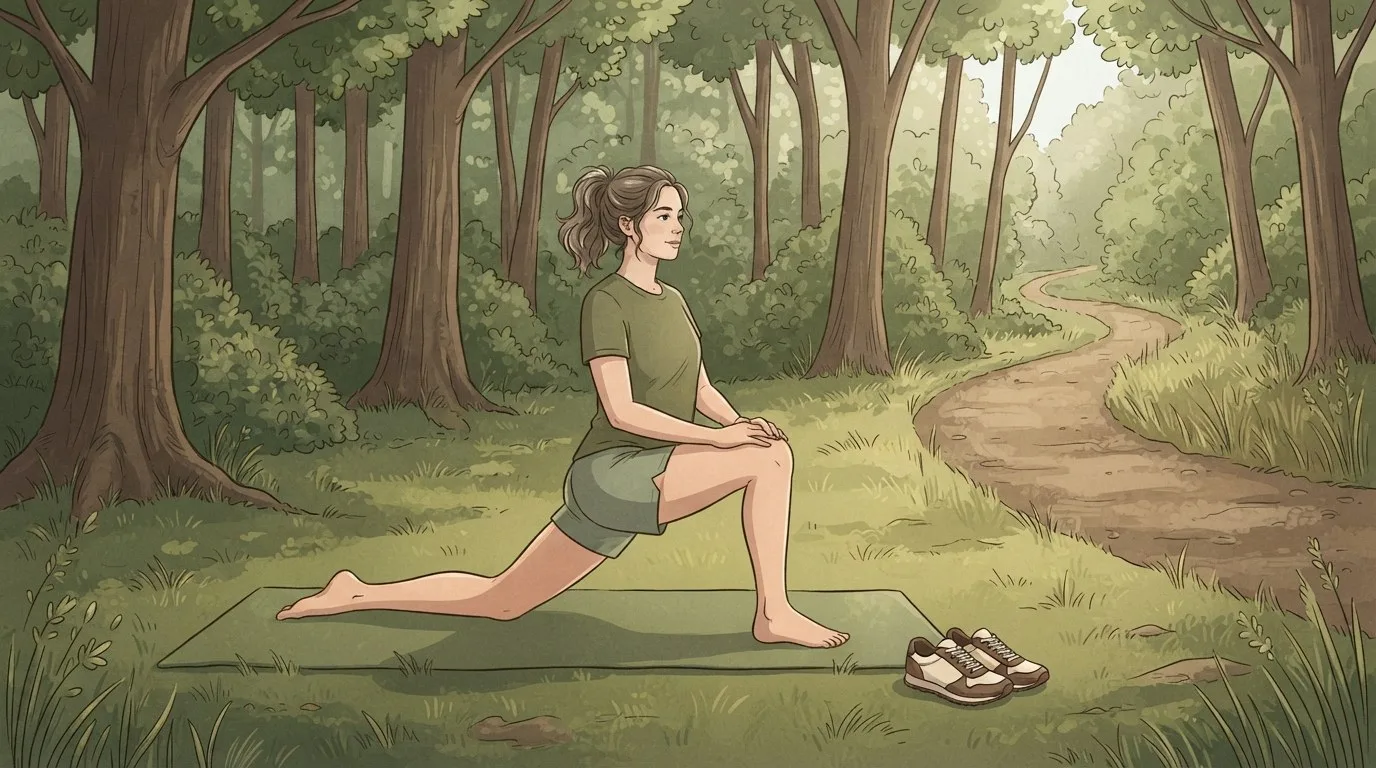
Every runner knows the list. Run, stretch, foam roll, do your strength work, maybe add yoga. Most of us run, skip the rest and promise to catch up next week. Then the hips feel locked, the hamstrings feel short, and a familiar ache shows up a few miles into a long run.
When the run is the main event, everything else feels optional. A 60-minute yoga class on a rest day competes with sleep, work and family, and it usually loses. So the mobility work that would make running feel better never becomes a habit.
Yoga for runners works when it's short, specific and scheduled around your runs. That means a few minutes of moving poses before some runs, longer holds after easy ones, and a handful of balance poses for the hips that steady every stride. Below are the yoga poses for runners that earn their place, two ready-made sequences, and what the trials in runners and athletes actually found.
What Yoga Does for Runners, According to the Trials
Yoga research in runners is thinner than the number of yoga-for-runners videos would suggest. There are a handful of small trials in runners and athletes, and they point in a consistent direction. Yoga reliably improves flexibility and balance. It has little measurable effect on running economy, and nobody has yet tested whether it prevents injuries.
Flexibility and balance in athletes
The clearest trial in athletes is Polsgrove, Eggleston and Lockyer (2016), in the International Journal of Yoga. Fourteen male college athletes added two yoga sessions a week for 10 weeks, and 12 teammates added nothing. The yoga group improved sit-and-reach, shoulder flexibility and a single-leg stork-stand balance test, while the comparison group didn't change. They also reached deeper joint angles in the poses themselves, including more ankle bend in a lunge and more hip and knee extension in downward dog.
A 2025 systematic review of yoga in track and field athletes by Singh and colleagues, in the Journal of Bodywork and Movement Therapies, found the same pattern. Programs of two to four sessions a week for 8 to 15 weeks produced significant gains in flexibility and balance and moderate gains in strength. Some of the included studies found little effect on stress or performance, and the authors rated the overall study quality as fair.
Running economy and breathing
Yoga breathing gets a lot of credit in running circles, and one lab has tested it directly. In Seltmann and colleagues (2020), 11 runners practiced three styles of pranayama for 30 minutes a day, six days a week, for three weeks, while 10 runners did nothing new. The breathing group improved two lung-function measures, forced vital capacity and the air they could blow out in one second. Their running economy at 60, 70 and 80 percent of VO2 max didn't change. Their legs did feel a little easier at the hardest pace.
A follow-up from the same lab, Clifton and colleagues (2023), let 21 runners choose their own treadmill speed at a set effort. After three weeks of the same breathing practice, the yoga group picked faster speeds at both an easy and a hard effort, and the control group didn't. Both studies were small, and neither was described as randomized. Read them as a hint that breathing practice may change how hard running feels, with no evidence yet that it makes you more economical. Our guide on how to breathe while running covers breathing on the run itself.
Should you chase more flexibility for its own sake? Probably not. Several studies have found that stiffer distance runners tend to be slightly more economical, and our guide to the best stretches for runners walks through that evidence. For yoga, the practical takeaway is to aim for comfortable range in the hips and hamstrings and leave extreme splits to dancers.
Race-day performance
One small trial tested yoga right before a run. Donohue and colleagues (2006), in the British Journal of Sports Medicine, timed 90 high school distance runners over a mile, then a week later randomly assigned them to brief yoga exercises, a motivational shouting routine or nothing, about 20 minutes before a second timed mile. The yoga group ran significantly faster than the control group, though the effect was small. The fired-up motivational group improved the most. A short yoga routine before a hard effort seems harmless at worst, and the runners liked it.
Injuries
Here the evidence runs out. Xu and colleagues (2022) gave collegiate athletes two 90-minute yoga classes a week for 12 weeks and found bigger gains than a control group on the Functional Movement Screen, especially in the deep squat, shoulder mobility and trunk stability push-up. The authors were careful to say more evidence is needed before linking those scores to fewer injuries. Stretching on its own hasn't prevented injuries in large trials, while strength training has, and the best-stretches guide linked above covers those numbers. Treat yoga as mobility and recovery work that sits next to your strength training, not in place of it.
Does Yoga Build Stamina for Running?
Not much. Hagins, Moore and Rundle (2007), in BMC Complementary and Alternative Medicine, measured 20 experienced practitioners inside a metabolic chamber during a 56-minute beginner hatha video. The session averaged 2.5 METs and about 49 percent of predicted maximum heart rate, roughly the effort of walking at 2 miles per hour. The sun salutations were the most demanding part, and the authors suggested that 10 minutes or more of them might add some useful intensity for unfit beginners.
For a runner, that's useful to know. Yoga days are recovery days for your heart and lungs, and your aerobic engine still gets built by running. If you want yoga to feel more athletic, flowing sun salutations are the part that raises your heart rate, but they won't replace an easy run.
The Best Yoga Poses for Runners
Runners need range in three places, the hip flexors, the hamstrings and the calves, plus strength in the glutes that hold the pelvis level when you land on one leg. These poses cover all four. Each links to a form guide where we have one.
| Pose | What it targets for runners | Best time |
|---|---|---|
| Downward dog | Calves, hamstrings, the whole back line | Before and after |
| Low lunge | Hip flexors of the back leg | After, or moving before |
| Half splits | Hamstrings of the front leg | After |
| Half pigeon | Glutes and outer hip | After or rest days |
| Bound angle (butterfly) | Inner thighs | After or rest days |
| Warrior 3 | Glutes, hamstrings, single-leg balance | Before or rest days |
| Tree pose | Side of the hip, foot and ankle control | Before |
| Chair pose | Quads and glutes | Before |
| Bridge | Glutes and the backs of the legs | After or rest days |
| Legs up the wall | Rest for tired legs | After long runs |
For tight hip flexors and hamstrings
Downward dog is the runner's all-in-one pose: pressing the heels toward the floor stretches the calves, and lifting the sitting bones stretches the hamstrings. Pedal your feet, bending one knee and then the other, to find the tight side. A low lunge targets the hip flexors at the front of the back leg, the muscles that pull your knee through each stride. Half splits follow naturally: shift your hips back over the rear knee, straighten the front leg, flex that foot and hinge forward with a long back.
For the glutes and outer hips
Half pigeon stretches the glutes of the front leg, which take a beating on hills and long runs. Slide a folded blanket under the front hip if it floats, so the stretch lands in the hip rather than the knee. Butterfly pose opens the inner thighs, a spot many runners never stretch.
For single-leg strength and balance
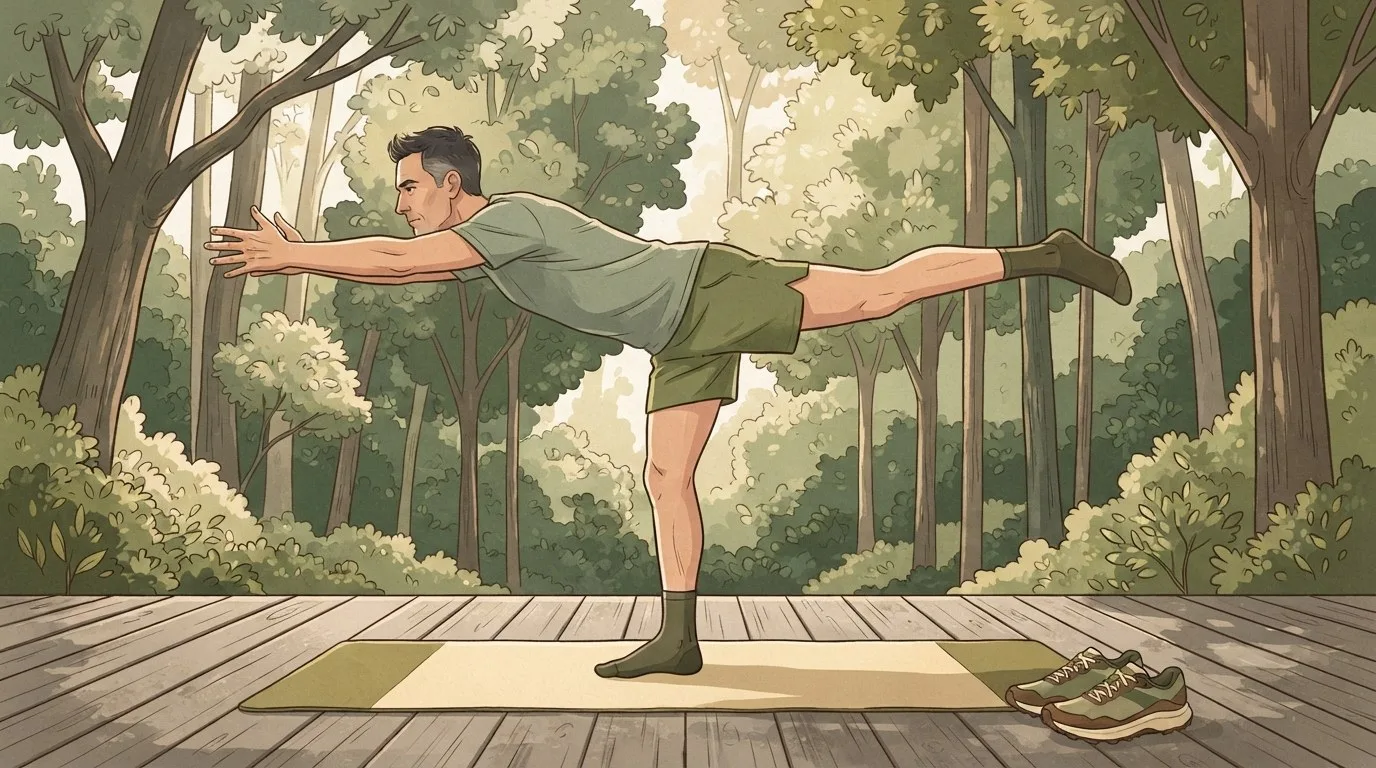
Running is a series of single-leg landings, so standing balances earn their place. Lehecka and colleagues (2021), in the International Journal of Sports Physical Therapy, measured glute activity with EMG in 31 healthy adults across five poses: tree, warrior 2, warrior 3, half moon and bird dog. Half moon and warrior 3 ranked highest for both muscles. The gluteus maximus of the lifted leg reached 63.3 percent of maximum in half moon and 46.1 percent in warrior 3, and the lifted leg's gluteus medius reached about 42 percent in both.
That's meaningful work for the hip muscles that keep your pelvis level when you land. Tree pose trains the same side-of-hip control at a gentler level, and chair pose loads the quads and glutes together. Hold each for five slow breaths per side and use a wall until you're steady.
A 10-Minute Pre-Run Yoga Flow
Before a run, the goal is warm, mobile hips and awake glutes, not deep stretching. Move with your breath and hold nothing for longer than a few breaths. Kay and Blazevich (2012), in Medicine & Science in Sports & Exercise, reviewed 106 studies and found that static stretches held for 60 seconds or longer can briefly reduce maximal muscle force, while holds under 60 seconds generally didn't. Short holds keep you on the safe side.
- Standing reach and fold (1 minute). Breathe in as you sweep your arms overhead, breathe out as you fold forward with soft knees. Six to eight rounds.
- Downward dog with pedaling (1 minute). Bend one knee while pressing the other heel down, then switch, one breath per side.
- Lunge to half splits (2 minutes). From a low lunge, breathe in as you shift forward into the hip, breathe out as you shift back over the rear knee and straighten the front leg. Five slow rounds per side.
- Plank to cobra to downward dog (1.5 minutes). Lower from plank to the floor, lift into a low cobra, then press back to downward dog. Four rounds.
- Chair pose pulses (1 minute). Sit back into chair pose and rise to standing eight times, heels down.
- Tree pose (1.5 minutes). Five breaths per side, then rise onto the ball of your standing foot for one more breath to wake up the calf.
- Warrior 3 (1.5 minutes). Three breaths per side, twice, with a hand on a wall or a tree if you need it.
- Deep squat (30 seconds). Feet wider than your hips, heels down or on a folded towel, elbows gently pressing the knees apart.
Save this flow for easy runs, long runs and the 10 minutes before a workout's warm-up jog. Before intervals or a race, keep it to the moving parts and start your usual jogging warm-up afterward.
Find out what's really holding you back
FitCraft, our mobile fitness app, pairs you with an AI coach who builds you a personalized plan around your goals, schedule, and fitness level. Every FitCraft program is designed by Domenic Angelino, MPH (Brown University) and NSCA-CSCS, with research published in the Journal of Strength and Conditioning Research and Medicine & Science in Sports & Exercise.
Take the Free Assessment Free • 2 minutes • No credit cardA 20-Minute Post-Run Yoga Sequence
After an easy run, or in the evening on a rest day, you can hold poses longer. This is where yoga earns its keep as recovery. Petviset and colleagues (2025), in the International Journal of Exercise Science, had 20 male university athletes recover from a 30-minute interval session with 15 minutes of yoga on one day and 15 minutes of static stretching on another. After yoga, their breathing rate dropped faster at 5, 10 and 15 minutes, and their heart rate variability, a marker of the body shifting toward rest, was higher at 5 and 10 minutes. The authors credit the breathing, rhythmic movement and relaxation built into yoga.
- Child's pose with slow nasal breathing (2.5 minutes). Knees wide, arms long. Lengthen each exhale until your breathing settles.
- Downward dog (1.5 minutes). Pedal for 30 seconds, then hold with both knees soft for the rest.
- Low lunge (2 minutes). One minute per side, back knee on a folded towel, hips easing forward until you feel the front of the back hip.
- Half splits (2 minutes). One minute per side with your hands on books or blocks, front foot flexed and back long.
- Half pigeon (3 minutes). Ninety seconds per side, chest upright for the first half, then folding forward onto your forearms.
- Butterfly (2 minutes). Sit tall on a folded blanket, soles together, and let your knees fall open on their own.
- Bridge (2 minutes). Three holds of 20 seconds with rests between, squeezing the glutes at the top.
- Reclined twist (2 minutes). One minute per side, shoulders heavy on the floor.
- Legs up the wall (3 minutes). Hips close to the wall, legs resting up it, arms by your sides. A good way to finish after a long run.
Hold each stretch at a point of firm but comfortable tension and breathe slowly. If anything pinches, especially at the sit bone in half splits or at the knee in half pigeon, ease out and use more support. New to yoga? Our guide to yoga for beginners at home teaches the basic poses first in a 20-minute routine of its own.

How to Fit Yoga Into Your Running Week
Two or three yoga sessions a week is the dose behind most of the athlete trials, and it's enough. Use the pre-run flow before a couple of runs, the post-run sequence after one or two easy runs, and save any long class for a rest day. Keep long, deep holds away from the hours before speed work or a race.
| Your running week | Where yoga fits |
|---|---|
| 3 runs a week | Pre-run flow before the long run, post-run sequence after one easy run, one 30-minute session on a rest day |
| 4 to 5 runs a week | Pre-run flow before easy and long runs, post-run sequence after two easy runs |
| 6 or more runs a week | Post-run sequence after two easy runs, pre-run flow as a warm-up on long-run day, no extra yoga days |
| Race week | Short pre-run flows only, gentle post-run holds, nothing new or deep |
Strength work still belongs in the week. Yoga poses are bodyweight holds, so they can't keep adding load the way strength training can, and strength training has the strongest trial evidence for fewer sports injuries. Two short sessions of bodyweight and dumbbell work, squats, split squats, single-leg deadlifts and calf raises, cover what yoga can't.
Fitting all of that around your runs is the hard part, and it's usually where plans fall apart. FitCraft covers yoga, mobility, cardio and dumbbell or bodyweight strength in one app. Every exercise comes with an interactive 3D demo from your AI coach, the workouts step up as you progress, and streaks and leaderboards reward the weeks you keep showing up. If you want that planned around your running, start with a personalized training program.
What Is the Best Type of Yoga for Runners?
The best type of yoga for runners is the one you'll repeat, but some styles fit a training week better than others:
- Hatha or slow flow. Steady holds and simple transitions. The best all-round choice for runners, and the easiest to learn.
- Vinyasa. Faster, linked movements. Good as a pre-run flow or for a runner who likes to sweat, though it's harder to learn from scratch.
- Yin or restorative. Long, passive holds of three to five minutes. Good on rest days and in the evening, never before a run.
- Hot or power yoga. Hard on top of high mileage. The heat adds sweat losses to the ones your runs already cause, so save it for the off-season if you enjoy it.
Is There a Downside to Yoga for Runners?
A few, and all of them come from doing too much or doing it at the wrong time:
- Deep holds before fast running. Long static holds can blunt force for a while afterward. Keep them for after the run.
- Chasing extreme range. Runners don't need splits, and forcing deep hamstring folds can irritate the tendon where the hamstrings attach at the sit bone.
- Treating yoga as cardio. At about 2.5 METs, a typical session won't maintain your aerobic fitness during a running break.
- Swapping it for strength work. Yoga builds some strength in beginners, but bodyweight holds can't keep adding load the way squats and single-leg deadlifts with dumbbells can.
The Bottom Line
Yoga for runners is a mobility and recovery habit: short moving flows before runs, longer hip and hamstring holds after easy runs, and standing balances for the glutes. The trials in athletes show better flexibility and balance and calmer recovery. They don't show better running economy or fewer injuries, which is why strength work stays in the plan.
You don't need an hour on a mat. You need ten minutes before a few runs and twenty after a couple more, repeated week after week. That's the kind of consistency your hips will notice by the next training block.
Frequently Asked Questions
What are some good yoga poses for runners?
Good yoga poses for runners are downward dog for the calves and hamstrings, low lunge for the hip flexors, half pigeon for the outer hips, half splits for the hamstrings, and warrior 3 and tree pose for single-leg balance and glute strength. In a 2021 EMG study, half moon and warrior 3 produced the highest glute activity of five common poses.
Should runners do yoga before or after a run?
Runners can do both, with different styles. Before a run, use a short moving flow that holds each pose for a breath or two, because a review of 106 studies found static stretches of 60 seconds or longer can briefly reduce muscle force. After an easy run or on a rest day, hold hip and hamstring poses for 45 to 90 seconds.
How many times a week should runners do yoga?
Two or three yoga sessions a week is enough for most runners. The athlete trial that improved flexibility and balance used two sessions a week for 10 weeks, and a review of track and field athletes found programs of two to four weekly sessions over 8 to 15 weeks. A 10-minute flow before some runs and one longer session on a rest day fits most training plans.
Does yoga prevent running injuries?
No trial has shown that yoga prevents running injuries. Yoga improved movement-screen scores in collegiate athletes, but the researchers said more evidence is needed before linking that to fewer injuries. Strength training has the best injury-prevention evidence, so runners should treat yoga as a mobility and recovery tool alongside strength work, not instead of it.
Is yoga better than stretching for runners?
Yoga covers more than stretching does, because it adds single-leg balance, glute work and slow breathing. In a crossover study of 20 athletes, 15 minutes of yoga after interval training lowered breathing rate and raised heart rate variability faster than 15 minutes of static stretching. If you only have five minutes, plain static stretches still cover range of motion.
Can beginner runners do yoga for runners?
Yes. Beginner runners can do yoga for runners by starting with the easiest version of each pose: bent knees in downward dog and forward folds, a hand on a wall in balance poses and a blanket under the hips in half pigeon. Start with the post-run sequence on two days a week and add the pre-run flow once the poses feel familiar.