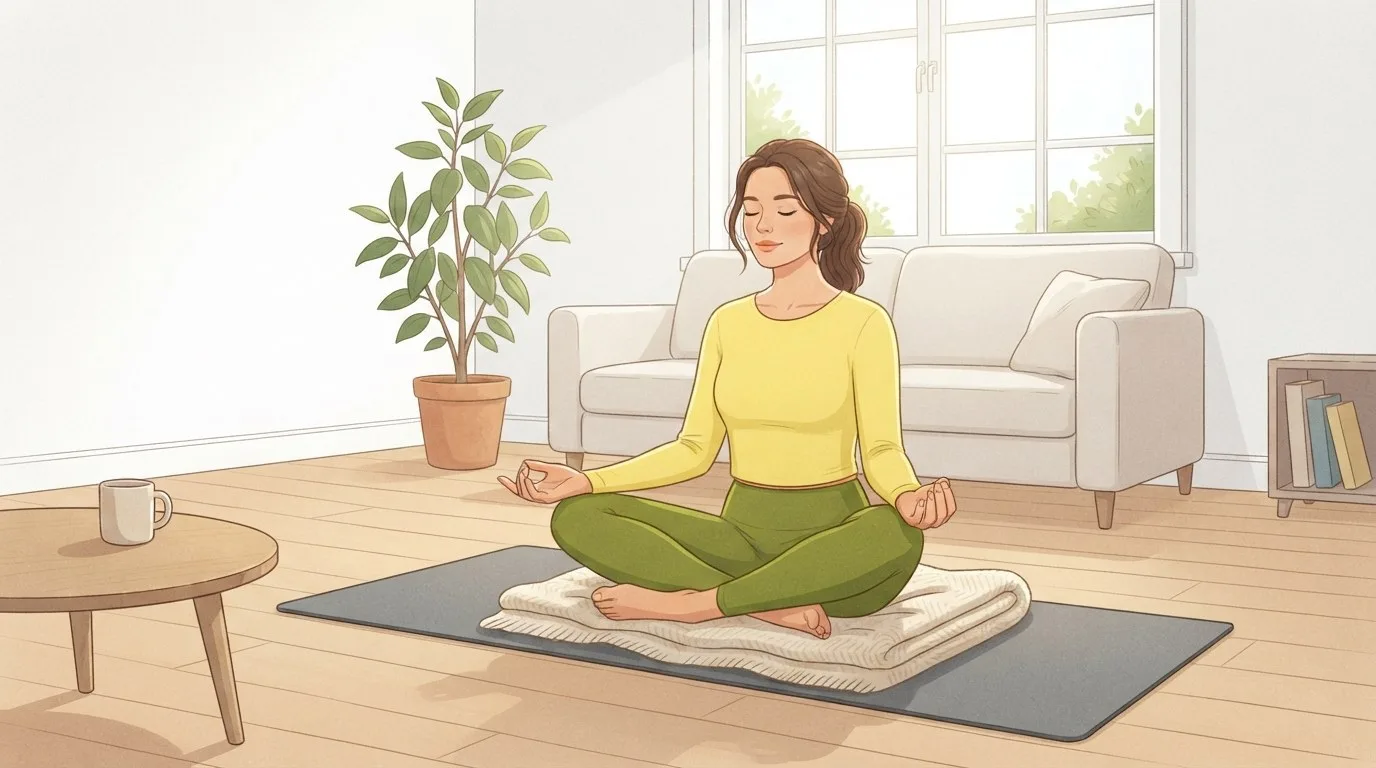
You've probably saved a few yoga videos already. Maybe you even rolled out a mat once, pressed play and spent most of the class pausing to work out where your left foot was supposed to go.
That's a common way to start, and an awkward one. A fast flow assumes you know the pose names. A long class asks for an hour you don't have. And watching an instructor fold flat over her legs can make yoga feel like something for people who are already bendy.
Yoga for beginners at home works when the routine is short, the poses are simple and the plan tells you what comes next. Learning how to do yoga is mostly learning a dozen basic shapes and how to breathe in them. This guide gives you those shapes, in order, plus a four-week plan and what the trials say you can expect.
How Should a Beginner Start Yoga?
Start small and start at home. Pick three or four days a week, the same time on each of them, and one spot where your mat can stay rolled out or within reach. Twenty minutes is enough. The adults in the Lau trial described below practiced about 23 minutes a day at home and improved on every fitness test the researchers used.
For the first two weeks, learn the shapes before you chase depth. Every pose in the routine below has an easier version, and the easier version is the right one if you're new, stiff or coming back after a long break. Hold each pose for a few slow breaths through your nose. Come out the moment anything feels sharp rather than stretchy.
Three rules cover most of what a teacher would tell you in a first class:
- Breath leads, movement follows. Breathe in as you lengthen or lift. Breathe out as you fold or twist. If you can't keep your breath smooth, ease off.
- Bend your knees freely. Tight hamstrings are the most common beginner limit. Soft knees let your back stay long in forward folds and downward dog.
- Use props from day one. A blanket under your hips, books under your hands and a wall beside you make every pose easier to learn.
What Do You Need for Yoga at Home?
Less than the ads suggest. Here's the full list:
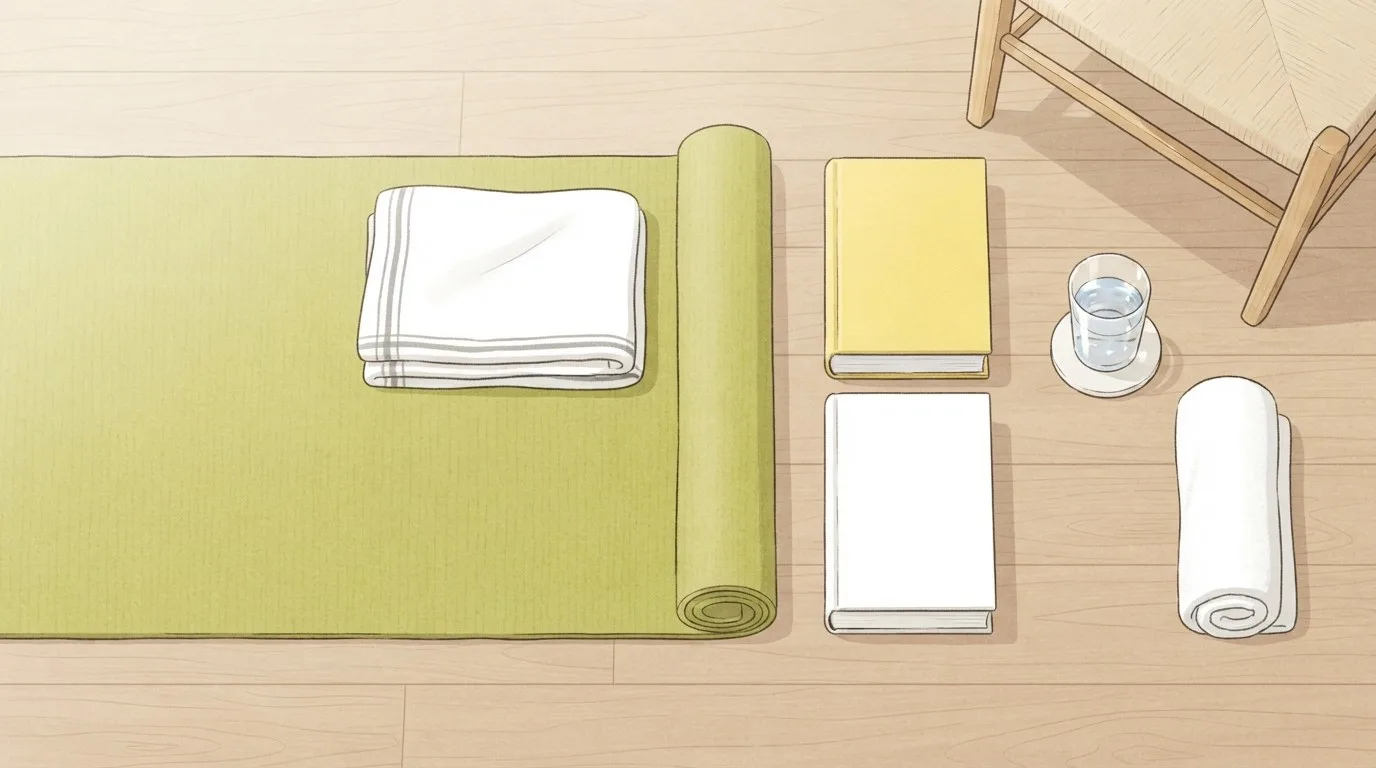
- A mat. Any non-slip mat works. On carpet, a thinner mat feels steadier. On a hard floor, a thicker one is kinder to your knees.
- Floor space. About 2 by 1 meters (6 by 3 feet), ideally next to a clear stretch of wall for balance poses.
- A blanket or large towel. Fold it to sit on in seated poses and to pad your knees in kneeling ones.
- Two thick books or two blocks. They bring the floor closer to your hands in forward folds and lunges.
- A sturdy chair. Optional, for balance and for easier versions of several standing poses.
- Clothes you can move in and bare feet, so your feet grip the mat.
Keep a glass of water nearby and silence your phone for the 20 minutes. That last step does more for a home practice than any piece of gear, because nobody is there to notice when you drift off to check a message.
The 20-Minute Yoga for Beginners at Home Routine
This basic yoga routine moves from the floor to standing and back down, so your body warms up before the standing poses and settles at the end. The times add up to 20 minutes. Do the one-sided poses on both sides.
| # | Pose | Time | What it does |
|---|---|---|---|
| 1 | Easy pose with slow breathing | 2 min | Settles your breath and posture |
| 2 | Cat-cow | 1.5 min | Warms up the spine |
| 3 | Child's pose | 1 min | Gentle stretch for the back and hips |
| 4 | Downward dog, knees bent | 1.5 min | Stretches the calves, hamstrings and back |
| 5 | Low lunge | 2 min | Opens the front of the hips |
| 6 | Warrior 1 | 2 min | Builds leg strength and steadiness |
| 7 | Chair pose | 1 min | Strengthens the thighs and glutes |
| 8 | Tree pose at the wall | 2 min | Trains balance |
| 9 | Cobra | 1.5 min | A gentle backbend |
| 10 | Bridge | 1.5 min | Strengthens the glutes and the backs of the legs |
| 11 | Lying twist | 2 min | Relaxes the back and hips |
| 12 | Final rest | 2 min | Lets your breath and heart rate settle |
1. Easy pose (2 minutes)
Sit cross-legged on the folded edge of your blanket so your hips sit a little higher than your knees. Rest your hands on your thighs and lengthen up through the crown of your head. Breathe through your nose, counting four in and four out. If your knees ride up near your chest, add another fold to the blanket.
2. Cat-cow (90 seconds)
Come onto hands and knees, wrists under shoulders and knees under hips. Breathe in as your belly sinks and your chest lifts, then breathe out as you round your back toward the ceiling. Move slowly for 8 to 10 rounds and keep the range comfortable. Our cat-cow guide covers easier versions on a chair or counter.
3. Child's pose (1 minute)
From hands and knees, bring your big toes together, widen your knees and sit your hips back toward your heels with your arms reaching forward. If your hips don't reach your heels, slide a pillow or the folded blanket between them. Breathe into your back and let your forehead rest on the mat or a book.
4. Downward dog with bent knees (90 seconds)
Tuck your toes and lift your hips up and back into an upside-down V. Bend your knees as much as you need to keep your back long, with your hips as the highest point. Your heels can stay well off the floor. Hold for 5 breaths, lower to your knees for a breath, and repeat three times. The downward dog form guide shows the wall version if your wrists or shoulders object.
5. Low lunge (1 minute each side)
From downward dog, step your right foot forward between your hands and lower your left knee onto the folded blanket. Stack your front knee over your ankle, place your hands on your front thigh or on the books, lift your chest and let your hips ease forward. You'll feel it at the front of your back hip. Step back and switch sides.
6. Warrior 1 (1 minute each side)
Stand at the front of your mat and step one foot back about a leg's length, back heel down with the toes turned out slightly. Bend your front knee over your ankle, turn your hips toward the front as far as is comfortable and reach your arms overhead. Hold for 5 breaths, rest, repeat, then switch. A shorter step or your hands on your hips makes warrior pose easier.
7. Chair pose (1 minute)
Stand with your feet hip-width apart, bend your knees and sit your hips back as if toward a chair, arms reaching up. Keep your heels down, your knees pointing the same way as your toes and your tailbone drawn down so your lower back doesn't over-arch. Hold for 3 to 5 breaths, stand up, and repeat. Chair pose is the strength move of the routine, so expect your thighs to burn a little.
8. Tree pose at the wall (1 minute each side)
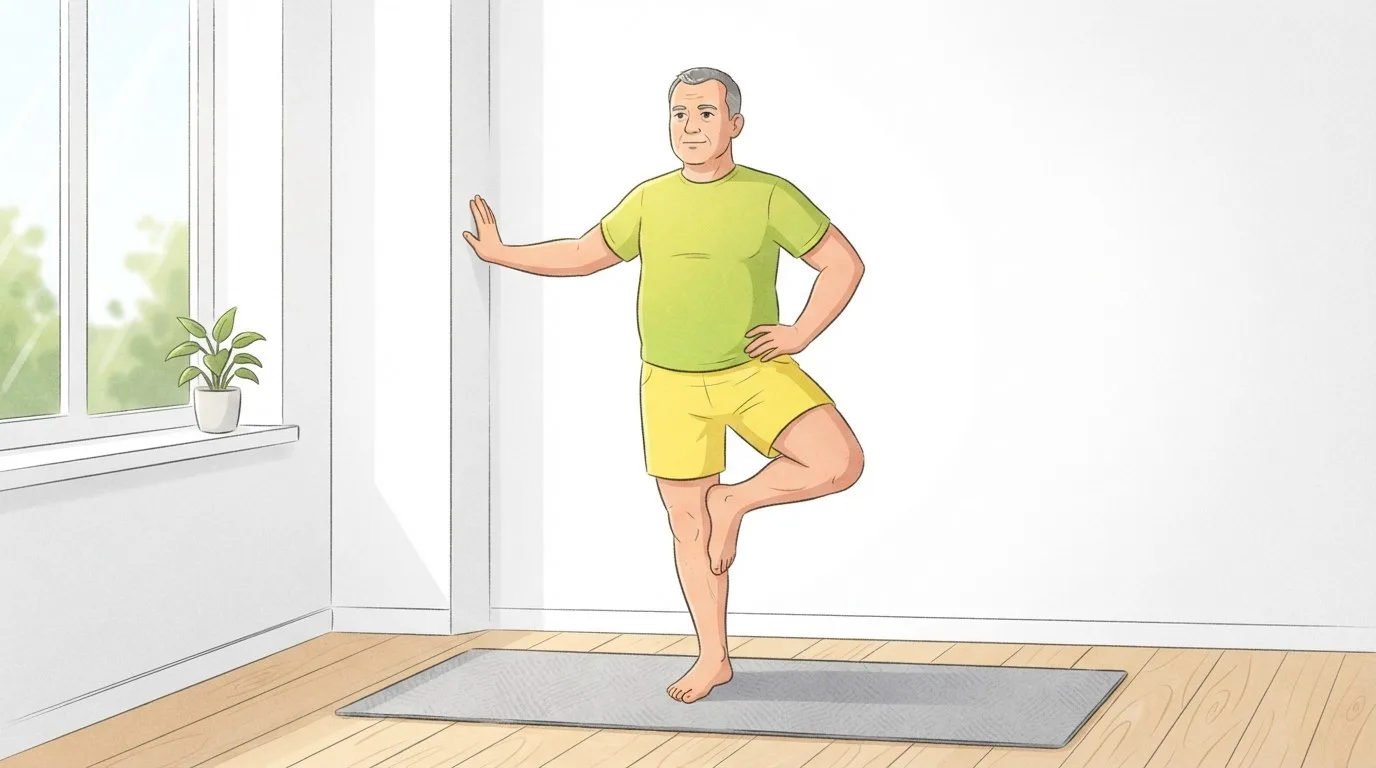
Stand side-on to the wall with your fingertips touching it. Shift your weight onto one foot and press the sole of the other foot into your inner calf or inner thigh, never against the knee, keeping both hips level. When you feel steady, bring your free hand to your chest. Our tree pose guide has the kickstand version, with your toes on the floor, for the first few sessions.
9. Cobra (90 seconds)
Lie face down with your hands under your shoulders. Press up until your arms are mostly straight but your elbows stay slightly bent, with your hips and thighs on the floor. Rise only as high as your lower back feels comfortable, keep your neck long and look forward. Hold for 3 breaths, lower, and repeat three or four times. The cobra pose guide shows the lower baby cobra if this feels like too much.
10. Bridge (90 seconds)
Roll onto your back, knees bent and feet flat about hip-width apart. Press through your heels and lift your hips until your shoulders, hips and knees make one straight line, and stop there so your lower back doesn't arch. Hold for 3 breaths, lower slowly and repeat five times. This is the yoga version of the glute bridge.
11. Lying twist (1 minute each side)
Stay on your back with your arms out in a T. Keep one leg long and let the other knee, bent to about 90 degrees, drop across your body. Keep both shoulders on the floor and let the knee go only as far as that allows. A pillow under the knee makes this spinal twist easier to hold.
12. Final rest (2 minutes)
Lie flat with your legs long, arms by your sides and palms up. Let your breath return to its own rhythm and stay still for two minutes. A rolled towel under your knees helps if your lower back complains. Beginners often skip this part, but it's the moment your heart rate and breathing settle before you get on with your day.
Short on time? Cat-cow, downward dog, low lunge, cobra and the lying twist make a 10-minute version for busy days. Doing the short version on a hectic day counts as keeping the habit.
Find out what's really holding you back
FitCraft, our mobile fitness app, pairs you with an AI coach who builds you a personalized plan around your goals, schedule, and fitness level. Every FitCraft program is designed by Domenic Angelino, MPH (Brown University) and NSCA-CSCS, with research published in the Journal of Strength and Conditioning Research and Medicine & Science in Sports & Exercise.
Take the Free Assessment Free • 2 minutes • No credit cardYour 4-Week Beginner Yoga Plan
Beginners progress in yoga in three ways: more sessions, longer holds and harder versions of each pose. Add one at a time. Stacking all three in the same week is how sore wrists and strained hamstrings happen.
| Week | Sessions | What changes |
|---|---|---|
| Week 1 | 2 to 3 sessions of the 20-minute routine | Easiest version of every pose. Hold standing poses for 3 breaths and learn the order. |
| Week 2 | 3 sessions | Hold standing poses for 5 breaths. Straighten your knees slightly in downward dog if your back stays long. |
| Week 3 | 3 to 4 sessions | Repeat poses 4 to 7 a second time, which takes the session to about 27 minutes. Try tree pose with your hand off the wall. |
| Week 4 | 4 sessions, one of them longer | Hold standing poses for 5 to 8 breaths. On the longer day, add triangle pose after warrior 1, or follow a 30-minute beginner class. |
By the end of week 4 you'll know the shapes well enough to follow most beginner yoga classes, online or in a studio, without pausing every minute. That's the real milestone of the first month. Flexibility comes later, and it comes from repetition.
How often should you practice once the first month is behind you? It depends on your goal, and our breakdown of how often you should do yoga gives the session counts behind the trials for flexibility, back pain, stress and strength.
What the Research Says About Yoga for Beginners
Most yoga trials recruit people who have never practiced, which makes them a good guide to what a newcomer can expect. Three of them answer the questions beginners ask most.
Flexibility and fitness: one class a week plus home practice
Lau, Yu and Woo (2015), in Evidence-Based Complementary and Alternative Medicine, put 173 adults with an average age of 52 into either a 12-week hatha yoga program or a waitlist. The yoga group got one 60-minute class a week, adapted for beginners, plus handouts of the poses to practice at home. Their practice logs showed about 165 minutes of home practice a week, roughly 23 minutes a day.
Compared with the waitlist, the yoga group improved their sit-and-reach scores on both legs, their push-ups, their curl-ups and their aerobic fitness on a treadmill test, in men and women alike. Attendance averaged 94 percent, and no serious adverse events occurred. The groups weren't randomized, so treat the size of the gains with some caution. Still, the shape of the program is the useful part: one guided session a week, with most of the work done at home in short daily sessions.
Back pain: as good as physical therapy
The largest head-to-head test is Saper and colleagues (2017), in the Annals of Internal Medicine. They randomized 320 adults with chronic low back pain, most of them on low incomes, to 12 weekly yoga classes, 15 physical therapy visits or an education book. After 12 weeks, yoga was as good as physical therapy for back-related function and pain, and people in both groups were about 21 to 22 percentage points less likely than the education group to be taking pain medication.
The follow-up matters for home practice. For the next 40 weeks, the yoga group was split between drop-in classes and practicing at home. Both kept their improvements for a full year, with no difference between them. Once people had learned the poses, home practice held the gains as well as going back to class. If back pain is your main reason to start, our Pilates vs yoga comparison weighs the two side by side.
Stress: comparable to relaxation training
Smith and colleagues (2007), in Complementary Therapies in Medicine, randomized 131 adults with mild to moderate stress to ten weekly one-hour sessions of hatha yoga or of relaxation training. Both groups felt less stressed and less anxious, and yoga matched relaxation on those scores. Yoga did better on a mental health measure at ten weeks.
Six weeks after the sessions ended, the groups looked alike again, and the relaxation group scored a little higher on vitality and mental health. Yoga is a good way to unwind, and like any habit, its calming effect lasts about as long as you keep doing it.
Is Yoga at Home Safe for Beginners?
For most healthy adults, yes. Injuries do happen, though, and they cluster in predictable places. Swain and McGwin (2016), in the Orthopaedic Journal of Sports Medicine, counted 29,590 yoga-related injuries treated in US emergency departments from 2001 to 2014. The trunk was the most commonly injured area, at 46.6 percent, and sprains and strains made up 45 percent of diagnoses. In 2014 the injury rate was 11.9 per 100,000 participants aged 18 to 44, 17.7 for ages 45 to 64 and 57.9 for those 65 and older.
That pattern points to five habits that keep home practice safe:
- Warm up on the floor first. The routine above starts with breathing, cat-cow and child's pose for a reason. Cold hamstrings and backs are the easiest to strain.
- Treat sharp pain as a stop sign. A stretch should feel strong but tolerable. Pinching in the knee, hip or lower back means you back out of the pose.
- Skip headstands and shoulder stands for now. Inversions put load on the neck and belong after you've built strength and had some in-person instruction.
- Practice balance poses at a wall. Falls are a bigger risk after 65, and a wall or chair costs you nothing in learning.
- Respect old injuries. If a knee, shoulder or back has bothered you before, take the easiest version of every pose that loads it and ask a clinician which poses to skip.
What not to do before doing yoga
Don't eat a large meal in the two to three hours before you practice, because twists and forward folds press on a full stomach. Don't drink alcohol beforehand. Don't skip the first floor poses to get to the standing ones faster. And don't measure yourself against an instructor on a screen: her range took years, and your sessions should feel like work you could repeat tomorrow.
Five Beginner Yoga Mistakes to Avoid
- Locking your knees. In standing poses, keep a micro-bend in the standing leg so the muscles hold you up instead of the joint.
- Rounding your back to reach the floor. In forward folds and downward dog, bend your knees or put your hands on books. A long back with bent knees beats a round back with straight legs.
- Holding your breath. Breath-holding usually means a pose is too deep. Come up a little until breathing feels easy again.
- Sinking into your wrists. On hands and knees and in downward dog, spread your fingers and press through the whole hand, including the knuckles.
- Doing too much on day one. An hour-long advanced flow on your first day usually means sore wrists and a skipped second session. Twenty easy minutes you'll repeat beats sixty you won't.
How Yoga Fits Into the Rest of Your Week
Yoga at home pairs well with strength and cardio. A simple week for a beginner is three yoga sessions plus two short strength workouts, with walks on the other days. If you'd like yoga, mobility and strength in a single plan, our guide to yoga and mobility at home shows how to combine them. Runners have different needs, and our guide to yoga for runners covers pre-run and post-run sequences built around the hips and hamstrings.
The hardest part of any home practice is the week-three slump, when the novelty wears off and nobody is expecting you on the mat. That's a design problem, and it's the one FitCraft is built around. Its workouts include yoga and mobility alongside strength and cardio. An AI coach demonstrates each exercise on an interactive 3D model, your workouts adjust as you progress, and streaks reward you for showing up. If you're weighing a few options, we've compared five workout apps for beginners.
The Bottom Line
Yoga for beginners at home comes down to a short routine of basic poses, done three or four times a week, with props and a wall for support. Trials of beginners found better flexibility, strength and aerobic fitness after 12 weeks, back pain relief on par with physical therapy, and stress relief on par with relaxation training.
One FitCraft user, Tim, went from zero flexibility to completing a yoga program in 60 days. You don't need to be flexible to start. Flexibility is what you get from showing up for the next 20 minutes, and then the next.
Frequently Asked Questions
Is 20 minutes of yoga per day enough?
Yes, 20 minutes of yoga a day is enough for a beginner to get more flexible and a little fitter. In a 12-week controlled trial, adults who took one weekly class and practiced about 23 minutes a day at home improved their sit-and-reach, push-ups, curl-ups and aerobic fitness compared with a waitlist group. Short sessions you actually repeat beat long ones you skip.
What is the best way to start practicing yoga at home?
The best way to start practicing yoga at home is to pick one short routine of basic poses and repeat it three or four times a week at the same time and in the same spot. Use a mat, a folded blanket and a wall for support, take the easiest version of every pose, and add longer holds only after two weeks.
How can I learn yoga as a beginner without a class?
You can learn yoga as a beginner without a class by learning a dozen foundational poses one at a time, holding each for a few slow breaths, and checking your shape against a clear demonstration. Practice near a wall so balance poses feel safe. Once the shapes feel familiar, after about four weeks, follow along with longer beginner classes online or in a studio.
What is the best yoga routine for beginners?
The best yoga routine for beginners moves from the floor to standing and back to the floor in about 20 minutes: easy seated breathing, cat-cow, child's pose, downward dog with bent knees, low lunge, warrior 1, chair pose, tree pose at a wall, cobra, bridge, a lying twist and two minutes of rest. Every pose has an easier version for stiff or new bodies.
Is yoga at home good for beginners over 50?
Yes, yoga at home suits most beginners over 50, as long as the practice is gentle at first. The participants in a 12-week hatha yoga trial averaged 52 years old and improved flexibility, strength and aerobic fitness with no serious adverse events. Injury rates in emergency-department data were highest after 65, so older beginners should use a wall or chair for balance and skip deep backbends and inversions at first.
How long does it take to get flexible with yoga?
Most beginners notice poses feeling easier within two to four weeks of practicing three or four times a week, and measurable flexibility gains usually show up over 8 to 12 weeks. The trials that found flexibility improvements in beginners ran for 10 to 12 weeks, so judge your progress over months rather than days.