The squat reach is a no-equipment strength move built from two familiar pieces: a squat and a one-arm overhead reach. The squat works your lower body. As you stand, you turn a quarter turn to one side, pivot on your back foot, and reach one arm up overhead, then switch sides on the next rep.
It needs no equipment, so you can do it at home or while traveling. FitCraft rates it Advanced, so get comfortable with a steady bodyweight squat before you add the turn and reach.
Quick Facts: Squat Reach
- Equipment needed: None
- Difficulty: Advanced
- Modality: Strength
- Body region: Full body
- FitCraft quest category: Strength
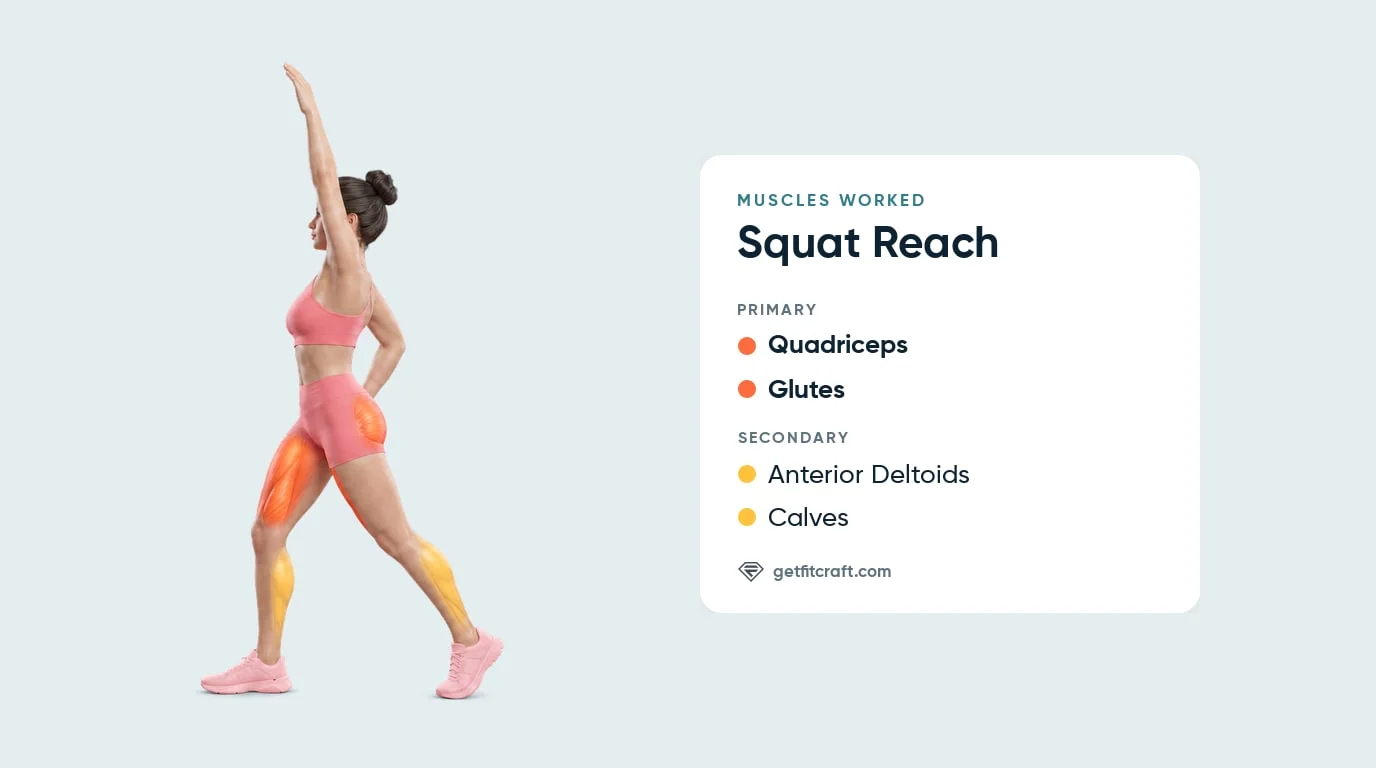
Muscles & Systems Worked
Primary movers: the quadriceps extend the knees as you stand, while the glutes extend the hips. During the descent, those same muscles lengthen under control to manage squat depth and keep the rep smooth.
Secondary movers: the anterior (front) deltoids raise your arm overhead in each reach, and the calves lift your back heel and keep you up on the ball of that foot as you pivot.
Why these muscles: no study has measured the squat reach itself. Reference exercise libraries (ExRx, ACE, NASM, NSCA) agree the squat works the quadriceps and glutes. The front deltoids and calves come from what the turn and reach ask of your body: lifting one arm overhead and rising onto the ball of the back foot.
Step-by-Step: How to Do a Squat Reach
Step 1: Set Your Stance
Stand facing forward with your feet wider than hip-width and your toes turned out. Hold your hands up in front of your chest, brace your core, and keep your chest up before the first rep.
Step 2: Sit Into the Squat
Sit your hips back and down until your thighs are close to parallel. Keep your heels flat, your chest up, and your knees in line with your toes.
Tip: Keep the squat to a depth you can control. If your heels start to lift, stop a little higher.
Step 3: Stand, Turn, and Reach
As you stand, turn your hips and chest a quarter turn to the left. Lift your right heel and pivot on the ball of your right foot, and reach your right hand up overhead, with the arm straight or the elbow bent, while your left hand goes to the back of your hip.
Tip: Reach up, not out in front, with your fingertips toward the ceiling.
Step 4: Turn Back to the Front
Turn back to face forward, bring your hands back in front of your chest, and squat again. Squeeze your glutes each time you stand out of the squat.
Tip: Do not rush the turn. A steady pace on every rep keeps you balanced as you pivot.
Step 5: Repeat on the Other Side
Repeat the turn and reach to the right: lift your left heel, pivot on your left foot, and reach your left arm overhead. Keep alternating sides with a steady rhythm, breathing in as you squat down and out as you stand. End the set when your heels lift in the squat, your balance wobbles in the turn, or the reach starts drifting forward.
Get this exercise in a personalized workout
FitCraft, our mobile fitness app, uses its AI coach Ty to program strength work like this into your plan at the right volume and intensity, based on your level, goals, and equipment. Ty was designed and trained by Domenic Angelino, MPH (Brown University) and NSCA-CSCS, with research published in the Journal of Strength and Conditioning Research and Medicine & Science in Sports & Exercise.
Take the Free Assessment Free · 2 minutes · No credit card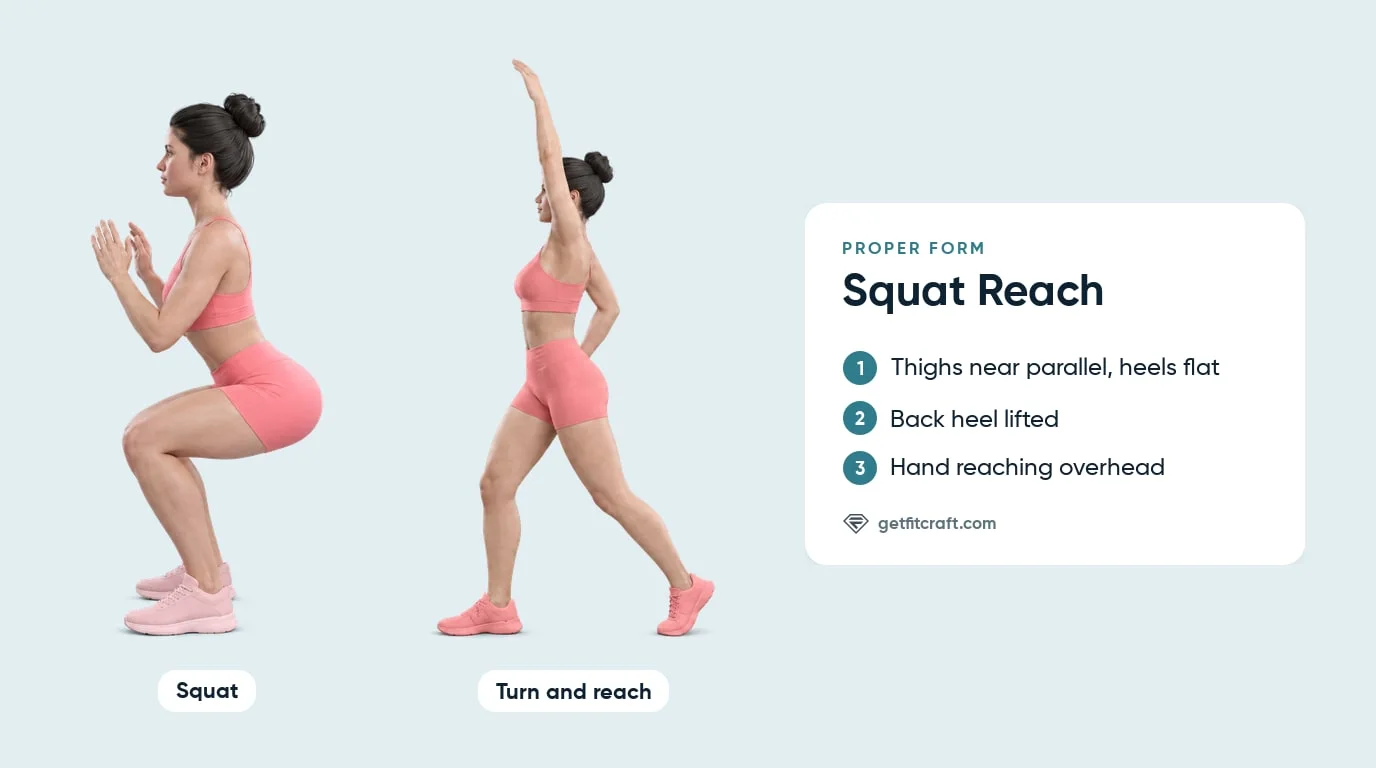
Common Mistakes (and How to Fix Them)
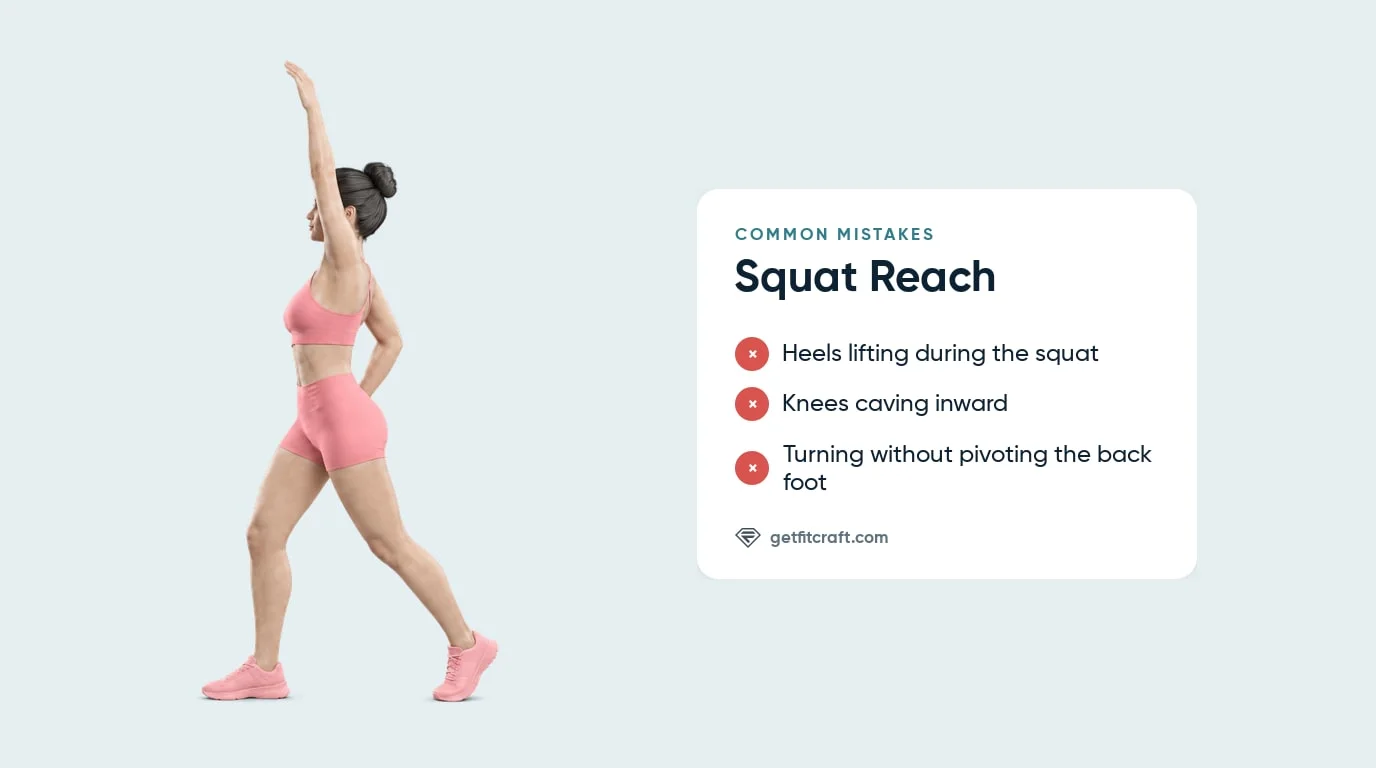
- Heels lifting in the squat. Your back heel lifts on purpose only during the turn. In the squat, a lifting heel usually means the squat is deeper than your current ankle range. Fix it by reducing depth, slowing down, and pairing the move with calf raises and ankle mobility work.
- Arm drifting forward. If your shoulder cannot reach overhead cleanly, the arm angles forward. Fix it by keeping your chest up and reaching up over your head, only as far as your shoulder allows.
- Knees collapsing inward. Letting the knees cave reduces control and can irritate the knees. Fix it by tracking the knees over the middle toes and using slower reps.
- Rounding the back at the bottom of the squat. Fix it by keeping your chest up, bracing lightly, stopping the squat at a depth you can control, and practicing cat-cow before training.
- Rushing the turn. Turning fast makes it easy to lose your balance. Fix it by keeping the same steady pace on every rep, on both sides.
- Turning without pivoting the back foot. Fix it by lifting your back heel and pivoting on the ball of that foot as you turn, so your foot turns with your hips.
Squat Reach Variations: Regressions and Progressions
Partial Squat Reach
Squat only part of the way down, then stand, turn, and reach as usual. Use this version first if your heels lift, your balance feels uncertain in the turn, or your shoulders are stiff.
Standard Squat Reach
The app's version, rated Advanced: squat until your thighs are close to parallel, then turn, pivot, and reach to one side, alternating sides on every rep. Use the full depth only if your heels stay flat and your chest stays up.
When to Avoid or Modify Squat Reaches
Squat reaches are safe for many healthy adults, but the combination of squat depth, overhead reach, and conditioning pace means a few situations call for a slower version, shorter range, or a different exercise. Always consult your physician or physical therapist for personalized guidance.
- Known cardiovascular disease or uncontrolled hypertension. Fast squat reaches can raise heart rate and blood pressure quickly. Get medical clearance, avoid breath holding, and use lower-intensity options such as step-n-clap.
- Acute knee, ankle, hip, shin, or foot pain. Deep squatting can aggravate irritated joints and tendons. Use a partial range, practice bodyweight squats, or pause the movement until symptoms settle.
- Shoulder pain with overhead reach. If the reach causes any pain, pinching, or numbness, stop, and keep the reaching arm lower when you try again. Add shoulder and thoracic mobility before returning to the full reach.
- Pregnancy, early postpartum recovery, or pelvic-floor symptoms. Dynamic conditioning can increase pressure and balance demand. Use slow partial reps or low-impact standing movements until cleared by a qualified clinician.
- Vertigo, balance disorders, or dizziness. The up-down rhythm can provoke symptoms. Keep the movement shallow, hold a stable support, or choose a non-squatting alternative.
- Asthma or exercise-induced bronchoconstriction. Keep your inhaler accessible if prescribed, extend the warm-up, and stop if breathing symptoms escalate.
Related Exercises
Use these movements to build the pieces that make a squat reach feel controlled:
- Lower-impact alternative: Step-N-Clap keeps the session moving without deep squat demand.
- Squat foundation: Squats build the lower-body pattern before the overhead reach is added.
- Power progression: Jump Squats add explosive lower-body work when landing mechanics are ready.
- Core foundation: Forearm Planks and Deadbugs train the rib and pelvis control that keeps the reach from becoming a back arch.
- Ankle and calf preparation: Calf Raises and Calf Hops build lower-leg control for deeper, steadier reps.
- Mobility prep: Cat-Cow helps the thoracic spine move before overhead reaching.
How to Program Squat Reaches
Use squat reaches as bodyweight strength work or in a circuit, then scale total work gradually. The American College of Sports Medicine position stand on resistance training emphasizes progressive overload, technical quality, and recovery between hard sessions (Ratamess et al., 2009).
| Level | Work | Rest between sets | Frequency |
|---|---|---|---|
| Beginner | 20-30 sec partial reps | 60-90 sec | 2-3 sessions/week |
| Intermediate | 30-45 sec partial reps, squatting deeper as control improves | 45-60 sec | 3-4 sessions/week |
| Advanced | 45-60 sec standard reps | 30-45 sec | 3-5 sessions/week |
Where in your workout: use squat reaches in a warm-up before lower-body training, after resistance training as a short metabolic finisher, or inside a standalone low-impact conditioning circuit. Avoid doing hard intervals before heavy squats or deadlifts because fatigue can lower strength-work quality.
Form floor over rep targets: if your heels lift, chest collapses, knees cave, or the reach turns into a back arch, end the set. Clean reps matter more than filling the clock.
How FitCraft Programs This Exercise
The FitCraft app includes the squat reach as an Advanced bodyweight strength exercise, done alternating sides. It builds your plan from your level, goals, and equipment, and adjusts your training as you get stronger.
Frequently Asked Questions
What muscles does the squat reach work?
Squat reaches train the quadriceps and glutes as you bend and straighten your knees and hips in the squat. In the turn and reach, the front deltoids raise your arm overhead and the calves lift your back heel as you pivot on the ball of that foot.
Is the squat reach a good warm-up exercise?
They can be. A squat reach moves your hips, knees, and ankles through a squat, then turns your trunk and raises one arm overhead, so a few slow reps can fit a warm-up. FitCraft rates the full move Advanced, so start shallow and deepen the squat only as far as you can control.
Can beginners do squat reaches?
FitCraft rates the squat reach Advanced, so beginners should build the bodyweight squat first. A partial squat reach, with a shallower squat, is an easier way to learn the turn and the reach. The full version needs enough squat control to keep your heels flat and enough balance to pivot on the back foot as you turn.
Can I do squat reaches if I have high blood pressure?
Ask your physician before using squat reaches as fast conditioning if you have known cardiovascular disease or uncontrolled hypertension. Use a slow tempo, keep the range pain-free, avoid breath holding, and substitute lower-intensity work such as step-n-clap if your provider limits high-intensity intervals.
How deep should I squat in a squat reach?
Squat until your thighs are close to parallel, and only as deep as you can while keeping your heels flat, chest up, and knees in line with your toes. If your heels lift or your back rounds, reduce the range and work on ankle and hip mobility.