You finish the last set, you're sweaty and pleased with yourself, and the stretching is the first thing you cut. Sometimes it's time. More often it's that nobody ever told you which stretches to do after a workout or how long to hold them, so it felt like ten minutes of guessing on the floor.
Then the next morning your legs feel like planks, and you wonder whether the skipped stretch is to blame. A lot of people carry a low-level guilt about stretching that never gets resolved, because the advice they've heard contradicts itself.
What's missing is a plan. Below is a short routine with clear holds, in an order that moves from standing to lying down so you only get on the floor once, plus an honest account of what stretching after exercise does for soreness, flexibility, injuries and muscle growth.
The 10-Minute Post-Workout Stretching Routine
Do these in order. Hold each stretch for 30 seconds, or 30 seconds per side for the one-sided moves, and breathe slowly through your nose. Ease in until you feel mild tension in the muscle, then stay there without bouncing. If a position pinches a joint or hurts, back off until it doesn't. Each name links to a full form guide with easier and harder versions.
| # | Stretch | Main muscles | Hold |
|---|---|---|---|
| 1 | Downward dog | Calves, hamstrings, back, lats | 30 seconds |
| 2 | Half kneeling stretch | Hip flexors, hamstrings | 30 seconds per side |
| 3 | Half pigeon | Glutes, deep hip rotators | 30 seconds per side |
| 4 | Butterfly pose | Inner thighs | 30 seconds |
| 5 | Hip abductor stretch | Outer hip, glutes | 30 seconds per side |
| 6 | Cobra pose | Abs, front of the hips | 20 to 30 seconds |
| 7 | Thread the needle | Upper back, rear shoulders | 30 seconds per side |
| 8 | Seated rear delt stretch | Back of the shoulder, upper back | 30 seconds per side |
| 9 | Tricep and lat stretch | Triceps, lats | 30 seconds per side |
| 10 | Spinal twist | Lower back, glutes, chest | 30 seconds per side |
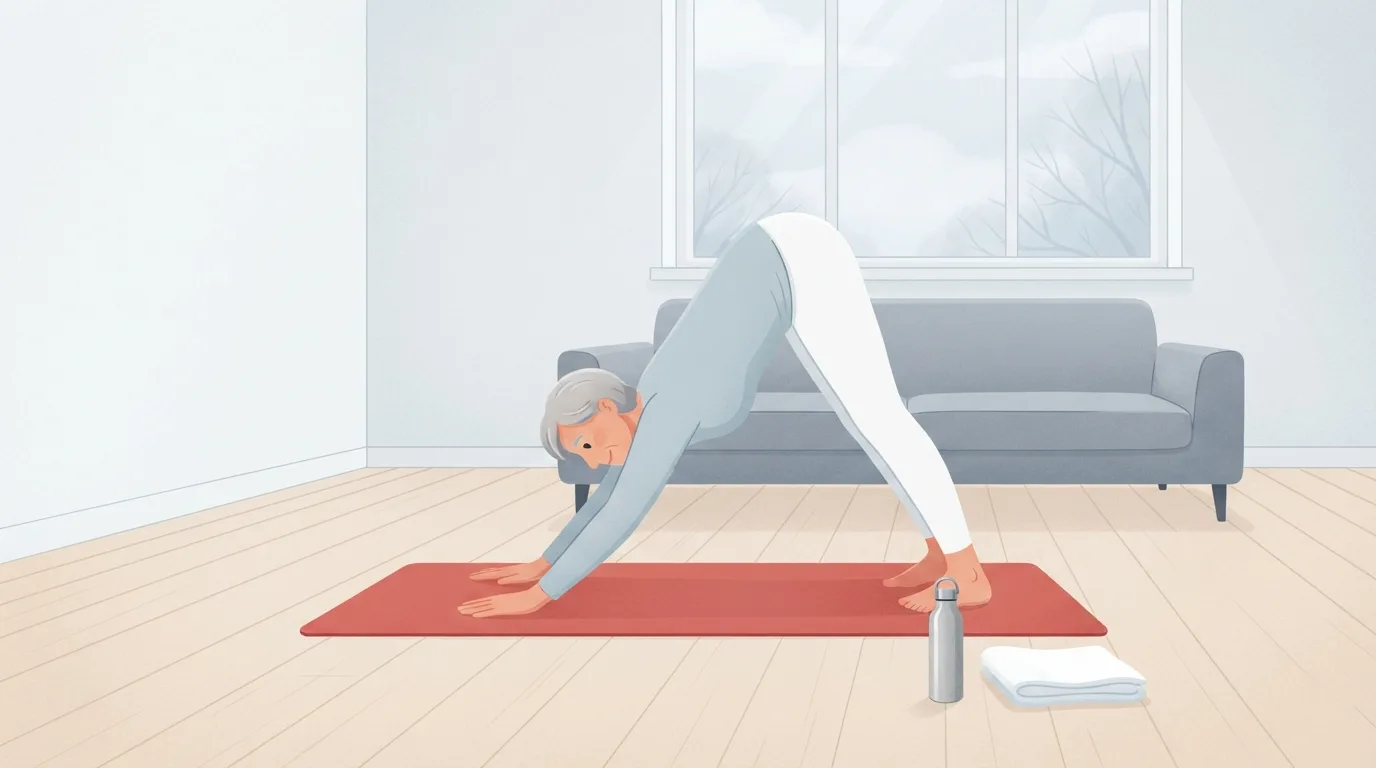
1. Downward dog
From standing, fold forward, put your palms on the floor and walk them out until you can push your hips up and back into an upside-down V. Bend your knees as much as you need to keep your back long, and let your heels sink toward the floor without forcing them down. Five or six slow breaths is about 30 seconds. The downward dog guide shows how to work toward straighter legs.
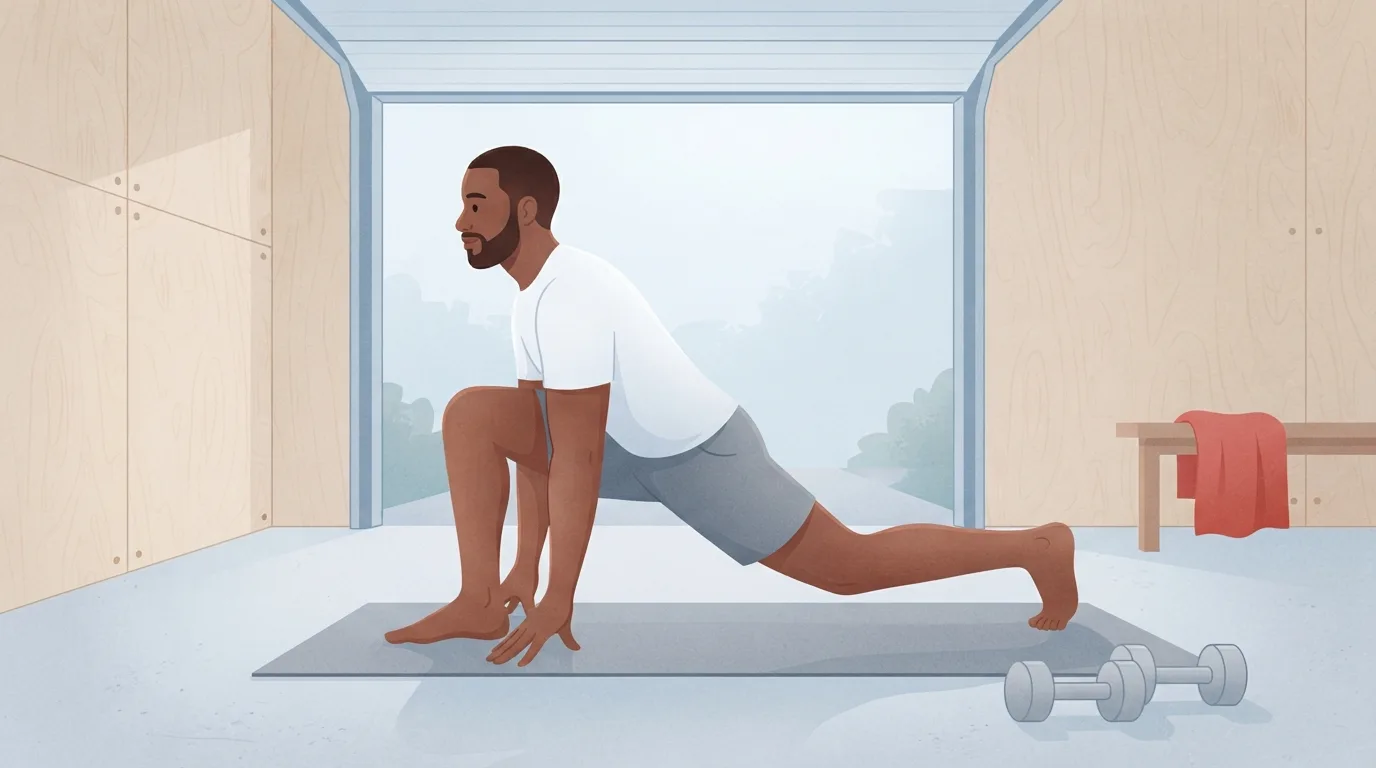
2. Half kneeling stretch
From downward dog, step one foot forward between your hands so the front knee sits over the ankle. Keep both hands on the floor beside that foot, keep the back knee lifted with the heel up, and let your hips sink forward and down. You'll feel it at the front of the back hip and along the back of the front thigh. Hold, then switch legs. The half kneeling stretch page covers hand placement if the floor feels far away.
3. Half pigeon
From the lunge, lower the front knee to the floor behind the same wrist and tuck that heel toward the opposite hip. Slide the back leg straight behind you and point both hip bones forward. Sit tall with your hands beside your hips, or walk them forward for more stretch in the glute. A folded towel under the front hip keeps your pelvis level and spares the knee. The half pigeon guide has a gentler version if your hips are tight.
4. Butterfly pose
Sit down, bring the soles of your feet together and let your knees fall open. Sit up tall, hold your feet or ankles and let gravity lower the knees. Never push them down. For more stretch along the inner thighs, hinge forward from the hips with a long back. The butterfly pose page explains how close to bring your heels.
5. Hip abductor stretch
Stay seated with both knees bent and feet flat. Cross one ankle over the opposite knee so the crossed knee turns out, wrap your hands around the bottom knee and hug it toward your chest while you sit tall. The stretch lands in the glute and the outer hip of the crossed leg. The hip abductor stretch page lists easier and deeper versions.
6. Cobra pose
Roll onto your front with your hands flat under your shoulders. Let your hips and thighs rest heavy, then press your chest up while your hips stay on the floor and your elbows stay slightly bent. Rise only as high as feels comfortable in your lower back. If your spine feels stiff, follow it with five slow rounds of cat-cow on all fours before the next stretch. The cobra pose guide shows the lower and higher versions.
7. Thread the needle
On all fours, slide one arm under your chest and past the other arm with the palm up, and let that shoulder and the side of your head lower toward the floor. Breathe into the space between your shoulder blades. Then press back up and switch sides. The thread the needle page has a moving version too.
8. Seated rear delt stretch
Sit tall with your legs crossed. Bring one arm across your chest below your chin, hook it with your other forearm near the elbow and draw it in until you feel the back of the shoulder open. Keep your chest facing forward instead of turning toward the arm. The seated rear delt stretch guide covers where to hold the arm.
9. Tricep and lat stretch
Still seated, reach one arm up, bend the elbow and let your hand drop behind your head. Rest the other hand on the bent elbow and ease it back until you feel a stretch along the back of the upper arm and down the side of your back. Keep your lower back from arching. The tricep and lat stretch page shows the full setup.
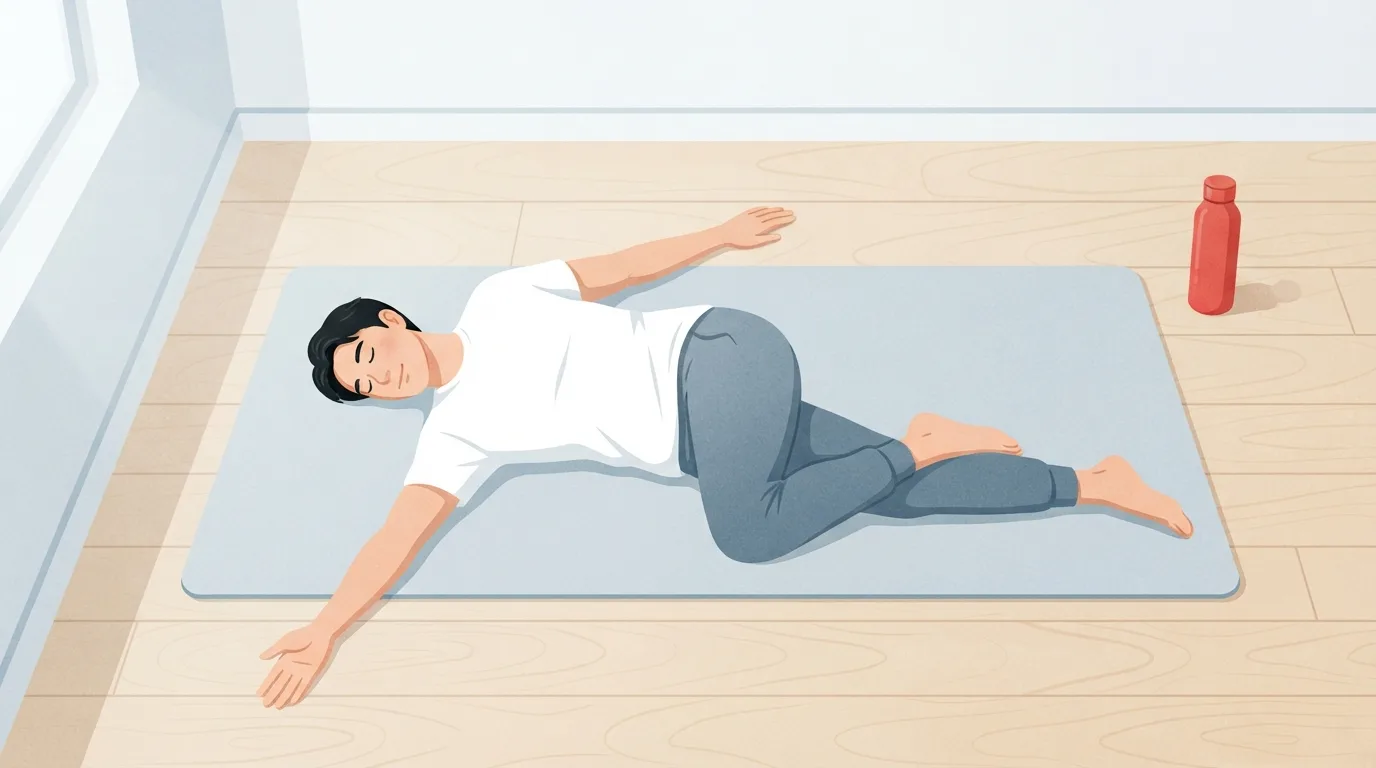
10. Spinal twist
Lie on your back with your arms out in a T. Bend one knee, then let it drop across your body toward the floor on the other side while both shoulders stay down. Turn your head away from the knee if your neck is comfortable. Hold, bring the knee back to the middle and switch. Finish with a few slow breaths before you stand up. The spinal twist guide explains how far to let the knee drop.
Timing it out: the three two-sided holds take about a minute and a half, the seven one-sided stretches take about seven minutes, and moving between positions fills the rest. On a push day you can add the rotator cuff stretch for the front of the shoulder and the chest.
Post Workout Stretches for Legs or Upper Body Only
Short on time? Pick the stretches that match what you trained. After a leg day, do numbers 1 to 5 and finish with the spinal twist, which takes about six minutes. After an upper-body day, do downward dog, cobra, thread the needle, the seated rear delt stretch and the tricep and lat stretch, then add the rotator cuff stretch if you did presses or push-ups. A full-body session gets all 10.
If you run, the muscles that tighten are mostly the calves, quads and hip flexors, and the order of the holds changes. Our guide to the best stretches for runners has a running-specific routine for before and after a run, so it isn't repeated here.
How Long to Hold a Stretch After a Workout
Thirty seconds is the sweet spot for most adults. Bandy, Irion and Briggler (1997) randomly assigned 93 adults with tight hamstrings to stretch five days a week for six weeks using different hold times and frequencies. Every stretching group gained range over the controls. Holding for 60 seconds instead of 30 added nothing, and neither did stretching three times a day instead of once.
How much you stretch across the week is less settled. Thomas and colleagues (2018) reviewed 23 long-term studies and concluded that at least 5 minutes of static stretching per muscle group per week, spread over at least five days, gave the clearest range-of-motion gains. A larger 2024 meta-analysis by Konrad and colleagues pooled 77 studies and 186 effect sizes and found that volume, intensity and frequency didn't significantly change the result. What did matter was the type: static stretching and PNF, a contract-then-relax method done with a partner or a strap, beat ballistic and dynamic stretching for long-term flexibility, and women gained more range than men.
Put together, the practical rule is simple. Hold each stretch once for 30 seconds per side, repeat your tightest one a second time, and do the routine after most workouts rather than saving it for one long session on Sunday.
What Stretching After Exercise Does for Soreness
Less than most people hope. Herbert, de Noronha and Kamper's 2011 Cochrane review pooled 12 randomized or quasi-randomized trials. Eleven of them were small, with 10 to 30 people in the stretching condition. Across four trials of stretching after exercise, soreness the next day fell by an average of 1.04 points on a 100-point scale, with a confidence interval running from 6.88 points better to 4.79 points worse. The effect looked the same anywhere from half a day to three days after the workout.
The one large trial in that review tells a slightly kinder story. Jamtvedt and colleagues (2010) recruited 2,377 adults who exercised regularly and asked half of them to do 30-second static stretches of seven leg and trunk muscle groups before and after every session for 12 weeks. Peak soreness over a week dropped by about 4 points on the same 100-point scale, which is small. But the share of weeks with soreness people called bothersome fell from 32.3 percent in the non-stretching group to 24.6 percent in the stretching group.
So stretching won't erase the ache after a hard leg day, and a missed stretch isn't why you're sore. Soreness after a new or harder session fades on its own within a few days, and it shrinks as your body gets used to the work. If you stretch every session anyway, you may have a few more weeks where the stiffness never gets annoying.
Find out what's really holding you back
FitCraft, our mobile fitness app, pairs you with an AI coach who builds you a personalized plan around your goals, schedule, and fitness level. Every FitCraft program is designed by Domenic Angelino, MPH (Brown University) and NSCA-CSCS, with research published in the Journal of Strength and Conditioning Research and Medicine & Science in Sports & Exercise.
Take the Free Assessment Free • 2 minutes • No credit cardBenefits of Stretching After a Workout
If soreness isn't the reason, these are the reasons that hold up.
- Flexibility that builds over weeks. Regular static stretching reliably increases range of motion, as the Konrad meta-analysis above shows. Hips that move better make a deep squat, a lunge or a floor-to-standing transfer feel easier.
- A habit with a built-in trigger. Stretching attached to the end of a workout happens on the days you train, without a separate reminder. Thomas and colleagues found that how often you stretch each week is linked to bigger gains, so stretching after most sessions adds up.
- Fewer muscle and tendon strains, possibly. In the Jamtvedt trial, stretching didn't lower the overall injury rate (hazard ratio 0.97), but injuries to muscles, ligaments and tendons were less common: 0.66 per person per year with stretching against 0.88 without. That's one trial, and our review of static vs dynamic stretching covers the wider injury evidence and what to do before a workout instead.
- A calmer finish. Van Hooren and Peake (2018) reviewed cool-down research and found that an easy active cool-down, such as light jogging or cycling, may help breathing and heart rate settle faster, even though it doesn't reduce soreness or improve next-day performance. Their review covers active cool-downs rather than stretching, but a few minutes of slow holds gives you the same quiet transition before you get on with your day.
Stretching After Lifting Weights
Stretching after weight training is a good habit if you want more flexibility, and it doesn't work against your lifting. Two questions come up most often.
Does stretching after a workout help muscle growth?
Not in any way you'd notice from a 10-minute cool-down. Warneke and colleagues (2024) pooled 42 randomized trials with 1,318 participants and found that long-term static stretching on its own produced small strength gains (effect size 0.30) and small gains in muscle size (effect size 0.20). The clearer effects came from long stretch durations, high frequencies and programs lasting many weeks, far more than a few holds after lifting. The useful takeaway runs the other way: if stretching on its own can nudge muscle size up slightly, a short stretch after training isn't going to shrink it.
Will stretching after lifting make you weaker?
No. The strength dip linked to static stretching shows up when you hold long stretches right before a heavy or explosive effort, and even that dip is small when each hold lasts under a minute. After the last set there's no performance left to protect. Save the long holds for the end, and warm up with moving drills at the start.
Is It Good to Do Yoga After Lifting Weights?
Yes, if the yoga is gentle. Downward dog, pigeon, butterfly, cobra and the spinal twist in the routine above are all yoga poses, so a slow 10 to 15 minute flow works as a cool-down. A hard power-yoga class is different: that's a second workout, and it belongs on another day or after a lighter session. If you'd like guided sessions, FitCraft includes yoga and mobility workouts alongside strength and cardio, with an AI coach who demonstrates each pose as a 3D character, and our page on the bodyweight workout app for home shows how those sessions fit around your training.
Is It Safe to Stretch After a Workout?
For most healthy adults, yes. Your muscles are warm, and the holds in this routine use body weight and gravity rather than force. Keep three rules. Stay at mild tension, a 3 or 4 out of 10, and never push into pain. Don't bounce at the end of the range. And treat sharp pain, pinching in a joint, numbness or tingling as a signal to stop rather than breathe through.
Go more carefully if you're very flexible already, since more range isn't the goal for you, or if you're recovering from an injury or surgery. A physical therapist can tell you which positions to skip.
The Bottom Line
Post workout stretches are worth 10 minutes for flexibility, not for soreness. Hold each of the 10 stretches for 30 seconds, do the routine after most sessions, and judge it by how your hips and shoulders move in six weeks rather than how your legs feel tomorrow.
The hard part is still doing them in week six, when the novelty has worn off. One FitCraft user, Tim, went from zero flexibility to finishing a yoga program in 60 days. A routine that's already planned and waiting for you is easier to keep.
Frequently Asked Questions
How long should you stretch after a workout?
Five to ten minutes is enough for most people. Hold each stretch for about 30 seconds, or 30 seconds per side, and cover the muscles you trained plus your hips and upper back. In Bandy and colleagues' 1997 trial, 30-second holds improved hamstring flexibility as much as 60-second holds.
Is stretching after a workout good or bad?
Stretching after a workout is good for flexibility and harmless for most people, but it isn't a soreness cure. A 2011 Cochrane review found post-exercise stretching cut next-day soreness by about one point on a 100-point scale. Regular static stretching does improve range of motion over weeks, and there's no evidence it undoes the training you just did.
Does stretching help lower cortisol?
There's no good evidence that it does. In a 2024 crossover study of 17 elite youth basketball players, Pernigoni and colleagues found that static stretching after training produced the same cortisol, heart rate variability and soreness results as an active recovery session. A slow stretch can still feel calming, which is a fine reason to do it.
Is it good to stretch as soon as I wake up?
Yes, gentle stretching in the morning is fine, and it counts toward your weekly flexibility work. Muscles are cooler first thing, so ease in more slowly and keep each hold at mild tension. How often you stretch across the week matters more than what time of day you do it.
Should you do static or dynamic stretches after a workout?
Static stretches suit the end of a workout, and dynamic stretches suit the start. A 2024 meta-analysis of 77 studies found static and PNF stretching improved long-term range of motion more than ballistic or dynamic stretching. Before training, moving stretches warm you up without the small strength dip that long static holds can cause.
Does stretching after a workout prevent muscle growth?
No study has shown that a few minutes of stretching after lifting blunts muscle growth. A 2024 meta-analysis of 42 trials found that long-term static stretching on its own produced small gains in muscle size, mostly with long daily holds. A 10-minute cool-down won't build muscle, but it won't cost you any either.