You've been training for a while. The weights have crept up and the workouts feel hard, yet your shirts fit the same way they did six months ago.
It's easy to blame your genetics, or to decide that real muscle needs a gym and a barbell. More often the plan is the problem: random workouts, sets that stop well short of hard, and no system for doing a little more each week. Without a structure, it's hard to tell whether anything is working, and that's when most people drift away.
A hypertrophy workout plan fixes that with structure. Below you'll find what hypertrophy training is, the three variables the research says matter most, and a 12-week dumbbell and bodyweight program built on them.
What Is Hypertrophy Training?
Hypertrophy training is resistance training set up to make muscles bigger. Muscle hypertrophy is growth in the size of muscle fibers, and it happens when a muscle repeatedly works hard against resistance and then recovers. A hypertrophy training program arranges sets, reps, effort and rest so that happens as efficiently as possible.
It overlaps heavily with strength training, since both use the same exercises. The differences are in the details, and the research is fairly clear about which details matter for which goal.
Hypertrophy training vs strength training
| Variable | Hypertrophy training | Strength training |
|---|---|---|
| Reps per set | About 6 to 30, most often 8 to 15 | About 1 to 6 |
| Effort | 0 to 3 reps short of failure | Further from failure is fine |
| Weekly sets | About 10 to 20 per muscle | Fewer, spread over more practice sessions |
| Rest between sets | 2 to 3 minutes on big exercises | 3 minutes or more |
| What improves most | Muscle size | The most weight you can lift once |
Three findings sit behind that table. A 2017 meta-analysis of 21 studies by Schoenfeld and colleagues found that light and heavy loads built similar muscle when sets were taken to failure, while heavy loads built more one-rep-max strength. Robinson and colleagues (2024), in Sports Medicine, found muscle growth increased as sets ended closer to failure, while strength gains were similar across a wide range. And Pelland and colleagues (2026), also in Sports Medicine, found that training more often raised strength but had a negligible effect on growth once weekly sets were accounted for.
The Three Things a Hypertrophy Workout Plan Has to Get Right
Programs that build muscle share three features: enough weekly sets, sets that end close to failure, and a way to do a little more over time. Exercise choice and rest matter too, but they sit on top of these.
1. Enough weekly sets
Schoenfeld, Ogborn and Krieger (2017), in the Journal of Sports Sciences, pooled 15 studies and found a graded dose-response. Each extra weekly set per muscle added about 0.37 percent to the average gain. Pelland's 2026 analysis, with 67 studies and 2,058 people, confirmed that more sets meant more growth but with smaller returns at the top. It also predicted growth best when an exercise that only partly trains a muscle counted as half a set, so a set of push-ups counts as half a triceps set.
For a multi-week plan, that means starting near 10 hard sets per muscle a week and adding sets in steps, rather than jumping straight to 20. The plan below starts the major muscles at 6 to 10 direct sets a week and ends at 8 to 14.
2. Sets that end close to failure
A set only builds much muscle if it gets hard. The Robinson meta-regressions found growth rose as sets ended closer to failure. Reaching failure itself adds little, though. A meta-analysis of 15 studies by Refalo and colleagues (2023) found only a trivial advantage for sets taken to failure over sets stopped short (an effect size of 0.19), and no advantage when failure meant the point where another rep is impossible.
So most sets in this plan stop 1 to 3 reps short. The target moves closer to failure as the weeks pass, from 2 or 3 reps in reserve in the first block to 0 or 1 on the last set of curls, raises and extensions in the third.
3. A way to do more over time
Progressive overload doesn't have to mean a heavier dumbbell every week. In an 8-week trial by Plotkin and colleagues (2022), in PeerJ, 43 trained men and women either added load at fixed reps or added reps at a fixed load. Leg muscle growth was similar, and the small differences were of questionable practical importance. That's good news with dumbbells, where the next weight up can be a 10 to 20 percent jump.
Reps can't climb forever, though. Lasevicius and colleagues (2018) trained 30 men for 12 weeks with one limb at 20 percent of their one-rep max and the other at 40, 60 or 80 percent. The 20 percent limbs grew less: 8.9 percent in the thigh against about 20 percent with the heavier loads. If a set takes more than about 30 reps to get close to failure, move to a harder variation.
Find out what's really holding you back
FitCraft, our mobile fitness app, pairs you with an AI coach who builds you a personalized plan around your goals, schedule, and fitness level. Every FitCraft program is designed by Domenic Angelino, MPH (Brown University) and NSCA-CSCS, with research published in the Journal of Strength and Conditioning Research and Medicine & Science in Sports & Exercise.
Take the Free Assessment Free • 2 minutes • No credit cardThe 12-Week Hypertrophy Workout Plan
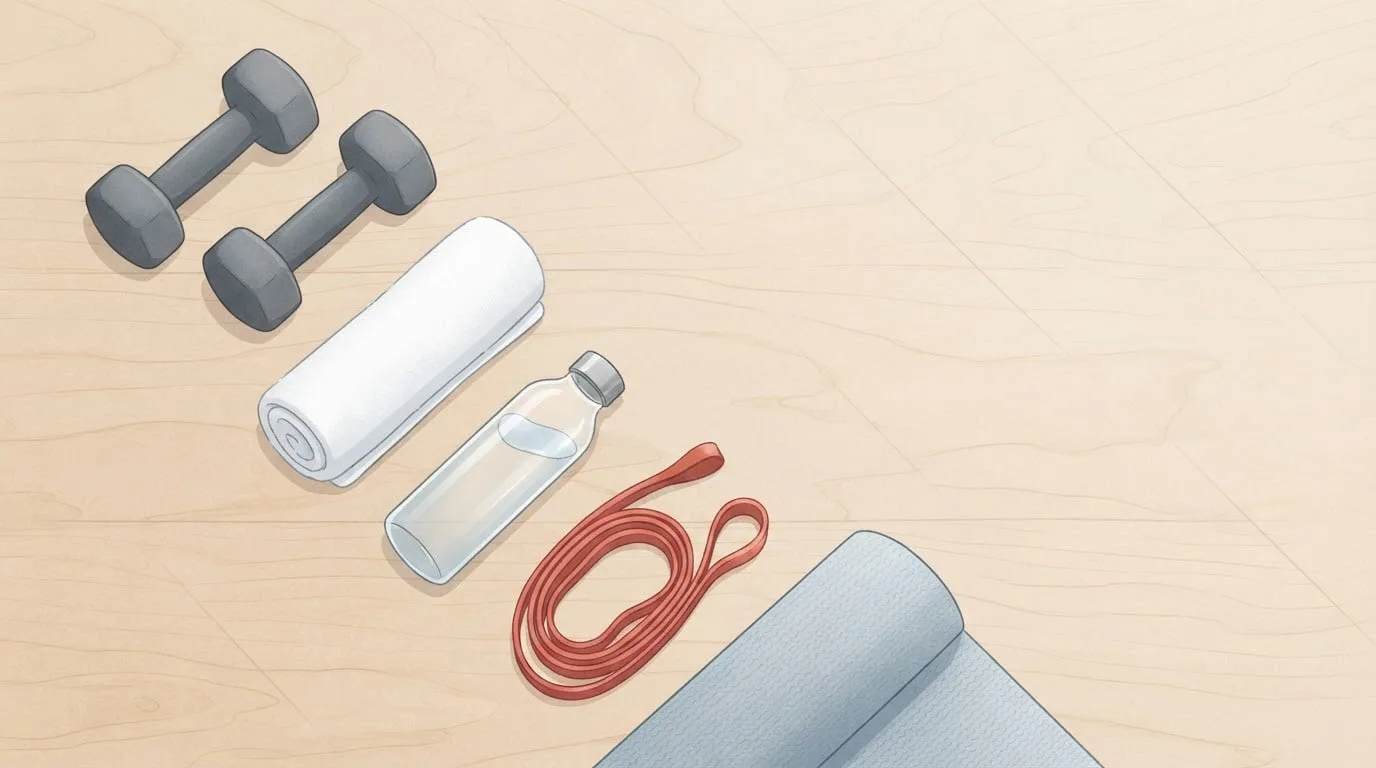
This hypertrophy workout program runs four days a week as an upper and lower split: two upper-body sessions and two lower-body sessions, such as Monday, Tuesday, Thursday and Friday. Every muscle gets two sessions a week. Each session takes about 50 to 65 minutes, and you need dumbbells (an adjustable pair is easiest), a bench and a mat. A gym's cables and machines can stand in for any exercise, but the plan doesn't need them.
Rest 2 to 3 minutes after sets of the first two exercises in each session and 60 to 90 seconds after the rest. Longer rest is worth the time on big exercises. In Schoenfeld and colleagues (2016), 21 trained men who rested 3 minutes between sets for 8 weeks gained more thigh muscle and strength than men who rested 1 minute.
How the 12 weeks are structured
| Weeks | Sets | Effort | Focus |
|---|---|---|---|
| 1 to 3 | As listed in the sessions below | 2 to 3 reps in reserve | Learn the movements and find your working weights |
| 4 | Half the sets | 3 to 4 reps in reserve | Lighter week |
| 5 to 7 | Add 1 set to the first two exercises of each session | 1 to 2 in reserve; last set of isolation exercises to failure | Push your reps and weights up |
| 8 | Half the sets | 3 to 4 reps in reserve | Lighter week |
| 9 to 11 | Weeks 5 to 7 sets, plus 2 weekly sets for one or two priority muscles | 1 to 2 in reserve on big exercises; 0 to 1 on isolation exercises | Your hardest weeks |
| 12 | Half the sets | 3 to 4 reps in reserve | Lighter week, then measure and retest |
Upper A (Monday)
| Exercise | Sets | Reps |
|---|---|---|
| Dumbbell bench press (or floor press) | 3 | 6 to 10 |
| One-arm dumbbell row | 3 | 8 to 12 each arm |
| Seated dumbbell overhead press | 2 | 8 to 12 |
| Two-arm bent-over dumbbell row | 2 | 10 to 15 |
| Dumbbell lateral raise | 3 | 12 to 20 |
| Dumbbell curl | 2 | 10 to 15 |
| Overhead dumbbell triceps extension | 2 | 10 to 15 |
Lower A (Tuesday)
| Exercise | Sets | Reps |
|---|---|---|
| Goblet squat | 3 | 8 to 12 |
| Dumbbell Romanian deadlift | 3 | 8 to 12 |
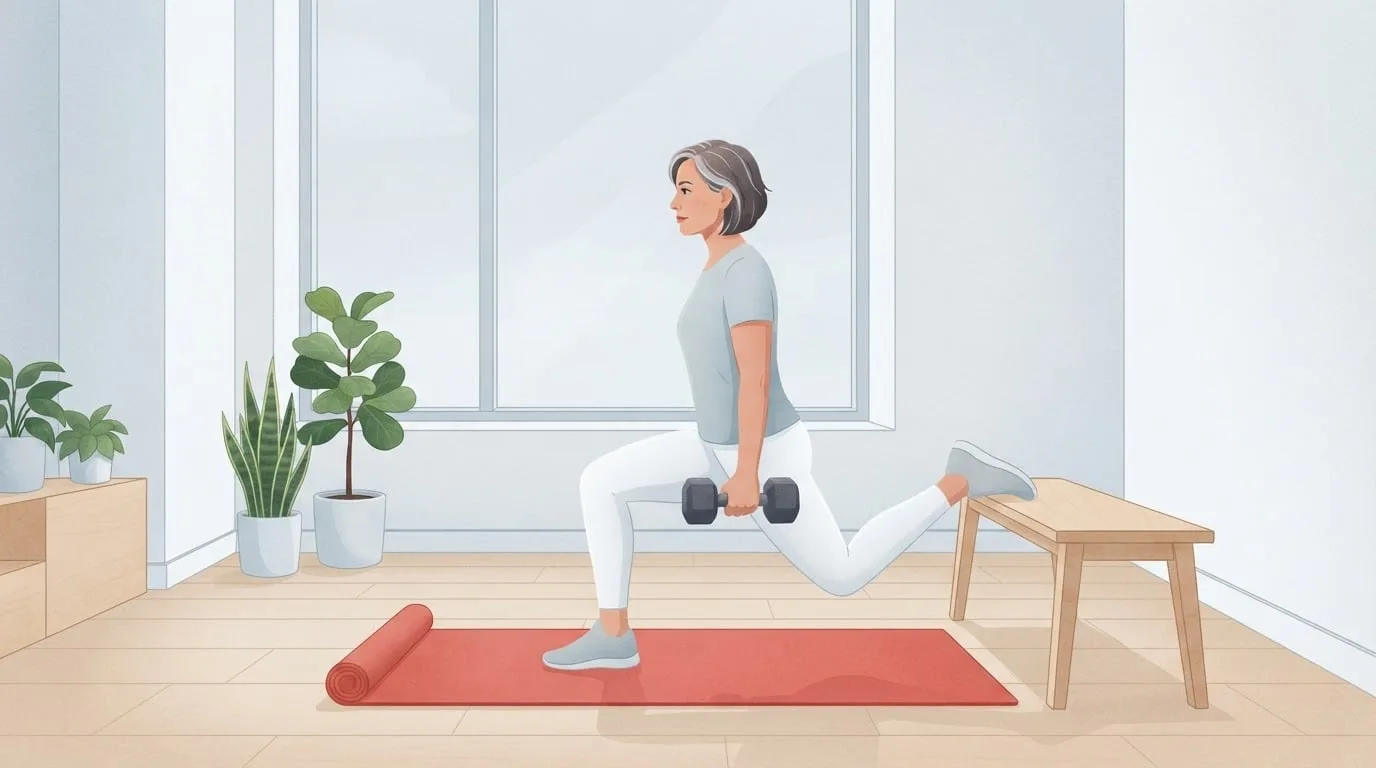
| Dumbbell reverse lunge | 2 | 10 to 12 each leg |
| Single-leg hip thrust, shoulders on the bench | 2 | 10 to 15 each leg |
| Standing calf raise on a step | 3 | 12 to 20 |
| Dead bug | 2 | 8 to 10 each side |
Upper B (Thursday)
| Exercise | Sets | Reps |
|---|---|---|
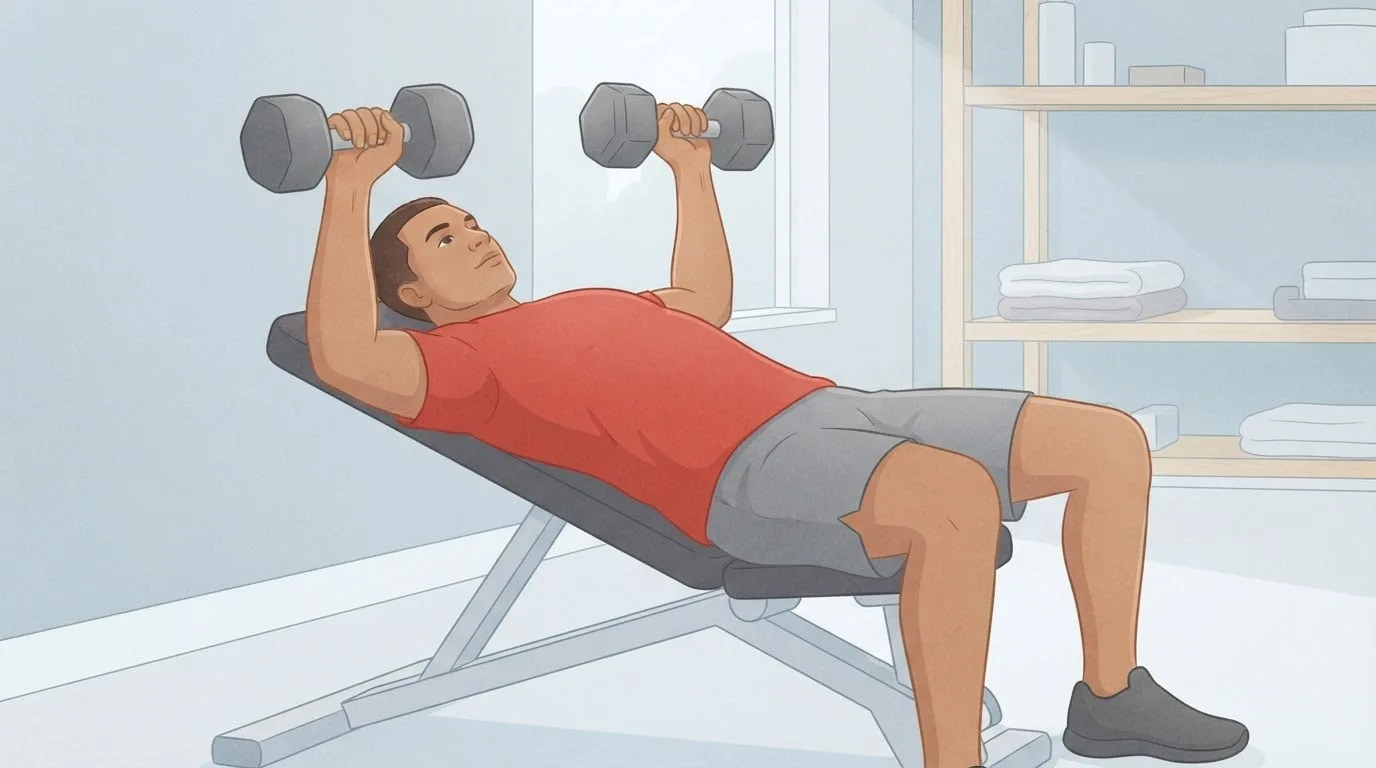
| Incline dumbbell press, bench at about 30 degrees | 3 | 8 to 12 |
| Chest-supported dumbbell row | 3 | 10 to 15 |
| Push-up (feet raised once 20 reps is easy) | 2 | Stop 1 or 2 reps short of failure |
| Dumbbell lateral raise | 2 | 12 to 20 |
| Rear delt fly | 2 | 12 to 20 |
| Incline dumbbell curl, bench at about 45 degrees | 2 | 10 to 15 |
| Lying dumbbell triceps extension | 2 | 10 to 15 |
Lower B (Friday)
| Exercise | Sets | Reps |
|---|---|---|
| Bulgarian split squat | 3 | 8 to 12 each leg |
| Single-leg Romanian deadlift | 3 | 8 to 12 each leg |
| Dumbbell hip thrust | 2 | 10 to 15 |
| Heels-elevated goblet squat | 2 | 12 to 15 |
| Single-leg calf raise | 3 | 10 to 15 each leg |
| Side plank | 2 | 20 to 40 seconds each side |
To save time on upper days, pair the curl and the triceps extension: do a set of one, then a set of the other, then rest. Warm up for 5 minutes before each session with lighter sets of the first exercise.
Weekly sets per muscle
| Muscle | Weeks 1 to 3 | Weeks 5 to 7 | Weeks 9 to 11 |
|---|---|---|---|
| Chest | 8 | 10 | 10 to 12 |
| Back | 8 | 10 | 10 to 12 |
| Quads | 10 | 12 | 12 to 14 |
| Hamstrings | 6 | 8 | 8 to 10 |
| Side delts | 5 | 5 | 5 to 7 |
| Biceps | 4 | 4 | 4 to 6 |
| Triceps | 4 | 4 | 4 to 6 |
These are direct sets only. Counted the way the Pelland analysis did, rows add half a set each to the biceps and rear delts, presses and push-ups add half a set each to the triceps, and squats, lunges and hinges add to the glutes. That puts the arms at about 8 to 10 effective sets a week before you add anything.
How to Progress Through the 12 Weeks
Write down the weight and reps for every exercise, then use double progression:
- Pick a weight that lets you reach the bottom of the rep range at the target effort.
- Add reps session by session until you hit the top of the range on every set.
- Next session, move up to the next weight and drop back to the bottom of the range.
If the next dumbbell is too big a jump, keep the weight and make the set harder another way. Lower the weight over 3 seconds, pause for a second in the stretched position, or switch to a harder variation, such as a single-leg version of a leg exercise.
The lighter weeks are there to let joints and motivation recover. They don't cost muscle. Coleman and colleagues (2024), in PeerJ, had 39 trained men and women take a full week off at the midpoint of a 9-week program. Their leg muscle grew as much as a group that trained straight through, though their strength gains were slightly smaller. If you feel fresh at week 4 or week 8, you can skip that lighter week; nothing in the evidence makes it mandatory.
At the end of each block, check the muscles you care about most. If one hasn't grown after a block and you're recovering well, give it the 2 extra weekly sets in the next block.
Hypertrophy Workout Plan 3 Days a Week
If four days won't fit, run three full-body sessions on non-consecutive days and keep the same 12-week block structure. Each session takes one exercise from each pattern: a squat or lunge, a hinge, a press, a row, a lateral raise and an arm exercise, with 3 sets each. That puts most major muscles at about 9 hard sets a week from the start. In weeks 5 to 7, add a set to the squat, hinge, press and row, which brings those muscles to 12.
Our guide on how to build muscle at home lays out a ready-made three-day full-body week with a different rep range each day, and it walks through the load and effort studies in more depth.
What Is the Best Routine for Hypertrophy?
The best routine for hypertrophy is the one that gives each muscle about 10 or more hard sets a week and that you'll keep doing for months. How you split the week matters much less. Ramos-Campo and colleagues (2024), in the Journal of Strength and Conditioning Research, pooled 14 studies with 392 people and found split routines and full-body routines built similar muscle and strength when volume was equated.
- Three days a week: full body, as above.
- Four days a week: the upper and lower plan on this page.
- Five days a week: a bro split workout gives each muscle group its own day. Keep each muscle near 10 hard sets per session.
- Six days a week: push pull legs, run twice through the week.
Hypertrophy Exercises: How to Choose and Swap Them
Good hypertrophy exercises let you work close to failure safely and move through a full range of motion. Range of motion matters. McMahon and colleagues (2014), in the Journal of Strength and Conditioning Research, found that 8 weeks of leg training through a long range of motion grew more muscle in the lower thigh and built more strength than the same training through a short range.
Exercises that load a muscle at long lengths are worth a place in the plan. Maeo and colleagues (2023), in the European Journal of Sport Science, trained 21 adults for 12 weeks with one arm doing triceps extensions overhead and the other with the arm at the side. The overhead arm's triceps grew 19.9 percent against 13.9 percent, even with lighter loads. That's why this plan uses an overhead triceps extension, incline curls, Romanian deadlifts and split squats.
Keep your exercises for a whole block. A systematic review by Kassiano and colleagues (2022) found that some planned variation can help muscles grow in more regions, but swapping exercises too often may hold gains back. Change one or two exercises between blocks if you like, and keep the rest so you can keep progressing them.
Swaps that keep the plan working:
- No bench: floor press instead of the bench press, push-ups with feet raised instead of the incline press, a bent-over row instead of the chest-supported row.
- Light dumbbells only: single-leg versions of squats and hinges, slower lowering, and a pause at the bottom.
- At a gym: cable or machine versions of the same movements, such as a cable row or leg press.
Hypertrophy Workout Plan for Women
Women can run the same plan without changes. A meta-analysis by Roberts, Nuckols and Krieger (2020), in the Journal of Strength and Conditioning Research, found no significant difference between men and women in muscle growth on the same training (10 studies), and women gained more upper-body strength relative to where they started.
Many women want more glute and leg development. If that's you, make the glutes a priority muscle in weeks 9 to 11 by adding a set to each hip thrust, or trade one lateral raise set on each upper day for a set of hip thrusts.
Protein and Recovery During the Plan
Training is the signal, and food and sleep let you act on it. In a meta-analysis of 49 trials with 1,863 people, Morton and colleagues (2018) found that gains in lean mass from training stopped improving at a total protein intake of about 1.6 grams per kilogram of body weight a day. That's about 110 grams a day for a 70 kg person, spread across meals. Most people get there from food.
Sleep and calories matter too. Short sleep and a large calorie deficit both make hard sets feel harder and recovery slower, so a hypertrophy block isn't the time for an aggressive diet.
What to Expect Over 12 Weeks
Growth starts sooner than most people think. Seynnes, de Boer and Narici (2007) scanned the thighs of seven young adults during a 35-day leg program. Quadriceps size had increased measurably by day 20 and was up 6.5 to 7.4 percent by day 35. That was a small study on a flywheel machine, but it shows early weeks aren't wasted.
| When | What usually changes |
|---|---|
| Weeks 1 to 3 | Your weights climb fast, mostly from better coordination. Measurable muscle growth can begin around week 3. |
| Weeks 4 to 8 | Tape measurements start to move and clothes begin to fit differently. |
| Weeks 9 to 12 | Most people who trained consistently can see the change in side-by-side photos. |
| After week 12 | Start a new 12 weeks from your weeks 5 to 7 set numbers, with new priority muscles if you like. |
Age slows the pace of muscle gain, but older lifters still gain. Peterson, Sen and Gordon (2011), in Medicine & Science in Sports & Exercise, pooled 49 studies in adults aged 50 and older. Resistance training added an average of 1.1 kg of lean mass, older participants gained less, and higher-volume programs gained more.
The Bottom Line
A hypertrophy workout plan works when it gets three things right: about 10 to 20 hard sets per muscle a week, sets that end 1 to 3 reps from failure, and steady progress in reps or weight. Dumbbells and bodyweight cover all of it. Run the 12 weeks, take the lighter weeks when you need them, and judge the result by measurements and photos, not by how sore you feel.
If you'd rather have someone else plan the sets, our comparison of the best strength training apps covers the options. FitCraft builds programs from dumbbell and bodyweight exercises, an AI coach demonstrates each exercise on an interactive 3D model, and the workouts adjust as you progress. Streaks and leaderboards help with the part a 12-week plan depends on, which is showing up four times a week.
As one FitCraft user, Matt, put it: "The real win is I actually want to work out now. That's never happened before."
Frequently Asked Questions
What is hypertrophy training?
Hypertrophy training is resistance training aimed at making muscles bigger. It typically uses sets of about 6 to 30 reps stopped 0 to 3 reps short of failure, 10 to 20 hard sets per muscle a week, and steady progress in reps or weight. Strength training uses the same exercises but heavier loads and fewer reps, aimed at the most weight you can lift once.
How many sets per week for hypertrophy?
Start with about 10 hard sets per muscle a week and work up toward 15 to 20 if you recover well and stop progressing. A 2017 meta-analysis found each extra weekly set added about 0.37 percent to muscle growth, and a 2026 analysis of 67 studies found the returns get smaller as weekly sets climb.
Is 8 to 12 reps best for hypertrophy?
No single rep range is best. Muscle grows about as well from light and heavy loads when sets end close to failure, although training at only 20 percent of your max grew about half as much muscle in one trial. Use 6 to 12 reps for presses, squats and rows and 10 to 20 for raises, curls and extensions.
Can you build muscle with only dumbbells?
Yes. Muscle responds to hard sets rather than the type of weight, so dumbbells and bodyweight exercises build muscle when sets end close to failure and you keep adding reps or weight. Single-leg exercises and slower lowering keep light dumbbells challenging for the legs.
What age is hardest to gain muscle?
Gaining muscle gets gradually harder with age, but it doesn't stop. A meta-analysis of 49 studies in adults aged 50 and older found an average gain of 1.1 kg of lean mass from resistance training, with smaller gains in older participants and bigger gains from higher-volume programs.
How long should a hypertrophy program last?
Run a hypertrophy program for 8 to 12 weeks before judging it, and keep the same main exercises for at least 4 weeks so you can progress them. Muscle growth can be measured after about 3 weeks of training, but visible change usually takes 2 to 3 months.