
The first time most people try an AMRAP workout, they treat round one like a sprint. It takes 50 seconds. Round two takes 70, and by minute eight they're standing over the push-up spot with their hands on their knees. If you've searched "what is an AMRAP workout" after a session like that, wondering how anyone makes AMRAP workouts look smooth, you're in good company.
That crash doesn't mean you're unfit or undisciplined. AMRAPs reward a skill that almost nobody explains, which is pacing. Without it, every AMRAP turns into a test you fail, and feeling like you failed is a big reason people stop showing up.
This guide fixes that. It explains the format, how to pace it, and how to score and log it so it becomes a benchmark. You also get six AMRAP workouts from 7 to 30 minutes with bodyweight and dumbbells, a section on AMRAP push-ups and pull-ups, and what the research says about AMRAP vs EMOM and HIIT.
What Is an AMRAP Workout?
AMRAP stands for as many rounds (or reps) as possible. In a conditioning AMRAP the clock is fixed and the work is open: you cycle through a short circuit until time runs out, and your score is how much you got done. The same letters also describe a single rep-out set in strength training. Our AMRAP glossary entry covers both meanings in brief, and this guide is about the timed workout.
The easiest way to understand an AMRAP is to compare it with the two formats it's usually grouped with:
| Format | What's fixed | What changes | Your score |
|---|---|---|---|
| AMRAP | The time | How much work you do | Rounds plus reps |
| EMOM | The work in each minute and the total time | How much rest you get | Whether you finished every minute |
| For time | The amount of work | How long it takes | Your finishing time |
How to Do an AMRAP Workout: 4 Choices
- Set the time cap. Five to 10 minutes is short and intense. Twelve to 20 minutes is the classic length. At 25 to 30 minutes the effort turns steady, closer to endurance work than a sprint.
- Pick 3 to 5 AMRAP exercises that spread the work around. One lower-body move, one upper-body push, one pull or hip hinge and one move that raises your heart rate is a reliable mix. Choose moves you can still do well when you're tired.
- Size the round. Pick reps so that one round takes about 60 to 90 seconds when you're fresh. If a round takes 3 minutes or more, you'll only finish a handful, and your score will barely move from one month to the next.
- Set the standards before you start. Decide what counts as a rep: chest to a fist's height from the floor on push-ups, hips below the knees on squats. A score only means something if the reps are the same every time.
How to Pace an AMRAP
Pacing decides your score, and an unpaced AMRAP is brutal. Maté-Muñoz and colleagues (2018), in the Journal of Sports Science and Medicine, had 32 young, strength-trained men do Cindy: as many rounds as possible of 5 pull-ups, 10 push-ups and 15 air squats in 20 minutes. Their heart rate averaged 92 percent of predicted maximum and reached about 97 percent by the end. Blood lactate rose from about 1.6 to 12 mmol/L, and they rated the session around 17.6 on the 6-to-20 Borg effort scale, past "very hard." Jump height was 7.3 percent lower afterward.
Those were trained men pacing themselves. A newer study points the same way. In the 2025 PeerJ comparison described further down, jump height dropped after an AMRAP in both experienced and less experienced athletes, while the same work done as an EMOM caused no significant drop. These pacing rules keep that fatigue under control:
- Start at 7 out of 10. Round one should feel like you're holding back. If round one is much faster than every round after it, you started too hard.
- Split sets before they fail. Break 10 push-ups into 6 and 4 from the first round instead of grinding to failure in round four. A planned 5-second break costs less than a forced 30-second one.
- Keep transitions short. Set your stations close together. Walking between them is where AMRAP time disappears.
- Recover on the easiest move. Squats and jumping jacks are where you catch your breath, so slow down there rather than resting on the floor.
- Spend what's left in the last 2 minutes. Once you know you'll make it to the end, empty the tank.
Even splits are the goal. Your last full round should take no more than about 20 percent longer than your first.
How to Score and Log an AMRAP
Write the score as completed rounds plus extra reps. Say the round is 5 push-ups, 10 squats and 15 lunges. If you finish 8 full rounds plus 5 push-ups and 7 squats, your score is 8+12.
- Count rounds with something physical. Move a pebble, a dried bean or a hair tie from one pile to another after each round. Counting in your head fails once you're tired.
- Log more than the number. Write the date, the score, any scaling, such as incline push-ups or the dumbbell weight, and how hard it felt out of 10.
- Retest every 4 to 6 weeks. Repeat the same AMRAP with the same standards. A higher score with the same rules means you're fitter. A higher score with looser reps means nothing.

6 AMRAP Workouts You Can Do at Home
Warm up before any of these with two minutes of easy marching or jumping jacks, then one slow round of the workout at half speed with half the reps. The workouts are ordered by time cap. Do the moves in order, repeat the round until time runs out, and write down your score.
1. 7-minute bodyweight AMRAP (beginner)
- 10 chair squats or bodyweight squats
- 8 incline push-ups on a counter or sturdy table
- 10 glute bridges
This is a good first AMRAP. There's no jumping, and the glute bridges give your arms a rest before the next round. Aim for 3 to 5 steady rounds on your first try.
2. 12-minute no-equipment AMRAP (intermediate)
- 5 burpees
- 10 push-ups
- 15 air squats
- 20 mountain climbers (10 per leg)
This is a classic home AMRAP. The burpees open each round, and you can step back instead of jumping back as soon as your form gets ragged.
3. 20-minute bodyweight AMRAP: Cindy at home
- 5 pull-ups, or 8 table rows under a heavy, solid table
- 10 push-ups
- 15 air squats
This is Cindy, a well-known CrossFit benchmark, with a row in place of the pull-up if you don't have a bar. Only row under a heavy, solid table that can't tip toward you, and see our inverted row page for the setup. Pace it at 6 or 7 out of 10, because 20 minutes is long.
4. 10-minute dumbbell AMRAP
- 8 goblet squats
- 10 bent-over dumbbell rows
- 8 dumbbell shoulder presses
Choose dumbbells you could shoulder-press 12 to 15 times when fresh. For the goblet squat, hold one end of a single dumbbell at your chest.
5. 20-minute dumbbell AMRAP
- 8 dumbbell thrusters (squat, then drive the dumbbells overhead as you stand)
- 12 dumbbell reverse lunges (6 per leg)
- 10 bent-over dumbbell rows
- 6 burpees
This one works the whole body every round. Use lighter dumbbells than you would for straight sets, because the thrusters come back every couple of minutes.
6. 30-minute no-equipment AMRAP (long and steady)
- 10 push-ups
- 20 reverse lunges (10 per leg)
- 15 air squats
- 30-second plank
- 20 jumping jacks
Pace this one at about 6 out of 10. It's closer to steady endurance work than a sprint, and the goal is to keep moving for the full 30 minutes without stopping for long.
Find out what's really holding you back
FitCraft, our mobile fitness app, pairs you with an AI coach who builds you a personalized plan around your goals, schedule, and fitness level. Every FitCraft program is designed by Domenic Angelino, MPH (Brown University) and NSCA-CSCS, with research published in the Journal of Strength and Conditioning Research and Medicine & Science in Sports & Exercise.
Take the Free Assessment Free • 2 minutes • No credit cardAMRAP Push-Ups and Pull-Ups
An AMRAP set, one set for as many good reps as possible, is also the simplest strength test you can do at home. Push-ups are the classic. Yang and colleagues (2019), in JAMA Network Open, followed 1,104 active male firefighters for 10 years after a paced push-up test. Men who completed more than 40 push-ups had a 96 percent lower rate of cardiovascular events than men who managed fewer than 10. It was an observational study of men in one job, so push-ups mark fitness rather than cause heart health. Still, it shows how much one rep count can tell you.
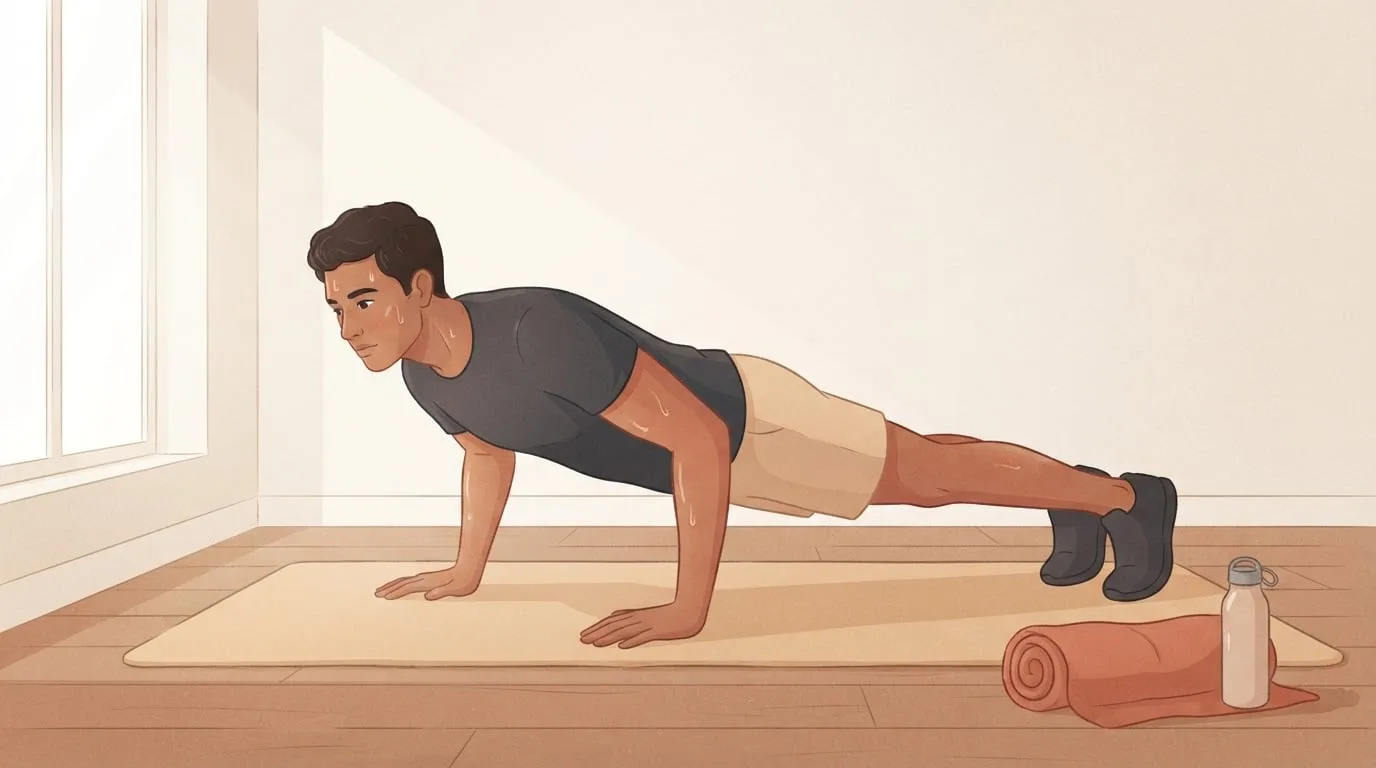
To run a push-up AMRAP:
- Warm up with 2 easy sets of 5 push-ups.
- Use one strict standard: body straight, chest to a fist's height from the floor, arms fully straight at the top.
- Stop at the first rep that breaks that standard, not at collapse.
- Retest every 4 weeks. Our guide to how many push-ups you should be able to do shows where your number sits for your age.
Your push-up AMRAP also sets your training numbers. A third to a half of it is a good working set for circuits and for an EMOM workout, which turns that number into reps per minute.
For pull-ups, the same rules apply: start from a dead hang and finish with your chin over the bar. If you can't do one yet, do an AMRAP set of table rows or inverted rows instead and track that number while you build up. Our guide to getting your first pull-up lays out the steps.
Which Is Better, AMRAP or EMOM?
Each one does a different job. In a 2025 PeerJ study by Oliver-López and colleagues, 25 adults with functional fitness experience did identical work three ways: as an AMRAP, as an EMOM and for time, each inside 12 minutes. Heart rate barely differed between the formats, averaging in the low to mid 160s. The AMRAP left blood lactate at about 10 to 11 mmol/L against 8 to 9 after the EMOM, and the experienced athletes rated it 7.1 out of 10 against 6.3 for the EMOM. Only the AMRAP left both groups with a significant dip in jump height.
A second study shows how the AMRAP's open pacing can play out differently for different people. Toledo and colleagues (2021), in Life, compared an AMRAP with a for-time workout of the same volume in 23 experienced CrossFit athletes (13 men and 10 women). Heart rate and lactate didn't differ between the two formats, but the women's training load was higher when they did the AMRAP.
So neither is better overall. Use an AMRAP when you want a score and a hard day, and an EMOM when you want clean reps with less fatigue, for example the day before another session.
Is AMRAP the Same as HIIT?
Not quite. A 2018 paper by Feito and colleagues in the journal Sports, written to define high-intensity functional training, separates the two. In their account, HIIT is repeated short bursts of vigorous work with rest or easy recovery in between. Functional training uses varied, multi-joint movements for different lengths of time, with or without rest. An AMRAP has no planned rest at all, so it sits closer to functional training than to classic HIIT.
The intensity can be just as high, though. Cindy kept trained men at 92 percent of predicted maximum heart rate for 20 minutes, which is HIIT territory. The difference is that HIIT hands you the rest, while an AMRAP makes you decide when to take it. Our review of HIIT vs steady-state cardio covers where each kind of training fits.
What Is 20 Minutes of HIIT Equivalent To?
There's no exact exchange rate, but two studies give a useful frame. Gillen and colleagues (2016), in PLoS One, had sedentary men train three times a week for 12 weeks. One group did 10-minute sessions with one minute of all-out cycling sprints, and the other did 50 minutes of moderate cycling. Peak aerobic fitness rose 19 percent in both groups, and insulin sensitivity improved by a similar amount, despite a five-fold difference in exercise time.
For body fat, a 2017 meta-analysis by Wewege and colleagues in Obesity Reviews found the same kind of time trade. Across 13 trials in adults with overweight or obesity, intervals matched moderate cardio for fat loss while taking about 40 percent less of people's training week. Those studies used cycling and running intervals rather than AMRAPs, so treat them as a rough guide. A genuinely hard 20-minute session can do the fitness work of a much longer moderate one, but it costs more recovery, so two or three a week is plenty.
Scaling an AMRAP for Beginners
Scaling isn't cheating. It's how you get a score you can repeat and improve. Change one of these before you change anything else:
- Halve the reps. Five push-ups and 8 squats a round is a real workout.
- Use an easier version. Try incline push-ups, chair squats, step-back burpees or a lighter dumbbell.
- Shorten the cap. A 7- or 10-minute AMRAP done well beats a 20-minute one that falls apart in minute nine.
- Add a built-in rest. Rest 30 seconds after each full round. It's no longer a pure AMRAP, and that's fine while you learn to pace.
Form matters most when the clock is running and nobody is watching. Klimek and colleagues (2018), in the Journal of Sport Rehabilitation, reviewed three cohort studies. CrossFit's injury rates were comparable to or lower than those of Olympic weightlifting, distance running and gymnastics, and shoulder injuries were somewhat common. Injuries were also more common when no supervision was available. At home you're your own supervisor, so set your rep standards before the timer starts and keep them.
Can an AMRAP Workout Help With Weight Loss?
An AMRAP's biggest weight-loss advantage may be that people stick with it. Heinrich and colleagues (2014), in BMC Public Health, randomly assigned 23 inactive adults with overweight or obesity to 8 weeks of either high-intensity functional training, with workouts of 5 to 30 minutes, or 50 minutes of moderate aerobic exercise plus resistance training. The functional training group spent much less time exercising each week, kept enjoying it, and more of them planned to continue.
Body composition didn't change in either group over those 8 weeks, which is the honest part. Fat loss comes from what you eat and how much you move across the whole week. A short, scored AMRAP two or three times a week helps by being something you'll keep doing.
FitCraft is built around that kind of consistency. Streaks and leaderboards give you a reason to come back for the next session, and workouts adjust as you progress. The strength sessions use dumbbells and bodyweight, with an AI coach who demonstrates every move on an interactive 3D model you can zoom in on, which helps when you're learning a new move. If most of your training happens at home without equipment, see how FitCraft works as a bodyweight workout app for home.
The Bottom Line
An AMRAP workout is a fixed time, a short circuit and a score. Size each round at 60 to 90 seconds, start at 7 out of 10, split sets before they fail, and write your score as rounds plus reps. Retest in four to six weeks with the same standards, and save AMRAPs for hard days, with EMOMs or easier sessions in between.
A score you can beat is a reason to show up again. As Matt, a FitCraft user, put it: "The real win is I actually want to work out now. That's never happened before."
Frequently Asked Questions
What is an AMRAP workout?
An AMRAP workout gives you a fixed amount of time to complete as many rounds of a short circuit as you can. You rest only when you choose to, and the rounds and extra reps you finish become your score. Most AMRAPs last 7 to 20 minutes and use 3 to 5 exercises.
Is AMRAP the same as HIIT?
Not quite. HIIT alternates hard bursts with planned rest, while an AMRAP has no planned rest and you pace yourself through continuous work. A hard AMRAP can reach HIIT-level heart rates, though: in one study a 20-minute bodyweight AMRAP averaged 92 percent of predicted maximum heart rate.
Which is better, AMRAP or EMOM?
Neither is better overall. When the total work was identical, an AMRAP produced more lactate and more leg fatigue than an EMOM, while heart rate stayed similar. Use an AMRAP when you want a score and a hard day, and an EMOM when you want quality reps with less fatigue.
What is 20 minutes of HIIT equivalent to?
There's no exact exchange rate. In a 12-week trial, 10-minute sprint interval sessions with one minute of all-out work raised aerobic fitness as much as 50-minute moderate sessions, and a 2017 meta-analysis found interval training cut fat mass about as much as moderate cardio in about 40 percent less time.
What are some good CrossFit AMRAP workouts?
Cindy is the best-known bodyweight benchmark: as many rounds as possible of 5 pull-ups, 10 push-ups and 15 air squats in 20 minutes. Without a pull-up bar, swap the pull-ups for 8 table rows. Gym AMRAPs often add barbell lifts and rowing, which you can replace with dumbbell thrusters and burpees at home.
What are the only 5 exercises you'll ever need?
No five exercises cover everything, but a squat, a hip hinge, a push, a pull and a plank train the main ways your body moves. At home that could be goblet squats, dumbbell Romanian deadlifts, push-ups, dumbbell rows and planks, and those five also make a solid AMRAP circuit.
What is the 3-3-3 rule at the gym?
The 3-3-3 rule is a social-media template rather than a training standard, and versions differ. The usual one is three exercises for three sets, three days a week. It isn't an AMRAP, but three exercises is also a good size for a first AMRAP circuit.
How do you score an AMRAP?
Write the score as completed rounds plus extra reps, such as 8+12 for eight full rounds and 12 reps into the ninth. Note any scaling, like incline push-ups or a lighter dumbbell, and repeat the same AMRAP with the same standards in four to six weeks to see if the score goes up.