Does HIIT build muscle, or does it just leave you sweaty? It's a reasonable thing to wonder after twenty minutes of burpees that left your legs shaking. The burn feels like the kind of work that should make muscles grow, and a lot of home workout programs promise you'll "tone and build" with intervals alone.
The trials tell a more modest story. High-intensity interval training is one of the best tools there is for raising your fitness in little time, and it can nudge muscle size up in people who are new to training. It isn't a muscle-building program, though, and the reasons are specific: how long each interval lasts, what stops you, and whether the load ever goes up.
This page covers what the lean-mass trials found, why HIIT builds some muscle and not more, who gains the most, whether HIIT raises testosterone, how to combine HIIT and weights in the same week, and a way to make intervals do more for your muscles with dumbbells and bodyweight.
What the Lean-Mass Trials Show
The most complete answer comes from the 2025 meta-analysis by Wiens and colleagues, which pooled 54 studies of HIIT and sprint interval training covering 1,136 healthy adults aged 18 to 80. Most participants were sedentary, untrained or recreationally active. Only three studies used trained people. Here's what they found:
- Fat-free mass rose about 1.2 percent on average from before to after training, across 26 studies.
- Quadriceps size grew about 4.7 percent in the four studies that measured it with MRI.
- Against steady cardio, HIIT came out slightly ahead on fat-free mass (a standardized effect of 0.16), and against no exercise by a bit more (0.33). Neither difference was statistically clear.
- Against resistance training, HIIT was likely worse for leg press strength, in the three studies that compared them directly.
The authors rated the certainty of all of it as low, because 25 of the 54 studies had a high risk of bias and every confidence interval crossed zero. Fat-free mass is also a rough stand-in for muscle, since it includes water, organs and bone.
Volume matters too. Sultana and colleagues (2019) looked only at low-volume HIIT, the short sessions that total 500 MET-minutes a week or less, across 47 studies. Low-volume HIIT didn't change lean body mass compared with no exercise, and it didn't beat steady cardio either. It did improve cardiorespiratory fitness more than both.
One study shows the gap with lifting directly. Robinson and colleagues (2017) randomized young adults (18 to 30) and older adults (65 to 80) to 12 weeks of HIIT, resistance training or a combination. Fat-free mass rose in every group, and the largest gain, 2.2 kg, was in young adults who lifted. Only the HIIT and combined groups improved aerobic capacity and the mitochondria in their muscles. Each mode did its own job.
Why HIIT Builds Some Muscle
A hard interval asks a lot of the muscles doing the work. In their review, Callahan and colleagues (2021) describe HIIT bouts at or above the pace that drives your oxygen use to its maximum as placing high tension on skeletal muscle, which partly resembles the demands of resistance exercise. That effort recruits the larger, fast-twitch fibers that easy cardio leaves mostly idle, and for an untrained muscle, that's a new enough signal to grow.
Two small trials show it happening in the thigh, where interval work is concentrated:
- Cycling intervals, 3 weeks. Blue and colleagues (2018) randomized 44 adults with overweight or obesity to one of two 3-week HIIT programs or no training. The group doing ten 1-minute bouts at 85 to 100 percent of peak oxygen uptake grew the outer quadriceps by about 3.2 square centimeters on ultrasound, while the control group didn't change.
- Running intervals, 10 weeks. Estes and colleagues (2017) had 12 untrained college students, 10 of them women, run four 4-minute intervals at 90 to 95 percent of maximum heart rate two or three times a week. The outer quadriceps grew about 10.6 percent, against a 1.2 percent drop in the 5 controls.
Both studies were small and short, and both used people who weren't training. That pattern runs through the whole literature: HIIT grows the muscles that do the intervals, mostly the legs, in people for whom any hard work is new.
Why HIIT Can't Match Lifting for Muscle
Muscle grows when sets end close to the point where the muscle itself can't do another rep, and when the challenge keeps rising from week to week. HIIT tends to miss both.
The clock or your lungs end the set, not your muscles
A 30-second round of jump squats stops when the timer beeps, or when you're too out of breath to keep going. Your legs might still have plenty left. Load matters less than people think, as long as the muscle is pushed hard: Morton and colleagues (2016) found that 49 trained men built similar muscle over 12 weeks lifting light weights for 20 to 25 reps or heavy weights for 8 to 12, with every set taken to failure. Interval rounds rarely get that close, because breathing gives out first.
Bodyweight intervals don't get heavier
Your body weight is the same in week ten as in week one. Once a burpee or a jump squat is familiar, it stops being a new stimulus for growth, and HIIT programs usually progress by adding rounds or cutting rest, which trains your heart and lungs more than your muscles. Lifting progresses by adding weight or reps, which is exactly what keeps muscles adapting.
Most intervals barely touch the upper body
Bike sprints, running intervals, high knees and skaters are leg-dominant. The studies that found growth measured the thigh, and the Wiens review found no reliable evidence for strength or size gains anywhere else.
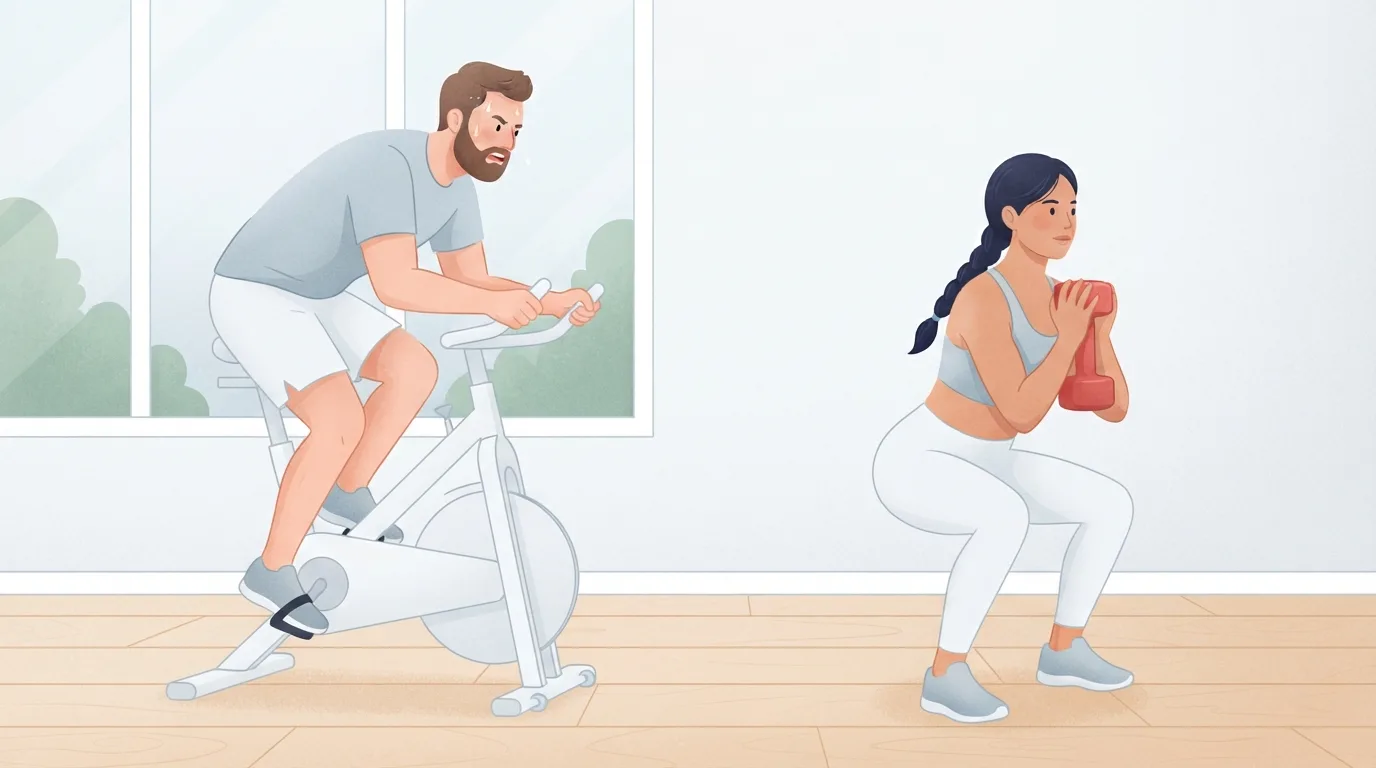
Here's how the two compare for the goals people usually mix up:
| Goal | HIIT | Resistance training |
|---|---|---|
| Muscle size | Small gains, mostly legs, mostly beginners | The most reliable way to build muscle anywhere you train |
| Strength | Little change, likely less than lifting for leg strength | Large gains that keep coming with progression |
| Aerobic fitness | Large gains in little time | Little or no change |
| How it progresses | More rounds, less rest, faster pace | More weight or more reps |
| Weekly dose | Two or three sessions | Each muscle at least twice a week |
Who Gains Muscle From HIIT?
The people who gain the most are the people who were doing the least. Nearly every positive trial used sedentary, untrained or overweight adults, and in the Robinson trial the biggest gain, 2.2 kg, went to young adults who lifted.
- Beginners. If your legs haven't been pushed hard in years, a few weeks of intervals can add measurable size to your thighs.
- Adults with overweight. A heavier body makes every interval a loaded effort, which may be one reason the Blue trial saw growth in three weeks.
- Middle-aged and older adults. Callahan and colleagues argue HIIT is worth using in groups prone to muscle loss, because it builds fitness and may hold or add some muscle at the same time. The Robinson trial, which included adults aged 65 to 80, found lean mass rose with all three types of training.
- Trained lifters. Expect little or nothing. Your muscles are already used to far more tension than a sprint delivers.
Knowing what to do is the easy part.
FitCraft, our mobile fitness app, pairs you with an AI coach who builds you a personalized plan around your goals, schedule, and fitness level. Every FitCraft program is designed by Domenic Angelino, MPH (Brown University) and NSCA-CSCS, with research published in the Journal of Strength and Conditioning Research and Medicine & Science in Sports & Exercise.
Take the Free Assessment Free • 2 minutes • No credit cardDoes HIIT Increase Testosterone?
A little, in some studies, and it doesn't matter much for muscle. The most-cited study is Herbert and colleagues (2017), who put 17 male masters endurance athletes, average age 60, through nine sessions of sprint intervals over six weeks. Each session was six 30-second sprints with 3 minutes of easy pedaling between them. Peak power rose from about 799 to 865 watts. Total testosterone didn't change significantly (15.2 to 16.4 nmol/L), and free testosterone rose slightly, from 7.0 to 7.5 ng/dL, right at the edge of statistical significance.
That's a real result in an older, already fit group, and it's a small one. It also doesn't mean more muscle. When Morton and colleagues tracked hormone levels after every workout in their 49 trained men, none of the post-exercise rises in testosterone, growth hormone or IGF-1 was related to how much muscle or strength anyone gained. Short hormone spikes are a side effect of hard work, not the cause of growth.
So if your goal is testosterone for its own sake, the evidence for HIIT is thin. If your goal is muscle, the hormone question is a distraction from what works: progressive strength training and enough protein.
Can I Do HIIT and Weights on the Same Day?
Yes, and it won't cost you muscle growth. Sabag and colleagues (2018) pooled studies comparing HIIT plus resistance training with resistance training alone. Muscle growth and upper-body strength were the same either way. The only cost was a slightly smaller gain in lower-body strength (an effect size of about 0.25), which leaned toward cycling intervals and may shrink with more rest between the two sessions.
The broader interference effect between cardio and lifting is smaller than gym lore suggests, and our review of whether cardio kills your gains covers that evidence. For HIIT specifically, three habits keep the cost near zero:
- Lift first when muscle is your priority, so your legs are fresh for the strength work.
- Separate them by several hours when you can, or put HIIT on a different day from your hardest leg session.
- Cap HIIT at two or three sessions a week. More than that eats into the recovery your strength days need.
How to Make HIIT Build More Muscle
If you like the pace of intervals and want more muscle from them, fix the two problems above: make each work period end near muscular fatigue rather than breathlessness, and let the load climb over time. Dumbbells make both possible at home.
Try strength intervals. Pick a dumbbell weight you can lift only about 10 to 15 times, do as many clean reps as you can in 40 seconds, and rest 20 to 40 seconds. Run four rounds of this circuit:
- Goblet squat, holding one dumbbell at your chest.
- Single-arm dumbbell row, 20 seconds each side.
- Push-up, on your knees or hands elevated if you need to.
- Dumbbell Romanian deadlift.
- Reverse lunge with dumbbells at your sides.
- Dumbbell overhead press.
When you can beat your rep count in every round, move to the next dumbbell size. That progression is what turns a sweaty circuit into strength training with a cardio bonus. Keep your separate sprint-style HIIT for the fitness side, using the routines in our home HIIT workout guide.
Eat to support it. In a meta-analysis of 49 trials, Morton and colleagues (2018) found protein added muscle during strength training up to about 1.6 g per kilogram of body weight a day, with no extra benefit beyond that. For a 170 lb (77 kg) person, that's about 125 g a day.
A Weekly HIIT and Strength Training Schedule
Training each muscle at least twice a week produces more growth than once, according to a meta-analysis by Schoenfeld and colleagues (2016). This week hits every major muscle three times with dumbbells and bodyweight and keeps two HIIT sessions for fitness:
| Day | Session | Time |
|---|---|---|
| Monday | Full-body dumbbell strength (squat, row, press, hinge) | 35 to 45 min |
| Tuesday | HIIT: bike, run or bodyweight intervals | 20 min |
| Wednesday | Full-body dumbbell strength, different exercises | 35 to 45 min |
| Thursday | Walk or mobility | 20 to 30 min |
| Friday | Dumbbell strength intervals (the circuit above) | 25 min |
| Saturday | HIIT, then easy walking | 20 to 40 min |
| Sunday | Rest |
If fat loss is the main goal, the same week works, because HIIT and steady cardio produce similar fat loss in trials. Our comparison of HIIT vs steady-state cardio covers that evidence, and the strength days are what make sure the weight you lose is mostly fat.
What This Means for You
If you've been doing HIIT and wondering why your arms and shoulders haven't changed, nothing is wrong with you or your effort. Intervals are built to make your heart and lungs better, and they do that faster than almost anything else. They were never designed to make your muscles bigger, and the trials show it: a small bump in the legs for beginners, and little beyond that.
So give each tool its job. Keep two or three HIIT sessions for fitness, add two or three dumbbell or bodyweight strength sessions that get harder over time, and eat enough protein. You'll keep the conditioning you like and finally see the shape change you were hoping intervals would bring. A dumbbell workout app that adds weight and reps for you takes the guesswork out of that progression.
The harder part is still showing up for the strength days when HIIT feels like enough. FitCraft's strength programs use dumbbells and bodyweight, a 3D AI coach demonstrates every exercise and says your name as you train, and your workouts adjust as you progress. Mike, 23, came out of it visibly stronger in four months: "The streak system got me hooked. I didn't want to break my chain."
Frequently Asked Questions
Does HIIT build muscle?
HIIT builds a little muscle, mostly in the legs of people who don't already train. A 2025 meta-analysis of 54 studies found fat-free mass rose about 1 percent on average, with low-certainty evidence. Resistance training builds considerably more, so use HIIT for fitness and lift for muscle.
Is 20 minutes of high intensity cardio enough?
It's enough to improve your fitness, but not to change your body composition. A 47-study review of low-volume HIIT found it raised cardiorespiratory fitness more than no exercise and more than steady cardio, yet it didn't change fat mass or lean mass. Two or three short sessions a week plus strength training covers both goals.
What are some common HIIT exercises?
Common HIIT exercises include sprints on a bike or on foot, burpees, jump squats, mountain climbers, high knees and skater hops. For more muscle stimulus, dumbbell moves such as thrusters, goblet squats, renegade rows and swings work well as intervals because you can add load over time.
What are the downsides of HIIT training?
HIIT is hard to recover from, so more than two or three sessions a week tends to leave you tired rather than fitter. Jumping intervals load the joints, the high heart rate is a real strain for anyone with heart disease, and on its own HIIT builds little muscle or upper-body strength.
Does HIIT increase testosterone in females?
Few HIIT trials have measured testosterone in women, and the small ones report mixed results. It matters less than it sounds, because short hormone rises after exercise don't predict muscle growth in either sex. Progressive strength training and enough protein are what build muscle.
Will HIIT on a cut cause muscle loss?
Not by itself. Trials of HIIT show lean mass holding steady or rising slightly, not falling. Muscle loss during a diet comes mainly from a large calorie deficit, low protein and dropping strength training, so keep lifting two or three times a week and eat enough protein while you cut.
Does HIIT increase growth hormone?
Hard intervals briefly raise growth hormone, as most intense exercise does. That short rise doesn't translate into extra muscle: in a 12-week study of 49 trained men, none of the post-exercise rises in growth hormone, testosterone or IGF-1 was related to muscle or strength gains.