Quarter squats use the top portion of a squat: a small knee bend, a slight hip shift back, and a controlled return to standing. They are not the same as cutting a normal squat short because you got tired. The point is to own a shallow athletic position and keep the knees, hips, and feet lined up.
That makes the quarter squat useful before squats, jump squats, running drills, or any workout where you need the lower body to move quickly without dropping into deep flexion. Treat it as a skill and mobility drill first. Speed comes later.
Quick Facts: Quarter Squats
- Equipment needed: None
- Difficulty: Beginner to Intermediate
- Modality: Mobility, warm-up, and bodyweight strength skill
- Body region: Lower body
- FitCraft quest category: Mobility
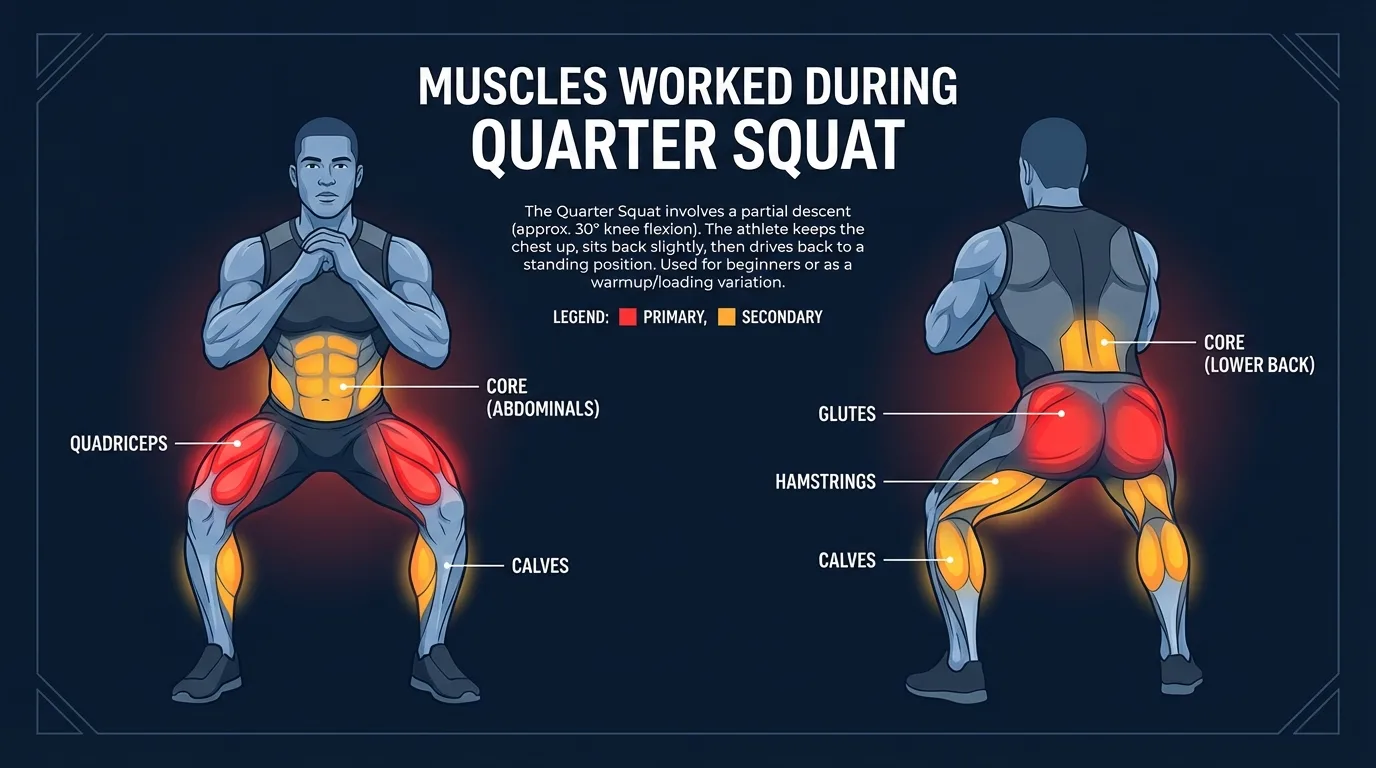
Areas Stretched & Mobilized
The quadriceps drive the knee-extension portion of the quarter squat. On the way down, they control the shallow knee bend eccentrically. On the way up, they shorten to help you stand tall again.
The glutes and calves assist by keeping the hips and ankles organized. The glutes help stop the knees from drifting inward, while the calves and foot muscles keep pressure spread across the whole foot.
The trunk, hip abductors, and deep hip rotators stabilize the position isometrically. You should feel control through the hips and midsection with no hard stretch or heavy burn.
No exercise-specific citation is included here because the old quarter-squat citation on this page did not support its original claim. Mechanically, the shallow range explains the training effect: less hip and knee flexion means less total range than a full squat, but more practice at the joint angles used in a ready stance, takeoff, and landing prep.
Step-by-Step: How to Do a Quarter Squat
- Set your stance. Stand with your feet about shoulder-width apart and toes turned slightly out. Keep pressure across the heel, big-toe mound, and little-toe mound.
Coach Ty's cue: "Tripod foot first. The rep starts from the ground."
- Brace and stack your torso. Breathe into your ribs and gently brace your trunk. Keep your chest tall without flaring the ribs or arching the lower back.
Coach Ty's cue: "Tall chest, quiet ribs."
- Lower into a shallow squat. Send the hips back slightly and bend the knees a few inches. Stop before the movement becomes a half squat.
Coach Ty's cue: "Small range. Clean position."
- Track knees over toes. Keep each knee pointing in the same direction as the toes. If the knees cave inward, slow down and reduce the range.
Coach Ty's cue: "Knees follow toes all the way."
- Stand tall with control. Press through the midfoot to return to standing. Exhale as you stand, reset your foot pressure, and repeat.
Coach Ty's cue: "Smooth first, fast later."
Get this exercise in a personalized workout
FitCraft, our mobile fitness app, uses its AI coach Ty to program mobility work like this into your plan at the right volume and intensity, based on your level, goals, and equipment. Ty was designed and trained by Domenic Angelino, MPH (Brown University) and NSCA-CSCS, with research published in the Journal of Strength and Conditioning Research and Medicine & Science in Sports & Exercise.
Take the Free Assessment Free • 2 minutes • No credit card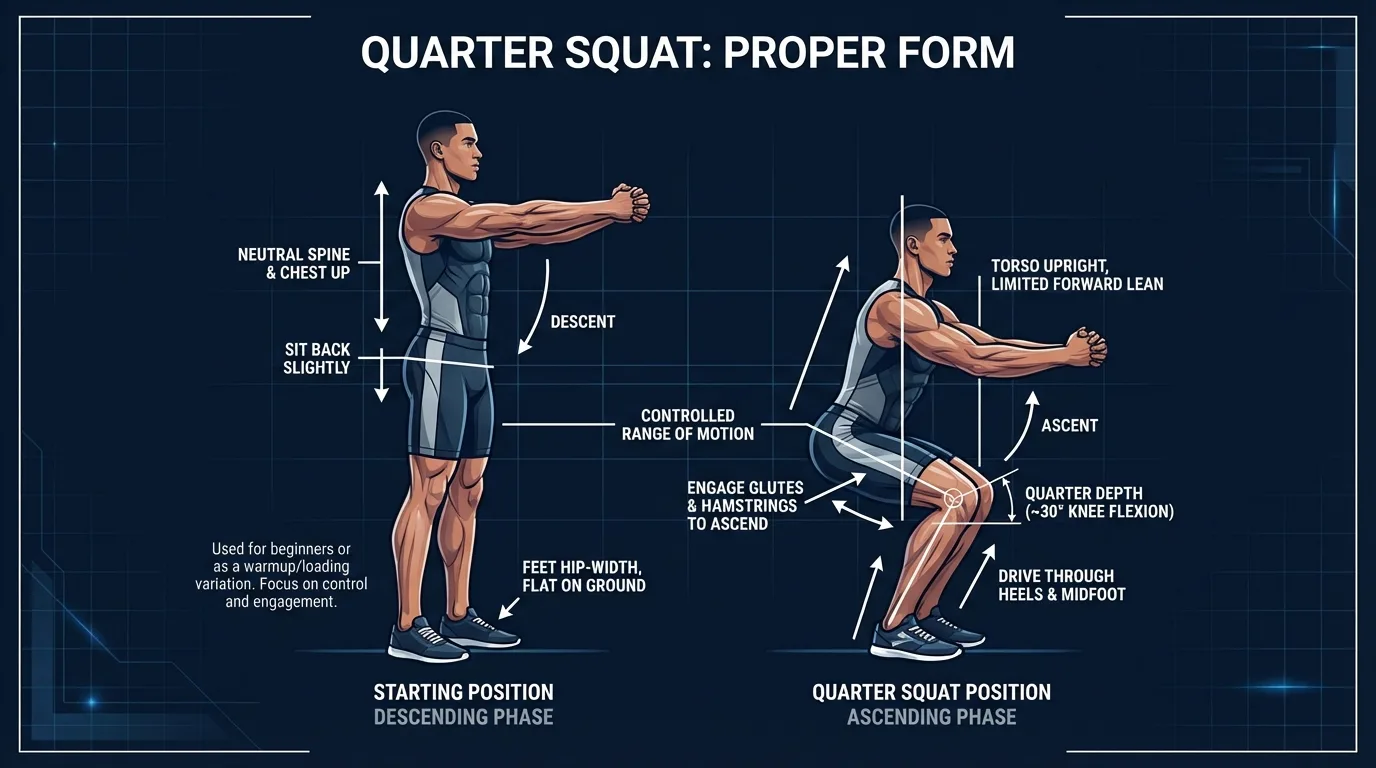
Common Mistakes
Turning it into a half squat
What it looks like: You keep lowering until the movement is closer to a half squat than a quarter squat.
Why it matters: The drill loses its purpose. The shallow range is there so you can practice clean stance control and quick leg drive.
The fix: Film from the side or use a high box as a depth reference. Stop while the knees are only lightly bent.
Letting the knees cave inward
What it looks like: One or both knees drift toward the midline as you lower or stand.
Why it matters: Inward knee collapse teaches a pattern you don't want to carry into deeper squats, landings, or loaded training.
The fix: Slow the rep down. Keep the kneecaps pointing over the second and third toes.
Rocking onto the toes
What it looks like: The heels get light and the body tips forward.
Why it matters: You lose the foot tripod and turn the drill into a forward knee dip.
The fix: Keep the heel heavy and the big-toe mound grounded at the same time. If that feels impossible, pair the drill with cross-legged ankle stretch.
Adding speed before control
What it looks like: You bounce through sloppy reps because the movement feels easy.
Why it matters: Fast reps only help when the position is repeatable.
The fix: Use a one-second pause at the bottom for the first few sets. Add speed after the same depth and knee track show up every rep.
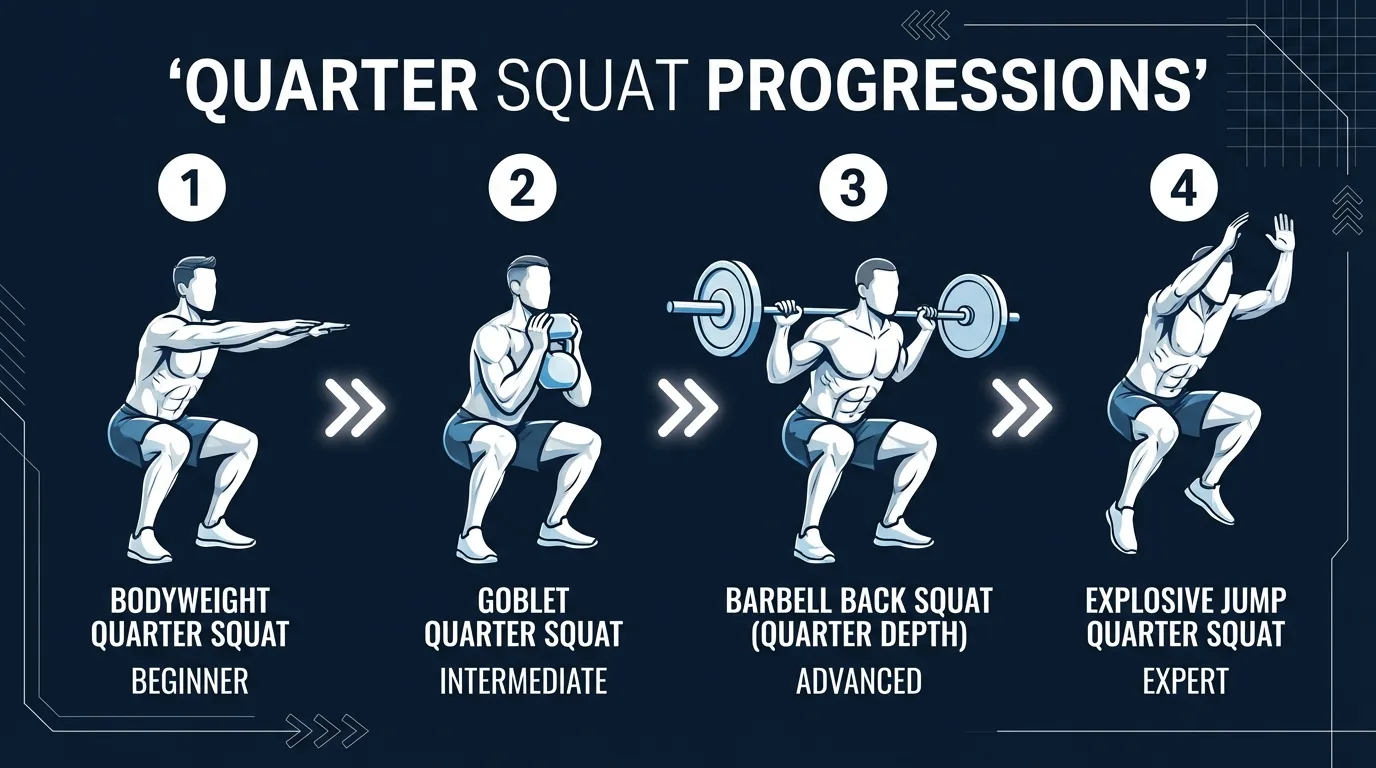
Quarter Squat Variations: Regressions and Progressions
Wall-Assisted Quarter Squat
Stand with your back lightly touching a wall and slide down only a few inches. The wall gives posture feedback while you learn the shallow range.
Bodyweight Quarter Squat
Use the standard freestanding version once the wall drill feels smooth. Keep the range small and the feet quiet.
Wall Sit
Hold a partial squat against a wall when you want more quad endurance without adding movement speed. Use a comfortable knee angle.
Jump Squat
Progress to jump squats only after quarter squat reps look clean. The jump adds impact and speed, so land softly and stop before form fades.
When to Avoid or Modify Quarter Squats
Quarter squats are safe for most healthy adults, but a few situations call for a smaller range, slower tempo, or medical guidance. Always consult your physician or a qualified healthcare provider before starting or returning to exercise if symptoms are active or changing.
- Acute knee, hip, or ankle injury. Keep the range pain-free and stop if swelling, catching, sharp pain, or instability shows up. Use wall support or skip the drill until cleared.
- Recent lower-body surgery. Even shallow bending can irritate healing tissue. Follow your surgeon or physical therapist's allowed range.
- Hypermobility or connective tissue disorders. Avoid bouncing. Use slow active control and consider wall sits or supported holds instead.
- Acute muscle strain. Don't stretch or load through a fresh strain. Reintroduce shallow squats only after walking and basic mobility feel normal.
- Pregnancy, especially later trimesters. Use a wider stance, hold a stable surface, and stay in a comfortable range. Stop if pelvic pressure, dizziness, or pain appears.
- Low-back pain, disc symptoms, or active sciatica. Keep the torso stacked and shallow. If symptoms travel down the leg, skip the drill and get assessed.
Related Exercises
- Squat foundation: Squats build the deeper range that quarter squats should support.
- Partial-range quad endurance: Wall sits train a similar lower-body angle without moving reps.
- Ankle mobility pairing: Cross-legged ankle stretch helps if the heels lift or the foot tripod collapses.
- Hip mobility pairing: Hip abductor stretch supports cleaner knee tracking and hip control.
- Power progression: Jump squats add speed and impact after the shallow squat pattern is consistent.
- Lower-leg support: Calf raises strengthen the ankle and foot control that keeps quarter squats stable.
How to Program Quarter Squats
Use quarter squats as mobility work, a warm-up pattern, or low-load power preparation. The broader progression model from Ratamess et al., 2009 still applies: start with a dose you can perform cleanly, then increase range, speed, or total work only when the movement stays controlled.
| Level | Hold time or reps | Sets | Frequency |
|---|---|---|---|
| Beginner | 15-30 second supported holds or 6-8 slow reps | 1-2 | 5-7 sessions/week as warm-up practice |
| Intermediate | 30-45 second holds or 8-12 controlled reps | 2-3 | 3-5 sessions/week |
| Advanced | 5-10 faster reps, or 20-30 second crisp power-prep sets | 2-4 | 2-4 sessions/week before lower-body training |
Place quarter squats early in the session after easy movement prep and before deeper squats, lunges, or jumps. Long static holds fit better after training or in a short mobility break.
Keep the form floor higher than the rep target. If your heels lift, knees cave, back arches, or the depth changes from rep to rep, end the set there.
Frequently Asked Questions
What muscles do quarter squats work?
Quarter squats mainly use the quadriceps to bend and straighten the knees through a short range. The glutes, calves, hip stabilizers, and trunk muscles assist, but the shallow depth makes this more of a partial squat and mobility drill than a full lower-body strength exercise.
Are quarter squats good for beginners?
Quarter squats can help beginners learn stance, knee tracking, and foot pressure with low complexity. They should sit next to full squat practice, wall support, or mobility work so the person still builds usable range of motion.
Can I do quarter squats with knee pain?
Use caution with knee pain. A shallow range may feel more tolerable than a deep squat, but pain during the descent, inward knee collapse, swelling, or a recent knee injury means you should stop and get guidance from a healthcare provider or physical therapist.
How deep should a quarter squat be?
Lower only a few inches until the knees bend lightly and the hips move back just enough to load the legs. If the thighs move close to halfway down, you have shifted into a half squat.
Are quarter squats better than full squats?
Quarter squats are useful for practicing a shallow athletic stance, warming up the ankles and knees, or introducing faster reps. Full squats build more complete range, strength, and muscle through the hips and thighs.