You already know you should be lifting. Your doctor said it, your daughter said it, and three articles said it before you clicked this one. What none of them told you is where to actually begin on Monday morning, in your own living room, with whatever you own.
That gap is why so many people over 60 never start. The advice arrives as a verdict without instructions. So you either do nothing, or you copy a program written for a 28-year-old and quit in week two with a sore shoulder and the private conclusion that this isn't for you.
It is for you. You just need the program written the way a coach would write it: screen, stage, progress, stop when the body says stop. That's what's below.
What the Evidence Already Settles, in One Paragraph
Progressive resistance training makes older adults stronger, faster on their feet and better at rising from a chair, and the safety record across the trials is good. That's the finding of a Cochrane review of 121 randomised trials, and the NSCA's position statement on resistance training for older adults reaches the same place. We covered all of it, including effect sizes and the fall-rate data, in our full review of strength training after 60. Read that page if you want the evidence. This page assumes you've already decided and just want the plan.
Screen Yourself Before the First Session
Screening isn't a formality. It's how you find out which stage to start at, and it takes about ten minutes.
The two answers that mean you call your doctor first
The American College of Sports Medicine revised its preparticipation screening in 2015 specifically because the old model sent too many people to a doctor's office and, in doing so, became a barrier to exercise (Riebe et al., 2015). The revised logic is built around current activity level, known disease and symptoms. Boiled down for a home program, two answers change the plan:
- You have diagnosed cardiovascular, metabolic or kidney disease. Not "my blood pressure runs a little high", but a diagnosis on your chart. Talk to your physician before you start, and ask specifically about resistance exercise, not just walking.
- You get symptoms with exertion. Chest pressure, unusual breathlessness, dizziness, palpitations or ankle swelling when you climb stairs or carry a bag. Symptoms come before everything else in the algorithm, and they mean a call before a squat.
If neither applies, the 2015 recommendations don't require medical clearance before starting light-to-moderate resistance exercise. Most people reading this are in that group.
The 30-second chair stand test
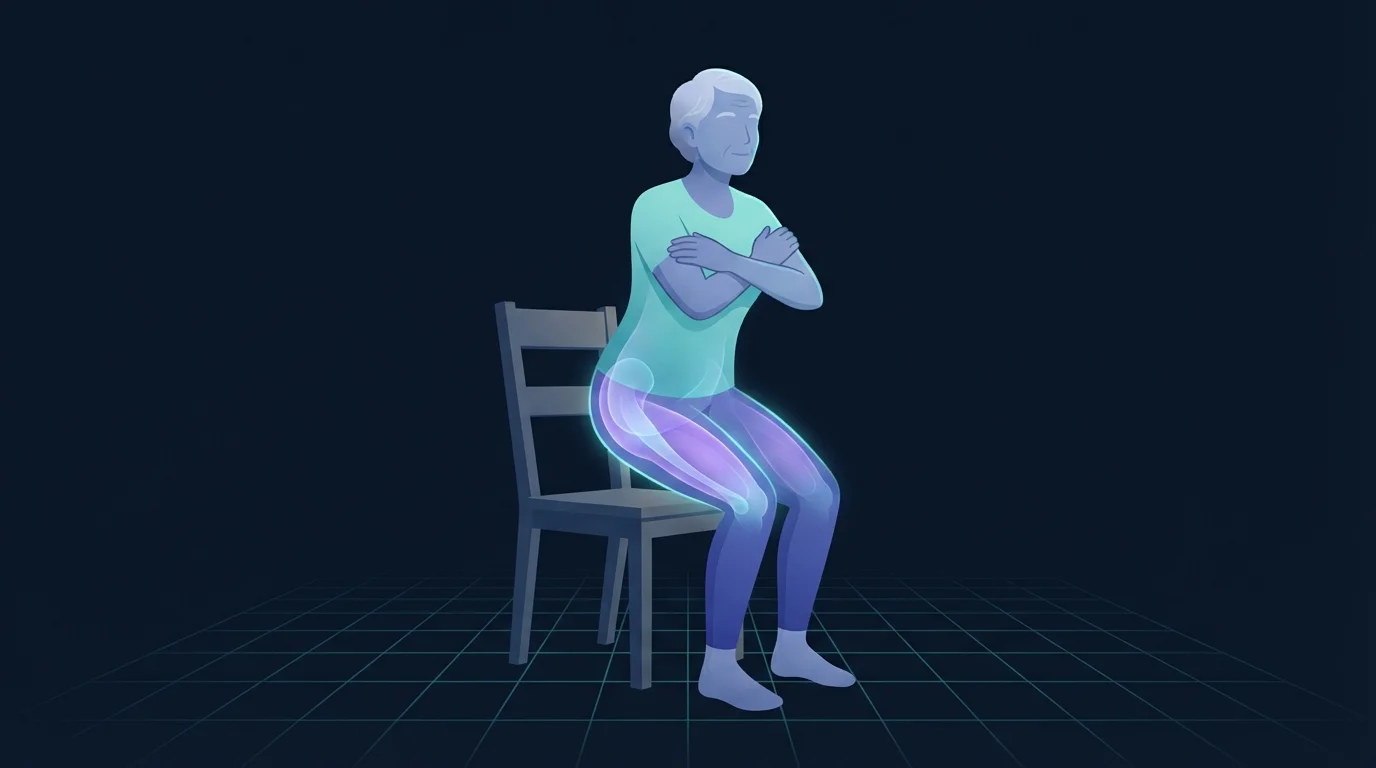
This is the test that tells you where to start. Sit in a straight-backed chair with a firm seat, arms crossed over your chest, and stand up and sit down as many times as you can in 30 seconds without using your hands. Count full stands.
It has real norms. Jones, Rikli and Beam (1999) validated the 30-second chair stand against one-rep-max leg press in community-dwelling older adults and published age-group and sex-specific ranges, which is what makes your score interpretable instead of just a number.
| Your result | Where to start | First goal |
|---|---|---|
| You need your hands, or fewer than 8 stands | Stage 1, seated | Eight hands-free stands from a normal chair |
| 8 to 12 stands | Stage 2, standing bodyweight | Fourteen stands, and one full sit-to-stand from a low chair |
| 13 or more stands | Stage 3, loaded | Goblet squat with a dumbbell for ten controlled reps |
The balance and walk checks
Two more, both from the short physical performance battery that Guralnik and colleagues (1994) built and validated in more than 5,000 adults aged 71 and older. First, stand with your feet in a straight line, one heel touching the other toe, and hold it for 10 seconds with a counter or chair back within reach. Second, time yourself walking a measured 4 metres at your normal pace.
You're not diagnosing anything. You're getting a before number. Retest both in eight weeks and the change will tell you more than the bathroom scale will.
Stage 1: Seated Exercises for Seniors, Weeks 1 to 3
Seated exercises for seniors get treated as a consolation prize. They aren't. A meta-analysis of chair-based exercise programs covering 1,388 older adults found improvements in handgrip strength, 30-second arm curl performance and the 30-second chair stand (Klempel et al., 2021). Chair-based work builds the strength you need to leave the chair.
Three weeks, two or three days a week, five movements:
- Sit-to-stand with hands. Push off your thighs, stand tall, sit down slowly over three seconds. Two sets of eight. The slow sit is the whole exercise.
- Seated knee extension. Straighten one knee, hold a beat at the top, lower over three seconds. Two sets of ten each leg.
- Seated band row. Loop a band around a table leg in front of you, pull your elbows back past your ribs, squeeze. Two sets of twelve.
- Seated overhead press. Light dumbbells, water bottles or a band underfoot. Two sets of ten.
- Seated march. Lift one knee at a time, tall spine, thirty seconds. Two sets.
If you want a bigger menu of seated work, our chair exercises for seniors guide has the full list with setup cues. Come back here for the progression.
Stage 2: Standing Bodyweight, Weeks 4 to 8
Stage 2 is where the chair becomes a tool instead of a seat. You're standing for everything now, with the chair behind you as a target and in front of you as a handrail.
- Box squat to the chair. Sit back until you touch the seat, stand up without bouncing. Three sets of eight to twelve.
- Counter push-up. Hands on a kitchen counter, body in one line, chest to the edge. Three sets of eight to twelve. Lower your hands to a sturdy table as you get stronger.
- Hip hinge to a chair back. Hands on the chair back, push your hips straight back, feel the hamstrings, stand tall. Three sets of ten.
- Split stance step-up to a low step. One step, lead with the same leg for a full set. Two sets of eight each side.
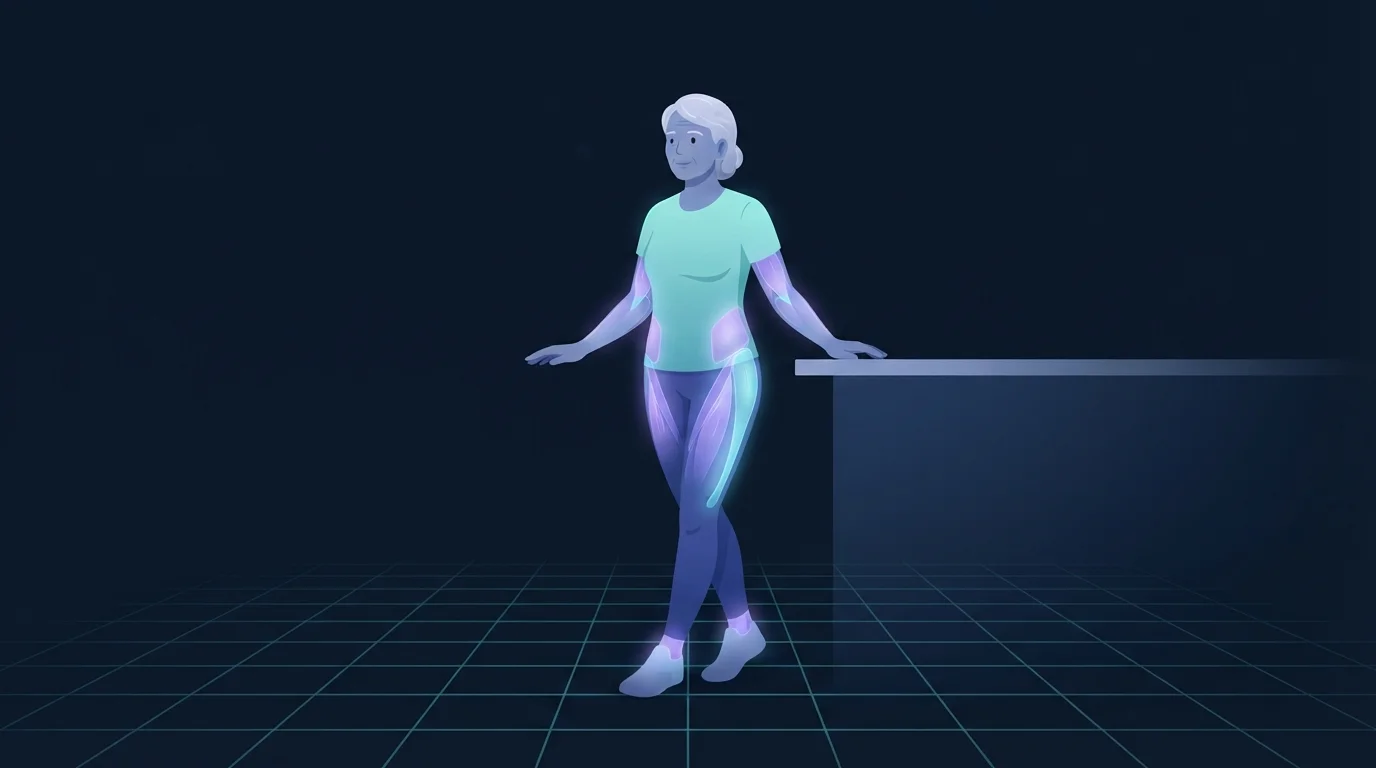
- Standing calf raise. Fingertips on the counter for balance only. Two sets of fifteen.
- Suitcase carry. One weight in one hand, walk thirty seconds, stand tall. Two rounds each side. This one does more for trunk strength than any crunch.
The rule that keeps stage 2 honest: your hands stay off the support as soon as the movement allows it. Fingertips, then one finger, then nothing. That gradual removal of support is the progression, and it's why stage 2 works without a single weight.
Stage 3: Loaded, Week 9 Onward
Stage 3 isn't a new program. It's stage 2 with weight in your hands, which is exactly why the first eight weeks matter.
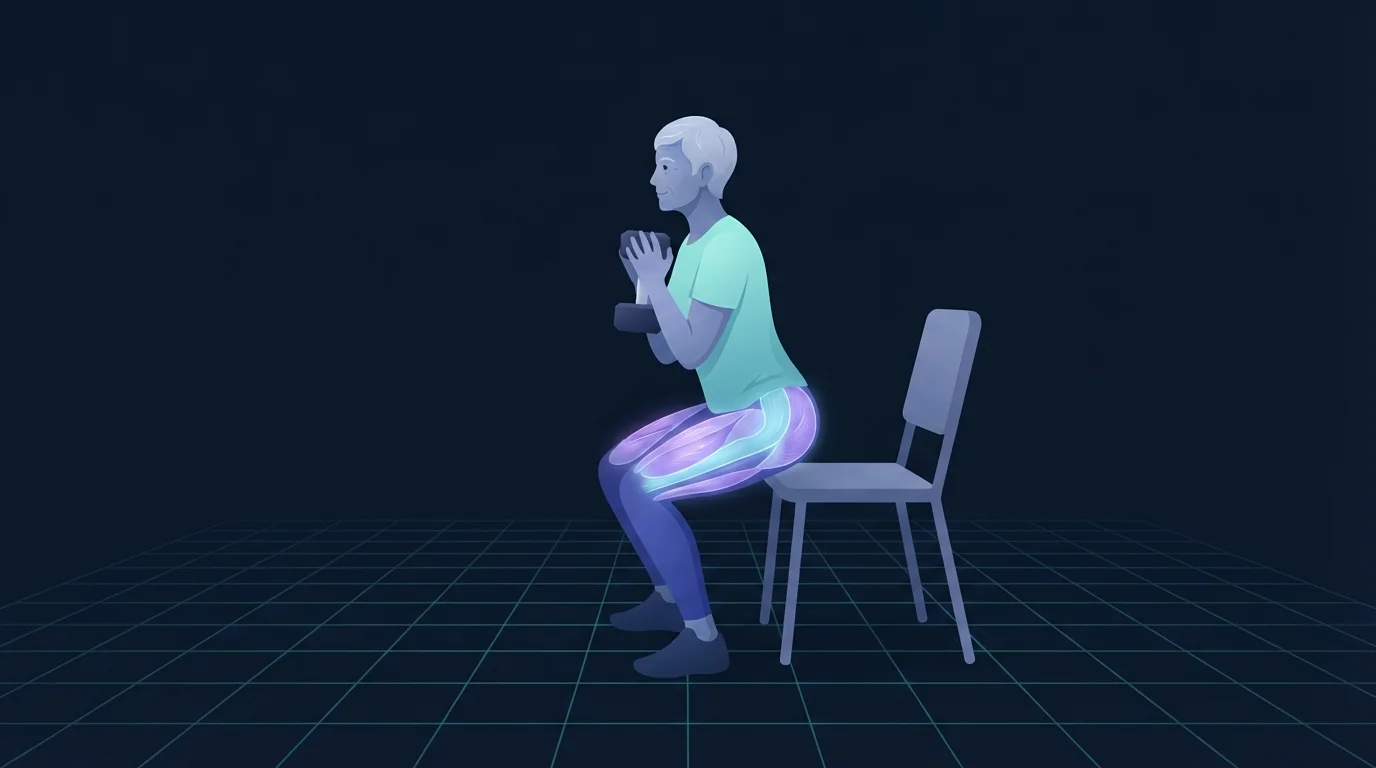
- Goblet squat. One dumbbell held at the chest, chair still behind you. Three sets of eight to twelve.
- Dumbbell Romanian deadlift. Light, hips back, flat back, stop at the knee. Three sets of ten.
- Dumbbell or band row. Chest supported on the back of a chair if standing bent over bothers you. Three sets of ten to twelve.
- Seated or standing overhead press. Three sets of eight to ten.
- Step-up, holding one dumbbell. Three sets of eight each side.
- Loaded carry. Two dumbbells, forty seconds, tall posture.
Dumbbells, kettlebells and bands all work here. The programs in the research used machines, free weights and bodyweight, and the common thread was progressive overload, not the equipment. You do not need a barbell and you do not need a gym.
Find out what's really holding you back
FitCraft, our mobile fitness app, pairs you with an AI coach who builds you a personalized plan around your goals, schedule, and fitness level. Every FitCraft program is designed by Domenic Angelino, MPH (Brown University) and NSCA-CSCS, with research published in the Journal of Strength and Conditioning Research and Medicine & Science in Sports & Exercise.
Take the Free Assessment Free • 2 minutes • No credit cardHow to Pick the Load: Effort, Not Percentages
Most programs tell you to lift a percentage of your one-rep max. For a 70-year-old starting out, testing a one-rep max is a bad idea and the number goes stale in three weeks anyway. Use effort instead.
The scale worth learning is RPE expressed as repetitions in reserve, validated by Zourdos and colleagues (2016): a 10 means you could not have done another rep, a 9 means one left, an 8 means two left, a 7 means three left. Working sets in this program live at 7 to 8. The last two reps should be slow and effortful. They should not be a struggle you'd be embarrassed to be filmed doing.
This isn't a compromise choice. Buskard and colleagues (2019) put 82 healthy community-dwelling older adults, average age 72, through eleven weeks of resistance training and compared three ways of deciding when to add load: a fixed percentage increase, repetition-maximum testing, and perceived effort. Strength and functional outcomes came out statistically the same across all three. The authors picked the effort method anyway, on the grounds that it's the one people are most likely to tolerate and keep doing. That's the right reason to choose a method.
How to progress: when a set of ten feels like a 7 for two sessions running, add reps until you hit twelve, then add the smallest weight increase you own and drop back to eight. Two or three pounds per hand is plenty.
Your Weekly Senior Strength Training Template
Two days is the floor. Three is better once the first six weeks are behind you. Leave 48 hours between sessions that hit the same muscles.
| Day | What you do | Effort |
|---|---|---|
| Monday Full body A |
Squat pattern 3 x 8-12 Push pattern 3 x 8-12 Row 3 x 10-12 Suitcase carry 2 x 30 sec each side Balance work 5 min |
RPE 7 to 8 |
| Tuesday Optional |
20 to 30 min walk Balance work 5 min |
Conversational |
| Thursday Full body B |
Hip hinge 3 x 10 Overhead press 3 x 8-10 Step-up 3 x 8 each side Calf raise 2 x 15 Balance work 5 min |
RPE 7 to 8 |
| Saturday Add from week 7 |
Power sit-to-stand 3 x 5 Fast band row 3 x 8 Carry 2 x 40 sec Balance work 5 min |
Fast up, slow down |
Sessions run 25 to 35 minutes. If that sounds short, that's the point. The trials that produced the results people quote used sessions in roughly that range, and a 30-minute session you do for a year beats a 75-minute session you do for three weeks.
Power Work: The Piece Most Senior Programs Leave Out
Strength is how much you can move. Power is how fast you can move it. They decline at different rates, and power goes first.
That distinction has practical consequences: catching yourself on a stumble, crossing a street before the light changes and standing up quickly are all power tasks, not strength tasks. A systematic review by Byrne and colleagues (2016) in Sports Medicine examined muscle power and physical function in ageing and concluded that power is at least as relevant to everyday function as maximal strength, and that pragmatic training can target it directly.
It doesn't take special equipment. Fielding and colleagues (2002) randomised 30 older women with self-reported disability to 16 weeks of high-velocity or low-velocity resistance training at the same load and volume. Both groups got stronger. The high-velocity group produced significantly greater gains in muscle peak power. The only difference was the speed of the lifting phase.
How to add it, starting around week 7: pick two movements you already do well. Lift fast, in about one second, and lower slowly, over three. Three sets of five, with full rest between sets. Stop the set the moment the speed drops off, because a slow "power" rep is just a rep. Our review of power training for older adults covers the dose and velocity literature in more depth.
Balance Training Belongs in the Same Session
Strength work alone doesn't train balance, and the fall-prevention programs with the best evidence pair the two deliberately.
The reference program is Otago, a home-based set of leg strengthening and balance exercises delivered by a physiotherapist. In the original trial, Campbell and colleagues (1997) randomised 233 women aged 80 and over in general practice to the home program or usual care, with the exercise group performing the routine three times a week plus walking, and recorded significantly fewer falls over a year. A later meta-analysis by Thomas, Mackintosh and Halbert (2010) in Age and Ageing pooled the Otago trials and found reductions in both falls and death.
Five minutes at the end of every session covers it:
- Feet together, eyes open, 30 seconds. Then eyes closed if that's steady. Counter within reach.
- Semi-tandem then tandem stance, 30 seconds each side. Heel beside the toe, then heel in front of the toe.
- Single-leg stand, 10 to 30 seconds each side. Fingertips on the counter, then off.
- Heel-to-toe walking, 10 steps. Along a counter or hallway wall.
- Sideways walking, 10 steps each direction.
Balance is safe to train daily, which makes it the easiest thing to keep when a week falls apart. Our roundup of the best balance exercises for seniors has progressions for each of these when 30 seconds stops being a challenge.
Best Exercises for Women Over 50: What Changes and What Doesn't
The movement patterns don't change. The priority does. Bone density falls fastest in the years around and after menopause, and bone responds to load and impact rather than to duration.
The LIFTMOR trial is the clearest demonstration. Watson and colleagues (2018) randomised 101 postmenopausal women with low bone mass to eight months of supervised high-intensity resistance and impact training twice a week, or to a low-intensity home program. The high-intensity group improved bone mineral density at the lumbar spine and femoral neck, improved height, and improved functional performance. One minor adverse event was reported across the supervised program.
LIFTMOR used barbells under supervision, which is not what most people are doing at home, and the honest translation is this: load the hips and spine with the heaviest weight you can control well, keep some standing and stepping work in the program rather than making everything seated, and prioritise the squat, hinge and carry patterns. If osteoporosis is on your chart, that plan needs a clinician's input on impact and on spinal flexion before you run it.
Women over 50 who want an app to handle the programming will find our roundup of the best fitness apps for over 50 useful, with separate picks for strength, joints and balance.
When to Stop a Set, Scale Back, or Call Your Doctor
Knowing when to stop is a skill, and nobody teaches it. Here it is.
Stop the set immediately if your form changes shape, if a joint gives you a sharp or catching pain, if you feel dizzy or light-headed, if you're breathless beyond what the effort explains, or if you notice chest pressure or an irregular heartbeat. The American Heart Association's scientific statement on resistance exercise (Williams et al., 2007) notes that resistance training is appropriate for most adults including many with cardiovascular disease, and also that breath-holding drives blood pressure up sharply. So breathe out on the effort. Never hold your breath and strain.
Scale back for a week if soreness is still limiting you 72 hours later, if your sleep gets worse, if grip strength drops noticeably, or if a joint aches every session rather than occasionally. Cut the sets in half and keep the sessions. Skipping the week entirely is what turns a scale-back into a stop.
Call your doctor for any new chest symptom, any fall, any joint pain that persists beyond two weeks, any unexplained swelling, or before restarting after an illness or a hospital stay.
Mild muscle soreness a day or two after a session is normal and it fades as your body adapts. Sharp pain during a rep is a different thing, and it's information, not weakness.
The Bottom Line
Senior strength training is two or three 30-minute sessions a week, six movements, load chosen by effort, five minutes of balance work at the end, and two power sets once you've got eight weeks behind you. Start seated if the chair stand test says to. Progress by removing support, then by adding reps, then by adding the smallest weight you own.
The reason most people over 60 don't get the results the research describes isn't the program. It's month four, when nothing feels new and nobody's watching. Track the chair stand test, not the mirror. Retest every eight weeks. Watching that number climb is the most reliable motivation there is, because it's the one that shows up in your life.
You're not too old and you're not too late. You were handed a verdict without a plan. Now you have one.
Frequently Asked Questions
What is senior strength training?
Senior strength training is resistance exercise programmed for adults roughly 60 and older, where the goal is keeping the strength and power you need for stairs, chairs, curbs and groceries rather than a number on a barbell. In practice it means two or three sessions a week, six to eight movements that cover the legs, hips, push, pull and trunk, and a load you can control for eight to twelve reps with two or three reps left in the tank. Bodyweight, resistance bands and light dumbbells all count.
How many days a week should seniors strength train?
Two days a week is the honest minimum and the level most people should start at, with a third day added after about six weeks if the first two feel routine. Leave at least 48 hours between sessions that train the same muscles. Balance work is the exception: it's low-stress enough to do daily, and the fall-prevention trials that worked best prescribed it three times a week on top of the strength sessions.
What are the best seated exercises for seniors?
The five that carry a session are the sit-to-stand, the seated knee extension, the seated row with a band anchored in front, the seated overhead press, and the seated march. They cover the same movement patterns a standing program covers, which is why chair-based programs improve grip strength, arm-curl performance and 30-second chair-stand scores in older adults (Klempel et al., 2021). Seated work is a starting stage, not a permanent ceiling.
What are the best exercises for women over 50?
The same movement patterns everyone else trains, with a bias toward loading the hips and spine, because bone density falls fastest in the years around and after menopause. Squat or sit-to-stand patterns, hip hinges, rows, presses and loaded carries cover it. In the LIFTMOR trial, postmenopausal women with low bone mass who trained hard twice a week improved lumbar spine and femoral neck bone mineral density, and the supervised program logged one minor adverse event (Watson et al., 2018).
How much weight should a senior lift?
Enough that the last two reps of a set of ten are genuinely hard, and no more. That lands near 7 out of 10 on a repetitions-in-reserve effort scale (Zourdos et al., 2016). Picking loads by effort rather than by a percentage of a one-rep max matters for older adults: when 82 community-dwelling adults averaging 72 years old trained for eleven weeks under three different progression methods, the strength results were statistically the same, and the effort-based method was judged the most tolerable (Buskard et al., 2019).
How much protein do older adults need to build strength?
The PROT-AGE expert group recommends 1.0 to 1.2 grams of protein per kilogram of body weight per day for healthy older adults, and 1.2 to 1.5 grams per kilogram for those who are exercising or managing illness, with the caveat that people with severe kidney disease need medical supervision (Bauer et al., 2013). Spreading it across meals is easier than hitting it at dinner. Talk to your doctor before making a large change to your protein intake.