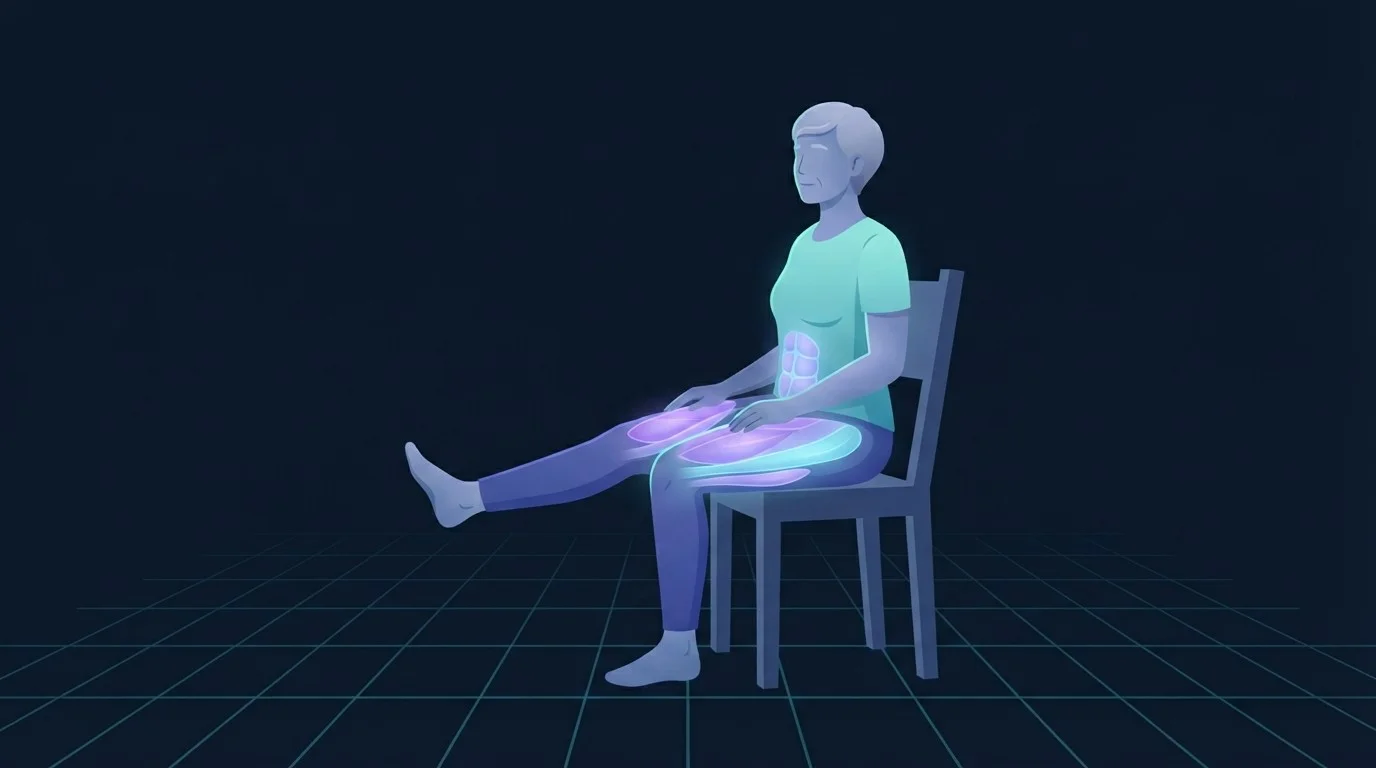
Most chair exercise videos have the same problem. Week one is identical to week twelve. The same eight moves, the same ten repetitions, the same nothing in your hands. You'll feel better for doing them, and after two months you'll be exactly as strong as when you started.
That's a shame, because the research on chair-based exercise is genuinely encouraging when the programme progresses. This guide covers what seated work does and doesn't change, a ten-move routine you can run at a kitchen table, how often to do it, how to make it harder without buying anything, and the point at which you should stop sitting down.
What Counts as a Chair Exercise?
A chair exercise is any strength, mobility or cardio movement performed sitting in a chair, or standing while holding one for support. That second half gets forgotten. In the research literature, chair-based exercise programmes routinely include standing work with the chair as a handrail, and those are usually the sessions doing the most for balance.
They exist for three overlapping groups of people:
- People whose balance isn't reliable yet. Standing on one leg is not a sensible first exercise if you've fallen this year. Sitting removes the fall risk while you rebuild the leg strength that makes standing safe.
- People with joints that object to load. Knee and hip osteoarthritis, a recent replacement, or plain stiffness. Sitting takes bodyweight off the joint and lets you train the muscle around it. Our guide to exercising with joint pain goes further on that trade-off.
- People who are simply deconditioned. Weeks in hospital, a long illness, a winter of not much. Here the chair is scaffolding you're meant to outgrow.
Which group you're in changes what success looks like. Group three should be out of the chair inside two months. Group one may use one for years, and that's a perfectly good outcome.
Do Chair Exercises Actually Build Strength?
Yes, and the effect is bigger than most people expect from an exercise you can do in slippers.
The best available synthesis is a 2021 systematic review in the International Journal of Environmental Research and Public Health, which pooled 25 chair-based exercise studies covering 1,388 older adults, 19 of them contributing to meta-analysis and most of them randomised trials. Against control groups, chair-based exercise improved handgrip strength by a mean of 2.10 kg (95% CI 0.76 to 3.43), added 2.82 repetitions to the 30-second arm curl (95% CI 1.34 to 4.31) and added 2.25 repetitions to the 30-second chair stand (95% CI 0.64 to 3.86). The authors concluded that chair-based exercise should be promoted as a simple way to maintain and develop strength (Klempel et al., 2021).
Two extra numbers in that review matter as much as the effect sizes. The typical session was twice a week for about 45 minutes. And reported adherence ran from 70% to 96%, a range most gym-based programmes would be delighted with.
The picture holds in the frailest population studied. A 2023 meta-analysis in the International Journal of Nursing Sciences pooled nine randomised trials of chair-based resistance band exercise in 878 residents of long-term care facilities. Handgrip strength improved by 2.17 kg (95% CI 1.22 to 3.11), lower limb muscular endurance by 1.32 repetitions (95% CI 0.69 to 1.96) and activities of daily living by a standardised mean difference of 0.30 (95% CI 0.11 to 0.48). Sleep quality and depression scores improved too (Efendi et al., 2023). Those programmes ran roughly three times a week for 40 to 46 minutes.
None of this is surprising once you accept the mechanism underneath it. The NSCA's position statement on resistance training in older adults makes the case plainly: countering muscle disuse through resistance training is a powerful way to fight the loss of strength and muscle mass that comes with age (Fragala et al., 2019). Muscle responds to load. It doesn't check whether you were standing when you applied it. For the mechanism in more depth, see our review of resistance training and sarcopenia.
What chair exercise did not change
The same 2021 review is worth reading for its null results. Berg Balance Scale scores moved by 0.66 points (95% CI -1.01 to 2.33). Timed up and go moved by 0.95 seconds (95% CI -1.12 to 3.01). Gait speed moved by -0.03 m/s (95% CI -0.21 to 0.16). All three confidence intervals cross zero. Seated training produced strength, and it did not produce balance or walking speed.
That's exactly what you'd predict. Balance is a skill trained by being slightly off balance, under control, on your feet. A chair removes the very stimulus that would improve it. Which is why the routine below is built to be escaped from.
Find out what's really holding you back
FitCraft, our mobile fitness app, pairs you with an AI coach who builds you a personalized plan around your goals, schedule, and fitness level. Every FitCraft program is designed by Domenic Angelino, MPH (Brown University) and NSCA-CSCS, with research published in the Journal of Strength and Conditioning Research and Medicine & Science in Sports & Exercise.
Take the Free Assessment Free • 2 minutes • No credit cardHow Do You Set Up Safely?
The chair itself is the first decision, and most people get it wrong by using whatever is nearest.
- Straight back, no arms, no wheels, no cushion. A dining chair. Armrests get in the way of the arm moves and tempt you into pushing up with them. Wheels are self-explanatory. A soft cushion makes the seat height unpredictable, which is the one variable you want held constant.
- Seat height around 17 inches. That's the height used in clinical chair-stand testing, and it's the reference point for every sit-to-stand rep you count. Lower seats are harder. If yours is low, that's useful later, not now.
- Back against a wall, non-slip floor. No rugs with loose edges. Shoes on, laced, flat sole. Not socks, and not backless slippers.
- Room to extend a leg forward and reach both arms out sideways. Clear that space before you start rather than mid-set.
Position, every single repetition
Sit forward so your back is off the backrest, feet flat and about hip width, ankles under or slightly behind your knees, shoulders down, chin level. Then the rule that ruins the most chair routines: breathe out on the effort. Holding your breath while you strain raises blood pressure sharply, and this is the exact population in which that matters most.
Stop signals
End the session and seek medical advice the same day for chest pain or pressure, shortness of breath out of proportion to the effort, dizziness or light-headedness, an irregular or racing heartbeat, new sharp joint pain, or numbness or weakness down one side. Soreness that shows up the next morning and eases with gentle movement is normal and expected. Pain during a repetition is not.
The Ten-Move Seated Routine
Run it as a circuit: one set of every move, a short rest, then a second set. That's roughly 25 minutes at a sensible pace. Beginners should do the first four moves only for the first two weeks, then add one move per week.
| Move | Sets and reps | What it trains | The cue that matters |
|---|---|---|---|
| 1. Seated march | 2 x 20 total | Hip flexors, core | Lift the knee, don't lean back to help it |
| 2. Knee extension | 2 x 10 each leg | Quadriceps | Pause one second at the top, lower slowly |
| 3. Heel and toe raise | 2 x 15 | Calves, shins | Full range both ways, no bouncing |
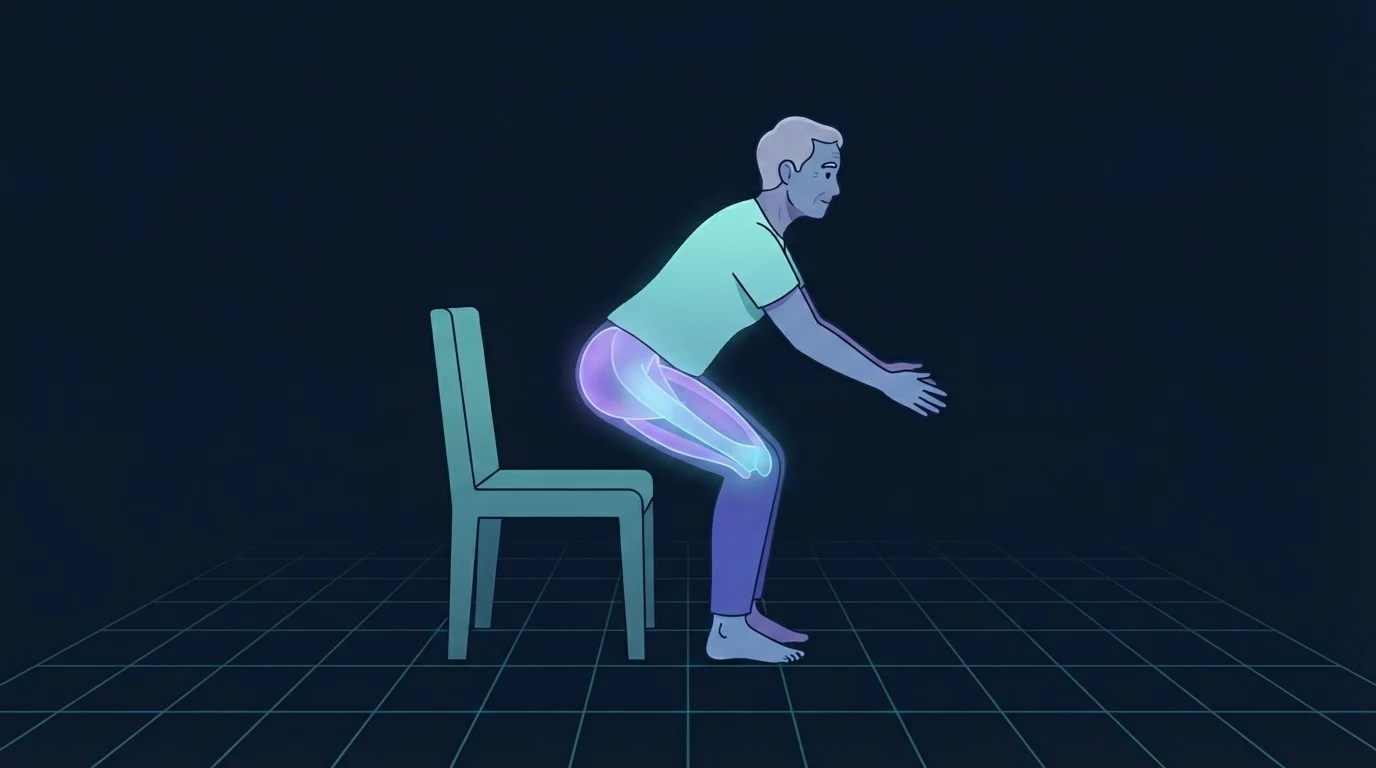
| 4. Sit-to-stand | 2 x 5 to 10 | Glutes, quadriceps | Nose over toes before the hips leave the seat |
| 5. Band seated row | 2 x 10 | Upper back, biceps | Elbows past the ribs, shoulders down |
| 6. Band chest press | 2 x 10 | Chest, triceps | Band behind the back, press level with the sternum |
| 7. Overhead press | 2 x 10 | Shoulders | Ribs down, don't arch the lower back |
| 8. Seated hip abduction | 2 x 12 | Gluteus medius | Band above the knees, push out and hold two seconds |
| 9. Trunk rotation | 2 x 8 each side | Obliques, thoracic mobility | Turn from the ribs, keep both hips planted |
| 10. Seated cat cow | 1 x 8 | Spinal mobility | Move with the breath, never force the end range |
Moves 5 through 8 need a light resistance band, which is the single best purchase in this guide. Everything else is bodyweight. If you haven't used bands before, our resistance band training guide covers anchoring and tension, and we have a full page on the seated cat cow if move 10 is new to you.
How Often Should Seniors Do Chair Exercises?
Two to three sessions a week, on non-consecutive days, of 30 to 45 minutes.
That's not a guess. It's the dose the successful trials used. The chair-based programmes in the 2021 review most commonly ran twice a week for about 45 minutes. The long-term care band programmes ran about three times a week for 40 to 46 minutes. And it lines up with the Physical Activity Guidelines for Americans, which ask older adults for muscle-strengthening activity covering all major muscle groups on 2 or more days a week, inside a multicomponent programme that also includes balance and aerobic work (Piercy et al., 2018).
The same guidelines carry the line that matters most for anyone reading a page about chair exercise: when older adults can't manage 150 minutes of moderate aerobic activity a week because of chronic conditions, they should be as physically active as their abilities and conditions allow. The target isn't all or nothing.
Two practical points. Strength moves want a rest day between them, because the adaptation happens between sessions. Mobility work, moves 9 and 10, can be done daily and is a good thing to do on the off days. And starting at 10 to 15 minutes rather than 45 is almost always the right call. The trials measured what an established programme achieves, not what week one should look like.
How Do You Make Chair Exercises Harder?
This is the part almost every seated routine skips, and it's the reason so many of them stop working. Muscle adapts to a load and then stops adapting. Progressive overload is the whole game.
Add difficulty in this order, and change one thing at a time:
| Stage | What changes | Move on when |
|---|---|---|
| 1. Range | Complete each rep through its full range before adding anything else | Every rep looks the same as the first |
| 2. Tempo | Three seconds down, one second pause, one second up | You can hold the pause without wobbling |
| 3. Reps | Add 2 reps per set per week, up to about 15 | The last rep still feels controlled at 15 |
| 4. Load | A light dumbbell, an ankle weight, or the next band colour up | You're back to 10 clean reps with the new load |
| 5. Support | Sit-to-stand without hands, then from a lower seat | 10 hands-free stands with no rocking |
| 6. Base | Standing behind the chair, two hands on the back | Two hands feel unnecessary for a full set |
| 7. Balance | One hand, then fingertips, then a hover | You're training balance, which is the destination |
Judge effort rather than counting to a number. On a 0 to 10 scale of RPE, the last two reps of a set should feel like a 6 or 7: definitely working, definitely could do two more. That's the intensity the strength trials used, and it's well short of grinding.
The test that tells you it is working
The 30-second chair stand test, developed by Jones, Rikli and Beam (1999), is the cleanest home benchmark there is. Sit in the middle of a 17-inch chair, arms crossed over your chest with hands on opposite shoulders, feet flat. Stand up fully and sit back down as many times as you can in 30 seconds. If you have to use your arms to stand, stop the test and make hands-free standing the goal instead. Have someone stand beside you.
The CDC's STEADI programme publishes below-average cut-offs for that test, and a below-average score signals fall risk:
| Age | Below average, men | Below average, women |
|---|---|---|
| 60 to 64 | Under 14 stands | Under 12 stands |
| 65 to 69 | Under 12 stands | Under 11 stands |
| 70 to 74 | Under 12 stands | Under 10 stands |
| 75 to 79 | Under 11 stands | Under 10 stands |
| 80 to 84 | Under 10 stands | Under 9 stands |
| 85 to 89 | Under 8 stands | Under 8 stands |
| 90 to 94 | Under 7 stands | Under 4 stands |
Test on day one, then every four weeks. The chair-based trials moved this score by about 2.25 repetitions, so an improvement of two or three stands over eight weeks means your programme is doing its job. A flat score two tests in a row means you've stopped progressing the load.
When Should You Stop Sitting Down?
As soon as you can stand safely with a hand on the chair back. Here's why that matters more than any other sentence in this guide.
The Cochrane review of exercise for preventing falls pooled 108 randomised trials in 23,407 community-dwelling older adults, average age 76. Exercise reduced the rate of falls by 23% (rate ratio 0.77, 95% CI 0.71 to 0.83, high-certainty evidence). Balance and functional exercise on its own, across 39 trials and 7,920 participants, reduced it by 24% (rate ratio 0.76, 95% CI 0.70 to 0.81, high-certainty evidence) (Sherrington et al., 2019).
Those programmes had people on their feet. That's the point of them. Set against the chair-based review's null results for balance and gait speed, the message is simple: seated work builds the strength that makes standing work possible, and standing work is what reduces falls. Our summary of the balance training and falls research covers the specific standing progressions.
A reasonable transition, once your sit-to-stand is hands-free:
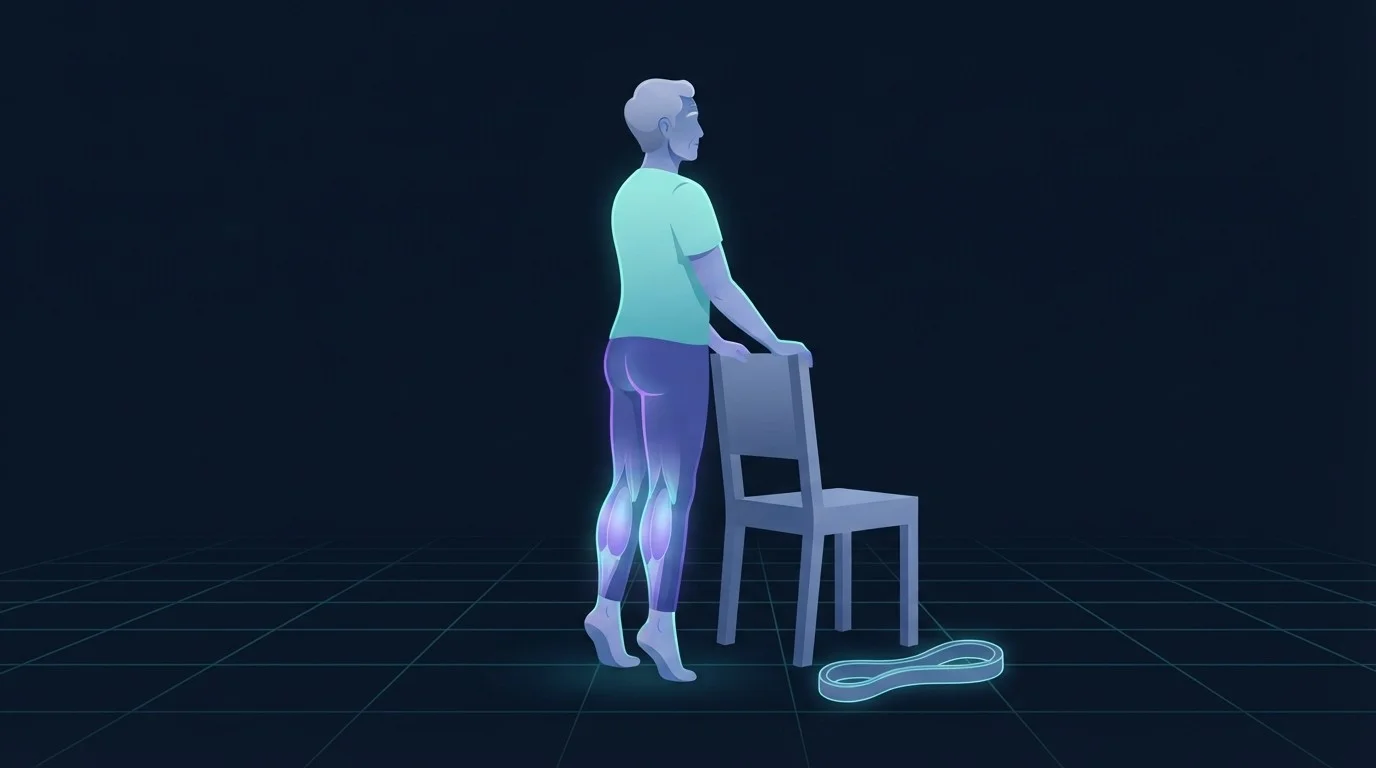
- Weeks 1 to 2. Move 3, the heel and toe raise, done standing behind the chair with both hands on the back.
- Weeks 3 to 4. Add standing hip abduction and a slow marching step, still two hands.
- Weeks 5 to 6. Same work, one hand on the chair.
- Weeks 7 onward. Fingertips only, then hands hovering just above the chair back. Never remove the chair. It stays there as the thing you'd grab.
If standing isn't on the table for you, none of that is a failure. The long-term care trials found real gains in strength, daily function, sleep and mood in people who trained entirely seated. Keep the seated routine and keep progressing the load.
Seated Exercises for Seniors With Limited Mobility
Everything above assumes you can get into and out of a chair under your own steam. Plenty of people can't, and a large share of the searches for seated exercises for seniors come from exactly that group: wheelchair users, people who can't weight-bear on one side, people whose transfers need a second pair of hands. The advice changes more than most chair-exercise content admits.
If the chair is a wheelchair
Lock the brakes, turn the casters forward, and put your feet flat on the floor if you can reach it or on the footplates if you can't. Then cross the sit-to-stand off the list entirely. Rising out of a wheelchair is a transfer, not a training exercise, and the seat height, the tilt and the wheels are all working against you.
From the ten moves above, the band row, the band chest press, the overhead press, the trunk rotation and the seated cat cow transfer with no modification at all. The seated march and the knee extension transfer if you have voluntary control of those muscles. The heel and toe raise and the seated hip abduction often don't. Train what works rather than substituting something easier for what doesn't.
The dose for wheelchair users is already written down
This is the part almost nobody knows. There's a published, consensus-built exercise guideline for adults with spinal cord injury, and it's more specific than most guidance written for able-bodied older adults. For cardiorespiratory fitness and muscle strength: at least 20 minutes of moderate to vigorous aerobic exercise twice a week, plus 3 sets of strength exercises for each major functioning muscle group at moderate to vigorous intensity, twice a week. For cardiometabolic health: at least 30 minutes of moderate to vigorous aerobic exercise three times a week (Martin Ginis et al., 2018).
Read the phrase "each major functioning muscle group" carefully. The guideline doesn't ask you to train muscles you can't recruit. It asks you to train the ones you can, hard enough to matter, which is a much higher bar than most seated videos set. The evidence underneath it is a systematic review of 211 studies that found moderate to high confidence that exercise improves cardiorespiratory fitness, power output and muscle strength in adults with chronic spinal cord injury (van der Scheer et al., 2017).
The aerobic half is the piece seated routines nearly always drop. Arm cranking, a seated upper-body ergometer, continuous banded punching, or one long unbroken block of alternating band presses will all get you there. In that review, the gains came from 2 to 3 sessions a week of upper-body aerobic work at moderate to vigorous intensity, 20 to 40 minutes at a time, alongside upper-body strength training. If your injury sits at or above the mid-back, ask your clinician about blood pressure responses and autonomic dysreflexia before you push the intensity up.
If you can walk, but not far and not safely
This is the much larger group, and the best trial in it is the LIFE study. 1,635 adults aged 70 to 89 who were already at risk of disability were randomised either to a structured programme of walking, resistance and flexibility work (twice a week at a centre, three or four times a week at home) or to health education. Over an average of 2.6 years, major mobility disability, defined as losing the ability to walk 400 metres, occurred in 30.1% of the activity group against 35.5% of the education group (hazard ratio 0.82, 95% CI 0.69 to 0.98). Persistent mobility disability ran 14.7% against 19.8% (hazard ratio 0.72, 95% CI 0.57 to 0.91) (Pahor et al., 2014).
That programme was progressive and it included resistance training, which is precisely the ingredient most seated routines leave out. If you're in this group, use the chair for the strength work and keep whatever walking you can manage, however short, as its own separate thing. Our review of strength training after 60 covers the load side in more depth.
What to measure when a chair stand is off the table
The 30-second chair stand test is no use to you, so move the benchmark upstairs. Count how many band rows or arm curls you can complete in 30 seconds, and write down the band colour you did them with, because the colour is the load. Grip strength and the 30-second arm curl were the two outcomes that moved most in the pooled chair-exercise data, by 2.10 kg and 2.82 repetitions, so those are the numbers most likely to reward you for showing up. An inexpensive grip dynamometer settles the argument about whether anything is changing.
The Honest Limits
- A chair can't train balance. Three separate balance and mobility outcomes came back null in the pooled data. Nothing about that is fixable within seated exercise.
- Without progression it becomes maintenance. Maintenance is worth something. It just isn't what the strength numbers above describe. Those came from programmes that got harder.
- Bodyweight runs out. A seated leg lift is a fixed load forever. Bands and light dumbbells are what let stages 3 and 4 exist.
- Aerobic fitness needs its own attention. Seated marching and arm work raise the heart rate a little. Building endurance takes longer continuous effort, seated or otherwise.
- Two sessions a week is a floor, not a plan. The guidelines describe strength plus balance plus aerobic work. The chair covers one of the three well.
The Bottom Line
Chair exercises for seniors work, on the specific thing they're good at. Twenty-five studies say seated training builds grip strength, arm endurance and the leg strength you use to stand up, with adherence rates most programmes never see. They say nothing good about balance or walking speed, and the falls evidence is unambiguous that those come from being on your feet.
So treat the chair as equipment rather than a category. Sit on it while you build the strength, stand behind it while you build the balance, and progress the load every couple of weeks either way. If you want a wider look at what fits around it, our roundup of fitness apps for people over 50 compares the options for structured programmes at home, and our guide to staying fit over 60 covers the rest of the training week.
Frequently Asked Questions
Do chair exercises for seniors actually build strength?
Yes, for strength and muscular endurance. A 2021 systematic review of 25 chair-based exercise studies in 1,388 older adults found handgrip strength improved by 2.10 kg on average, 30-second arm curl repetitions rose by 2.82, and 30-second chair stand repetitions rose by 2.25 against controls. The same review found no significant change in walking speed, balance scores or timed up and go, so chair work builds the strength you use to stand and carry, and something standing has to build the balance you use to walk.
How often should seniors do chair exercises?
Two to three sessions a week on non-consecutive days. The chair-based trials that produced strength gains most often ran twice a week for about 45 minutes, and the chair-band trials in long-term care ran about three times a week for 40 to 46 minutes. That matches the Physical Activity Guidelines for Americans, which ask for muscle-strengthening work covering all major muscle groups on 2 or more days a week. Daily mobility work is fine, but the strength moves need a rest day between sessions.
How long should a chair exercise session be?
Around 30 to 45 minutes once you are established, and 10 to 15 minutes on day one. Most of the trials that produced measurable strength gains used sessions of roughly 45 minutes, but almost none of them started participants there. Beginning with three or four moves and adding one move a week reaches the same place with far less soreness and a much better chance you are still doing it in week eight.
Are chair exercises enough on their own?
They are enough to build and hold strength, and they are not enough to reduce falls on their own. The Cochrane review of 108 trials in 23,407 older adults found exercise cut the rate of falls by 23%, and the programmes that did it were built on balance and functional training, which means standing and challenging your balance on purpose. If you can stand safely with a hand on a chair, add standing work. If you cannot, chair exercise is still worth doing for strength, mood and daily function.
What chair should you use for chair exercises?
A stable dining chair with a straight back, no arms, no wheels and no cushion, placed on a non-slip floor with its back against a wall. Seat height matters: a seat around 17 inches high is the standard used in clinical testing, and a lower seat makes sitting and standing much harder. Armchairs, recliners, office chairs and folding chairs all fail this test for different reasons, and every one of them makes a sit-to-stand less predictable.
Can chair exercises help prevent falls?
Indirectly, by building the leg strength you need to catch yourself, but not directly. The chair-based exercise meta-analysis found no significant improvement in Berg Balance Scale scores or timed up and go. Balance improves when it is trained under load, which means standing on a narrower base, shifting weight and eventually reducing hand support. Use the chair as the handrail for that work rather than as the seat, and progress the support down as you get steadier.
When should you stop a chair exercise and call a doctor?
Stop immediately for chest pain or pressure, sudden shortness of breath out of proportion to the effort, dizziness, light-headedness, an irregular or racing heartbeat at rest, new joint pain that is sharp rather than working-muscle ache, or any numbness or weakness on one side. Sit down, rest, and seek medical advice the same day. Muscle soreness that arrives a day later and eases with gentle movement is normal. Pain during a repetition is not.
Are seated exercises for seniors the same as chair exercises?
Mostly, with one difference that matters. Seated exercises for seniors are performed sitting down, start to finish. Chair-based exercise, as the research literature defines it, also includes standing work with the chair used as a handrail, and that standing half is where the balance benefit lives. Pick the purely seated version when standing is not safe or not possible, and add the standing half as soon as it is. The seated portion builds grip, arm and leg strength. The standing portion is what the falls trials were actually built on.
Can seniors in a wheelchair do seated exercises?
Yes, and there is a published dose for it. The international exercise guideline for adults with spinal cord injury asks for at least 20 minutes of moderate to vigorous aerobic exercise twice a week plus 3 sets of strength exercises for each major functioning muscle group at moderate to vigorous intensity twice a week, and at least 30 minutes of aerobic work three times a week for cardiometabolic benefit (Martin Ginis et al., 2018). Lock the brakes, drop any sit-to-stand from the plan, keep the band rows, presses and trunk work, and add upper-body aerobic work such as arm cranking, which is the piece most seated routines leave out.