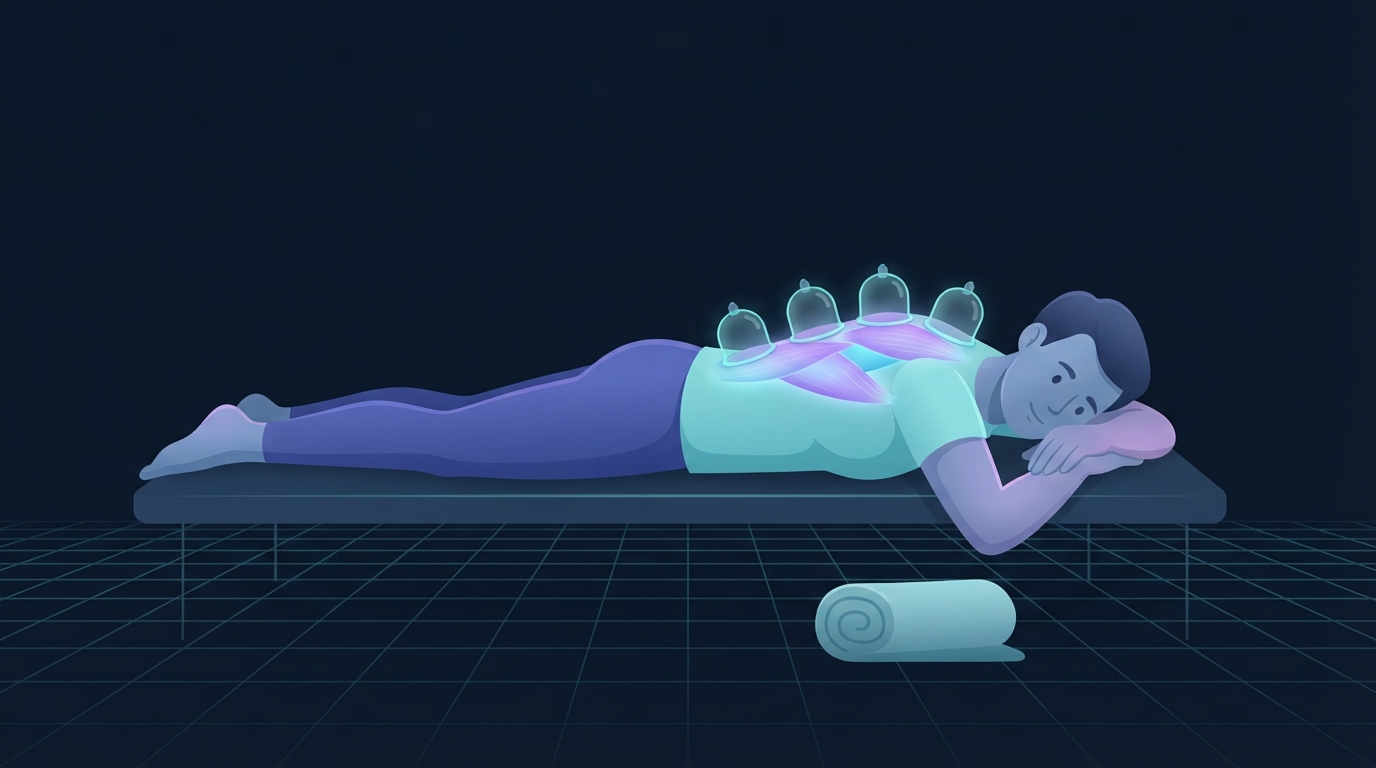
Cupping went from an obscure traditional practice to a mainstream recovery trend in a single week of the 2016 Olympics, when swimmers walked onto the deck covered in circular purple marks. Ten years later the cups are in physical therapy clinics, CrossFit gyms and the back rooms of massage studios, and the research base has grown enough to give a real answer.
The answer has two halves, and most articles only tell you the first one. Half one: people who get cupped report meaningfully less pain and move a little better afterward, and the effect sizes in the pooled data are not small. Half two: when researchers compare real cups against fake cups that look and feel almost identical, the advantage mostly evaporates. Both halves are true at once, and living with that is the whole story here.
This page walks through the primary reviews, what each one actually measured, the mechanisms that have been proposed and which of them survive contact with the data, what the negative trials in athletes and knee pain found, and where a session of cupping reasonably fits if you like it. If you want the neighbouring modalities, we have separate reviews of what foam rolling actually does and what percussion therapy actually does. The pattern across all three is similar, and recognizing it is more useful than any single finding.
The Research: What Studies Show
Cramer 2020: The Meta-Analysis That Split "Works" From "Works Better Than Sham"
Cramer, Klose, Teut, Rotter, Ortiz, Anheyer, Linde and Brinkhaus (2020) in The Journal of Pain is the reference review. The team pulled 18 randomized controlled trials covering 1,172 participants with chronic pain conditions, mostly low back pain, neck and shoulder pain, knee osteoarthritis and fibromyalgia, and ran three separate comparisons.
- Cupping versus no treatment: a large short-term effect on pain intensity, standardized mean difference -1.03 (95% CI -1.41 to -0.65), and a medium effect on disability, -0.66.
- Cupping versus sham cupping: -0.27 for pain and -0.26 for disability. Neither reached statistical significance.
- Cupping versus other active treatments: -0.24 for pain, not significant, and -0.52 for disability, which did favor cupping.
- Safety: adverse events were more frequent with cupping than with no treatment, but not significantly more frequent than with sham or with the other active treatments.
The authors' conclusion was careful: cupping might be a treatment option for chronic pain, but the evidence remains limited by clinical heterogeneity and risk of bias. That is the whole finding in one sentence. Something real happens. Whether the cups are the active ingredient is unresolved.
Wood 2020: Where Dry Cupping Shows Its Largest Numbers
Wood, Fryer, Tan and Cleary (2020) in the Journal of Bodywork and Movement Therapies narrowed the question to dry cupping and added range of motion as a co-primary outcome. Twenty-one randomized trials, 1,049 participants.
Two pain findings stood out. Chronic neck pain improved by a mean difference of 21.67 points on a 100-point scale (95% CI -36.55 to -6.80). Non-specific low back pain improved by 19.38 points (95% CI -28.09 to -10.66). For context, most clinicians treat 20 points on a 100-point pain scale as a change a patient genuinely notices. Range of motion also improved against no treatment, standardized mean difference -0.75.
And then the same caveat: the authors wrote that definitive conclusions about effectiveness and safety could not be made, because the underlying evidence was low to moderate quality. Most of the comparisons that produced the big numbers were against no treatment or usual care, not against a convincing fake.
Kim 2018: The Neck Pain Question, Asked on Its Own
Neck pain is the single most-studied cupping indication, which is why it gets a dedicated review. Kim, Lee, Kim and colleagues (2018) in BMJ Open assembled 18 trials of cupping for neck pain specifically. Their reason for doing so is worth repeating: neck pain ranks second only to depression as a cause of years lived with disability worldwide, so even a modest, short-lived intervention has a large potential audience. The clinical picture that emerges from the neck literature matches the broader reviews. Short-term relief is reported consistently. Long-term structural change is not.
Bridgett 2018: What Happened When Researchers Looked at Athletes
The Olympic marks are what made cupping famous, so the athlete evidence deserves its own line. Bridgett, Klose, Duffield, Mydock and Lauche (2018) in the Journal of Alternative and Complementary Medicine reviewed 11 randomized trials covering 498 amateur and professional athletes across soccer, football, handball, swimming, gymnastics and track and field.
Reported benefits included perceptions of pain and disability, increased range of motion and reductions in creatine kinase. But most trials carried unclear or high risk of bias, outcome measures were inconsistent across studies, and not one of the 11 trials reported safety data. The authors' conclusion was blunt: no explicit recommendation for or against the use of cupping for athletes can be made.
Jenkins 2025: The Placebo-Controlled Question, Asked Again
Jenkins and colleagues (2025) in JOSPT Open did the cleanest version of the analysis. Instead of pooling everything and reporting the sham comparison as a secondary result, they searched seven databases through June 2025 for trials that compared dry cupping directly against placebo cupping in people with musculoskeletal complaints, and pooled only those.
Five trials qualified, four were poolable, 281 participants split evenly between real and placebo cups. Short-term pain (immediately to one week) came out at a mean difference of -9.9 on a 100-point scale with a confidence interval running from -30.5 to 10.7, which crosses zero comfortably. At four weeks a single trial of 37 people showed -17.2. At long-term follow-up a single trial of 52 people showed -2.2. The overall certainty rating: very uncertain, at every time point.
Why the Sham Comparison Decides Everything Here
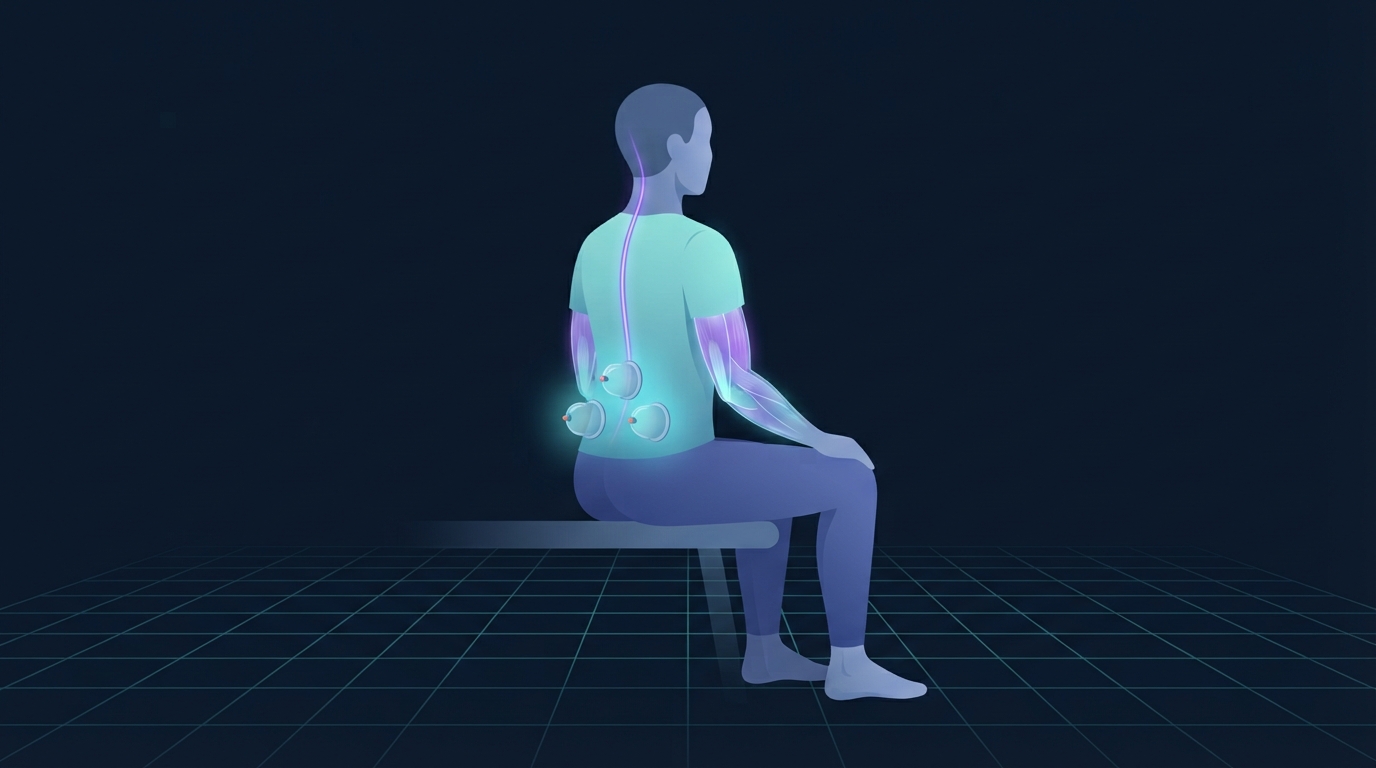
A sham needs to be convincing, and cupping is unusually hard to fake. Researchers usually use cups with a valve that leaks or a modified cup that makes the suction noise and applies contact pressure without drawing skin up into the dome. A participant who has never been cupped before will often not know the difference. A participant who has, usually will.
That matters because the gap between the "versus nothing" number and the "versus sham" number is where the non-specific effects live: the expectation of relief, the attention of a practitioner, lying still for twenty minutes, the strong novel sensation on the skin, and simple regression to the mean, since most people book a session when their pain is at its worst. Those effects are not fake. A patient whose back hurts less for two days got a real benefit. They just are not evidence that negative pressure did the work.
This is exactly the shape of the evidence on several other passive recovery tools. Foam rolling produces small but consistent effects on soreness and flexibility that turn out to be neurophysiological rather than structural, and the fascia-release explanation does not survive scrutiny. Percussion devices reliably move range of motion and do close to nothing for strength or power. Recognizing the pattern makes you a better consumer of the next recovery gadget.
How Cupping Therapy Actually Works
Al-Bedah, Elsubai, Qureshi and colleagues (2019) in the Journal of Traditional and Complementary Medicine screened 223 articles, analyzed 64, and sorted the proposed mechanisms into six theories. Ranked by how well the human evidence supports them:
- Pain gate and diffuse noxious inhibitory control. A strong, novel, non-damaging sensory input competes with the pain signal at the spinal cord and recruits descending inhibition from the brainstem. This is the same family of mechanisms behind massage, TENS and the odd relief you get from scratching around a sore spot. It is the best-supported explanation and it predicts exactly what the trials find: real short-term relief that fades.
- Local circulation and nitric oxide. Negative pressure increases skin blood flow under and around the cup and may raise local nitric oxide, which drives vasodilation. Measurable, short-lived, plausible as a contributor to the loosened feeling.
- Mechanical decompression of superficial tissue. Cupping lifts skin and superficial fascia rather than compressing it, which is genuinely different from massage. Whether that lift changes tissue properties beyond the session is unproven.
- Immune and hormonal activation. Proposed, with thin human data behind it.
- Reflex zone effects. Proposed, mostly theoretical.
- Blood detoxification. The weakest of the six. No human trial has shown cupping clearing toxins or heavy metals. The authors themselves concluded that no single theory explains the whole effect.
One thing the mechanism list makes clear: nothing in it predicts a lasting change. Every well-supported pathway is a temporary neurological or circulatory response. That is consistent with a review base full of short-term wins and almost no long-term ones.
Get an evidence-based plan built for you
FitCraft, our mobile fitness app, pairs you with an AI coach who builds you a personalized plan around your goals, schedule, and fitness level. Every FitCraft program is designed by Domenic Angelino, MPH (Brown University) and NSCA-CSCS, with research published in the Journal of Strength and Conditioning Research and Medicine & Science in Sports & Exercise.
Take the Free Assessment Free • 2 minutes • No credit cardThe Two Trials That Say No
Two recent sham-controlled trials are worth knowing by name, because they test cupping in the exact scenarios people buy it for.
Coutinho and colleagues (2025) in the Journal of Bodywork and Movement Therapies randomized 81 recreational runners after a running session to either five minutes of cupping on the quadriceps or a sham hip and knee mobilization, then followed them for 72 hours. Muscle pain: no difference (-0.61, 95% CI -1.35 to 0.14). Fatigue intensity: no difference. Perceived recovery: no difference. Vertical jump height: no difference. Four outcomes, four nulls.
Cavalcanti, Almeida Silva, Pontes-Silva and colleagues in Brazilian Journal of Physical Therapy ran the longer version in a clinical population: 62 women aged 50 to 75 with knee osteoarthritis, 12 sessions of real or sham dry cupping across six weeks, measuring pain, disability, functional capacity and quality of life. Both groups improved. Neither group improved more than the other, at any time point, on any variable.
That second trial is the more informative one, because it used a full course of treatment rather than a single session. If cupping had a cumulative, dose-dependent, mechanism-driven effect, six weeks of it in a symptomatic population is where that effect should surface. It did not.
Common Misconceptions
Misconception: "The darker the marks, the more toxins came out"
The marks are pooled blood from capillaries that ruptured under negative pressure. Mark color tracks capillary fragility, skin type, how long the cup sat and how strong the suction was. It does not track toxin load, muscle tightness, hydration or how badly you needed the session. The detox theory is the weakest of the six mechanisms Al-Bedah 2019 catalogued, and it has no supporting human trial.
Misconception: "Cupping releases fascia"
This is the same claim made for foam rolling, and it has the same problem. Fascia is tough collagenous tissue that requires forces far beyond what a suction cup generates to deform in any lasting way. What cupping does is lift superficial tissue briefly and give the nervous system a loud input. Those are real effects with real short-term consequences. They are not tissue remodeling.
Misconception: "Cupping speeds up muscle recovery after hard training"
The athlete trial base is thin and the one recent sham-controlled test in runners found nothing on pain, fatigue, perceived recovery or jump height. Bridgett 2018 could not make a recommendation either way. If your goal is faster recovery between hard sessions, the better-supported levers are sleep, protein intake, and active recovery work, all of which have stronger trial support than any passive modality.
Misconception: "It's placebo, so it's worthless"
The opposite conclusion also overshoots. Pain is a nervous system output, and interventions that change the nervous system's input and expectation change pain genuinely. If a cupping session leaves you moving more freely and more willing to train this week, that outcome counts. The honest framing is that cupping is a comfort and confidence tool with a low risk profile, not a structural treatment, and it should be priced and prioritized accordingly.
Where Cupping Reasonably Fits
Here is the practical read on the evidence, stated as plainly as the data allows.
- Good fit: chronic neck, shoulder or low back pain where you want short-term relief that lets you move and train. Wood 2020's neck and low back numbers are the largest in the file.
- Good fit: a pre-session mobility bump if stiffness is the thing keeping you off the floor. The range-of-motion effect is consistent, if brief.
- Poor fit: post-training recovery in healthy athletes. Coutinho 2025 tested exactly that and found nothing.
- Poor fit: a standalone treatment for knee osteoarthritis. Cavalcanti's six-week sham-controlled course found no advantage.
- Poor fit: anything framed as detox, lymphatic drainage or fascial release.
The durable answer for chronic neck and back pain is not on this list, because it is not a passive modality at all. Progressive loading is. Exercise therapy has the strongest and longest-running evidence base of any intervention for non-specific low back pain, and the analgesic effect of training itself, called exercise-induced hypoalgesia, shows up reliably in controlled studies. Cupping can make the first two weeks of that program more tolerable. It cannot replace it. If you want help building the loading side, our roundup of the best strength training apps compares the tools that actually program progression instead of just logging it.
Safety and Side Effects
Dry cupping in healthy adults is low risk. Expect circular bruising that lasts three to seven days, temporary skin discoloration, and mild soreness at the cup sites. Cramer 2020 found adverse events were more common with cupping than with no treatment at all, which is unsurprising given the marks, but not significantly more common than with sham cupping or with other active treatments.
Risk rises with the technique. Wet cupping, which involves small skin incisions, adds infection and scarring risk and should only be performed by a trained practitioner using sterile single-use equipment. Fire cupping, where a flame is used to create the vacuum, has a documented burn and blistering risk. Bridgett 2018 flagged that none of the 11 athlete trials reported safety data at all, so the athlete-specific risk picture is genuinely unmeasured rather than confirmed safe.
Cupping is a poor choice over broken or infected skin, over a known or suspected deep vein thrombosis, over a tumor site, on anticoagulant therapy or with a bleeding disorder, over active eczema or psoriasis, on very thin or fragile skin, and during pregnancy over the abdomen or lower back.
What the Research Suggests Going Forward
Three things would change the picture, and none of them are exotic.
First, better shams. Every review in the file says the same thing: the placebo-controlled trials are few, small and heterogeneous. Jenkins 2025 could only pool four of them. Until a validated sham exists that naive and experienced participants both fail to distinguish, the central question stays open.
Second, dose standardization. Cup size, suction strength, duration, number of cups, static versus dynamic technique and session frequency all vary wildly across trials. Bridgett 2018 counted applications ranging from 1 to 20 sessions. When the intervention is that loosely defined, a pooled effect size is a blur of many different interventions.
Third, longer follow-up. Nearly all the positive findings sit in the immediate-to-one-week window. Two of the three time windows Jenkins 2025 could analyze rested on a single small trial each. The field does not yet know whether cupping does anything at three months, and that is the window that matters for chronic pain.
Until then, the defensible position is the one Cramer's team took six years ago and nobody has overturned. Cupping might help, the risk is low if the technique is dry and the practitioner is careful, and the honest expectation is short-term comfort rather than repair.
References
- Cramer H, Klose P, Teut M, Rotter G, Ortiz M, Anheyer D, Linde K, Brinkhaus B. "Cupping for Patients With Chronic Pain: A Systematic Review and Meta-Analysis." J Pain. 2020;21(9-10):943-956. doi:10.1016/j.jpain.2020.01.002
- Wood S, Fryer G, Tan LLF, Cleary C. "Dry cupping for musculoskeletal pain and range of motion: A systematic review and meta-analysis." J Bodyw Mov Ther. 2020;24(4):503-518. doi:10.1016/j.jbmt.2020.06.024
- Kim S, Lee SH, Kim MR, Kim EJ, Hwang DS, Lee J, Shin JS, Ha IH, Lee YJ. "Is cupping therapy effective in patients with neck pain? A systematic review and meta-analysis." BMJ Open. 2018;8(11):e021070. doi:10.1136/bmjopen-2017-021070
- Bridgett R, Klose P, Duffield R, Mydock S, Lauche R. "Effects of Cupping Therapy in Amateur and Professional Athletes: Systematic Review of Randomized Controlled Trials." J Altern Complement Med. 2018;24(3):208-219. doi:10.1089/acm.2017.0191
- Jenkins LC, et al. "The efficacy of dry cupping compared to placebo cupping for people with musculoskeletal complaints: a systematic review with meta-analysis." JOSPT Open. 2025. doi:10.2519/josptopen.2025.0159
- Coutinho LOB, Alves BS, Caetano RO, Lauria FO, Carvalho GL, Silva CV, Fonseca DS, Felicio DC. "Cupping therapy does not improve quadriceps muscle pain and fatigue intensity, perceived recovery, and vertical jump height after running: A randomized clinical trial." J Bodyw Mov Ther. 2025;42:441-445. doi:10.1016/j.jbmt.2024.12.039
- Cavalcanti RR, Almeida Silva HJ, Pontes-Silva A, et al. "Dry cupping therapy has no effect on pain, function, or quality of life in women with knee osteoarthritis: Randomized placebo-controlled trial." Braz J Phys Ther. 2026;30(1):101259. doi:10.1016/j.bjpt.2025.101259
- Al-Bedah AMN, Elsubai IS, Qureshi NA, Aboushanab TS, Ali GIM, El-Olemy AT, Khalil AAH, Khalil MKM, Alqaed MS. "The medical perspective of cupping therapy: Effects and mechanisms of action." J Tradit Complement Med. 2019;9(2):90-97. doi:10.1016/j.jtcme.2018.03.003
Frequently Asked Questions
What are the benefits of cupping therapy?
The best-supported cupping therapy benefits are short-term reductions in musculoskeletal pain and a temporary increase in range of motion. Cramer and colleagues (2020) pooled 18 randomized trials and 1,172 participants in The Journal of Pain and found a large effect on pain intensity compared with no treatment (standardized mean difference -1.03) and a medium effect on disability (-0.66). Wood and colleagues (2020) reported pain drops of roughly 20 points on a 100-point scale for chronic neck pain and non-specific low back pain. The catch is that almost all of that advantage disappears when cupping is compared with sham cups rather than with nothing.
Does cupping work better than a placebo?
Not by a margin the evidence can confirm. In Cramer 2020, cupping beat no treatment by a standardized mean difference of -1.03 for pain but beat sham cupping by only -0.27, which was not statistically significant. Jenkins and colleagues (2025) in JOSPT Open pooled the placebo-controlled trials directly, found 4 usable trials and 281 participants, and rated the evidence very uncertain at every follow-up window. Two recent sham-controlled trials, one in 81 recreational runners and one in 62 women with knee osteoarthritis, found no difference between real and sham cups.
Do the cupping marks mean toxins are being removed?
No. The circular marks are pooled blood from small capillaries that ruptured under negative pressure, closer to a suction bruise than to a detox signal. Al-Bedah and colleagues (2019) reviewed the proposed mechanisms in the Journal of Traditional and Complementary Medicine and listed blood detoxification as one of six competing theories, with no direct human evidence that cupping clears toxins or heavy metals. Darker marks track how fragile the capillaries were and how long the cup sat, not how sick or how tight you are.
Does cupping help athletes recover faster?
The athlete data is the weakest part of the file. Bridgett and colleagues (2018) reviewed 11 randomized trials covering 498 amateur and professional athletes and concluded that no explicit recommendation for or against cupping in athletes can be made, with most trials at unclear or high risk of bias and none reporting safety data. A 2025 randomized trial in 81 recreational runners found cupping the quadriceps after a run produced no improvement in muscle pain, fatigue, perceived recovery, or vertical jump height against a sham control at 72 hours.
Is cupping therapy safe?
Dry cupping is generally low risk in healthy adults, and the usual side effects are circular bruising, skin discoloration lasting several days, and short-lived soreness at the cup sites. Cramer 2020 found adverse events were more common with cupping than with no treatment, though not significantly more common than with sham or other active treatments. Wet cupping and fire cupping add real risks of burns, blistering, scarring, and infection. Cupping is a poor fit over broken skin, over deep vein thrombosis, on anticoagulant therapy, on skin with active eczema or infection, and during pregnancy.