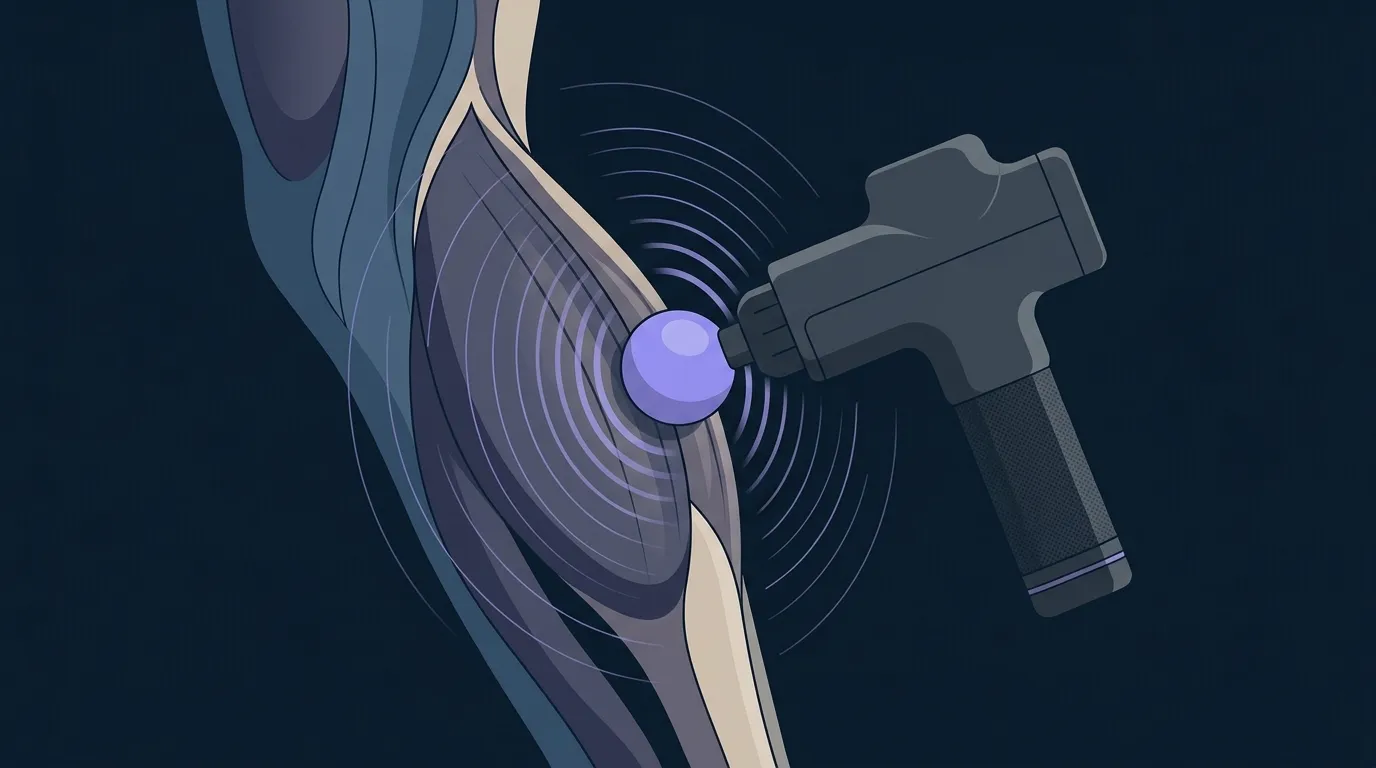
Massage guns went from niche physiotherapy equipment to a fixture in home gyms in about five years. That commercial rise ran well ahead of the research. In 2019 there were essentially no peer-reviewed studies of percussion therapy delivered by these devices. By 2023 there were two systematic reviews and enough randomized trials to draw some real conclusions about what the tool actually does.
The short version: the acute effects on flexibility and soreness are real and consistent across studies. The pre-workout performance-enhancement story is the part the marketing gets wrong. And the difference between a mediocre session and a useful one seems to come down mostly to how long you spend on the tissue.
This article walks through the primary studies, what they actually measured, where the evidence is strong, where it is thin, and how to use the tool for the specific outcomes it is good at without expecting it to do things it does not do.
The Research: What Studies Show
Konrad 2020: The Calf Study That Anchored the Field
The most-cited early experimental study on percussion therapy is Konrad, Glashüttner, Reiner, Bernsteiner, and Tilp (2020), published in the Journal of Sports Science and Medicine. Sixteen healthy recreational male athletes received a single 5-minute percussion treatment on their calf muscles with a Hypervolt device, or served as a no-treatment control. Ankle dorsiflexion range of motion and maximum voluntary isometric contraction torque of the plantar flexors were measured before and after.
Two results matter. First, maximum dorsiflexion ROM increased by 5.4 degrees on average in the treatment group, an 18.4 percent increase, with a large effect size. The control group did not change. Second, plantar-flexor strength did not decrease. That combination is unusual. Most acute flexibility interventions that produce a 5-degree ROM bump (long-duration static stretching, for example) also produce a small acute drop in force output. Percussion appeared to move flexibility without the strength trade-off, at least on the calf, at least at 5 minutes of continuous application.
That single study gave the field its founding hypothesis: percussion moves ROM through a neural or mechanical pathway distinct from stretching, which is why it can produce flexibility gains without the classic post-stretch power decrement. The subsequent research has largely borne that out for flexibility outcomes and complicated it for strength and power outcomes.
Ferreira 2023: The First Systematic Review
The best synthesis of the acute-effects literature is Ferreira, Silva, Vigário, Martins, Casanova, Fernandes, and Sampaio (2023), published in the Journal of Functional Morphology and Kinesiology. The team pooled 11 studies of massage gun interventions across recovery, flexibility, strength, and performance outcomes.
The flexibility conclusion was consistent with Konrad: massage guns "could be effective in improving iliopsoas, hamstrings, triceps suralis, and posterior chain muscles' flexibility" acutely. The recovery conclusion was that massage guns are "cost-effective instruments for stiffness reduction, range of motion, and strength improvements after a fatigue protocol." Meaning: use one after training when the tissue is stiff and sore, and it helps.
The important negative finding: "In strength, balance, acceleration, agility, and explosive activities, massage guns either did not have improvements or showed a decrease in performance." A massage gun is not a pre-workout activator. Applied immediately before a jump, a sprint, or a heavy lift, the tool ranges from neutral to slightly detrimental depending on protocol. That undercuts a lot of the sideline-and-warmup marketing use cases.
Sams 2023: The Pain Review
Around the same time, Sams, Langdown, Simons, and Vseteckova (2023) published a parallel systematic review in the International Journal of Sports Physical Therapy. They analyzed 13 studies involving 255 adults, and their focus was slightly different: musculoskeletal pain outcomes in addition to strength and flexibility.
Their conclusions confirmed and extended the Ferreira review. A single application of percussion produced acute improvements in muscle strength, explosive strength (in some protocols), and flexibility. Multiple treatments over a program reduced musculoskeletal pain experiences. The authors framed massage guns as "a portable and cost-effective alternative" to traditional vibration therapy and clinician-delivered soft-tissue work, with the caveat that heterogeneous study protocols made it hard to prescribe a definitive dose.
The pain finding matters. A large fraction of people who buy a massage gun are treating a chronic ache more than they are chasing an athletic outcome. The Sams review is the best current evidence that repeated home use of a massage gun can measurably move perceived pain over weeks, not just minutes. That is the outcome the tool is arguably best suited for.
Li 2025: The DOMS Duration RCT
The most useful practical study to appear in the last year is Li, Luo, Zhang, Cheng, Wu, and Wen (2025), published in Frontiers in Public Health. Thirty physically active male college students were randomized to three groups after squat-induced delayed onset muscle soreness: static stretching, 25 minutes of percussion massage therapy, or 40 minutes of percussion massage therapy. All three protocols were applied at 24 and 48 hours post-exercise. Outcomes were pain scores, knee ROM, and countermovement jump performance.
At 48 hours, the 40-minute percussion group had significantly lower pain scores, greater knee ROM, and better jump performance than both the static stretching and the 25-minute percussion groups. The 25-minute percussion group performed roughly the same as static stretching on all three outcomes. The authors' plain-language conclusion: "Two 40-min PMT sessions were significantly more effective for recovery than two 25-min sessions."
The finding is a slap against the way most people actually use these tools. A typical home massage-gun session is 3 to 5 minutes of scattered targeting across a few areas. That is dose-equivalent to no treatment for DOMS recovery, per this study. To get the recovery outcome the marketing promises, the treatment has to be systematic and comparatively long. Whether most people will actually spend 40 minutes on their legs after a hard leg session is a separate question. But the dose-response signal in this study is clear: short sessions do nothing measurable for soreness; long sessions do.
Szymczyk 2022: The Tendon-Specific Caveat
A useful corrective from the same era is Szymczyk, Węgrzynowicz, Trybulski, Spieszny, Ewertowska, Wilk, and Krzysztofik (2022), in the International Journal of Environmental Research and Public Health. Eleven physically active participants (8 male, 3 female) received percussion massage to the Achilles tendon, with drop jump performance and Achilles tendon stiffness measured immediately before, immediately after, and 5 minutes later.
The findings pushed back on a specific popular use case: percussing the Achilles right before jumping. Drop jump height did not improve immediately after the treatment, and 5 minutes later showed a small decline. Achilles tendon stiffness showed a non-significant downward trend immediately post-treatment that reversed within 5 minutes. Applying percussion to a stiff tendon you are about to load explosively appears to make the tendon less stiff, briefly, in a way that reduces its usefulness as a spring for jumping and returns to baseline before it matters.
The read-across: percussion on muscle bellies is a different intervention than percussion on tendon tissue. Softening a tendon acutely is not what you want if you are about to plyometric-load it. Save percussion of the Achilles, patellar tendon, and hip flexor tendon for after training, not before.
How Percussion Actually Works
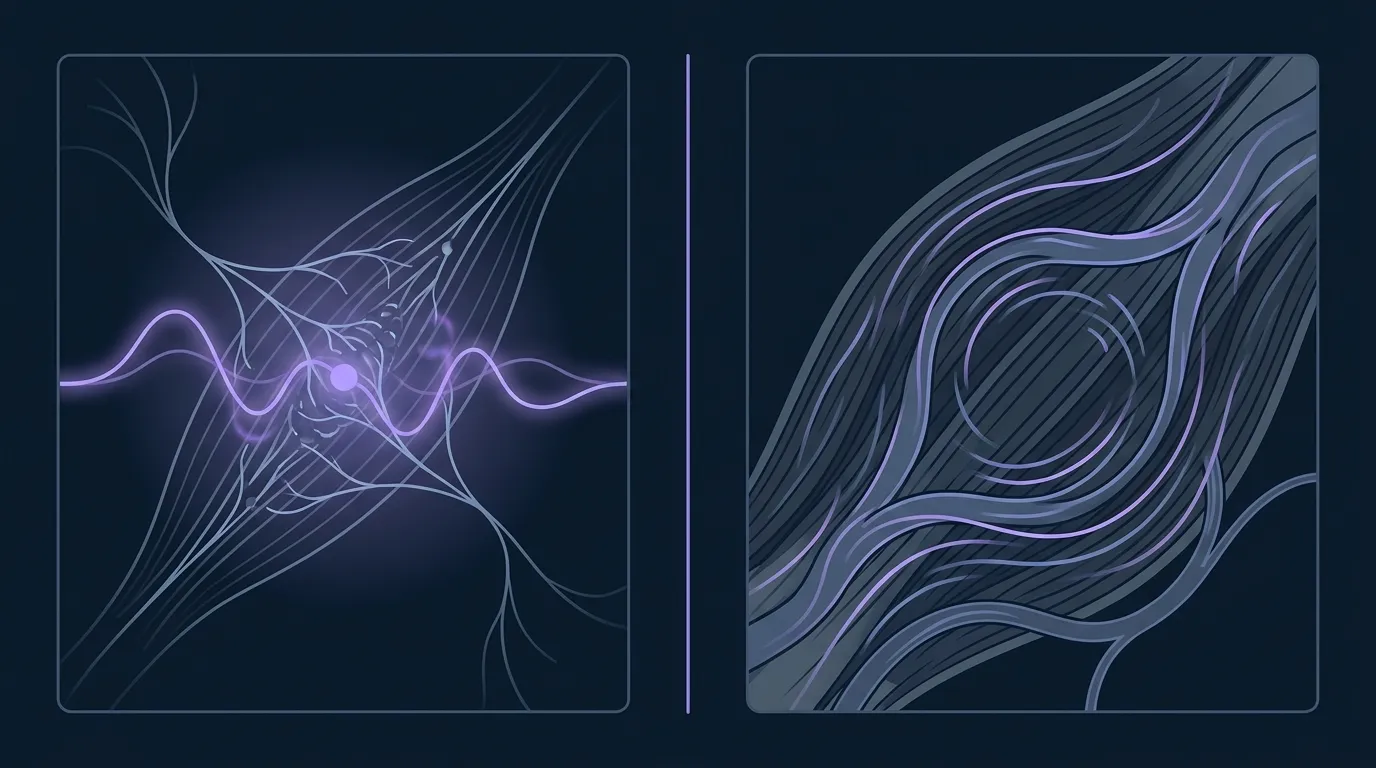
A massage gun delivers a small-amplitude, high-frequency mechanical pulse into soft tissue, typically at 20 to 50 Hz. That is different from foam rolling, which applies a slower, larger-amplitude compression, and different from vibration therapy delivered on a plate, which vibrates the whole body. The training-relevant question is what that specific input actually does to muscle and connective tissue.
The current best-supported mechanistic explanation has two parts. First, the rapid oscillation appears to reduce reflex-driven muscle tension by desensitizing muscle spindle and Golgi tendon organ output. That is a plausible explanation for why ROM increases without a strength decrement, because the tissue is more compliant without needing to be actually longer. Second, the mechanical pulsing moves interstitial fluid and may temporarily alter the mechanical properties of connective tissue, which is a plausible route to reduced perceived stiffness and pain.
Neither pathway is fully nailed down. What is clear from the data is that the effect is real, largely acute (returning toward baseline over minutes to hours), and useful in specific contexts. The mechanism story matters because it explains the boundaries. Percussion is not producing lasting structural change in muscle or fascia within a session. What it is doing is transiently modulating tissue behavior in ways that let you move better and feel less sore for a window of time.
Why This Matters for Your Fitness
The practical implication of the research is that a massage gun does a small number of jobs well and a lot of jobs poorly. Naming the jobs it does well:
Acute mobility for a stiff joint before general training. Two to three minutes on a tight calf, hip flexor, or upper trap before a general warm-up will produce a measurable ROM increase, per the Konrad and Ferreira data. That is useful for someone whose ankles never quite hit dorsiflexion, or whose hips feel stuck at the top of a squat.
Post-exercise soreness reduction. The Li (2025) RCT is the cleanest evidence that a long-enough percussion session at 24 and 48 hours after a hard workout meaningfully reduces DOMS and preserves performance capacity. Meaningful means real, not miraculous. You still trained hard, so you will still feel it. The percussion is moving the intensity of that soreness down enough to show up on a 10-point pain scale and on functional tests.
Chronic musculoskeletal pain over weeks. The Sams (2023) systematic review is the best evidence that repeated home percussion can move perceived pain in the medium term for common chronic complaints. If you have a nagging upper trap, a tight IT band, or a low-grade forearm ache, a daily short session is defensible.
Naming the jobs it does poorly:
Pre-competition or pre-heavy-lift activation. The Ferreira review is clear that percussion immediately before explosive activity is neutral at best and slightly negative at worst. Skip it before your working sets.
Percussion of a tendon you are about to jump on. The Szymczyk (2022) finding on Achilles percussion argues specifically against pre-jump treatment of tendon tissue. A stiff tendon is what makes a plyometric jump work.
Replacing training itself. Nothing in the research suggests that percussion moves any long-term fitness outcome, sarcopenia, cardiovascular health, or performance in the absence of actual training. The tool is an adjunct. The foam rolling research has arrived at essentially the same conclusion for a similar tool.
None of that makes the tool bad. It means the tool is useful for the specific things it is good for and unhelpful for the things marketing tries to make it do.
Get an evidence-based plan built for you
FitCraft, our mobile fitness app, pairs you with an AI coach who builds you a personalized plan around your goals, schedule, and fitness level. Every FitCraft program is designed by Domenic Angelino, MPH (Brown University) and NSCA-CSCS, with research published in the Journal of Strength and Conditioning Research and Medicine & Science in Sports & Exercise.
Take the Free Assessment Free • 2 minutes • No credit cardHow to Use a Massage Gun in Practice
A defensible protocol translated from the study designs and coaching practice:
- Dose for a mobility bump: 2 to 3 minutes per muscle, applied continuously to one area at a time. Konrad (2020) used 5 minutes on the calf and produced a large ROM effect; shorter durations produce smaller but still useful effects. Slow, sweeping passes over the length of the muscle work; do not park in one spot for 30 seconds unless you are treating a specific trigger point.
- Dose for DOMS recovery: 5 to 8 minutes per major muscle group, systematically applied. The Li (2025) 40-minute total is a lot but distributed across several muscle groups. On a soreness-only day 24 to 48 hours post-workout, work each sore muscle group for a full 5 to 8 minutes rather than scattering 30-second passes over everything.
- Speed setting: use the middle range for most muscles, higher speeds only on dense tissue. Most devices offer 3 to 6 speed settings ranging roughly 20 to 50 Hz. Middle settings (roughly 30 Hz) are appropriate for most muscles. Higher speeds are used on dense tissue like the glutes and quads; lower speeds on smaller or bonier areas like forearms and calves near the tendon.
- Pressure: firm enough to indent the tissue, light enough to breathe normally. If you are wincing or bracing, the pressure is too high and you are triggering a defensive muscle response that opposes the intended relaxation effect. The device does the work; you guide it.
- Timing: after training or on rest days, not immediately before explosive activity. The Ferreira review and Szymczyk study are clear on this. Pre-workout percussion is only useful for a general mobility warm-up on a stiff joint, not as an activator before your working sets.
- Where to avoid: directly over bones, joints, tendons you are about to load explosively, or the front of the neck. The head attachment is meant for muscle bellies, not for percussing a bony surface or a fresh injury. Skip the low back if you have not learned proper positioning, because the lumbar erectors sit close to the kidneys and misaimed pressure is uncomfortable at best.
- Cheaper devices are mostly fine. The published studies used research-grade devices like the Hypervolt and Theragun, but the mechanism the effect depends on (rapid mechanical percussion at 20 to 50 Hz) is not proprietary. A budget device with adequate amplitude and speed range delivers the same input as a top-shelf one. What you pay for at the high end is battery life, quiet operation, build quality, and app connectivity, not fundamentally different tissue effects.
- Not a substitute for the training itself. Percussion is an adjunct. It does not build muscle, improve VO2 max, or replace a program. Program the training first; add percussion as a recovery layer when it fits.
Individual Variation: Who Responds Most
Training Status
Trained and untrained users both respond to acute ROM effects, though the baseline flexibility of an untrained beginner is often the bigger driver of how much they gain. A 5.4-degree dorsiflexion increase (Konrad 2020) on a calf that only hits 15 degrees to start with is a much bigger relative change than the same 5.4-degree increase on a calf that already hits 30 degrees. The mobility gain lands harder on the person who has less to begin with.
Sex
The main published studies are heavily male-skewed, and the field has not established meaningful sex-specific dose-response differences. General female-population data suggests women on average have slightly greater baseline ankle and hip mobility than men, which may mean the relative flexibility bump from a session is smaller for someone already flexible. The recovery and pain outcomes are unlikely to differ substantially by sex.
Age
Older adults are one of the populations that arguably benefits most, given how tightly ROM and perceived stiffness track with age-related tissue changes. Dose should start conservatively (2 to 3 minutes, lower speed setting) and progress cautiously. The primary risk is bruising in older skin, especially in anyone on anticoagulant medication, where percussion should be avoided or discussed with a clinician first. For general older adults without those specific concerns, the tool is safe and often subjectively helpful for chronic stiffness in the calves, hamstrings, hips, and shoulders.
Injury and Medical History
People with fresh acute injury, deep vein thrombosis history or risk, uncontrolled cardiovascular disease, active infection or inflammation, pacemakers (avoid the chest area), pregnancy (avoid the abdomen and low back), advanced osteoporosis, or those on blood thinners should either avoid percussion entirely or consult a clinician before using it on affected areas. The training studies almost universally used healthy adults; the safety data on clinical populations is thin.
Common Misconceptions
Misconception 1: "A longer, more intense session is always better."
Intensity is not the lever. Duration is. Li (2025) showed a clear dose-response for DOMS recovery at the duration level: 40 minutes worked, 25 minutes did not. Neither study group used high-intensity settings. Cranking up the speed and hammering harder does not compound the effect and does increase the risk of bruising and defensive muscle bracing that fights the intended relaxation effect. Spend more time at a moderate intensity, not less time at a maximum one.
Misconception 2: "Massage guns break up adhesions and scar tissue."
They do not. The mechanical force delivered by a handheld percussion device is nowhere near the force required to physically remodel mature scar tissue or fascial adhesions. What the tool actually does is transiently modulate neural drive and perceived tissue quality, which can feel like something has "released" without any structural change having occurred. The subjective effect is real; the mechanistic story is wrong. That distinction matters because it explains why the effect wears off within hours.
Misconception 3: "I should use my massage gun before every set of squats to activate my glutes."
The Ferreira (2023) review is unambiguous that percussion before explosive activity is neutral to slightly negative on strength and power. Percussion is not activation. If you want your glutes fired up for a heavy squat, use dynamic activation drills (glute bridges, banded lateral walks) and warm-up sets. Save the massage gun for after the session, when the goal changes from producing force to recovering from having produced it.
Misconception 4: "Foam rolling is obsolete now that massage guns exist."
The current evidence does not support that. The Sams (2023) review specifically frames massage guns as a portable alternative to existing soft-tissue tools, not a categorically superior one. Foam rolling still produces measurable acute ROM effects and DOMS reduction, and the roller has geometry advantages for large muscle groups (quads, upper back) that a handheld device does not. The best answer for most people is: use whichever tool you actually reach for, on whichever muscle it fits.
Misconception 5: "Percussion pre-warmup lets me skip a dynamic warm-up."
No study supports that. Percussion produces an acute flexibility gain but does not raise tissue temperature, elevate heart rate, or drill the movement patterns of the session, which are the actual jobs a dynamic warm-up does. Percussion is a supplement to a warm-up on stiff tissue, not a replacement for one. Do your normal warm-up. Add 2 to 3 minutes of percussion on a specific tight spot if you have one.
What the Research Suggests Going Forward
The current state of the literature is unusually clean for a tool that only became popular five years ago. The acute-flexibility finding is replicated across multiple studies and confirmed in two systematic reviews. The DOMS-recovery finding has a well-designed RCT with a clear dose-response pattern. The pain-reduction finding is supported by a second systematic review specifically focused on that outcome. And the negative finding on pre-workout performance is consistent across the review-level and study-level evidence.
What remains genuinely open:
- Whether percussion produces any durable structural change in muscle or connective tissue with repeated use over months. Current data says probably not, but there are no long-term histology studies on regular home users.
- Whether specific frequency ranges (20 vs 30 vs 40 vs 50 Hz) produce meaningfully different tissue effects. Current dose-finding studies are sparse enough that most protocols end up using whatever setting the manufacturer defaults to.
- Whether percussion added to a program produces meaningful long-term training-adaptation benefits (more sessions completed, less time lost to soreness, better ROM maintained) that show up on downstream outcomes. This is a plausible mechanism but not directly measured.
- Whether percussion is meaningfully useful for the older or clinical populations who are the fastest-growing at-home buyers. The trial base skews toward healthy young adults; the extrapolation to a 70-year-old with chronic knee osteoarthritis is not yet backed by direct evidence.
The practical bottom line for a general population program is straightforward. If you have a massage gun and you want to use it, use it for post-training soreness relief (5 to 8 minutes per sore muscle group at 24 to 48 hours out), for acute mobility on a stiff joint (2 to 3 minutes as part of a warm-up), and for chronic ache management over weeks (a daily short session on the offending muscle). Do not use it immediately before jumping or heavy lifting. Do not expect it to replace training. Do not spend a lot of money on a high-end device unless you value battery life and quiet operation.
Percussion is a real tool with real, bounded effects. Most tools worth having have the same shape. Recovery is not the whole story of getting fitter, and no tool is. What moves the needle is showing up. If a small recovery aid helps you show up next week, that is what makes it worth the shelf space. If it becomes a distraction from the training itself, it is not. The recovery guide covers the broader framework.

References
- Ferreira RM, Silva R, Vigário P, Martins PN, Casanova F, Fernandes RJ, Sampaio AR. "The Effects of Massage Guns on Performance and Recovery: A Systematic Review." J Funct Morphol Kinesiol. 2023;8(3):138. doi:10.3390/jfmk8030138
- Sams L, Langdown BL, Simons J, Vseteckova J. "The Effect Of Percussive Therapy On Musculoskeletal Performance And Experiences Of Pain: A Systematic Literature Review." Int J Sports Phys Ther. 2023;18(2). doi:10.26603/001c.73795
- Li H, Luo L, Zhang J, Cheng P, Wu Q, Wen X. "The effect of percussion massage therapy on the recovery of delayed onset muscle soreness in physically active young men — a randomized controlled trial." Front Public Health. 2025;13:1561970. doi:10.3389/fpubh.2025.1561970
- Konrad A, Glashüttner C, Reiner MM, Bernsteiner D, Tilp M. "The Acute Effects of a Percussive Massage Treatment with a Hypervolt Device on Plantar Flexor Muscles' Range of Motion and Performance." J Sports Sci Med. 2020;19(4):690-694. Full text
- Szymczyk P, Węgrzynowicz K, Trybulski R, Spieszny M, Ewertowska P, Wilk M, Krzysztofik M. "Acute Effects of Percussive Massage Treatment on Drop Jump Performance and Achilles Tendon Stiffness." Int J Environ Res Public Health. 2022;19(22):15187. doi:10.3390/ijerph192215187
Frequently Asked Questions
Do massage guns actually work?
For short-term flexibility and post-workout soreness, yes. Two 2023 systematic reviews (Ferreira and colleagues in the Journal of Functional Morphology and Kinesiology, and Sams and colleagues in the International Journal of Sports Physical Therapy) both concluded that a single application of percussive therapy produces acute improvements in range of motion and reductions in perceived pain. Konrad and colleagues (2020, Journal of Sports Science and Medicine) showed a 5-minute calf treatment increased ankle dorsiflexion by 5.4 degrees on average. What the evidence does not support is using a massage gun to boost strength, power, or jump performance immediately before an event. For those goals it appears to be either neutral or slightly detrimental.
Do massage guns help with muscle soreness (DOMS)?
Yes, when the treatment is long enough. Li and colleagues (2025, Frontiers in Public Health) randomized 30 physically active young men to static stretching, 25 minutes of percussion massage, or 40 minutes of percussion massage after squat-induced DOMS. The 40-minute group had significantly lower pain scores, greater knee range of motion, and better countermovement jump recovery at 48 hours compared with the other two groups. The 25-minute group performed similarly to static stretching. Duration matters more than most product marketing suggests.
Should I use a massage gun before or after a workout?
After, or on rest days, for most people. Ferreira and colleagues (2023, Journal of Functional Morphology and Kinesiology) reviewed 11 studies and concluded that massage guns applied immediately before explosive activity either produced no benefit or reduced strength and power output. Szymczyk and colleagues (2022, International Journal of Environmental Research and Public Health) found no improvement in drop jump performance immediately after Achilles-tendon percussion, and a slight decline 5 minutes later. Pre-workout percussion is fine for a general warm-up on stiff tissue but should not replace a proper dynamic warm-up if you are about to sprint, jump, or lift heavy.
How long should I use a massage gun on one muscle?
For an acute flexibility bump, 2 to 5 minutes per muscle is the range used in the most-cited studies. Konrad and colleagues (2020) used 5 continuous minutes on the calf and got a 5.4-degree dorsiflexion increase. For DOMS recovery, Li and colleagues (2025) needed 40 minutes total across muscle groups to see a clear benefit at 48 hours; a shorter 25-minute session was no better than static stretching. Practical rule: 2 to 3 minutes per muscle for a warm-up or mobility bump, 5 to 8 minutes per major muscle group for post-exercise soreness relief when you have a session that felt hard.
Is a massage gun better than a foam roller?
Not clearly. Both produce short-term flexibility gains and soreness reduction through overlapping mechanisms. The Sams and colleagues (2023, International Journal of Sports Physical Therapy) review specifically flagged massage guns as a portable, cost-effective alternative to vibration and traditional soft-tissue tools, but did not identify a consistent superiority over foam rolling. A massage gun is easier to use on hard-to-reach muscles (the calf, forearm, upper trap), lets you target a specific spot with more force, and takes less floor space than a foam roller. For most people, the honest answer is that whichever tool you actually use consistently will produce more benefit than whichever one sits in the closet.