Compression tights, socks, and sleeves have jumped from the physical-therapy clinic to the finish line to the Amazon cart in about two decades. The category is now worth several billion dollars a year, driven mostly by claims about faster recovery and less soreness after hard training. The physiology story is intuitive. Wrap the muscle, support the tissue, help the blood move. Whether the intuition holds up under randomized-trial scrutiny is a different question.
The evidence base is finally big enough to answer that question with something better than a shrug. Four separate meta-analyses have pooled the trials since 2014, and the results converge on a specific, modest, real effect. The garments help you recover, mostly in ways you can feel rather than in ways a blood test can pick up. The effect is bigger for what happens 24 to 72 hours after a hard workout than for what happens during the workout itself.
This article walks through the five most useful reviews and meta-analyses, what they actually measured, where the evidence is strong, and where the marketing outruns the data. If you already own compression tights, this is a case for keeping them in rotation. If you don't, this is an honest assessment of whether they'd move the needle.
The Research: What Studies Show
Hill 2014: The First Big Meta-Analysis of Muscle-Damage Recovery
The compression-garment literature had its first proper synthesis in 2014. Hill, Howatson, van Someren, Leeder, and Pedlar (2014) at St Mary's University and Northumbria University published in the British Journal of Sports Medicine a systematic review and meta-analysis of randomized trials on compression garments after exercise-induced muscle damage. The primary outcomes were DOMS, muscular strength, muscular power, and creatine kinase.
The pooled findings were clean. Compression garments produced a moderate benefit for the recovery of all four outcomes. The effect was largest at time points beyond 24 hours post-exercise, which matches a coherent physiological story. The garment isn't doing much during the initial hour of recovery. It appears to earn its keep across the days that follow, as the tissue is repairing.
Hill's paper also flagged the limitations that would define the rest of the literature. The studies used a wide range of garment types, pressure levels, and wear durations. Most were done in trained or well-trained participants. Sample sizes were generally small. The effect direction was consistent, but the confidence intervals were wide, and no single trial could carry the weight of the claim on its own. This is the shape of a legitimate but not spectacular signal.
Brown 2017: 23 Studies, and the 24-Hour Wear Protocol Emerges
Three years later, an expanded team (Brown, Gissane, Howatson, van Someren, Pedlar, and Hill, 2017) published in Sports Medicine a broader meta-analysis of 23 peer-reviewed studies. The analysis converted results into standardized mean effect sizes with 95% confidence intervals and examined how the effect depended on time (0 to 2 hours, 2 to 8, 24, and beyond 24), applied pressure (below 15 mmHg vs. 15 mmHg and above), and training status (trained vs. untrained).
Two conclusions came out sharpest. First, 24 hours of continuous post-exercise wear produced moderate reductions in DOMS and perceived fatigue. Second, the effect was strongest after resistance exercise, and specifically moderate enough to recommend compression garments to enhance next-day cycling performance. The pressure subgroup analysis pointed the same direction the field had suspected. Trials using at least 15 mmHg tended to produce clearer benefits than trials with softer garments.
The Brown paper is the current best-practice reference for how to actually use the things. If you're going to try compression, put them on soon after the session, wear them for roughly 24 hours (during the day, and at night if you can tolerate it), and use a real athletic-grade garment rather than fashion shapewear. The 15-mmHg threshold is not magic, but it's a reasonable line for "actually applying pressure" vs. "kind of snug."
MacRae 2011: The Mechanism Review (And Why It's Modest, Not Massive)
The mechanistic story sits underneath the outcome story, and the reference here is still MacRae, Cotter, and Laing (2011) at the University of Otago in Sports Medicine. Their review catalogued the physiological pathways by which compression garments have been hypothesized to work. The list is long and only partially validated.
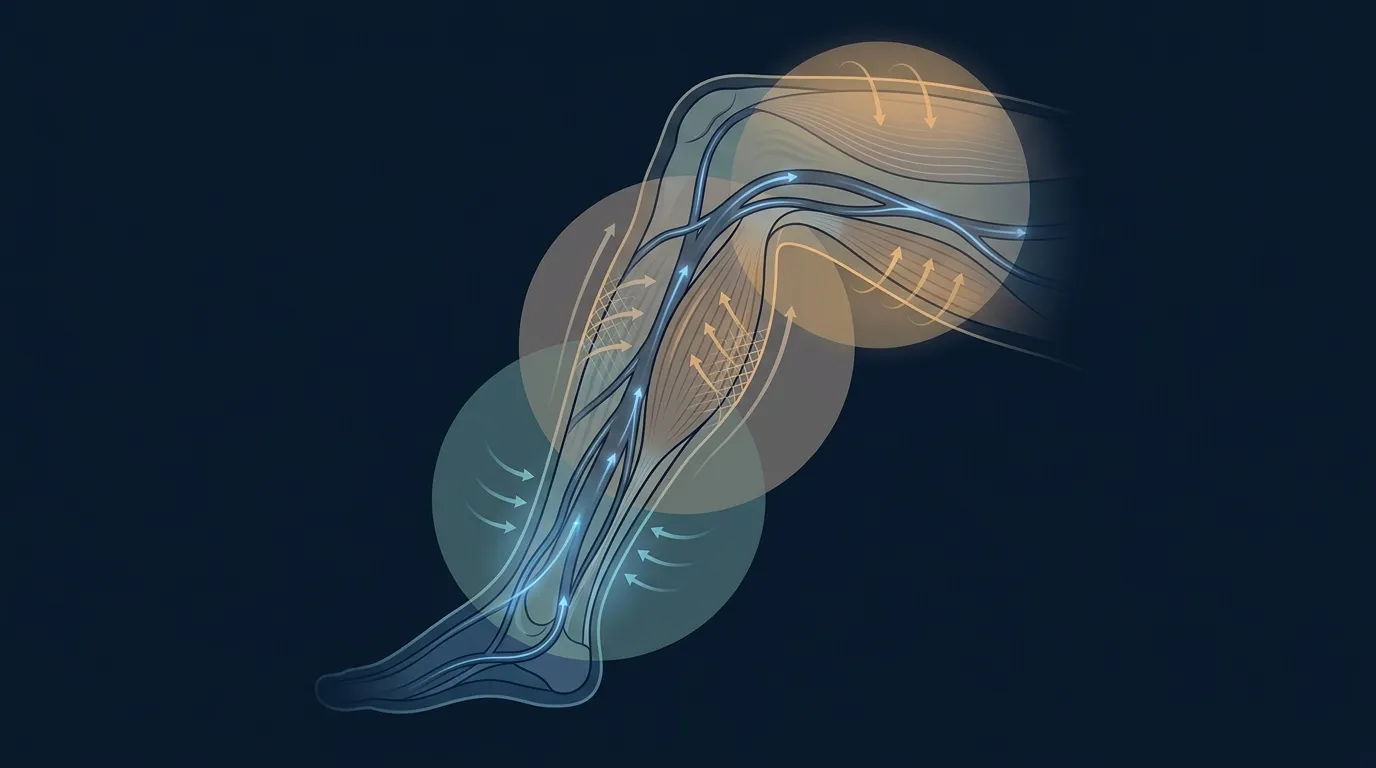
The most-cited proposed mechanisms: mechanical stabilization of the muscle that reduces oscillation on impact, graduated pressure that assists venous return and lymphatic clearance, small changes in thermoregulation and skin temperature, proprioceptive feedback that may nudge muscle-activation patterns, and modest reductions in the inflammatory and edema response that follows muscle damage. Any one of these could plausibly move a recovery marker a little. None of them, individually, would move it a lot.
MacRae's takeaway is worth quoting. Despite widespread acceptance by competitive and recreational athletes, convincing scientific evidence supporting large ergogenic effects during exercise remains elusive. Post-exercise recovery is the cleaner story. Even there, the mechanism is a stack of small effects, so a modest pooled outcome should not be a surprise. The physiology predicts what the meta-analyses find.
Marqués-Jiménez 2016: The Creatine Kinase Null Result
Not every meta-analysis has come back positive on every outcome. Marqués-Jiménez, Calleja-González, Arratibel, Delextrat, and Terrados (2016) at the University of the Basque Country published in Physiology and Behavior a systematic review with meta-analysis that specifically examined the effect of compression garments on exercise-induced muscle damage markers. Their pooled analysis, using Hedges g in a random-effects model, found that creatine kinase (the most commonly reported blood-based muscle-damage marker) was largely unaffected by compression garments.
This is a useful counterweight to Hill 2014, which reported a moderate CK benefit. The two papers include partially overlapping trials, apply somewhat different pooling and subgroup methods, and reach directionally different conclusions on the same biochemical outcome. The honest read is that the CK effect is at best small and at worst absent, while the functional and subjective outcomes (soreness, perceived fatigue, strength recovery, power recovery) are more consistently positive.
What this means practically: don't wear compression garments because you think they'll dramatically reduce muscle damage. Wear them because you're likely to feel and function better during the recovery window. Those are different claims, and the second one has better support.
Li 2025: The Most Recent Meta-Analysis (28 Studies, 107 Effect Sizes)
The most current synthesis is Li, Su, Du, Li, Lv, Liu, Feng, and Yu (2025), published in Life. The team pooled 28 studies yielding 107 effect sizes and focused on the two functional outcomes that have shown the most consistent benefit: muscle strength and muscle power recovery after exercise-induced fatigue.
The pooled effects were both statistically significant and small in magnitude: Hedges g = -0.28 for strength (95% CI: -0.38 to -0.18) and Hedges g = -0.23 for power (95% CI: -0.34 to -0.11). The subgroup analysis found compression garments were effective in mitigating the decline in muscle strength when rest intervals were 1 to 48 hours and beyond 72 hours, and in mitigating power decline when the resting interval was 1 to 24 hours. Trained individuals appeared to benefit more than untrained individuals across the strength outcome.
The 2025 paper is also the most honest about a persistent methodological problem. Many of the included trials did not measure or report the specific pressure values applied by the garments. That means the field is still guessing at the optimal pressure threshold, and the "15 mmHg or higher" heuristic from Brown 2017 is a reasonable but incomplete rule.
Why This Matters for Your Recovery Stack
For a FitCraft user training three to five times a week at home, compression garments sit alongside foam rolling, ice baths, and massage guns as a recovery-modality question: is this worth the money, the effort, and the space in the rotation? The honest answer depends on what you're trying to do.
The evidence points to a specific use case. You've done a hard, muscle-damaging session (heavy lower-body resistance work, downhill running, a long ride, a plyometric or interval day). You want to be functional in the next 24 to 72 hours, either because you have another training day or because life needs your legs. In that window, compression garments produce a small but real benefit on how sore you feel, how fatigued you feel, and how much of your strength and power you have back. That is a defensible reason to keep a pair in the closet.
Where they are unlikely to help: on light training days, during general aerobic base work, or as a replacement for the boring recovery basics. If you'd like the deeper reads on how these modalities stack up against each other, see the foam rolling research, the massage gun research, and the active recovery research. The comparison of magnitudes is instructive. None of these tools alone will transform a recovery week. Sleep, protein intake, and training load management do more heavy lifting than any device or garment.
Get an evidence-based plan built for you
FitCraft, our mobile fitness app, pairs you with an AI coach who builds you a personalized plan around your goals, schedule, and fitness level. Every FitCraft program is designed by Domenic Angelino, MPH (Brown University) and NSCA-CSCS, with research published in the Journal of Strength and Conditioning Research and Medicine & Science in Sports & Exercise.
Take the Free Assessment Free • 2 minutes • No credit card| Reader profile | What the research suggests |
|---|---|
| Recreational lifter after a heavy leg day | Put on tights or long socks within 30 to 60 minutes post-session. Wear for 24 hours if possible. Brown (2017) and Hill (2014) both found the strongest signal in this exact scenario. |
| Runner training for a race with back-to-back hard days | Between hard sessions is where the effect earns its space. The 24-to-72 hour window (Li 2025) is where compression garments consistently show benefit on strength and power recovery. |
| Someone who trains casually 2 to 3 times a week | Probably not worth the money. The effect is real but small, and the training load rarely produces the muscle damage that compression garments are best at mitigating. |
| Someone hoping to run faster today with them on | Not the tool. MacRae (2011) concluded the during-exercise ergogenic evidence is weak. The recovery story is the story. |
| Traveling by air after a hard session | Compression socks make sense here for the venous-stasis and edema reasons that were the original medical use case, independent of the sports-recovery literature. |
Compression garments also sit differently from cold-water immersion, which has its own set of tradeoffs. Cold plunges can blunt some of the hypertrophy adaptation from resistance training if used too aggressively post-lift (see the ice baths and muscle growth research). Compression garments do not appear to carry that same downside on the muscle-adaptation front. If you're on a hypertrophy block and looking for a recovery modality that doesn't compromise the training stimulus, compression sits in a friendlier position than an ice bath.
How Compression Garments Actually Work
Three physiological effects carry most of the load in the mechanism story. None of them dominates. All of them are plausibly small.
Venous return and edema reduction. Graduated compression (higher pressure distally, tapering proximally) is well-established in medical use to assist venous return and reduce lower-limb edema after surgery and long immobilization. Applied to a post-exercise athlete, the same pressure profile plausibly aids clearance of metabolic byproducts and the fluid accumulation that follows muscle damage. This is the least controversial mechanistic claim in the compression literature.
Mechanical stabilization and reduced muscle oscillation. During locomotion, especially impact-heavy locomotion (running, jumping, plyometrics), soft tissue oscillates on contact. That oscillation contributes modestly to muscle fatigue and possibly to muscle damage. Compression garments dampen the oscillation. The proposed benefit is less microdamage per stride, which would translate into a small reduction in DOMS a day or two later. The evidence here is suggestive rather than airtight.
Modest anti-inflammatory and proprioceptive effects. Some trials have reported small reductions in the inflammatory response and small changes in muscle-activation patterns with compression wear. These effects are hard to separate from placebo, but they may contribute at the margins. This is the least mechanistically clean part of the story.
The mechanistic honest summary: a stack of small effects predicts a small-to-moderate pooled outcome, which is what the meta-analyses find. If the mechanism had been "compression massively reduces muscle damage at the cellular level," we would have seen bigger and more consistent CK results than Marqués-Jiménez et al. (2016) reported. We did not.
Common Misconceptions
Misconception: "Compression garments give you faster times during the race."
The during-exercise ergogenic story is the weakest part of the compression literature. MacRae (2011) explicitly noted that convincing scientific evidence of ergogenic effects during exercise remains elusive, and the finding has held up in subsequent reviews. The clear signal is on the post-exercise recovery side, not on the acute performance side. Wear them after the race, not during it, if performance is what you care about.
Misconception: "All compression garments are the same."
They are not. Brown (2017) subgrouped by applied pressure and found trials using at least 15 mmHg produced clearer benefits than trials using under 15 mmHg. Cheap "compression" leggings from fast-fashion sites frequently do not reach that pressure and were not designed to. Athletic-grade brands (SKINS, 2XU, CEP, Under Armour Rush, Nike Pro) typically list mmHg ranges or graduated-compression profiles. If the label doesn't mention pressure, assume it's decorative rather than functional.
Misconception: "You have to wear them during and after every workout."
The evidence base does not support that use pattern. The clearest signal is on the 24-hour post-exercise window after a hard, muscle-damaging session (Hill 2014, Brown 2017, Li 2025). Wearing them during a light steady-state session or on a rest day is unlikely to produce meaningful additional benefit. Match the tool to the situation. Hard sessions and multi-day tournaments are the use case. General fitness weeks are not.
Misconception: "Compression garments accelerate the reduction in muscle damage."
Not quite. The subjective and functional outcomes (soreness, fatigue, strength, power) benefit more consistently than the biochemical muscle-damage markers like creatine kinase. Hill (2014) and Marqués-Jiménez (2016) actually reached different conclusions on CK from partially overlapping trial pools. The best current read is that compression garments help you feel and function better during recovery even when the cellular damage signal doesn't change much.
What the Research Suggests Going Forward
The compression-garment literature has matured. Four separate meta-analyses (Hill 2014, Marqués-Jiménez 2016, Brown 2017, Li 2025) now let us make specific, evidence-based claims. The garments produce a small-to-moderate benefit on DOMS, perceived fatigue, strength recovery, and power recovery, with the biggest effect in the 24-to-72-hour window after hard muscle-damaging exercise. They do not appear to meaningfully reduce blood-based muscle-damage markers. They do not appear to reliably improve performance during exercise. The strongest use case is hard sessions followed by another training day or a competition day.
Where the field still needs work: standardized reporting of applied pressure (Li 2025 flagged this as a major limitation), more head-to-head comparisons against other recovery modalities (cold plunge, active recovery, foam rolling, massage guns), and better-powered trials in female athletes, who remain underrepresented in the pooled samples. The next generation of trials should also settle whether compression garments blunt or preserve training adaptations across a full hypertrophy or endurance block, an important question that the current literature only begins to address.
For the trainee who wants to try them and see, the defensible starting protocol is athletic-grade tights or long socks rated at roughly 15 to 25 mmHg, put on within 30 to 60 minutes after a hard session and worn for 24 hours. Track subjective soreness and functional readiness on a 1-to-10 scale over 4 to 6 sessions. If there's no perceived difference by session 6, the pair is unlikely to be doing anything for you. If there is a difference, they've earned their spot in the recovery rotation alongside sleep, protein, and program design.
References
- Hill J, Howatson G, van Someren K, Leeder J, Pedlar C. "Compression garments and recovery from exercise-induced muscle damage: a meta-analysis." British Journal of Sports Medicine 48.18 (2014): 1340-1346. doi:10.1136/bjsports-2013-092456.
- Brown F, Gissane C, Howatson G, van Someren K, Pedlar C, Hill J. "Compression Garments and Recovery from Exercise: A Meta-Analysis." Sports Medicine 47.11 (2017): 2245-2267. doi:10.1007/s40279-017-0728-9.
- MacRae BA, Cotter JD, Laing RM. "Compression garments and exercise: garment considerations, physiology and performance." Sports Medicine 41.10 (2011): 815-843. doi:10.2165/11591420-000000000-00000.
- Marqués-Jiménez D, Calleja-González J, Arratibel I, Delextrat A, Terrados N. "Are compression garments effective for the recovery of exercise-induced muscle damage? A systematic review with meta-analysis." Physiology and Behavior 153 (2016): 133-148. doi:10.1016/j.physbeh.2015.10.027.
- Li X, Su H, Du L, Li G, Lv Y, Liu X, Feng L, Yu L. "Effects of Compression Garments on Muscle Strength and Power Recovery Post-Exercise: A Systematic Review and Meta-Analysis." Life 15.3 (2025): 438. doi:10.3390/life15030438.
Frequently Asked Questions
Do compression garments actually help you recover from exercise?
The pooled evidence supports a small-to-moderate effect on delayed onset muscle soreness, perceived fatigue, strength recovery, and power recovery. Hill et al. (2014) in the British Journal of Sports Medicine meta-analyzed randomized trials and reported that compression garments moderately improved recovery of DOMS, strength, and power, with the largest effects beyond 24 hours post-exercise. Li et al. (2025) in Life pooled 28 studies (107 effect sizes) and confirmed statistically significant restorative effects on strength (Hedges g = -0.28) and power (Hedges g = -0.23). The effect is real but modest. It is not a substitute for sleep, protein, or a well-designed program.
How long should you wear compression garments after a workout?
Across the trials that produced positive effects, 24 hours of continuous post-exercise wear is the most consistently studied protocol. Brown et al. (2017) in Sports Medicine specifically found that 24 hours of post-exercise wear produced moderate reductions in soreness and perceived fatigue. Hill et al. (2014) reported the strength and power benefits were larger at time points beyond 24 hours than immediately after exercise, suggesting the garment does its work as tissue is recovering rather than during the exercise itself.
Do compression garments improve performance during exercise (not just recovery)?
The evidence for wearing compression garments during exercise is weaker than the recovery evidence. MacRae et al. (2011) in Sports Medicine reviewed the physiology and performance data and concluded that convincing scientific evidence supporting ergogenic effects during exercise remains elusive. The clearer signal is in the 24-to-72-hour recovery window after hard sessions, not during the session itself. If your goal is next-day cycling or return-to-play readiness, wear them after. If your goal is running a faster 5K today, the effect is unlikely to matter.
Do compression garments reduce muscle damage markers like creatine kinase?
This is where the picture gets murkier. Hill et al. (2014) reported a moderate improvement in creatine kinase clearance with compression garments. Marqués-Jiménez et al. (2016) in Physiology and Behavior, using a different pooling method, found creatine kinase was largely unaffected by compression garments. The subjective outcomes (soreness, perceived fatigue) and functional outcomes (strength, power) show more consistent benefit than the blood-based muscle-damage markers. The current best read is that compression garments help you feel and function better during recovery even when the biochemical markers do not move much.
What pressure should compression garments apply to actually work?
Brown et al. (2017) subgrouped studies by pressure and found trials using at least 15 mmHg produced clearer benefits than trials using under 15 mmHg. Li et al. (2025) noted that many included trials did not measure or report actual applied pressure, which is a real limitation of the field. As a practical rule, medical-grade or athletic-grade sleeves rated at roughly 15 to 25 mmHg are within the range that showed benefits. Loose-fit shapewear or fashion compression is unlikely to reach that pressure.
Are compression garments better than foam rolling or ice baths for recovery?
Different tools, different windows. Foam rolling has a small acute effect on perceived soreness and range of motion (see the foam rolling research). Ice baths reduce perceived soreness in the short term but can blunt some hypertrophy adaptation from resistance training (see ice baths and muscle growth). Compression garments carry a smaller acute effect than ice baths, do not appear to blunt training adaptation, and produce most of their benefit across the 24-to-72-hour recovery window. If you're on a muscle-building block, compression sits in a friendlier position than cold plunging.