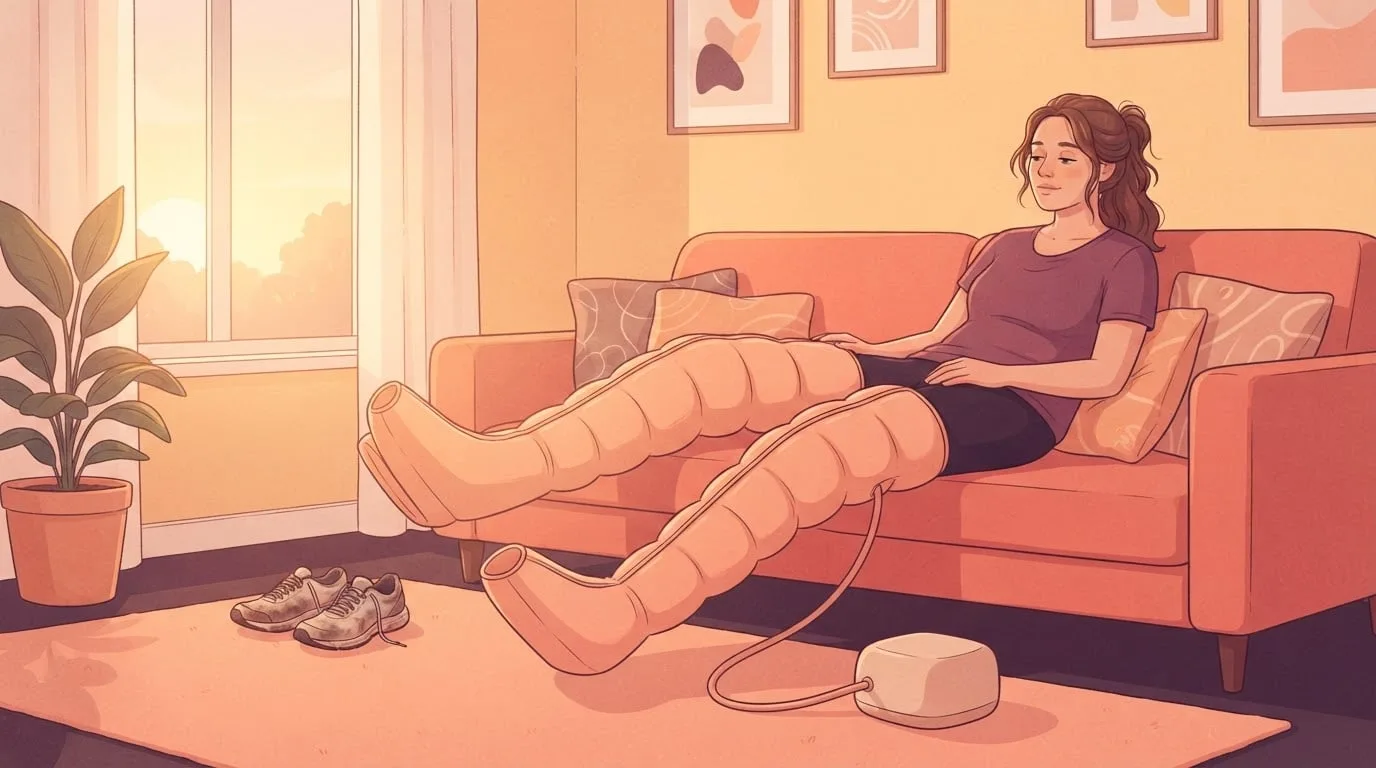
Lying back while a pair of air-filled sleeves squeezes your legs feels like recovery. That feeling is a big reason compression boots have spread from team training rooms and therapy clinics into living rooms after weekend long runs and leg days.
The trials tell a narrower story than the marketing does. Across more than two dozen studies, the most consistent effect of intermittent pneumatic compression is on how sore and tired you feel. Strength, sprint power and next-day performance mostly come back at the same speed with or without the boots.
This review covers what compression boots do inside your legs, what the meta-analyses and key trials found, which benefits the evidence supports, how to use the boots and how often, and who should skip them. It also explains how they compare with compression garments and massage guns.
What Do Compression Boots Do?
Compression boots are long inflatable sleeves that zip over each leg from the foot to the upper thigh. Inside, overlapping air chambers inflate one after another, starting at the foot and moving up, hold the squeeze for a moment, then release before the cycle repeats. The technique is called intermittent pneumatic compression, or IPC. The sequence is meant to copy what your calf muscles do when you walk: push blood and fluid in the veins back toward your heart.
Settings vary widely. Across the trials in a 2024 meta-analysis by Maia and colleagues, sessions ran from 15 to 60 minutes at roughly 60 to 235 mmHg, and the most common setup was about 80 mmHg for 20 to 30 minutes.
The squeeze does move blood. Zuj and colleagues (2018) measured flow in the main thigh artery of 12 healthy adults after three minutes of calf raises. With lower-leg compression timed to the heartbeat during two minutes of standing recovery, flow was about 213 mL a minute, against 153 without it. In a sham-controlled trial of 20 healthy young adults, one hour of low-pressure leg compression also improved flow-mediated dilation, a measure of how well arteries widen, in the leg and even in the arm, which wasn't compressed (Martin, Borges and Beck, 2015).
The same principle has a firm medical record. Hospitals use IPC to prevent blood clots in people who can't move. In the CLOTS 3 trial of 2,876 immobile stroke patients, IPC cut proximal deep vein thrombosis from 12.1 to 8.5 percent within 30 days, at the cost of more skin breaks on the legs, 3 percent against 1 percent (Dennis and colleagues, 2013). Recovery boots borrow that technology for legs that are tired rather than immobile.
Do Compression Boots Work? The Research
The meta-analyses: a little less soreness, no change in performance
Maia and colleagues pooled 17 randomized trials with 319 participants. IPC reduced pain and soreness by a small, statistically significant amount right after the session (standardized mean difference 0.49) and again at 96 hours (0.37). At 24, 48 and 72 hours the differences in soreness didn't reach significance. Muscle function, which grouped time trials, maximal strength and power output, showed only small to trivial, non-significant effects at every point from right after the session to 72 hours. Creatine kinase, a blood marker of muscle damage, moved inconsistently. The authors concluded that IPC offers, at best, moderate benefits for perceived pain and soreness.
A larger 2025 meta-analysis by Albillos-Almaraz and colleagues pooled 27 studies of 554 healthy adults whose muscles had been damaged by hard exercise. Soreness and pain fell by a small, significant amount (effect size 0.45 in favor of IPC), most other outcomes didn't change significantly, and the authors called the effect on recovery inconclusive.
Ultramarathon trials: fresher right away, not faster over the week
The most realistic test comes from a 161-km mountain race. Hoffman and colleagues (2016) randomly assigned 72 finishers to 20 minutes of massage, IPC or lying on their backs after the race. Right after treatment, IPC lowered fatigue scores compared with rest, and massage lowered pain and soreness. Over the following seven days, the groups didn't differ, and 400-meter run times on days 3 and 5 weren't faster with either treatment.
A follow-up gave 56 ultramarathoners four daily treatments instead of one (Heapy and colleagues, 2018). IPC again lowered fatigue scores right after treatment and on the first day after the race, but daily soreness ratings and 400-meter times over the next two weeks didn't improve.
Trials with a sham
You can feel the boots squeeze, so most trials can't hide which treatment people got, and that leaves the soreness results open to expectation. Sham designs help. In Haun and colleagues (2017), 20 resistance-trained men did three days of heavy squats, 10 sets of 5 at 80 percent of their max. After each session they wore leg sleeves for an hour that either inflated to about 70 mmHg or stayed flat. Knee strength and lifting volume didn't differ between groups. The inflated group kept its flexibility on day 3 while the sham group lost some, and markers of muscle protein breakdown and oxidative stress were lower with real compression.
In Sands and colleagues (2015), 24 elite athletes had 15 minutes of compression or the same setup with the pump switched off. Pressure-to-pain threshold, meaning how hard a muscle can be pressed before it hurts, rose right after real compression and stayed higher through that afternoon's practice. The sham group didn't change.
Performance in the next session
Trials that measured the next effort found little. Twenty-one trained cyclists rode for 20 minutes, rested for 30 with or without IPC, then raced a 4-minute time trial, and the difference was trivial and not significant (Overmayer and Driller, 2018). In 14 active adults, 30 minutes of compression between bouts of all-out 30-second cycling sprints didn't change peak or average power in the next sprint (Martin, Friedenreich and colleagues, 2015).
Inflammation didn't budge either. Ten endurance runners ran 20 miles at 70 percent of their aerobic capacity twice, once followed by an hour of IPC. Pain ratings and the rise in C-reactive protein, a blood marker of inflammation, were the same after both runs (Draper and colleagues, 2020).

Benefits of Leg Compression Boots: What the Evidence Supports
| Claimed benefit | What the research found |
|---|---|
| Better circulation | Yes, during and right after a session: more blood flow in the leg and better artery widening (Zuj 2018; Martin, Borges and Beck 2015) |
| Less muscle soreness | A small reduction, clearest right after a session (Maia 2024; Albillos-Almaraz 2025) |
| Less fatigue | Lower fatigue ratings right after treatment and the next day (Hoffman 2016; Heapy 2018) |
| Less muscle tenderness | Muscles tolerated more pressure for hours in elite athletes (Sands 2015) |
| Faster strength and power recovery | No consistent effect (Maia 2024; Haun 2017) |
| Better performance in the next session | No meaningful effect (Overmayer 2018; Martin, Friedenreich 2015) |
| Clearing lactate | Mixed: faster in one trial, higher in the next ride in another |
| Less inflammation or muscle damage | No change in C-reactive protein after 20-mile runs; creatine kinase results inconsistent (Draper 2020; Maia 2024) |
| Preventing blood clots | Proven in immobile hospital patients (Dennis 2013), not a reason for healthy, active people to use them |
The pattern is consistent. Measures of how your legs feel improve a little after a session, while measures of how fast your muscles get their strength back mostly don't change.
Why This Matters for Your Recovery
If you finish a hard week with heavy, achy legs, half an hour in compression boots will probably make them feel better. That counts for something when it gets you to your next workout. What the boots won't do is replace the basics that drive recovery: sleep, enough food and protein, and training you can absorb. Our review of the active recovery research compares those basics with the gadgets.
The bigger lever is a training plan you can recover from. An AI personal trainer app can carry that structure: FitCraft's AI coaches build you a personalized plan around your goals, schedule and fitness level, demonstrate each exercise in interactive 3D and adapt your workouts as you progress.
Get an evidence-based plan built for you
FitCraft, our mobile fitness app, pairs you with an AI coach who builds you a personalized plan around your goals, schedule, and fitness level. Every FitCraft program is designed by Domenic Angelino, MPH (Brown University) and NSCA-CSCS, with research published in the Journal of Strength and Conditioning Research and Medicine & Science in Sports & Exercise.
Take the Free Assessment Free • 2 minutes • No credit cardWhat Is the Best Way to Use Compression Boots?
- Use them after your hardest sessions. The trials applied them soon after races, long runs, sprint sets and heavy lifting, at a time you'd be resting anyway.
- Lie on your back with your legs straight, the position most trial participants used.
- Start with 20 to 30 minutes at a moderate setting. About 80 mmHg was the most common protocol in the research. The squeeze should feel firm, never painful, numb or tingly.
- Keep the rest of your recovery in place. Drink, eat and sleep as you would without the boots.
- Don't count on a performance boost. In the trials, the next ride, sprint or run wasn't better after the boots.
How Often Should You Use Recovery Boots?
Use them as often as you find them helpful, because no study has found an ideal frequency. Most trials tested a single session of 15 to 60 minutes. The ultramarathon follow-up used four daily sessions and still found benefits only in fatigue ratings, right after treatment and on the day after the race. No trial has tested months of regular use.
Are Compression Boots Good to Use Every Day?
For healthy people, daily use at normal settings looks low risk. An international consensus on compression therapy found that serious problems are very rare when compression is applied correctly (Rabe and colleagues, 2020). Daily use won't add benefits the research hasn't found, though. If the boots help you unwind after training, use them, and if you skip a day, you aren't missing a measurable recovery effect.
What Are the Downsides of Compression Boots?
- Most of the benefit is in how you feel. Strength, power and next-session performance didn't improve in the trials.
- They cost time. A session ties you to the couch for 20 to 60 minutes, time you could spend sleeping or on an easy walk.
- Discomfort and skin irritation. These are the most common side effects of compression therapy in the Rabe consensus.
- Rare but serious problems. The same consensus cites case reports of pressure injuries to the skin, a compressed nerve below the knee and one case of compartment syndrome from a malfunctioning boot. These came from medical use of IPC and are very rare.
When Should You Not Use Compression Boots?
Skip them, or ask a doctor first, if any of these apply to you:
- A leg that's newly swollen, warm, red or painful. Those can be signs of a blood clot, so get it checked before using any compression.
- Heart failure. Compression shifts blood from the legs toward the chest, and the Rabe consensus recommends against compression in severe heart failure.
- Numb feet or legs from diabetes or nerve damage. The consensus lists severe diabetic neuropathy with loss of sensation as a contraindication to sustained compression, because you can't feel when pressure is hurting your skin.
- Broken skin, a skin infection, a fresh injury or recent surgery on the leg.
- Pregnancy, peripheral artery disease or another circulation problem. Ask your doctor whether boots are appropriate and at what setting.
Compression Boots vs Compression Garments and Massage Guns
Compression garments squeeze steadily instead of in waves, and you wear them for hours after training rather than for half an hour on the couch. They also have a longer research record, which our compression garments research review walks through. A massage gun works on one muscle at a time with rapid strokes, and our massage gun research review covers what it does for range of motion and soreness. Pick the tool you'll actually use, or none of them.
Common Misconceptions
Misconception 1: "Compression boots flush out lactic acid"
Lactate isn't what makes you sore a day or two later, as our review of delayed onset muscle soreness research explains. The boot trials are mixed anyway. After repeated all-out sprints, blood lactate was lower with compression than with a sham at 25 minutes, 8.9 against 10.7 mmol/L, and at 35 minutes, but the next sprint wasn't more powerful (Martin, Friedenreich and colleagues, 2015). In 10 trained cyclists who rested between two hour-long rides, lactate during the second ride was higher after the boots, 3.9 against 2.7 mmol/L (Marcello and colleagues, 2019).
Misconception 2: "Higher pressure and longer sessions work better"
No one has shown a dose that works better. The trials ranged from 15 to 60 minutes and from about 60 to 235 mmHg, and they don't point to a pressure or session length that works best. Too much pressure can cause pain, and the Rabe consensus links tissue damage from IPC to misuse and faulty devices. Firm and comfortable is the target.
Misconception 3: "Compression boots speed up muscle repair"
The muscle-damage evidence is weak. Creatine kinase moved inconsistently across trials in the 2024 meta-analysis. The sham-controlled squat study found lower markers of protein breakdown and oxidative stress with real compression, which is interesting biology, but strength came back at the same rate in both groups (Haun 2017).
What the Research Suggests Going Forward
The picture is consistent across two meta-analyses and the trials behind them. Compression boots make tired legs feel a little better for a while after a session, and they raise blood flow while they run. They don't reliably bring back strength, power or performance faster, and their effect on muscle damage markers is inconsistent.
The trials have real limits. Most enrolled 10 to 24 people, mostly young, trained adults, followed them for hours or days, and couldn't hide the treatment, so expectation may explain part of the soreness effect. The sham-controlled trials help, but there are few of them. Almost none tested people who are new to exercise, older adults, or months of regular use.
So treat compression boots as a comfortable way to rest. If you own a pair and like them, use them after your hardest sessions. If you don't, sleep, food and a training plan you can recover from will do more for you.
References
- Maia F, Nakamura FY, Sarmento H, Marcelino R, Ribeiro J. "Effects of lower-limb intermittent pneumatic compression on sports recovery: A systematic review and meta-analysis." Biology of Sport 41.4 (2024): 263-275. doi:10.5114/biolsport.2024.133665
- Albillos-Almaraz L, Cavero-Redondo I, Rodríguez MÁ, Fares R, Crespo I, del Valle M, Olmedillas H. "From fads to facts: A systematic review and meta-analysis of intermittent pneumatic compression therapy for muscle recovery." Strength and Conditioning Journal 47.4 (2025): 450-464. doi:10.1519/SSC.0000000000000892
- Zuj KA, Prince CN, Hughson RL, Peterson SD. "Enhanced muscle blood flow with intermittent pneumatic compression of the lower leg during plantar flexion exercise and recovery." Journal of Applied Physiology 124.2 (2018): 302-311. doi:10.1152/japplphysiol.00784.2017
- Martin JS, Borges AR, Beck DT. "Peripheral conduit and resistance artery function are improved following a single, 1-h bout of peristaltic pulse external pneumatic compression." European Journal of Applied Physiology 115.9 (2015): 2019-2029. doi:10.1007/s00421-015-3187-8
- Dennis M, Sandercock P, Reid J, Graham C, Forbes J, Murray G; CLOTS Trials Collaboration. "Effectiveness of intermittent pneumatic compression in reduction of risk of deep vein thrombosis in patients who have had a stroke (CLOTS 3): a multicentre randomised controlled trial." The Lancet 382.9891 (2013): 516-524. doi:10.1016/S0140-6736(13)61050-8
- Hoffman MD, Badowski N, Chin J, Stuempfle KJ. "A randomized controlled trial of massage and pneumatic compression for ultramarathon recovery." Journal of Orthopaedic & Sports Physical Therapy 46.5 (2016): 320-326. doi:10.2519/jospt.2016.6455
- Heapy AM, Hoffman MD, Verhagen HH, et al. "A randomized controlled trial of manual therapy and pneumatic compression for recovery from prolonged running: an extended study." Research in Sports Medicine 26.3 (2018): 354-364. doi:10.1080/15438627.2018.1447469
- Haun CT, Roberts MD, Romero MA, Osburn SC, Mobley CB, Anderson RG, Goodlett MD, Pascoe DD, Martin JS. "Does external pneumatic compression treatment between bouts of overreaching resistance training sessions exert differential effects on molecular signaling and performance-related variables compared to passive recovery? An exploratory study." PLoS ONE 12.6 (2017): e0180429. doi:10.1371/journal.pone.0180429
- Sands WA, McNeal JR, Murray SR, Stone MH. "Dynamic compression enhances pressure-to-pain threshold in elite athlete recovery: exploratory study." Journal of Strength and Conditioning Research 29.5 (2015): 1263-1272. doi:10.1519/JSC.0000000000000412
- Overmayer RG, Driller MW. "Pneumatic compression fails to improve performance recovery in trained cyclists." International Journal of Sports Physiology and Performance 13.4 (2018): 490-495. doi:10.1123/ijspp.2017-0207
- Martin JS, Friedenreich ZD, Borges AR, Roberts MD. "Acute effects of peristaltic pneumatic compression on repeated anaerobic exercise performance and blood lactate clearance." Journal of Strength and Conditioning Research 29.10 (2015): 2900-2906. doi:10.1519/JSC.0000000000000928
- Draper SN, Kullman EL, Sparks KE, Little K, Thoman J. "Effects of intermittent pneumatic compression on delayed onset muscle soreness (DOMS) in long distance runners." International Journal of Exercise Science 13.2 (2020): 75-86. doi:10.70252/HSPN3402
- Marcello RT, Fortini L, Greer BK. "Intermittent pneumatic compression boot use elevates blood lactate during subsequent exercise." International Journal of Exercise Science 12.2 (2019): 385-392. doi:10.70252/ROTS2193
- Rabe E, Partsch H, Morrison N, et al. "Risks and contraindications of medical compression treatment: A critical reappraisal. An international consensus statement." Phlebology 35.7 (2020): 447-460. doi:10.1177/0268355520909066
Frequently Asked Questions
Do compression boots work?
Compression boots work for how your legs feel more than for how fast they recover. Meta-analyses of 17 and 27 studies found small reductions in soreness, but no reliable improvement in strength, power or next-session performance. If you enjoy them, they're a comfortable way to rest after hard training.
Are compression boots dangerous?
For most healthy people, no. Serious problems from compression therapy are very rare when it's used correctly, and the common side effects are discomfort and skin irritation. Skip them and see a doctor if a leg is newly swollen, warm or painful, and ask first if you have heart failure, numb feet or a skin infection.
Are compression boots good for neuropathy?
Not as a home recovery tool without a doctor's advice. An international consensus on compression therapy lists severe diabetic neuropathy with loss of sensation as a contraindication to sustained compression, because you can't feel when pressure is damaging the skin. If you have neuropathy, ask your doctor before using any compression device.
Do compression boots help with cellulite?
There's no good evidence that they do. We found no controlled trial testing compression boots on cellulite, and the recovery trials didn't measure it, so treat claims that the boots reduce cellulite as unproven.
Do I need compression boots if I train with FitCraft?
No. FitCraft workouts use your body weight and dumbbells, with yoga and mobility sessions in the mix, and your program adapts as you progress. Boots are optional, and sleep, food and a plan you can recover from matter far more for how you feel between workouts.