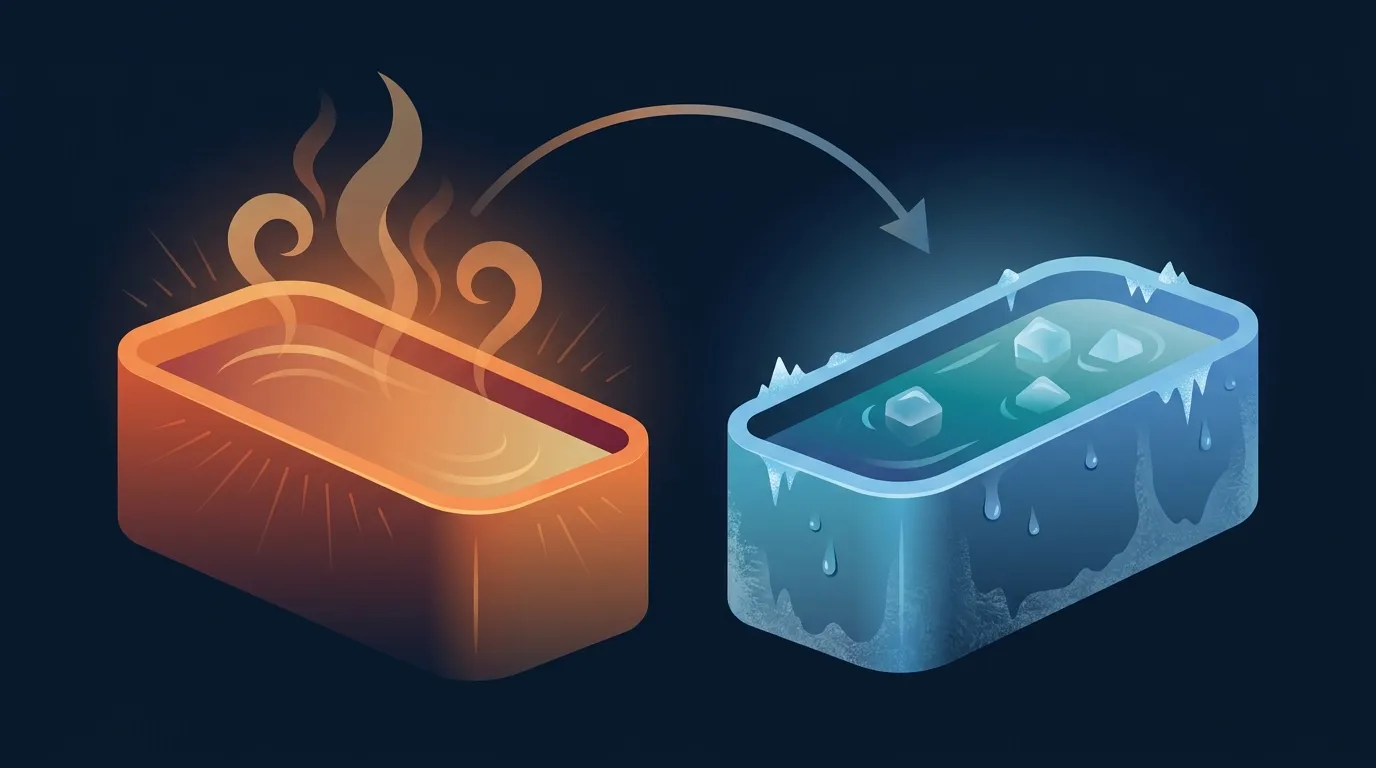
Contrast baths are old. Sports medicine textbooks in the 1920s described them as a rehab modality for sprains and tendinopathies. Physical therapy rooms have used them for decades. What is new is the last fifteen years of sports-recovery trials that finally tested them in the context they are marketed for today: post-workout soreness and next-day performance.
The evidence is not a mystery anymore. Contrast water therapy beats sitting still on almost every recovery outcome the literature measures. It is less obvious whether it beats a straight cold plunge or an active-recovery bike spin. This article walks through the specific studies, what they measured, what the pooled effect sizes look like, and how to fit contrast baths into a training week if you decide they are worth the setup.
The Research: What the Studies Show
Bieuzen 2013: The Meta-Analysis That Pooled the Sports-Recovery Data
The reference point for contrast water therapy is Bieuzen, Bleakley, and Costello (2013), published in PLOS ONE. The team screened the sports-recovery literature and pooled 18 randomized controlled trials (356 participants, 301 male and 55 female) that compared contrast water therapy to another intervention after exercise-induced muscle damage. They pooled the trials at five time points post-exercise: less than 6 hours, and 24, 48, 72, and 96 hours.
Against passive recovery, the effects were consistent and moderate. Muscle soreness dropped at every time point measured. At less than 6 hours, SMD was -0.62 (95% CI -0.95 to -0.28) across 6 trials. At 24 hours, SMD was -0.51 (95% CI -0.75 to -0.27) across 13 trials. At 48 hours, SMD was -0.58 (95% CI -0.85 to -0.31) across 10 trials. At 72 hours, SMD was -0.40 (95% CI -0.76 to -0.03) across 5 trials. Muscle strength recovery followed the same pattern. Contrast water therapy protected against strength loss at 24 hours (SMD 0.75), 48 hours (SMD 0.56), and 72 hours (SMD 0.62) compared to sitting still.
The moderate-effect finding matters because the recovery window from a hard session is the exact window most people can feel and remember. If a Tuesday hard session leaves you sore through Friday, and contrast water therapy pulls that soreness down by roughly half a standard deviation across three days, the practical experience is meaningful.
Then comes the caveat. When Bieuzen and colleagues compared contrast water therapy to other active modalities (cold water immersion, warm water immersion, active recovery, compression, stretching), the head-to-head evidence for contrast being superior was weak. The authors' summary: "There was little evidence for a superior treatment intervention." Contrast water therapy is better than doing nothing. Whether it is better than a cold plunge, an easy bike spin, or compression tights is less clear.
Vaile 2008: The Dose-Finding Trial in Cyclists
The most influential single trial in the contrast literature is Vaile, Halson, Gill, and Dawson (2008), published in the International Journal of Sports Medicine. The design is one of the more demanding in the recovery literature. Twelve competitive cyclists completed four separate five-day training blocks. Each block consisted of five consecutive exercise days, each including 105 minutes of riding and 66 maximal-effort sprints. Between exercise days, athletes did 14 minutes of one recovery modality: cold water immersion, hot water immersion, contrast water therapy, or passive rest. All athletes did all four blocks in a crossover design.
The outcome that mattered was whether they could hold their power output as the week progressed. Passive recovery bled power. Average sprint power dropped 1.7 to 4.9 percent below baseline across the five days. Hot water immersion did not help either. Power dropped 0.6 to 3.7 percent. Contrast water therapy went the other direction. Average power was maintained and often improved, at +0.5 to +2.2 percent versus baseline across the block. Cold water immersion produced a similar effect (+0.1 to +1.4 percent). The two water-cycling interventions were the only ones that kept athletes from sliding backward.
Vaile 2008 is the clearest experimental signal that contrast baths can preserve next-day performance across a hard training block. It is one study with 12 people, so the confidence interval is wide, but the effect is directionally consistent with what Bieuzen 2013 later pooled at the meta-analysis level.
Versey 2013: The Protocol Review That Standardized the Recipe
Every meta-analysis flags the same complication: contrast water therapy protocols vary widely across studies. Different temperatures, different ratios, different durations. Versey, Halson, and Dawson (2013) in Sports Medicine reviewed the water-immersion recovery literature and consolidated what "typical" looked like across the sports-recovery trials.
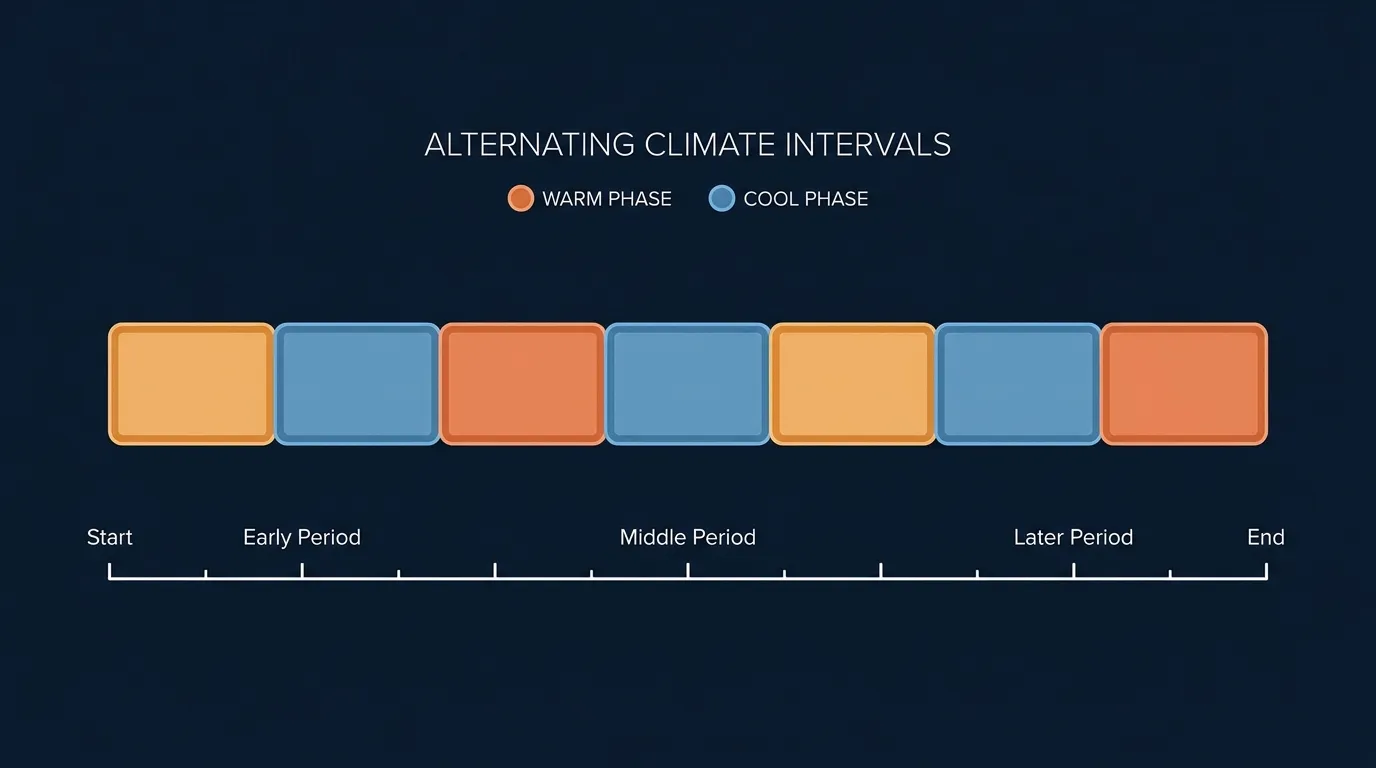
The template they described is what most of the effective trials used. Alternate between hot water at 38 to 42 degrees Celsius (100 to 108 degrees Fahrenheit) and cold water at 10 to 15 degrees Celsius (50 to 59 degrees Fahrenheit), in a 1-to-1 ratio (roughly one minute hot, one minute cold), for a total session length of 6 to 15 minutes. Most trials finish on cold. The Vaile 2008 protocol, for example, was 14 minutes of alternating 1 minute at 38 degrees and 1 minute at 15 degrees.
The 1:1 ratio is not sacred. Some trials tested 3:1 hot-to-cold, and some tested 1:2. The consistent variable is the alternation itself and the total dose, not the exact ratio. If a shower is your only option, a 30-to-60 second alternation still cycles the vasculature, which is the physiological driver the alternating protocol is trying to hit.
Higgins 2017: The Team-Sport Meta-Analysis Where the Signal Weakens
Bieuzen 2013 pooled trials from mixed exercise contexts. When the analysis narrows to a single context, the signal changes. Higgins, Greene, and Baker (2017), published in the Journal of Strength and Conditioning Research, meta-analyzed the trials specifically on team sport recovery: rugby, soccer, and other intermittent field sports. They compared cold water immersion, contrast water therapy, and control conditions.
The result was less flattering to contrast baths. Cold water immersion produced consistent 24-hour benefits for countermovement jump and sprint performance in this population. Contrast water therapy did not clearly outperform passive recovery for muscle soreness in the team-sport context, and it did not clearly beat cold water immersion for any performance outcome. The authors flagged high heterogeneity in the underlying protocols as one likely reason for the weaker pooled signal.
This does not overturn Bieuzen 2013. It narrows the claim. Contrast water therapy has robust effects versus passive recovery in the broader sports-recovery literature. In the specific case of team sport (where cold water immersion has been more thoroughly protocolized), cold water immersion is the better-supported single intervention.
Wang 2022: The Network Meta-Analysis Ranks the Options
Wang, Lu, Li, Zhang, Yan, Huang, and Ma (2022), in the Journal of Rehabilitation Medicine, ran the biggest network meta-analysis on DOMS treatments to date: 59 studies, 1,367 patients, and 10 interventions ranked head-to-head using the connected trial network. The interventions included contrast water therapy, cryotherapy, cold-water immersion, hot/warm-water immersion, hot packs, cold packs, ice massage, ultrasound, phase-change material, and passive recovery.
The rankings were context-specific. Within 24 hours of exercise, hot pack ranked first for pain relief, and contrast water therapy ranked second. Within 48 hours, hot pack still ranked first, and cryotherapy moved into second. Past 48 hours, cryotherapy ranked first. Contrast water therapy sat in the upper half of the rankings at every time point, but it was rarely the top-ranked intervention. If pain relief in the first 24 hours is the goal, the network data says a hot pack applied to the sore muscle is comparable, and probably simpler.
Take the ranking with the usual network meta-analysis caveats. Wang and colleagues flagged the moderate-to-low quality of the underlying trials. The ranking is a directional signal, not a settled ordering. Still, the takeaway is real. Contrast water therapy is a good intervention, and it is not the best one for every window.
Why This Matters for Your Recovery Stack
For a FitCraft user training three to five times a week at home, contrast water therapy is a modality with a specific fit. It is not a daily habit. It is a post-hard-session tool. Here is how to think about it.
Get an evidence-based plan built for you
FitCraft, our mobile fitness app, pairs you with an AI coach who builds you a personalized plan around your goals, schedule, and fitness level. Every FitCraft program is designed by Domenic Angelino, MPH (Brown University) and NSCA-CSCS, with research published in the Journal of Strength and Conditioning Research and Medicine & Science in Sports & Exercise.
Take the Free Assessment Free • 2 minutes • No credit card| Your goal | What the research suggests |
|---|---|
| Reduce soreness after a hard session | Contrast water therapy works. Bieuzen (2013) pooled data show a moderate effect versus sitting still at 24 to 72 hours. So does a hot pack (Wang 2022), so does cold water immersion, and often at similar magnitudes. |
| Hold performance across back-to-back hard days | Contrast between sessions works well. Vaile (2008) showed contrast preserved sprint power across five consecutive exercise days where passive recovery lost 1.7 to 4.9%. Reserve it for the days after your hardest sessions. |
| Team-sport recovery (soccer, rugby, weekly matches) | Cold water immersion is the better-supported single intervention here per Higgins (2017). Contrast can still help, but the head-to-head pooled data favors straight cold. |
| Recovery on the day after a hypertrophy lift | Contrast is a reasonable middle ground. The hypertrophy-blunting effect documented for post-lift cold water immersion has not been shown for contrast, because the protocol cycles back to warm water and shortens the vasoconstriction window. |
| Recovery from a hard yoga or mobility session | Probably unnecessary. Contrast water therapy's best-supported effects target the aftermath of higher-damage sessions. A shower is fine. |
Contrast water therapy sits differently from a few of the modalities we have reviewed. Cold water immersion produces slightly larger effects on pure soreness but carries a timing constraint against post-lift use for hypertrophy trainees. Compression garments produce a smaller effect but are wear-and-forget and do not blunt hypertrophy. Active recovery (an easy bike spin or walk) is what most of the trials use as the "active" control arm, and it holds up well. Sauna, from a longevity and cardiovascular standpoint (see the sauna cardiovascular research), does different work entirely.
How Contrast Water Therapy Actually Works
The mechanism story for contrast baths has two parts, and it sits between what pure cold and pure heat do individually.
Vasoconstriction and vasodilation cycling. Cold water at 10 to 15 degrees Celsius drops the temperature of the immersed limbs and triggers peripheral vasoconstriction. Blood pulls in from the periphery, interstitial fluid shifts back toward circulation, and edema in the muscle drops. Hot water at 38 to 42 degrees Celsius does the opposite. Vessels dilate, blood flow to the muscle rises, and metabolic byproducts clear faster. Alternating between the two, in a 1-to-1 ratio, produces a pumping effect that neither pure cold nor pure heat can match. Fluid moves in and out of the muscle repeatedly, and the vessels alternately shrink and expand.
The pain-signaling angle. Both cold and heat modulate nerve conduction. Cold slows conduction and dampens the ascending pain signal. Heat is comforting and downregulates central pain perception via a separate route. The alternating protocol hits both mechanisms. This is likely part of why Wang (2022) found hot pack and contrast water therapy both ranking near the top for 24-hour pain relief. Two different pain-modulating routes activated in quick succession is a lot of coverage for one modality.
What contrast water therapy does not do, based on the current evidence, is meaningfully change the acute anabolic signaling response after resistance training. The prolonged cold-only immersion that Roberts (2015) linked to hypertrophy blunting requires sustained vasoconstriction and dampened satellite-cell recruitment. Because contrast protocols cycle back to warm every one to two minutes, the sustained vasoconstriction never develops. The direct trials on contrast-vs-hypertrophy are thin, but the mechanism reasoning is why contrast baths are often recommended as the safer post-lift bath choice for lifters chasing muscle growth.
Common Misconceptions
Misconception: "Contrast baths are outdated. Cold plunge is the modern version."
The literature does not support that framing. Contrast baths and cold plunges are different tools with different effect profiles. Cold plunge (see the cold plunge recovery research) has larger effects on soreness and creatine kinase clearance. Contrast baths have similar effects on soreness with a friendlier profile for lifters, and they are meaningfully cheaper to set up (a bathtub and a kettle beats a $6,000 tub). Both are supported by pooled trial data. Neither is obsolete.
Misconception: "You need special equipment to do contrast water therapy."
Two adjacent tubs is the cleanest setup, and it is what most trials used. It is not the only option. A single bathtub filled with cold water plus a hot shower alternated in and out works. A shower alone, alternating hot and cold water in 30-to-60 second cycles, works less well but still cycles the vasculature. The Vaile 2008 protocol was 14 minutes total. If a Y facility, a hotel gym, or a friend's setup has a hot tub and a pool side by side, that is the trial-tested equivalent.
Misconception: "Contrast water therapy speeds injury healing."
The recovery literature is on healthy exercise-induced muscle damage (soreness, temporary strength loss, biochemical markers). It is not on tendon rehab, ligament sprains, or fracture healing. Contrast baths do have a long history in clinical rehab settings, but the evidence there is separate from the sports-recovery evidence. If you are rehabbing an injury, follow your physical therapist's protocol. Contrast baths may be part of it, but the sports-recovery pool of studies is not the right evidence base to reason from.
Misconception: "Colder cold and hotter hot is better."
Not in the pooled data. The trials that produced the strongest effects used cold at 10 to 15 degrees Celsius and hot at 38 to 42 degrees Celsius. Colder than 10 degrees produces more shivering and dropout without a clear benefit on the outcome measures. Hotter than 42 degrees becomes a scald hazard and adds cardiovascular stress without extra recovery signal. The Versey (2013) protocol summary reflects the temperatures that worked in the trials, not the extreme ends.
What the Research Suggests Going Forward
The contrast water therapy literature is not new, and it has matured to the point where a clean summary fits in four sentences. First: contrast water therapy reliably reduces post-exercise soreness and preserves strength recovery compared to sitting still (Bieuzen 2013). Second: it is not obviously superior to cold water immersion, active recovery, or a hot pack, and in team-sport contexts cold water immersion has a slight edge (Higgins 2017, Wang 2022). Third: the strongest single-trial signal is preservation of next-day performance across back-to-back hard training days (Vaile 2008). Fourth: because the protocol cycles back to warm water, contrast baths appear to sidestep the post-lift hypertrophy-blunting effect that pure cold water immersion has. That last point is inference from mechanism, not direct evidence, but it is why lifters who want a bath after training are often steered toward contrast rather than pure cold.
The next generation of trials should settle a few open questions. Head-to-head trials of contrast versus cold water immersion on hypertrophy would resolve whether the mechanistic reasoning holds up in practice. Larger trials on women and older adults would fill in a literature that is mostly young male athletes. And trials on the "does duration matter" question would help. Most protocols use 6 to 15 minutes; whether 30 minutes or 3 minutes produces meaningfully different effects is not well tested.
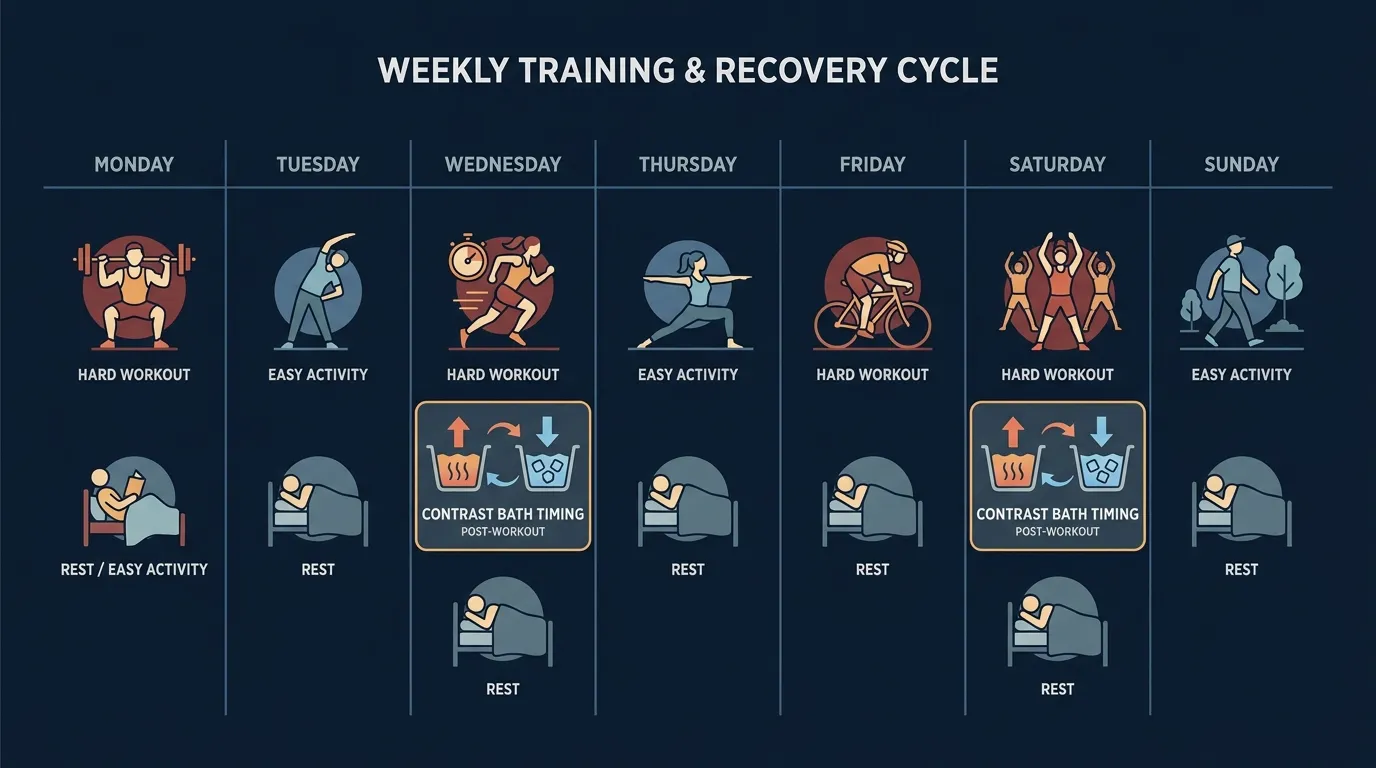
For the trainee deciding whether to run a contrast bath this week, the framework is clean. If a hard interval session, a race, or a training camp is coming, use contrast on the day of or the day after. Alternate 1 minute at 38 to 42 degrees Celsius with 1 minute at 10 to 15 degrees Celsius for 6 to 15 minutes, finishing on cold. If a hypertrophy session was the day's work and a bath sounds nice, contrast is a friendlier choice than pure cold plunge. If soreness relief is the only goal, a hot pack on the sore muscle produces a comparable effect for a lot less setup. Match the tool to the goal, and match the goal to the training block. That is where the effect either shows up or disappears.
References
- Bieuzen F, Bleakley CM, Costello JT. "Contrast water therapy and exercise induced muscle damage: a systematic review and meta-analysis." PLOS ONE 8.4 (2013): e62356. doi:10.1371/journal.pone.0062356.
- Vaile J, Halson S, Gill N, Dawson B. "Effect of hydrotherapy on recovery from fatigue." International Journal of Sports Medicine 29.7 (2008): 539-544. doi:10.1055/s-2007-989267.
- Versey NG, Halson SL, Dawson BT. "Water immersion recovery for athletes: effect on exercise performance and practical recommendations." Sports Medicine 43.11 (2013): 1101-1130. doi:10.1007/s40279-013-0063-8.
- Higgins TR, Greene DA, Baker MK. "Effects of cold water immersion and contrast water therapy for recovery from team sport: a systematic review and meta-analysis." Journal of Strength and Conditioning Research 31.5 (2017): 1443-1460. doi:10.1519/JSC.0000000000001559.
- Wang Y, Lu H, Li S, Zhang Y, Yan F, Huang Y, Ma Y. "Effect of cold and heat therapies on pain relief in patients with delayed onset muscle soreness: a network meta-analysis." Journal of Rehabilitation Medicine 54 (2022): jrm00258. doi:10.2340/jrm.v53.331.
Frequently Asked Questions
Does contrast water therapy actually help with recovery?
For soreness and short-term strength recovery, the pooled data says yes. Bieuzen, Bleakley, and Costello (2013) in PLOS ONE pooled 18 randomized trials (356 participants) and found contrast water therapy produced significant reductions in muscle soreness at 24 hours (SMD -0.51), 48 hours (SMD -0.58), and 72 hours (SMD -0.40) versus passive recovery, along with similar-magnitude preservation of muscle strength. Compared to other modalities, though, contrast water therapy did not consistently outperform cold water immersion, warm water immersion, active recovery, compression, or stretching. It beats sitting still. It is not obviously superior to the alternatives.
How do you do contrast water therapy correctly?
Versey, Halson, and Dawson (2013) in Sports Medicine reviewed the protocols used in the sports-recovery literature and identified a common template. Alternate between hot water at 38 to 42 degrees Celsius (100 to 108 degrees Fahrenheit) and cold water at 10 to 15 degrees Celsius (50 to 59 degrees Fahrenheit), using a 1-to-1 minute ratio (one minute hot, one minute cold), for a total session of 6 to 15 minutes. Most trials finish on cold. A poolside setup, two adjacent baths, or a shower with hot-then-cold cycles all approximate this. The dose the trials used is short and cyclical, not a long soak.
Is contrast water therapy better than a cold plunge?
For pure soreness reduction after high-intensity or muscle-damaging exercise, no. Cold water immersion has slightly larger pooled effects on DOMS and creatine kinase clearance. But contrast water therapy has one important advantage. The hypertrophy-blunting effect that Roberts (2015) documented for post-lift cold water immersion has not been shown for contrast therapy. Because the protocol alternates back into warm water, the sustained vasoconstriction and anabolic-signaling suppression is shorter. Trained lifters who want a recovery bath after lifting may prefer contrast to straight cold, though the direct comparison trials on hypertrophy are limited.
Does contrast water therapy help with performance the next day?
In one of the strongest single trials, yes. Vaile, Halson, Gill, and Dawson (2008) in the International Journal of Sports Medicine had 12 cyclists complete five consecutive exercise days that included 66 maximal-effort sprints, using one of four 14-minute recovery interventions between days. Contrast water therapy preserved average sprint power (+0.5 to +2.2% versus baseline). Cold water immersion also preserved it (+0.1 to +1.4%). Passive recovery lost 1.7 to 4.9% of power. Hot water immersion alone lost 0.6 to 3.7%. Contrast and cold were the only interventions that kept athletes from sliding backward across a hard training block.
Can I just take a hot-cold shower instead?
A hot-cold shower is a reasonable low-effort proxy, but it is not identical to what the trials tested. The immersion studies control the temperature and the surface area of contact, and both matter. A shower cools skin without submerging the muscle in a stable-temperature bath, which limits tissue penetration. If a tub is not available, alternating 30 to 60 seconds of hot and cold water in the shower for a total of 6 to 10 minutes will produce some vasoconstriction and vasodilation cycling. The recovery effect will be smaller than a proper immersion, but it is not zero, and it is nearly free.
How often can I do contrast water therapy?
There is no evidence base for daily use outside of a competition or hard training block. The sports-recovery trials use contrast water therapy after specific hard sessions, not as a daily habit. The Wang (2022) network meta-analysis ranks contrast water therapy second for pain relief within 24 hours of exercise, so post-session use is where the evidence sits. For general wellbeing benefits, the trial base is smaller and mostly uses cold water immersion. If a hard interval day, a competition, or a training camp is coming, contrast after the session is well supported. Daily as a fixed prescription is not something the research tests.
Is contrast water therapy better than compression garments or foam rolling?
Different tools, different windows. Compression garments produce a smaller effect than contrast baths on soreness but are wear-and-forget and do not blunt hypertrophy, which makes them a friendlier default for muscle-building blocks. Foam rolling has a small acute effect on soreness and range of motion. Contrast water therapy has a moderate short-term effect on soreness with a preserved-performance signal from Vaile 2008. Match the tool to the goal: compression for muscle-building blocks with hard sessions, contrast for competition weekends and hard interval days, foam rolling for general session-to-session maintenance.